
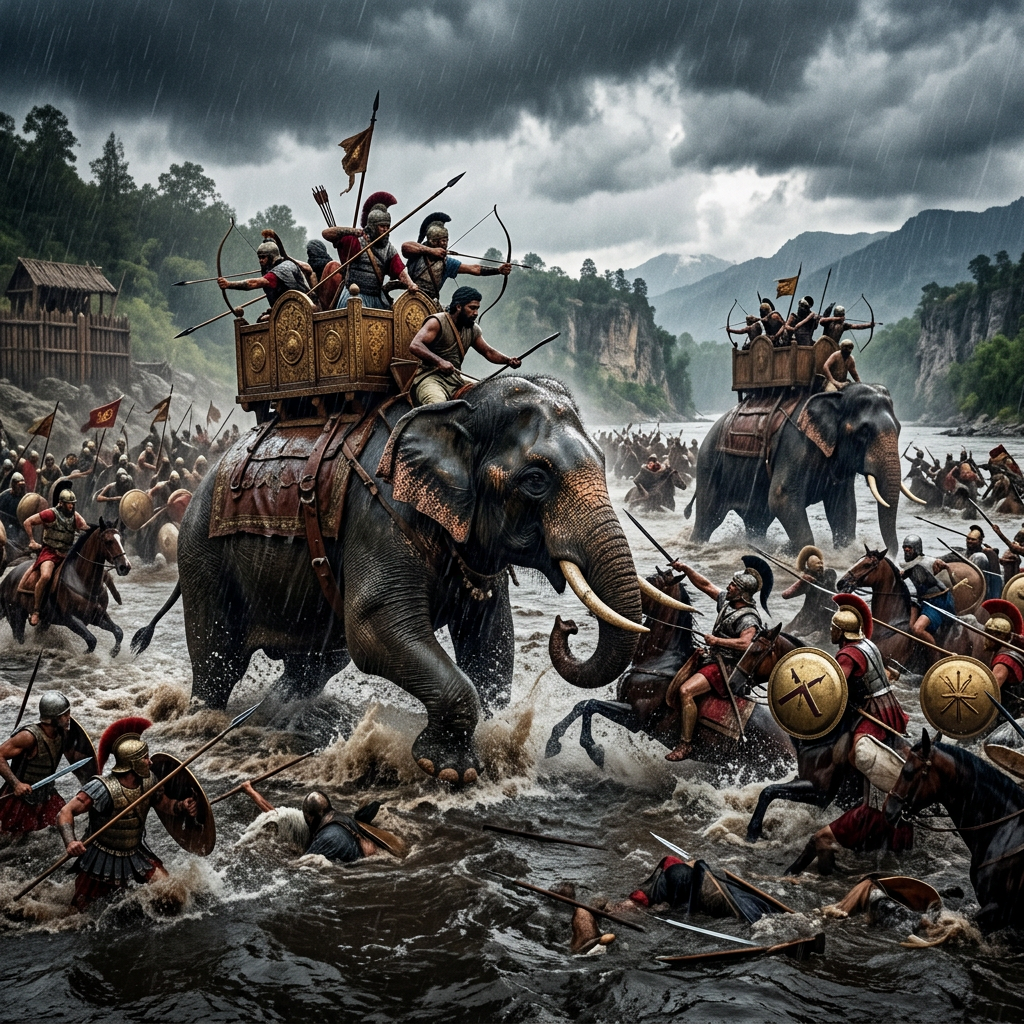
The Battle of the Hydaspes, fought in 326 BCE on the banks of the Hydaspes River (modern-day Jhelum River in Pakistan), was one of the most remarkable and challenging battles of Alexander the Great’s military career.
Unlike many of his previous opponents, Alexander faced a capable and determined ruler, Porus, whose army included a formidable weapon unfamiliar to the Macedonians: war elephants.
The battle marked the easternmost major conquest of Alexander’s campaigns and demonstrated his adaptability, strategic ingenuity, and respect for worthy adversaries.
Background
After defeating the Persian Empire and advancing through Central Asia, Alexander pushed deeper into the Indian subcontinent. His objective was to expand his empire beyond the territories previously known to the Greeks and Macedonians.
Many local rulers submitted peacefully, but Porus, king of a powerful realm between the Hydaspes and Acesines rivers, refused to surrender. Determined to defend his kingdom, Porus assembled an army and prepared to confront the Macedonian invader.
The Hydaspes River itself posed a major obstacle. Swollen by seasonal rains, it was wide, deep, and difficult to cross. Porus stationed his forces along the opposite bank, ready to attack any Macedonian attempt to ford the river.
Opposing Forces
Alexander commanded approximately:
- 30,000–40,000 infantry
- 5,000–7,000 cavalry
- Various allied and auxiliary troops
Porus fielded:
- Thousands of infantry
- Several thousand cavalry
- Chariots
- Approximately 200 war elephants
The elephants represented a serious challenge. Few Macedonian soldiers had encountered such animals in battle, and their size, noise, and destructive power could disrupt even disciplined formations.
Alexander’s Crossing
Unable to force a direct crossing, Alexander devised a deception plan. For weeks he moved troops along the riverbank, creating uncertainty about where he intended to cross.
Eventually, during a stormy night, Alexander led a selected force upstream to a concealed crossing point. The thunder and rain masked the movement of his troops and boats.
By dawn, the Macedonians had successfully crossed the river and established a foothold. Porus quickly dispatched forces to confront them, realizing too late that Alexander had outmaneuvered him.

The Battle
The battle opened with cavalry engagements as Alexander sought to gain control of the flanks. Using his superior mobility, he repeatedly attacked and pressured Porus’s cavalry.
The main confrontation occurred when the Macedonian infantry advanced against the Indian line anchored by war elephants. The elephants charged into the Macedonian ranks, causing confusion and casualties. Horses panicked, formations broke apart, and the battle became a brutal struggle at close quarters.
However, Macedonian discipline gradually prevailed. Soldiers targeted the elephants’ handlers and wounded the animals, causing many to panic. As the elephants became uncontrollable, they trampled friend and foe alike.
Meanwhile, Alexander’s cavalry attacks increasingly isolated portions of Porus’s army. After hours of intense fighting, the Indian forces began to collapse.
Porus and Alexander
One of the most famous moments of the campaign occurred after the battle. Despite his defeat, Porus reportedly continued fighting until exhausted and wounded.
When brought before Alexander and asked how he wished to be treated, Porus is said to have replied:
“Treat me as a king.”
Impressed by his courage and dignity, Alexander not only spared Porus but restored him to his throne and granted him additional territory. The decision reflected Alexander’s practice of incorporating capable local rulers into his expanding empire.
Reasons for Macedonian Victory
Strategic Deception
Alexander’s successful river crossing was the decisive operational achievement of the campaign. By misleading Porus about his intentions, he gained the initiative before the battle even began.
Flexible Leadership
The Macedonians adapted to the unexpected challenges posed by the elephants and adjusted their tactics during the battle.
Superior Cavalry
Alexander’s Companion Cavalry remained one of the most effective shock forces of the ancient world and played a critical role in breaking the enemy’s flanks.
Battlefield Experience
After nearly a decade of continuous campaigning, Alexander’s army possessed unparalleled combat experience and discipline.

Consequences
The victory secured Macedonian control over the Punjab region and represented the furthest major expansion of Alexander’s empire.
However, the battle also revealed the growing strain on his army:
- Casualties were higher than in many previous victories.
- Soldiers faced unfamiliar terrain, climate, and opponents.
- News of even larger kingdoms farther east discouraged further advances.
Soon afterward, at the Hyphasis River, Alexander’s troops refused to march deeper into India. Reluctantly, he agreed to turn back, ending his eastward conquest.
Historical Significance
The Battle of the Hydaspes is often considered Alexander’s most difficult victory. Unlike the Persian kings he had defeated, Porus proved a resilient and capable commander who fought with determination and skill.
The battle showcased Alexander’s greatest strengths: strategic creativity, adaptability under pressure, and the ability to overcome unfamiliar challenges. It also demonstrated the limits of conquest, as the victory ultimately preceded the first major refusal of his army to continue advancing.
Hydaspes stands as both a triumph and a turning point—a battle that displayed the height of Alexander’s military genius while signaling the end of his relentless march eastward.
Fortisetliber’s View
The Battle of the Hydaspes was Alexander the Great’s most challenging victory—a clash against Porus, a skilled and determined ruler, whose army included war elephants that tested the limits of Macedonian tactics.
Key Takeaways:
- Strategic Deception Wins: Alexander’s clever night river crossing forced Porus into a reactive position, proving initiative can decide battles before they even begin.
- Adaptability Under Pressure: Macedonians confronted a new threat—war elephants—and adjusted tactics mid-battle, demonstrating that flexibility is as critical as strength.
- Leadership by Example: Alexander led from the front, inspiring his troops to face fearsome odds and unfamiliar enemies.
- Integrating the Defeated: After victory, Alexander spared Porus and restored him as ruler, turning a foe into an ally—showing conquest is as much political as military.
Strategic Insight: Hydaspes teaches that brilliance lies not just in winning but in overcoming unprecedented challenges. Even when facing unknown terrain, new enemy tactics, and enormous risk, disciplined forces guided by bold, adaptable leadership can prevail.
FortisLiber Lens: Victory is about foresight, flexibility, and respect for the opponent. Alexander’s triumph at Hydaspes exemplifies how planning, courage, and adaptability transform a risky engagement into a decisive conquest.
Leave a Reply