
Introduction: The Most Secret Religion of Ancient Greece
Among all the spiritual traditions of Eleusinian Mysteries, none were more revered—or more strictly hidden—than the Eleusinian Mysteries. For nearly two thousand years, initiates from across the ancient Mediterranean traveled to the sacred town of Eleusis to undergo rites that promised profound spiritual transformation and, according to belief, a more hopeful existence after death.
Despite their fame, almost everything about these rituals remains shrouded in secrecy. Participants were forbidden from revealing what occurred inside the sanctuary, and violators faced severe punishment. As a result, modern understanding is based on fragmented accounts, archaeological evidence, and ancient literary references.
Still, what we do know paints a powerful picture of one of history’s most influential religious experiences.
The Mythological Foundation: Demeter and Persephone
At the heart of the Eleusinian Mysteries lies the myth of the mother and daughter: Demeter and Persephone.
According to tradition, Persephone was abducted by Hades and taken to the underworld. Her mother Demeter, goddess of harvest and fertility, searched the earth in grief, causing crops to fail and famine to spread. Eventually, a compromise was reached: Persephone would spend part of the year with Hades and part with her mother.
This myth symbolized the seasonal cycle—death in winter and rebirth in spring—but it also carried deeper spiritual meaning. The Eleusinian Mysteries are believed to have reenacted this myth in ritual form, guiding initiates through themes of loss, descent, and renewal.
Origins of the Eleusinian Mysteries
The origins of the Eleusinian Mysteries likely date back to the Mycenaean period (around 1600 BCE), long before classical Greece. The cult became formally integrated into the religious life of ancient Greece around the 7th century BCE.
The sanctuary at Eleusis, located near Athens, grew into a major religious center. Over time, it came under the control of Athens, which protected and promoted the rites. Unlike many ancient cults restricted to elites, the Eleusinian Mysteries were remarkably inclusive. Men, women, slaves, and foreigners could all be initiated—provided they spoke Greek and had not committed murder.
This inclusivity helped the cult spread widely and gain immense cultural influence throughout the ancient Mediterranean world.
The Two Levels of Initiation: Lesser and Greater Mysteries
The Eleusinian Mysteries were structured in two stages:
1. The Lesser Mysteries
Held in the spring, the Lesser Mysteries served as a preparation phase. Initiates purified themselves through ritual cleansing, sacrifices, and instruction. This stage often took place near Athens and symbolized spiritual readiness.
2. The Greater Mysteries
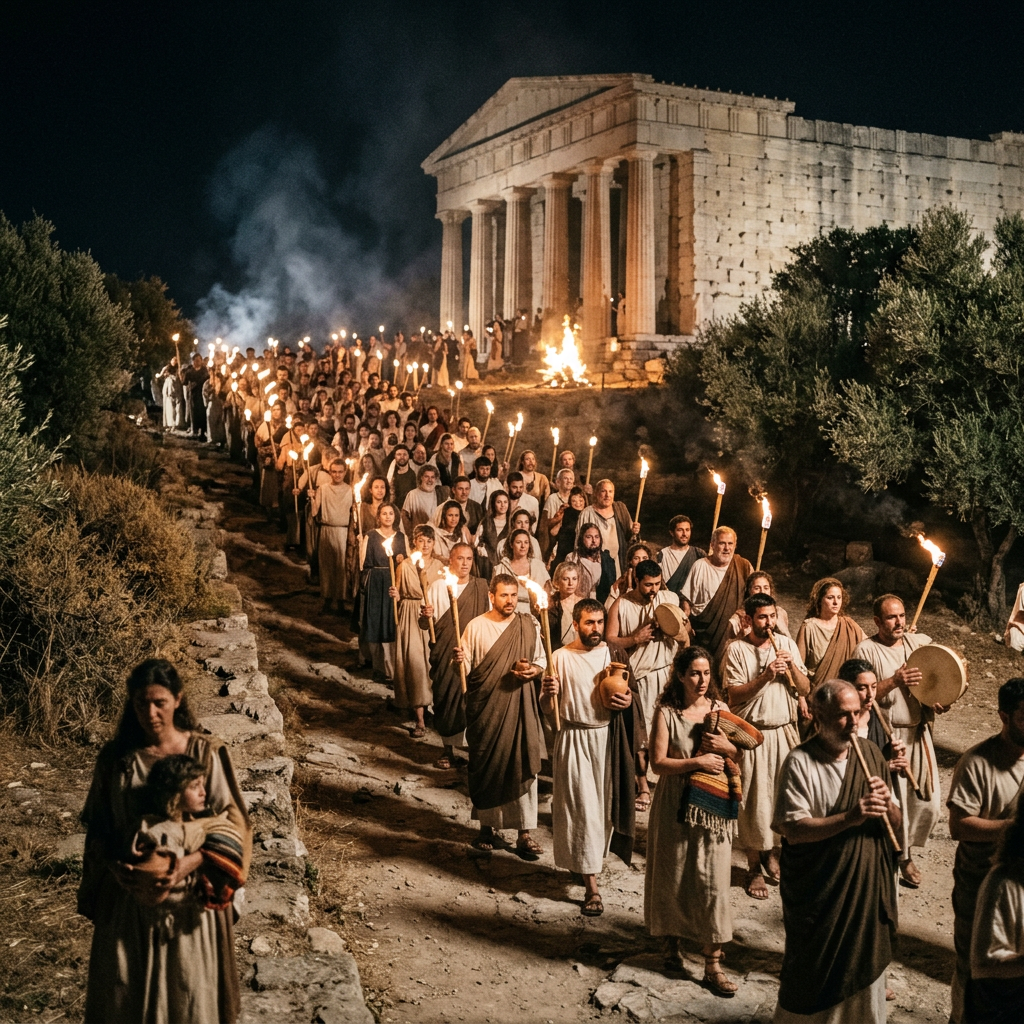
Held in the autumn, the Greater Mysteries were the central event. Participants traveled the sacred road from Athens to Eleusis in a ritual procession. Along the way, they performed chants, purification rites, and symbolic acts.
Once inside the Telesterion (the initiation hall), initiates experienced the most sacred rituals. What occurred there remains unknown, but ancient sources suggest a combination of sacred drama, symbolic revelation, and powerful sensory experiences involving darkness, light, and possibly ritual substances.

The Sacred Journey from Athens to Eleusis
The procession from Athens to Eleusis was one of the most important public elements of the ritual cycle. Participants walked approximately 20 kilometers along the Sacred Way, stopping at shrines and performing ritual acts.
This journey symbolized the transition from the ordinary world into the sacred realm. It also mirrored Persephone’s descent into the underworld and eventual return.
When the procession reached Eleusis, initiates entered a sacred space that represented the threshold between life, death, and rebirth.
The Telesterion: Heart of the Mysteries
The Telesterion was the great initiation hall of Eleusis, capable of holding thousands of participants. It was here that the final revelation occurred.
Although no direct records describe the rituals inside, scholars believe the experience may have included:
- Dramatic reenactments of the Demeter-Persephone myth
- Sacred objects revealed by priests
- Ritual silence and darkness followed by illumination
- Chanting, hymns, and sensory stimulation
- Psychological transformation through ritual structure
Some ancient writers hinted that initiates experienced a profound emotional shift—moving from fear of death to a hopeful vision of the afterlife.
The Role of the Mystai: What Initiates Experienced
Those who participated in the rites were known as mystai, meaning “initiates.” They underwent purification, fasting, and ritual instruction before entering the final ceremony.
The most important promise of the Eleusinian Mysteries was not material wealth or political power, but spiritual insight. Initiates were said to gain a deeper understanding of life and death, often described as a “blessed hope” for the afterlife.
Unlike many ancient religious systems focused on appeasing gods, the Eleusinian Mysteries emphasized personal transformation.
Sacred Symbols and Ritual Objects
While the inner rituals remain secret, several sacred objects are referenced in ancient texts:
- Barley and agricultural symbols representing fertility and renewal
- A sacred drink (kykeon) consumed during initiation
- Torches, symbolizing Demeter’s search for Persephone
- Sacred baskets (kistai) containing hidden ritual objects
The kykeon, in particular, has sparked modern debate. Some researchers speculate it may have had psychoactive properties, though this remains unproven.

Spiritual Meaning: Life, Death, and Rebirth
The Eleusinian Mysteries were not just religious ceremonies—they were existential experiences. At their core, they addressed humanity’s deepest fear: death.
By reenacting the cycle of descent and return embodied in Demeter and Persephone, initiates symbolically experienced death and rebirth during their lifetime.
This made the mysteries profoundly psychological as well as spiritual. Many scholars describe them as a form of ancient “transformational initiation,” helping participants reframe mortality as part of a larger cosmic cycle.
Influence on Ancient and Modern Thought
The Eleusinian Mysteries influenced philosophy, religion, and literature throughout antiquity. Prominent figures such as Plato and Cicero reportedly participated in the rites or referenced them with reverence.
The idea of initiation, transformation, and hidden knowledge also influenced later mystery traditions, including early mystical strands of Neoplatonism and certain strands of Western esotericism.
Even today, the Eleusinian Mysteries remain a symbol of humanity’s search for meaning beyond the visible world.
Decline and Suppression
The Eleusinian Mysteries continued for centuries under Roman rule but eventually declined during the rise of Christianity in late antiquity. In 392 CE, the Roman emperor Theodosius I banned pagan rituals, marking the official end of the tradition.
The sanctuary at Eleusis was later destroyed, and the secrets of the rites were lost to time.
Archaeological Discoveries at Eleusis
Modern archaeology has uncovered much of the sanctuary complex at Eleusis, including the Telesterion, sacred wells, and processional routes.
These findings confirm the scale and importance of the site but cannot fully reveal the inner mysteries. The absence of definitive evidence is part of what continues to fascinate historians and spiritual seekers alike.
Legacy of the Eleusinian Mysteries
Today, the Eleusinian Mysteries remain one of the most studied and enigmatic religious traditions of the ancient world. Their legacy can be seen in:
- Modern mystery religions and esoteric traditions
- Psychological interpretations of ritual initiation
- Literary and artistic references to Persephone’s descent
- Ongoing academic research into ancient spirituality
The enduring appeal lies in their secrecy. What cannot be fully known invites continuous interpretation.

Conclusion: Why the Eleusinian Mysteries Still Matter
The Eleusinian Mysteries of Eleusinian Mysteries represent more than an ancient ritual—they embody a timeless human concern with life, death, and transformation.
Centered in Eleusis and inspired by the myth of Demeter and Persephone, these rites offered initiates a powerful symbolic journey from darkness into light.
Even in the absence of full knowledge, their influence continues to shape how we think about spirituality, initiation, and the mysteries of existence itself.
Fortisetliber’s View
The Eleusinian Mysteries, the ancient initiation rites of Eleusinian Mysteries, are often described as one of the most secretive spiritual traditions of antiquity. But viewed through the motto fortis et liber—strong and free—their meaning shifts from historical curiosity to a timeless philosophy of personal transformation.
Rather than simply religious ceremonies, the Mysteries can be interpreted as a structured journey from dependence to inner strength, from ignorance to freedom.
Strength Through Descent
At the core of the myth is the descent of Persephone into the underworld. In a fortis reading, this descent is not a tragedy but an initiation into resilience.
To descend is to face what is hidden: fear, loss, uncertainty, and the unknown. The initiate, like Persephone, is not destroyed by this experience but transformed through it. Strength in this sense is not domination—it is the capacity to endure darkness without losing identity.
Freedom Through Knowledge
The liber aspect emerges in the promise of revelation. Initiates of the Eleusinian tradition were said to emerge with a new understanding of life and death, symbolically freed from the fear of mortality.
Freedom here is not political but existential. It is the liberation that comes when illusion is stripped away—when one no longer sees existence as random suffering but as a meaningful cycle of transformation.
In this sense, the Mysteries mirror the agricultural cycle embodied by Demeter: loss followed by renewal, absence followed by return.
The Initiation as Inner Discipline
From a fortis et liber viewpoint, the rituals of Eleusis represent disciplined self-mastery. The long journey from Athens to Eleusis, Greece symbolizes a deliberate movement away from comfort toward confrontation with the sacred unknown.
This path suggests that transformation is not accidental—it is chosen. The initiate does not stumble into enlightenment but walks toward it, step by step, through preparation, endurance, and surrender.
The Hidden Teaching
Though the exact rites of the Eleusinian Mysteries remain unknown, their secrecy itself becomes meaningful in this interpretation. What is hidden forces the seeker inward. Without external answers, understanding must be earned.
This aligns with the fortis et liber idea that true freedom cannot be handed down—it must be discovered through experience. Strength and freedom are inseparable: one is the capacity to endure, the other is the result of having endured.
Conclusion: A Timeless Initiation
Seen through this lens, the Eleusinian Mysteries are not merely ancient rituals but a symbolic blueprint for human transformation. They suggest that to become fortis et liber—strong and free—one must be willing to descend, endure, and return changed.
Leave a Reply