
Introduction
The Battle of Lake Vadimon (283 BC) stands as one of the decisive military engagements of early Roman expansion in Italy. Fought near Lake Vadimon in Etruria, this battle marked a turning point in Rome’s struggle to dominate the Italian peninsula. It was not merely a battlefield victory—it was a strategic breakthrough that shattered the last major resistance of Etruscan and Gallic forces in central Italy.
By the early 3rd century BC, Rome had evolved from a regional city-state into an assertive military power. However, its dominance was far from secure.
Northern Italy remained unstable, with Gallic tribes frequently raiding southward and Etruscan cities attempting to preserve their independence. The Battle of Lake Vadimon became the moment when Rome decisively shifted from defensive survival to uncontested expansion.
Historical Background
To understand the significance of the Battle of Lake Vadimon, it is essential to examine the geopolitical situation in Italy during the early 3rd century BC.
Rome’s Position in 283 BC
Rome had recently emerged victorious in several conflicts against neighboring Italian tribes, but it still faced major threats from:
- The Etruscans in central Italy
- The Senones and other Gallic tribes in the north
- Various Umbrian and Samnite groups
Rome’s victories in earlier wars had pushed its influence deeper into Etruria, creating tension with established powers.
Rising Tensions with the Gauls and Etruscans
The immediate background of the battle involves a coalition of Etruscan cities and the Senone Gauls. The Gauls had previously inflicted severe damage on Rome during the Sack of Rome in 389 BC, and their presence in northern Italy remained a persistent threat.
By 283 BC, both Etruscans and Gauls had reason to oppose Rome’s expansion. Their alliance—though culturally unstable—was driven by necessity rather than unity.
Causes of the Battle
Several interconnected factors led to the confrontation at Lake Vadimon:
1. Roman Expansion into Etruria
Rome’s gradual absorption of Etruscan territory alarmed regional powers, who saw Roman control as existentially threatening.
2. Gallic Raiding Pressure
Gallic tribes, especially the Senones, regularly raided Roman and Etruscan lands, destabilizing the region and prompting coordinated resistance.
3. Breakdown of Local Power Balance
The traditional Etruscan city-state system was weakening, allowing Rome to step into a power vacuum.
4. Strategic Roman Response
Rome adopted a proactive military strategy, choosing to confront coalition forces directly rather than merely defend its territory.
The Battlefield: Lake Vadimon
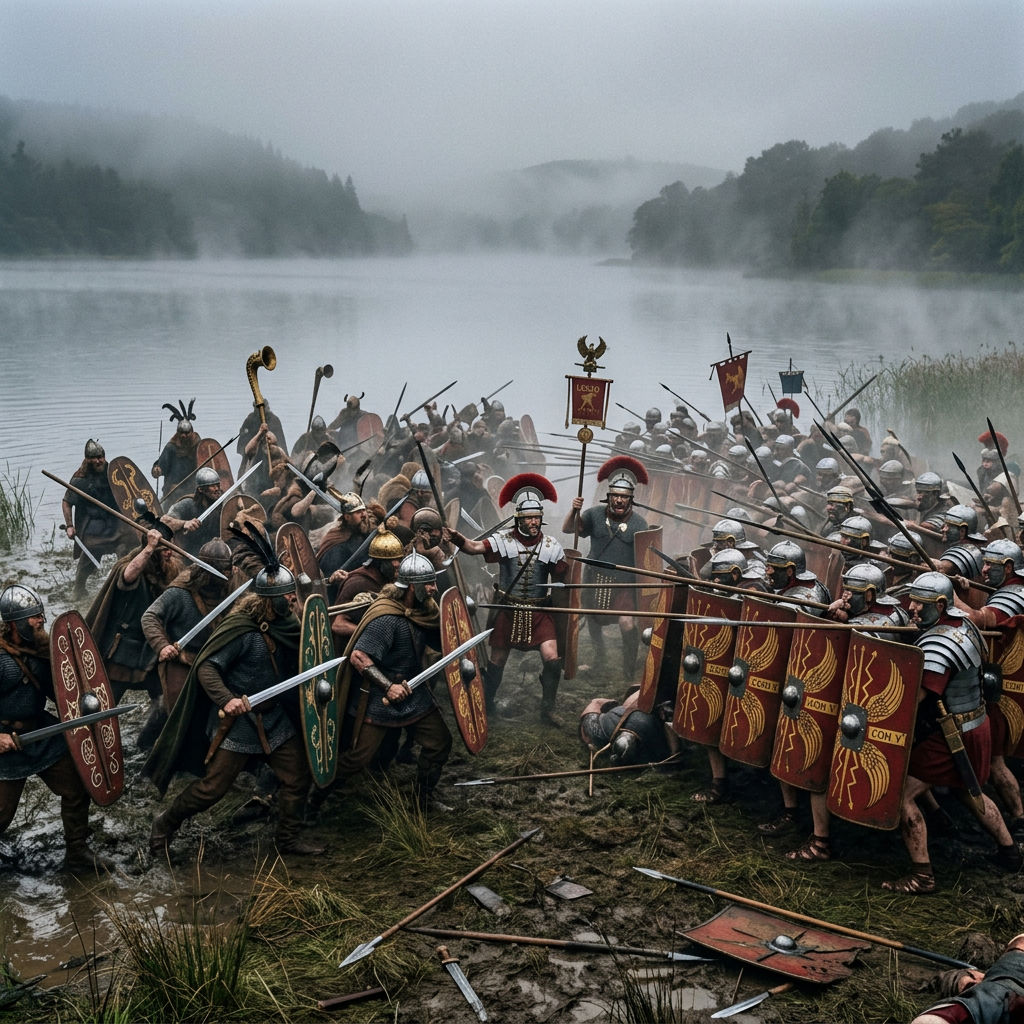
Lake Vadimon, located in Etruria, was surrounded by marshy terrain, forests, and uneven ground. This geography played a crucial role in the battle.
The environment favored disciplined infantry formations, something Rome was increasingly mastering. In contrast, Gallic warriors, known for aggressive charges and less structured formations, were at a disadvantage in constrained terrain.

The Forces Involved
Although exact numbers are uncertain, ancient sources suggest a significant engagement involving:
Roman Forces
- Well-trained citizen legions
- Increasingly standardized infantry tactics
- Strong command structure under Roman consuls
Etruscan-Gallic Coalition
- Etruscan infantry units with traditional formations
- Gallic warriors known for shock combat and mobility
- Limited coordination between allied forces
The lack of cohesion between Etruscans and Gauls proved to be a critical weakness.
The Course of the Battle
The battle unfolded as a decisive Roman engagement rather than a prolonged struggle.
Initial Contact
Roman forces likely engaged the coalition near the marshy edges of Lake Vadimon. Early skirmishes would have tested both sides, with neither immediately gaining dominance.
Roman Tactical Discipline
The Romans increasingly relied on:
- Cohesive infantry lines
- Controlled rotation of units
- Structured command hierarchy
This allowed them to absorb the initial impact of Gallic aggression.
Collapse of the Coalition Line
The Gallic warriors attempted their characteristic fierce charges, but the terrain and Roman discipline blunted their effectiveness. Once the Gallic assault stalled, Etruscan forces began to falter.
Roman Breakthrough
A coordinated Roman counterattack eventually broke the coalition line. Once cohesion collapsed, the battle turned into a rout.
Many coalition soldiers were killed or dispersed, and Roman forces secured a decisive victory.
Aftermath of the Battle
The aftermath of the Battle of Lake Vadimon (283 BC) was strategically transformative.
1. Collapse of Etruscan Resistance
The battle severely weakened Etruscan opposition to Rome. Many cities either submitted or became politically dependent on Rome.
2. Decline of Gallic Threat in Central Italy
While Gallic tribes continued to exist in northern regions, their ability to project power into central Italy was significantly reduced.
3. Expansion of Roman Influence
Rome’s victory allowed it to consolidate control over key territories in Etruria, strengthening its northern frontier.
4. Psychological Impact
The defeat reinforced Roman confidence and contributed to the growing belief in Rome’s military destiny.
Strategic Importance
The Battle of Lake Vadimon was not just another early Roman victory—it represented a structural shift in Italian power dynamics.
Rome as a Regional Hegemon
After this battle, Rome was no longer simply defending itself from invasions. It was actively shaping the political landscape of Italy.
End of a Multi-Front Threat
The coordination between Etruscans and Gauls, though temporary, represented one of the last serious attempts to counterbalance Roman expansion in central Italy.
Military Evolution
The battle reinforced the effectiveness of Roman tactical discipline over less coordinated tribal warfare.

Military Lessons from the Battle
Several important military lessons can be drawn from Lake Vadimon:
1. Discipline Over Ferocity
Gallic bravery and aggression were not enough to overcome Roman organization.
2. Terrain Advantage
Rome’s ability to adapt to marshy terrain demonstrated tactical flexibility.
3. Importance of Unity
The lack of coordination between Etruscans and Gauls weakened their overall effectiveness.
4. Command Structure Matters
Roman centralized command provided consistency in battlefield decisions.
Historical Sources and Reliability
Most knowledge of the Battle of Lake Vadimon comes from Roman historians such as Livy and later annalistic traditions. As with many early Roman battles, there are limitations:
- Numbers are likely exaggerated
- Speeches and dramatic details are literary constructions
- The exact sequence of events is uncertain
However, the broad historical consensus supports the occurrence of a major Roman victory over Etruscan and Gallic forces around this period.
Long-Term Impact on Rome
The consequences of the battle extended far beyond immediate military gains.
Consolidation of Italy
Rome’s victory contributed to the gradual unification of the Italian peninsula under Roman influence.
Foundation for Imperial Expansion
By neutralizing major internal threats, Rome was able to focus on external expansion, eventually leading to conflicts in the Mediterranean.
Strengthening of Roman Identity
Victories like Lake Vadimon reinforced Rome’s self-image as a disciplined and destined power.
Why the Battle Still Matters Today
The Battle of Lake Vadimon (283 BC) remains significant because it illustrates how Rome transitioned from vulnerability to dominance.
It highlights key themes in ancient military history:
- The decline of tribal coalitions
- The rise of disciplined infantry warfare
- The importance of strategic geography
- The early formation of Roman hegemony
Modern historians view this battle as part of the broader process that transformed Rome from a regional city-state into the dominant power of Italy.

Conclusion
The Battle of Lake Vadimon in 283 BC was a turning point in Roman military history. By defeating a coalition of Etruscan and Gallic forces, Rome secured its dominance in central Italy and removed one of its last major internal threats.
More importantly, the battle demonstrated the effectiveness of Roman discipline, organization, and strategic adaptability. It was not just a victory on the battlefield—it was a confirmation that Rome’s military system was superior to its rivals.
In the long arc of Roman history, Lake Vadimon represents the moment when the balance of power in Italy shifted permanently toward Rome, setting the stage for its future expansion across the Mediterranean world.
Fortisetliber’s View
From a FortisLiber perspective, the Battle of Lake Vadimon (283 BC) is best understood as the moment when Rome’s system stopped behaving like an emergent power and started behaving like a self-reinforcing machine.
What matters here is not just that Rome won, but how predictably it won. By this stage, Roman warfare was no longer improvisational. It was becoming procedural—repeatable structures of discipline, command, and endurance that could absorb culturally diverse enemies like the Etruscans and Gauls without needing equal cultural cohesion on the opposing side.
The coalition facing Rome was, in a sense, historically unstable from the start. The Etruscans fought to preserve a fading political order, while Gallic forces operated through momentum and shock rather than institutional continuity. Rome, by contrast, was beginning to convert battlefield experience into doctrine. Each war tightened the system. Each victory reduced uncertainty.
Lake Vadimon reflects this shift clearly: Rome did not merely defeat an alliance; it outlasted it organizationally. The battle signals a deeper transformation where Rome’s advantage was no longer just military skill, but structural coherence under pressure.
In FortisLiber terms, this is the quiet threshold of hegemony—when a state no longer wins because it is stronger in a given moment, but because its internal design makes long-term defeat increasingly unlikely.
Leave a Reply