
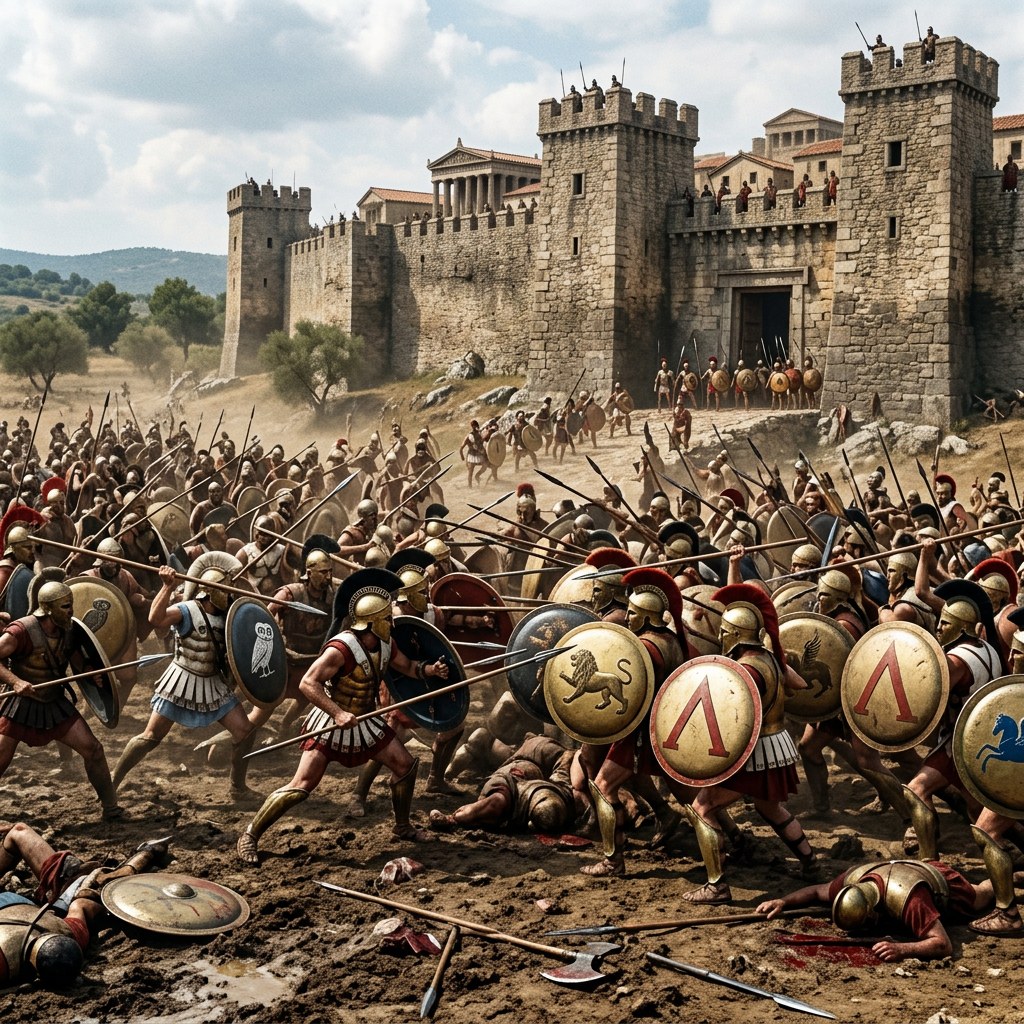
The Battle of Amphipolis, fought in 422 BC, was one of the defining engagements of the Peloponnesian War between Athens and Sparta. Although relatively small in scale compared to later conflicts, its outcome dramatically altered the balance of power in Greece, led directly to the Peace of Nicias, and claimed the lives of two of the war’s most influential leaders—Brasidas of Sparta and Cleon of Athens.
Located in northeastern Greece near the Strymon River, Amphipolis was far more than a distant colonial city. It was an economic powerhouse rich in timber, precious metals, and strategic access to Thrace. Whoever controlled Amphipolis controlled vital resources necessary for maintaining naval supremacy and regional influence.
Today, historians consider the Battle of Amphipolis one of the most significant military encounters of classical antiquity because of its political, military, and economic consequences.
Why Was Amphipolis So Important?
Founded by Athens in 437 BC, Amphipolis quickly became one of the city’s most valuable overseas possessions. Its strategic location offered several crucial advantages:
- Access to the forests of Thrace for shipbuilding timber.
- Control of trade routes connecting Greece with Thrace and Macedonia.
- Nearby gold and silver mines that financed military operations.
- Command of crossings over the Strymon River.
For Athens, losing Amphipolis threatened both its economy and naval power. For Sparta, capturing the city represented an opportunity to weaken its greatest rival while encouraging revolts among Athenian allies.
Background: The Peloponnesian War
The Peloponnesian War (431–404 BC) was fought primarily between the Athenian Empire, led by Athens and its Delian League allies, and the Peloponnesian League, headed by Sparta.
By the early 420s BC, the conflict had reached a stalemate. Athens remained dominant at sea, while Sparta maintained superiority on land.
In 424 BC, the Spartan commander Brasidas launched an ambitious campaign into northern Greece. Through diplomacy, rapid movement, and military skill, he persuaded several Athenian allies to defect.
His greatest success came when Amphipolis surrendered with relatively little resistance.
The loss shocked Athens.
One casualty of the city’s surrender was the Athenian general Thucydides, who arrived too late to save Amphipolis. He was subsequently exiled, using his years away from Athens to write what would become one of history’s greatest historical works: The History of the Peloponnesian War.
Athens Strikes Back
The Athenians could not allow such an important city to remain in Spartan hands.
In 422 BC, they organized an expedition under the leadership of Cleon, an influential politician and military commander known for his aggressive stance against Sparta.
Cleon assembled approximately:
- 1,200 Athenian hoplites
- 300 cavalry
- Thousands of allied infantry and light troops
His objective was simple:
Recapture Amphipolis before Sparta could reinforce it.
Inside the city, Brasidas commanded a smaller but highly disciplined force composed of Spartan soldiers, mercenaries, and local allies.
Although outnumbered, Brasidas understood the terrain and carefully prepared his defense.

The Commanders
Brasidas
Brasidas was among Sparta’s most innovative generals.
Unlike many Spartan commanders, he valued diplomacy alongside military force. He treated conquered cities fairly, respected local customs, and encouraged voluntary alliances rather than relying solely on intimidation.
His leadership earned widespread admiration—even among his enemies.
His tactical brilliance would prove decisive at Amphipolis.
Cleon
Cleon remains one of the most controversial figures in Athenian history.
Supporters viewed him as a determined defender of democracy.
Critics, including Thucydides and the playwright Aristophanes, portrayed him as impulsive, aggressive, and politically ambitious.
Modern historians suggest these portrayals may reflect political bias, but there is little doubt that Cleon’s military experience did not match Brasidas’ battlefield expertise.
The Battle Begins
As Cleon approached Amphipolis, he hesitated.
Rather than immediately assault the city, he attempted to observe Spartan movements while positioning his troops advantageously.
Brasidas recognized the uncertainty.
Instead of waiting behind the city’s walls, he devised a surprise attack.
Keeping most of his force hidden, he waited until the Athenians began repositioning and partially withdrawing.
This created temporary confusion in the Athenian ranks.
At precisely that moment, Brasidas launched a sudden assault from the city gates.
A second Spartan force simultaneously attacked from another direction.
The coordinated strike caught the Athenians completely off guard.
Spartan Tactical Success
The surprise attack shattered Athenian cohesion.
Many soldiers had not fully formed battle lines when the Spartans charged.
The disciplined Spartan hoplites rapidly exploited gaps in the Athenian formation.
Meanwhile, cavalry and light infantry prevented an organized retreat.
Brasidas personally led the assault, inspiring his troops despite suffering severe wounds during the fighting.
Cleon attempted to withdraw his army, but the retreat quickly became a rout.
While fleeing, Cleon was killed.
Without effective leadership, Athenian resistance collapsed.
Although Brasidas later died from his injuries, his forces had secured a remarkable victory.

Casualties
Ancient sources suggest:
Athenians
- Around 600 killed
- Significant loss of equipment
- Complete retreat
Spartans
- Only seven reported dead
- Brasidas mortally wounded
Although ancient casualty figures should always be treated cautiously, the disparity illustrates the effectiveness of the Spartan surprise attack.
Why Did Sparta Win?
Several factors contributed to the Spartan victory.
Brilliant Leadership
Brasidas demonstrated exceptional battlefield awareness, carefully choosing the ideal moment to attack.
Tactical Surprise
Rather than defending passively, Sparta seized the initiative.
The unexpected assault disrupted Athenian formations before they could organize.
Superior Discipline
Spartan hoplites maintained cohesion during combat, while Athenian units became fragmented.
Psychological Advantage
The sudden appearance of Spartan troops caused panic among soldiers already uncertain about Cleon’s intentions.
The Deaths of Brasidas and Cleon
One of history’s great ironies is that both commanders died during the battle.
Brasidas received heroic honors from the citizens of Amphipolis.
He was buried within the city and worshipped as its founder and protector for generations.
Cleon’s death removed one of Athens’ strongest advocates for continuing the war.
The simultaneous loss of both political hardliners made peace negotiations considerably easier.
The Peace of Nicias
Only one year after the battle, Athens and Sparta agreed to the Peace of Nicias in 421 BC.
Although the treaty ultimately failed to end the Peloponnesian War permanently, it provided several years of relative peace.
The Battle of Amphipolis had demonstrated that neither side could achieve a decisive victory without enormous cost.
Amphipolis After the Battle
Despite the peace agreement, Amphipolis did not return to Athenian control.
The city remained independent for several years before eventually becoming part of the expanding kingdom of Macedonia under Philip II.
Later, Amphipolis gained even greater historical importance because it became closely associated with Alexander the Great.
Several of Alexander’s most distinguished admirals, officers, and companions either came from Amphipolis or used it as an important military base during his campaigns.

Archaeological Discoveries
Modern archaeology has revealed much about ancient Amphipolis.
Excavations have uncovered:
- Massive city walls
- Public buildings
- Temples
- Residential districts
- Ancient roads
- Cemeteries
- The famous Lion of Amphipolis monument
Perhaps the site’s most internationally recognized discovery is the magnificent Kasta Tomb, unearthed in 2014. Although debate continues regarding its occupants, the monument highlights Amphipolis’ enduring importance during the Macedonian era.
These discoveries continue to deepen our understanding of the city’s strategic and cultural significance.
What Does Thucydides Tell Us?
Nearly everything known about the Battle of Amphipolis comes from Thucydides, whose account is considered one of the most reliable military histories ever written.
His detailed descriptions of strategy, leadership, morale, and decision-making provide invaluable insight into classical Greek warfare.
Ironically, his exile—caused by failing to save Amphipolis—allowed him to produce the historical masterpiece for which he is remembered today.
Legacy of the Battle
The Battle of Amphipolis represents much more than a Spartan battlefield victory.
It illustrates how leadership, timing, intelligence, and tactical flexibility can outweigh numerical superiority.
The engagement also demonstrates the importance of strategic geography in ancient warfare, where control of resources could determine the fate of entire states.
Even centuries later, military historians continue studying Brasidas’ tactics as an outstanding example of exploiting surprise and initiative.
Conclusion
The Battle of Amphipolis in 422 BC stands among the most influential conflicts of the Peloponnesian
War. Sparta’s unexpected victory under Brasidas not only preserved control of one of Greece’s most valuable cities but also reshaped the political landscape of the Greek world.
The deaths of Brasidas and Cleon removed two of the conflict’s most determined leaders, paving the way for the Peace of Nicias.
Yet the struggle for supremacy between Athens and Sparta would continue, eventually ending with Athens’ defeat in 404 BC.
More than 2,400 years later, the Battle of Amphipolis remains a remarkable example of military strategy, leadership, and the enduring impact a single battle can have on the course of history.
Fortisetliber’s View
The Battle of Amphipolis reminds us that history is shaped not only by the size of armies but by the quality of leadership. In 422 BC, the Spartan commander Brasidas defeated a larger Athenian force through decisive action, careful planning, and the courage to seize the initiative.
Yet the battle’s greatest legacy extends beyond military victory. Both Brasidas and the Athenian leader Cleon lost their lives, illustrating the heavy cost of war even for its most capable leaders. Their deaths paved the way for the Peace of Nicias, proving that a single battle can alter the course of history in unexpected ways.
Amphipolis teaches a timeless lesson: strategy, character, and leadership often outweigh numerical strength. Civilizations endure when their leaders act with wisdom, determination, and a clear understanding of the moment before them.
More than 2,400 years later, the echoes of Amphipolis still remind us that the decisions of a few can shape the destiny of many.
Leave a Reply