
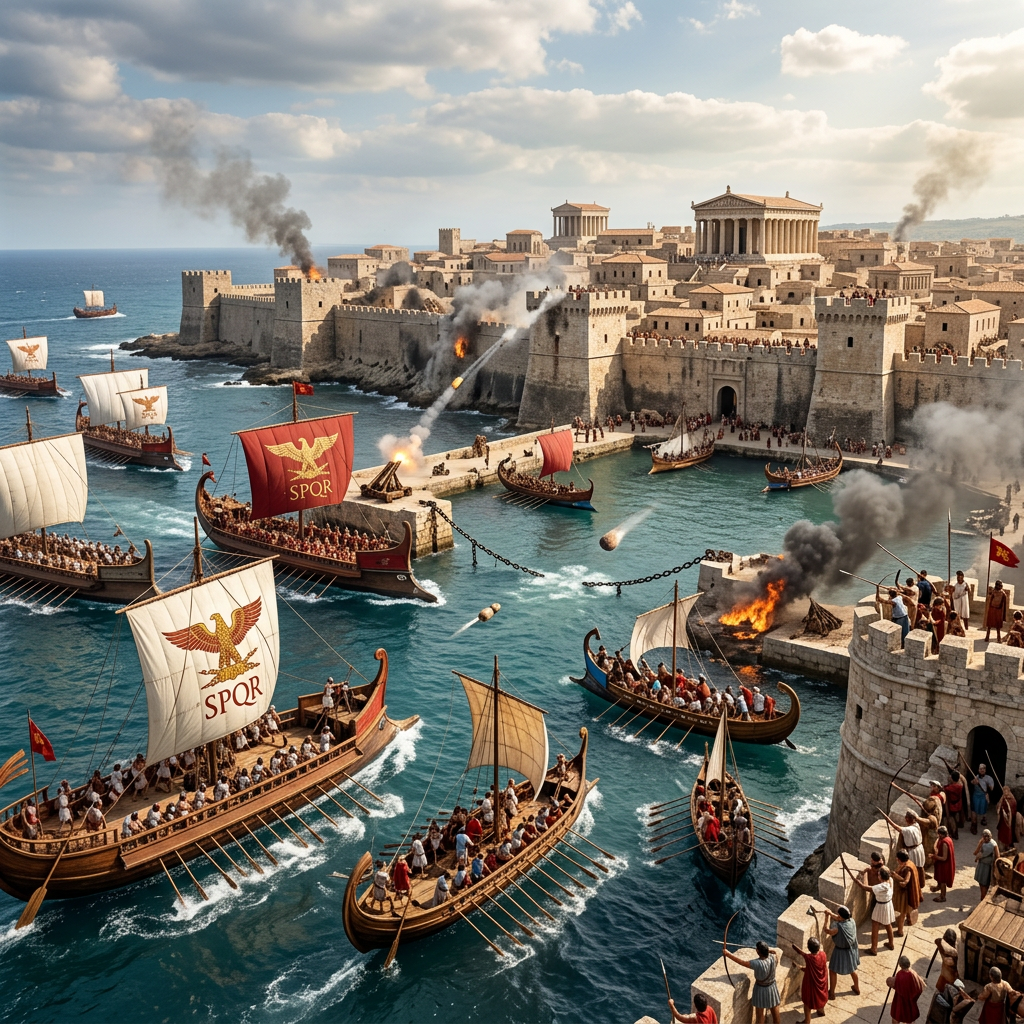
The Siege of Syracuse (213–212 BC) was one of the most dramatic and consequential episodes of the Second Punic War. It pitted the expanding power of the Roman Republic against one of the most sophisticated and wealthy cities of the ancient Mediterranean: Syracuse in Sicily.
The siege is remembered not only for its military intensity but also for the involvement of the legendary mathematician and engineer Archimedes, whose defensive inventions temporarily held back Roman forces.
This article explores the causes, key events, military technology, and aftermath of the siege, as well as its long-term impact on Roman dominance in the Mediterranean.
Historical Background: Why Syracuse Became a Target
The siege occurred during the wider conflict known as the Second Punic War (218–201 BC), fought between Rome and Carthage. After Carthage’s early victories under Hannibal in Italy, the war expanded into Sicily, a strategically vital island controlling sea routes and grain supplies.
Syracuse had long been a powerful and semi-independent Greek city-state in Sicily.
At the time of the siege, it was ruled by King Hieronymus, who had shifted allegiance from Rome to Carthage after the death of his grandfather Hiero II, a long-standing Roman ally.
This political realignment alarmed Rome. Syracuse’s location, wealth, and naval capability made it a potential threat. Rome responded decisively: Syracuse had to be brought back under control.
Thus began the Roman military campaign that would lead to the Siege of Syracuse (213–212 BC).
Roman Command and Strategy
The Roman Republic assigned the siege to the consul Marcus Claudius Marcellus, a seasoned commander known for aggressive tactics.
Roman forces approached Syracuse by both land and sea, attempting to encircle the city and cut off its supplies.
However, Syracuse was no ordinary target. It was heavily fortified with massive defensive walls, complex harbor defenses, and advanced siege countermeasures designed by Archimedes.
Rome’s strategy shifted from quick assault to prolonged siege warfare.
What they expected to be a short campaign turned into a grinding and costly operation lasting nearly two years.

The Genius of Archimedes and Syracuse’s Defenses
One of the most famous aspects of the siege is the defensive technology attributed to Archimedes. Although ancient historians sometimes exaggerate his role, there is strong evidence that he designed several innovative war machines.
These included:
1. The Claw of Archimedes
A mechanical crane-like device that could lift Roman ships out of the water and either capsize them or slam them against the rocks. Roman soldiers reportedly feared approaching the harbor because of it.
2. Giant Catapults and Ballistae
Syracuse’s walls were equipped with artillery capable of launching heavy projectiles at Roman troops and siege engines, disrupting assaults before they could reach the city.
3. Burning Mirrors (Legendary Account)
Some later sources claim Archimedes used reflective surfaces to concentrate sunlight and set Roman ships on fire. While debated by historians, the story remains a symbol of ancient ingenuity.
4. Improved Defensive Engineering
Reinforced walls, angled battlements, and layered defenses made Syracuse extremely difficult to breach.
These innovations turned the siege into a showcase of ancient engineering and forced Rome into a prolonged war of attrition.
Naval Warfare and Roman Setbacks
Rome attempted to attack Syracuse by sea, but the harbor defenses were particularly deadly. Ships approaching the city were vulnerable to Archimedes’ mechanical devices.
Roman naval forces suffered repeated losses. Some ships were lifted and overturned; others were shattered by projectile fire before reaching effective range.
These failures forced Rome to adjust tactics. Instead of direct assault, they focused on blockading the city and starving it into submission.
Life Inside Syracuse During the Siege
While Roman forces tightened their grip outside, conditions inside Syracuse gradually deteriorated.
Despite strong fortifications and stockpiled supplies, the prolonged siege created shortages of food and resources.
The city’s population faced increasing hardship, although its leadership initially remained confident due to its strong defenses and Archimedes’ innovations.
Political instability also weakened Syracuse internally.
The earlier assassination of Hieronymus had led to turmoil, and loyalty among factions inside the city was divided.

The Turning Point: Betrayal and Infiltration
After many months of stalemate, Rome eventually found a way into the city not through force, but through opportunity.
During a festival, Syracuse’s defenses were less strictly guarded. Roman forces, led by Marcellus, exploited this weakness. They infiltrated the city through a poorly defended section of the wall.
Once inside, Roman troops quickly secured key positions and opened the gates for the rest of the army.
This moment marked the collapse of Syracuse’s resistance.
The Fall of Syracuse (212 BC)
The capture of Syracuse was brutal and chaotic. Roman soldiers sacked parts of the city, and significant destruction followed.
One of the most tragic moments recorded by historians was the death of Archimedes. According to tradition, he was killed by a Roman soldier despite orders to spare him, as he was reportedly focused on a mathematical problem at the time.
His death symbolized the end of Syracuse’s intellectual golden age.
Marcus Claudius Marcellus is often criticized by ancient sources for the sack, although he is also noted for lamenting Archimedes’ death and attempting to preserve some of the city’s cultural heritage.
Strategic Importance of the Victory
The fall of Syracuse had major consequences for the Roman Republic:
1. Control of Sicily
Rome secured full control over Sicily, making it its first formal province. This provided access to grain supplies essential for feeding Rome’s growing population.
2. Naval Advantage
Eliminating Syracuse removed a major naval power in the central Mediterranean.
3. Psychological Impact
The victory demonstrated that even the most fortified and technologically advanced cities could fall to Rome.
4. Shift in the Second Punic War
The defeat weakened Carthaginian influence in Sicily and strengthened Roman momentum in the broader war against Hannibal.
Military Innovations and Legacy
The Siege of Syracuse (213–212 BC) is often studied in military history for its combination of engineering, strategy, and prolonged siege tactics.
Key lessons include:
- The importance of engineering in defensive warfare
- The effectiveness of siege attrition over direct assault
- The vulnerability of even advanced cities to internal betrayal
- The rising dominance of Roman military organization
It also highlights how scientific knowledge, embodied by figures like Archimedes, could temporarily reshape battlefield outcomes.
Historical Debate and Sources
Most of what is known about the siege comes from ancient historians such as Polybius and Livy. However, their accounts were written years after the events and sometimes include exaggerations or legendary elements.
For example, the “burning mirrors” story is widely debated among modern historians, while the mechanical devices like the Claw are considered more plausible due to their engineering feasibility.
Despite uncertainties, the overall narrative of a technologically advanced defense ultimately overwhelmed by Roman persistence is widely accepted.

Conclusion: Why the Siege Still Matters
The Siege of Syracuse remains one of the most significant military events of the ancient world. It represents the intersection of warfare, engineering, and politics during a critical phase of Roman expansion.
The fall of Syracuse marked not just the loss of a city, but the end of an era of Greek dominance in Sicily and the rise of Roman control across the Mediterranean.
More than two millennia later, the siege continues to fascinate historians, engineers, and military strategists alike. Its legacy endures through the story of innovation under pressure, the brilliance of Archimedes, and the relentless expansion of the Roman Republic.
Fortisetliber’s View
From a FortisLiber perspective, the Siege of Syracuse (213–212 BC) is not merely a military episode of the Second Punic War—it is a confrontation between two worldviews: Rome’s disciplined, expanding machine of conquest and Syracuse’s last stand of intellectual and civic ingenuity.
What makes this siege stand apart in ancient history is not just the outcome, but the nature of resistance. Syracuse did not rely solely on walls or manpower. It leaned on knowledge. The city became a living demonstration of how science and engineering can momentarily offset brute force. In this sense, the presence of Archimedes is not a side note—it is the symbolic center of the entire event.
Rome, represented by Marcus Claudius Marcellus, approached Syracuse as a conventional siege problem: isolate, pressure, and breach. Yet Syracuse refused to behave like a conventional target. Its defenses turned the harbor into a contested laboratory of mechanics and fear. Roman assumptions about inevitability were challenged by ingenuity.
But FortisLiber interpretation also emphasizes a harder truth: innovation can delay collapse, not always prevent it. Syracuse’s brilliance extended its survival but could not overcome internal fragmentation, resource limits, and Rome’s persistence. When the city finally fell in 212 BC, it marked the moment when intellectual resistance met the limits of isolation.
The death of Archimedes—reportedly while absorbed in mathematical thought—becomes more than anecdote. It symbolizes the vulnerability of knowledge when confronted by the chaos of conquest. Whether or not every detail of his final moments is accurate, the meaning has endured: ideas are powerful, but not invincible.
From this viewpoint, the siege is not a story of triumph or tragedy alone. It is a reminder that civilizations are shaped by the tension between force and intelligence. Rome ultimately prevailed, but Syracuse left behind a deeper legacy: the demonstration that even in war, the mind can reshape the battlefield.
In FortisLiber terms, Syracuse did not simply fall. It revealed what it means to resist with ingenuity in a world increasingly governed by power.
Leave a Reply