
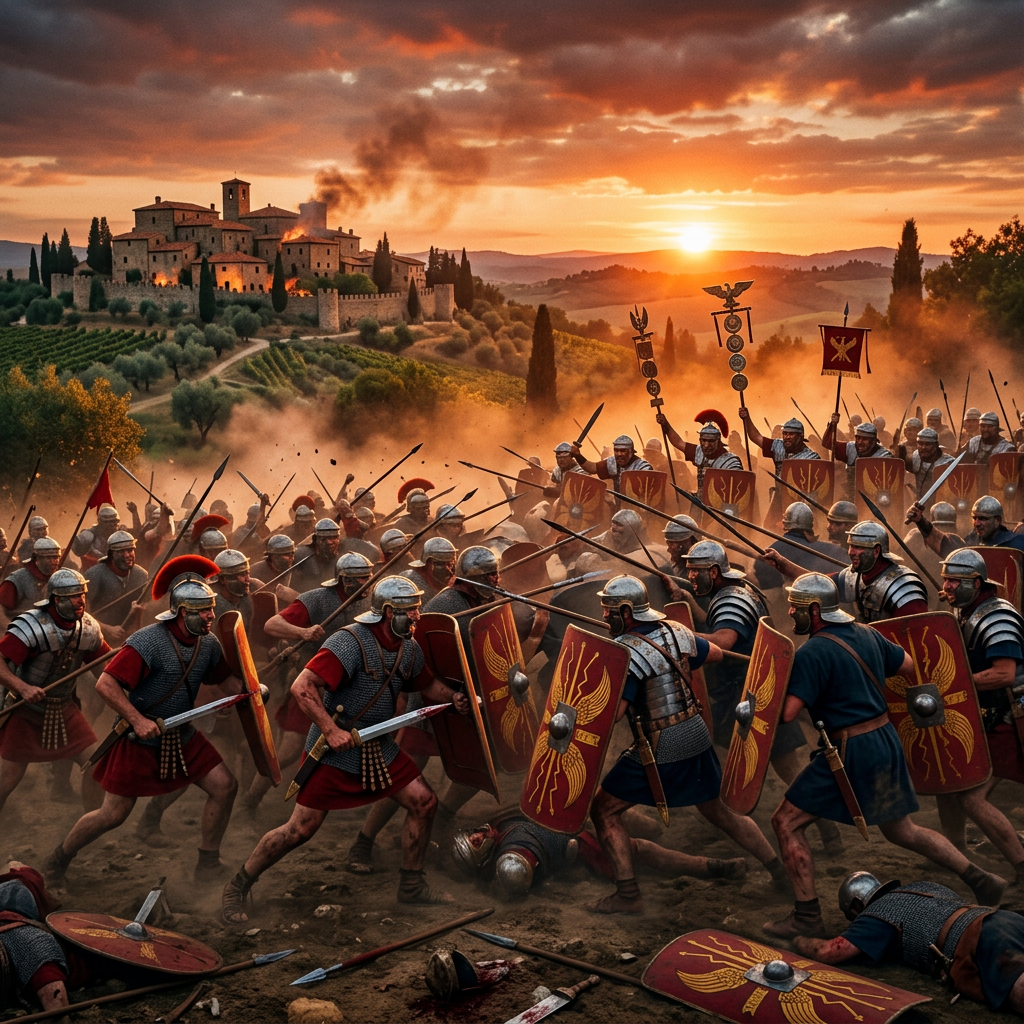
The Battle of Bedriacum refers to two major battles fought near the village of Bedriacum in northern Italy during one of the most turbulent periods in Roman history. Taking place in AD 69, the battles were pivotal moments in the Year of the Four Emperors, a chaotic civil war that erupted after the death of Emperor Nero.
Although often overshadowed by more famous Roman conflicts such as the Battle of Actium or the Battle of Teutoburg Forest, the Battles of Bedriacum had enormous historical significance. They determined who would rule the Roman Empire, reshaped imperial politics, and ultimately paved the way for the Flavian dynasty under Emperor Vespasian.
This article explores the causes, events, military strategies, key figures, and lasting impact of the Battles of Bedriacum.
What Was the Battle of Bedriacum?
The Battle of Bedriacum actually consisted of two separate engagements, both fought near the settlement of Bedriacum, located between modern Cremona and Mantua in northern Italy.
- First Battle of Bedriacum (April AD 69): Emperor Otho faced the forces of Vitellius.
- Second Battle of Bedriacum (October AD 69): Supporters of Vespasian defeated the army loyal to Vitellius.
These battles occurred during the Year of the Four Emperors, when four different men claimed the Roman throne within a single year.
The Political Background
The death of Emperor Nero in AD 68 ended the Julio-Claudian dynasty, leaving the empire without a clear successor.
Galba seized power but quickly lost support due to unpopular policies and his failure to reward the Praetorian Guard. In January AD 69, he was assassinated, and Otho became emperor.
Meanwhile, the Rhine legions proclaimed their commander, Aulus Vitellius, as emperor. Vitellius immediately marched toward Italy, setting the stage for the First Battle of Bedriacum.
Later in the same year, eastern legions declared their support for Titus Flavius Vespasianus—better known as Vespasian—creating yet another claimant to the imperial throne.
The First Battle of Bedriacum
The First Battle of Bedriacum took place on 14 April AD 69.
The Opposing Forces
Otho commanded troops that included:
- Praetorian Guard
- Italian legions
- Auxiliary soldiers
- Gladiators recruited for combat
Vitellius relied primarily on veteran Rhine legions, including:
- Legio XXI Rapax
- Legio V Alaudae
- Legio I Italica
- Other experienced frontier troops
Vitellius’ commanders, Aulus Caecina Alienus and Fabius Valens, had considerable battlefield experience.
The Battle
Otho’s advisors recommended delaying the battle until reinforcements arrived from the Danube provinces. Instead, Otho decided to engage immediately.
The armies met near Bedriacum after Otho’s troops completed a long and exhausting march. Fatigue proved to be a critical disadvantage.
Vitellian forces launched coordinated attacks against the weary Othonian army. Despite fierce resistance, Otho’s soldiers gradually lost cohesion.
Some units fought bravely until the very end, but the stronger and more experienced Rhine legions eventually overwhelmed them.
Otho’s Decision
Rather than prolong the civil war, Otho committed suicide two days after the defeat.
His decision earned widespread admiration among Roman historians because he chose to spare the empire further bloodshed instead of continuing a hopeless conflict.
Vitellius then entered Rome and became emperor.

Between the Battles
Vitellius’ reign proved short-lived.
His administration struggled with financial problems, declining discipline among the legions, and growing political opposition.
Meanwhile, Vespasian had secured enormous military resources in the eastern provinces.
The governor of Syria, Gaius Licinius Mucianus, joined Vespasian’s cause, while Danubian legions also declared their loyalty to him.
This dramatically shifted the balance of power.
The Second Battle of Bedriacum
The Second Battle of Bedriacum occurred in October AD 69.
This time, Vespasian himself remained in the East, while his supporters advanced into Italy under Marcus Antonius Primus.
The Road to Battle
Antonius Primus acted quickly before Mucianus arrived with additional reinforcements.
His objective was straightforward: defeat Vitellius’ army before it could consolidate.
Vitellius dispatched substantial forces to defend northern Italy.
The armies once again converged near Bedriacum.
The Night Battle
One of the most remarkable aspects of the Second Battle of Bedriacum was that much of the fighting occurred during the night.
Night battles were relatively rare in Roman warfare because command and communication became extremely difficult after dark.
Confusion spread across both armies.
Units struggled to identify friend from foe.
Despite the chaos, the Flavian forces gradually gained the upper hand.
Their discipline and determination allowed them to break Vitellian resistance after prolonged fighting.
The Sack of Cremona
Following the victory, Flavian troops captured nearby Cremona.
Unfortunately, the victorious soldiers subjected the city to a brutal sack lasting several days.
Buildings were burned.
Homes were looted.
Many civilians suffered greatly despite having little involvement in the political conflict.
Ancient historians viewed the destruction of Cremona as one of the darkest episodes of the civil war.
The Fall of Vitellius
After the defeat at Bedriacum, Vitellius’ position became increasingly hopeless.
Flavian armies marched toward Rome.
Street fighting erupted in the capital.
Eventually, Vitellius was captured and killed in December AD 69.
The Senate recognized Vespasian as emperor, ending the Year of the Four Emperors.
Military Tactics
The Battles of Bedriacum showcased both the strengths and weaknesses of Roman military organization.
Strengths
Roman armies demonstrated:
- Exceptional discipline
- Strong logistical organization
- Flexible battlefield formations
- Effective engineering support
Weaknesses
Civil wars also exposed significant vulnerabilities:
- Legions fought fellow Romans instead of foreign enemies.
- Political loyalty often outweighed military professionalism.
- Command decisions frequently reflected personal ambition rather than strategic necessity.
The First Battle illustrated the dangers of attacking with exhausted troops, while the Second Battle highlighted the risks of fighting under limited visibility.

Key Commanders
Otho
Although defeated, Otho is remembered as one of Rome’s more honorable claimants.
His willingness to sacrifice himself rather than continue the conflict impressed many ancient writers, including Tacitus.
Vitellius
Vitellius possessed experienced military support but proved unable to maintain political stability after gaining power.
His brief reign lasted only eight months.
Vespasian
Although absent from the battlefield during the Second Battle, Vespasian benefited from the victories of his loyal commanders.
He would become one of Rome’s greatest emperors.
His reign restored financial stability, strengthened the army, and began construction of the Colosseum.
Marcus Antonius Primus
Antonius Primus played the decisive military role in securing victory for the Flavian cause.
His aggressive leadership significantly accelerated Vespasian’s rise to power.
Historical Importance
The Battles of Bedriacum changed Roman history in several important ways.
End of the Civil War
The victories eventually brought an end to the political chaos following Nero’s death.
Rise of the Flavian Dynasty
Vespasian established a stable dynasty that ruled from AD 69 to AD 96.
His sons Titus and Domitian later became emperors.
Military Lessons
The conflicts demonstrated that provincial legions—not merely the Praetorian Guard or Senate—could determine imperial succession.
Future emperors increasingly relied on army support.
Political Transformation
The events permanently altered the balance of power within the empire.
Provincial armies became central players in Roman politics.
Ancient Sources
Our understanding of the Battles of Bedriacum comes primarily from several ancient historians.
Tacitus provides the most detailed account in his Histories, offering vivid descriptions of the campaigns and political maneuvering.
Suetonius discusses the principal emperors involved, while Cassius Dio supplies additional historical context.
Although these authors occasionally disagree on details, together they provide a remarkably comprehensive picture of the events.
Archaeological Evidence
The precise location of Bedriacum remains debated among historians and archaeologists.
Excavations around modern Calvatone in northern Italy have uncovered Roman remains consistent with the area’s historical importance.
However, centuries of agricultural activity have made identifying the exact battlefield difficult.
Unlike some ancient battlefields, relatively little physical evidence survives to reconstruct troop movements with certainty.

Legacy of the Battle of Bedriacum
The Battles of Bedriacum remind us that Rome’s greatest threats often came from within rather than from foreign enemies.
The civil wars of AD 69 demonstrated how quickly imperial authority could collapse when multiple armies backed competing emperors.
At the same time, the conflict produced one of Rome’s most capable rulers. Vespasian restored stability after months of violence and established reforms that strengthened the empire for decades.
Today, historians regard the Battles of Bedriacum as critical turning points in Roman history. They marked the end of one political era and the beginning of another, proving that control of the Roman legions—not merely political legitimacy—was the true key to imperial power.
Conclusion
The Battle of Bedriacum was far more than a pair of military engagements. It represented the climax of the Year of the Four Emperors and determined the future leadership of the Roman Empire.
The First Battle ended Otho’s reign, while the Second Battle secured victory for Vespasian’s supporters and paved the way for the Flavian dynasty.
These battles reshaped Roman politics, demonstrated the decisive influence of provincial legions, and highlighted both the strengths and dangers of Rome’s military system.
More than nineteen centuries later, the Battles of Bedriacum remain among the most consequential civil war engagements in ancient history, illustrating how military victories can alter the course of an empire.
Fortisetliber’s View
The Battles of Bedriacum remind us that even the greatest civilizations are vulnerable when political ambition outweighs the common good. In AD 69, Roman legions that had once defended the empire’s frontiers turned their weapons against fellow Romans, not in response to an external threat, but in pursuit of competing claims to supreme power.
The Year of the Four Emperors exposed a dangerous reality: the stability of Rome depended less on its institutions than on the loyalty of its armies. Once military commanders realized they could make and unmake emperors, the balance between civil authority and military influence shifted permanently.
The tragedy of Bedriacum extended beyond the battlefield. The sack of Cremona demonstrated how ordinary citizens often bear the greatest cost of political struggles they neither start nor control. Victory brought a new emperor, but it also left behind devastation, loss, and a reminder that civil wars rarely produce true winners.
Yet history also shows that crises can create opportunities for renewal. Vespasian’s eventual rise restored a measure of stability and inaugurated a dynasty that strengthened the empire after months of chaos. His success underscores an enduring lesson: lasting authority is built not merely through military victory, but through competent governance, fiscal responsibility, and institutional reform.
At Fortis Liber, we see Bedriacum as more than a chapter in Roman military history. It is a case study in the fragility of political systems, the consequences of factionalism, and the importance of leadership rooted in service rather than personal ambition. The battles serve as a timeless reminder that nations are strongest when unity, lawful institutions, and the public interest prevail over the pursuit of power.
Leave a Reply