
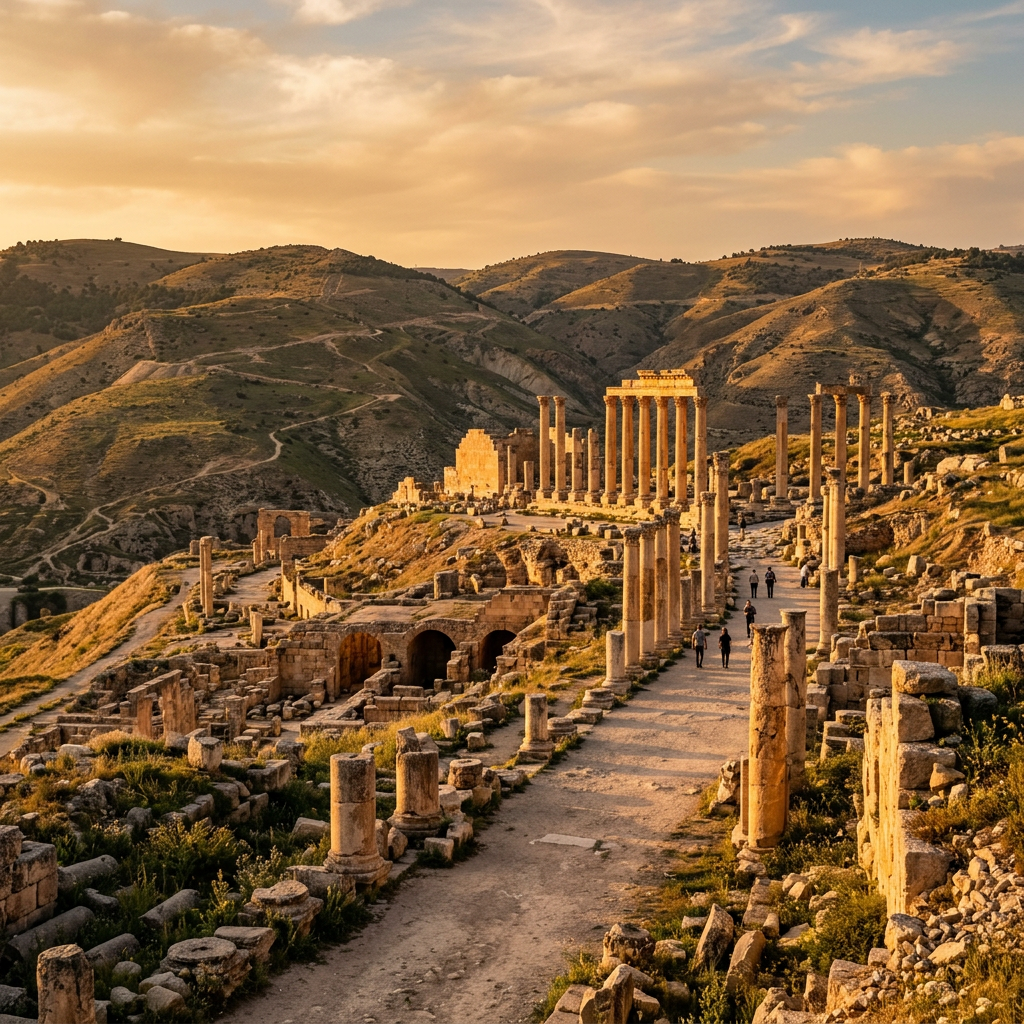
Nestled among the fertile hills of northern Jordan, Abila (Decapolis) was once one of the most prosperous cities in the famous Decapolis—a league of Greco-Roman cities that flourished throughout the eastern Roman Empire.
Although overshadowed today by better-known archaeological sites such as Jerash and Umm Qais, Abila possesses a remarkable history spanning over 6,000 years.
From Bronze Age settlements and Hellenistic expansion to Roman prosperity and Byzantine Christianity, Abila witnessed some of the most important civilizations of the ancient Near East.
Today, archaeologists continue to uncover temples, churches, theaters, tombs, and sophisticated water systems that reveal the city’s impressive past. Excavations show continuous occupation from around 4000 BCE until approximately 1500 CE, making it one of Jordan’s longest-inhabited archaeological sites.
Where Was Abila Located?
Abila lies in modern-day northern Jordan near the village of Quwaylibah, roughly 13 kilometers northeast of Irbid and just south of the Yarmouk River. The ancient city occupied two natural hills—Tell Abila and Tell Umm al-Amad—connected by a saddle-shaped valley.
Unlike many ancient settlements built on artificial mounds, Abila developed across natural limestone hills surrounded by fertile farmland and abundant springs. This strategic setting provided fresh water, rich agricultural land, and natural defenses, helping the city prosper for thousands of years.
What Was the Decapolis?
The Decapolis was a federation of Greco-Roman cities established in the eastern Mediterranean after the conquests of Alexander the Great. Although the name means “Ten Cities,” membership evolved over time, and ancient writers sometimes listed different cities.
The Decapolis became an important cultural bridge between Greek civilization and the indigenous Semitic populations of the Levant. Its cities featured Roman roads, theaters, temples, baths, marketplaces, and public forums while maintaining local traditions and religious practices.
Abila ranked among these influential urban centers alongside cities such as Gerasa (Jerash), Gadara (Umm Qais), Philadelphia (Amman), Scythopolis, and Pella.
Early History of Abila
Archaeological evidence indicates that people first settled in Abila during the Neolithic and Bronze Ages. Excavations have uncovered pottery, fortification walls, domestic structures, and tools dating back to approximately 4000 BCE.
Some scholars believe Abila may even appear in the 14th-century BCE Amarna Letters under a similar name, suggesting that it participated in the diplomatic and political networks of the ancient Near East.
During the Iron Age, residents constructed defensive walls that protected the growing settlement. These fortifications were later expanded under Hellenistic and Roman rule, reflecting the city’s increasing importance.

Abila During the Hellenistic Period
Following Alexander the Great’s campaigns, Greek influence spread rapidly throughout the region. Abila became part of the Hellenistic world and was, for a time, known as Seleucia.
Ancient historians Polybius and Josephus record that the Seleucid ruler Antiochus III captured the city during his military campaigns in 218 BCE. Later, the Hasmonean king Alexander Jannaeus expanded into the region, briefly bringing Abila under Jewish control before Roman intervention reshaped the political landscape.
Greek culture influenced the city’s architecture, language, coinage, administration, and public institutions.
Roman Prosperity and Membership in the Decapolis
Abila entered a new era after Pompey reorganized the region in 63 BCE. The city gained considerable autonomy and became one of the thriving cities associated with the Decapolis.
During the Roman period, Abila experienced remarkable urban development. Public buildings, temples, colonnaded streets, theaters, bath complexes, and sophisticated water systems transformed the city into a prosperous commercial center.
Archaeological excavations have uncovered:
- Roman temples
- A large theater
- Aqueducts
- Nymphaeum (public fountain)
- Pottery workshops
- Glass manufacturing facilities
- Olive oil presses
- Wine presses
- Rock-cut tombs
- Defensive city walls
The discovery of extensive pottery kilns and glass production workshops suggests that Abila was also an important manufacturing center supplying goods throughout the region. Coins minted under Roman rule demonstrate its economic vitality and regional influence.
Religion in Ancient Abila
Religion played a central role in Abila’s development.
During the Greco-Roman period, residents worshipped several deities, including Heracles, Athena, Tyche, and local gods that blended Greek and Near Eastern religious traditions.
Excavated temples, inscriptions, sculptures, and coins illustrate this rich religious diversity. The fusion of local beliefs with Hellenistic traditions reflects the broader cultural interaction that characterized the Decapolis.
As Christianity spread across the Roman Empire, Abila gradually transformed into an important Christian center.

Abila in the Byzantine Era
The Byzantine period marked another golden age for Abila.
Numerous churches were constructed across the city, several decorated with impressive mosaics and elaborate architectural details. Archaeologists have identified multiple basilicas, chapels, and ecclesiastical buildings that demonstrate Abila’s importance as a regional Christian community.
Religious activity continued well into the early Islamic period, illustrating the city’s cultural continuity despite political changes.
Decline of the City
Like many ancient cities in the Levant, Abila faced repeated natural disasters and political upheaval.
Historical evidence suggests that earthquakes during the 7th and 8th centuries caused widespread destruction. The Persian invasions, followed by changing trade routes and shifting political power under the early Islamic caliphates, further contributed to the city’s decline.
Although parts of Abila remained occupied during the Umayyad, Abbasid, Fatimid, Ayyubid, and Mamluk periods, its urban importance gradually diminished.
By around 1500 CE, the ancient city had largely been abandoned.
Archaeological Discoveries
Modern archaeological investigations began in earnest during the late twentieth century.
Since 1980, international teams have excavated portions of the city, revealing remarkable insights into everyday life across several millennia.
Important discoveries include:
- Roman roads
- Painted tombs
- Byzantine churches
- Aqueducts
- Residential neighborhoods
- Ancient fortification walls
- Pottery workshops
- Glass furnaces
- Agricultural installations
- Public buildings
Researchers believe that much of Abila remains buried beneath the surrounding landscape, meaning future excavations may reveal even more about the city’s history.
Why Abila Matters Today
Although less famous than Petra or Jerash, Abila offers archaeologists an exceptional opportunity to study long-term urban development in the ancient Near East.
Its uninterrupted occupation across multiple civilizations provides valuable evidence for understanding:
- Urban planning
- Roman provincial administration
- Religious transformation
- Byzantine Christianity
- Ancient trade networks
- Agricultural production
- Water management
- Daily life in the Decapolis
Because much of the city remains unexcavated, Abila continues to be one of Jordan’s most promising archaeological sites.
Visiting Abila
Abila is located in Jordan’s Irbid Governorate and remains relatively quiet compared with the country’s more famous archaeological attractions.
Visitors can explore scattered Roman columns, church remains, ancient walls, tombs, and the surrounding valleys. The peaceful landscape provides a unique opportunity to experience an important historical site without the crowds found at larger tourist destinations.
As archaeological research continues, conservation efforts aim to preserve the city’s monuments while increasing public awareness of its historical significance.

Conclusion
Abila (Decapolis) stands as one of Jordan’s most remarkable yet underappreciated archaeological treasures. Over thousands of years, the city evolved from a Bronze Age settlement into a flourishing member of the Decapolis, a prosperous Roman city, and later an influential Byzantine Christian center.
Its temples, theaters, churches, workshops, and defensive walls reveal a vibrant urban community shaped by Greek, Roman, Byzantine, and Islamic civilizations. Continuing archaeological work promises to uncover even more about this extraordinary city, helping historians better understand the cultural and political landscape of the ancient Levant.
For history enthusiasts, biblical scholars, and travelers interested in Jordan’s rich heritage, Abila remains a fascinating destination that deserves far greater recognition.
Fortisetliber’s View
History often remembers the grand capitals and imperial cities, but civilizations are equally defined by the places that quietly connected cultures, ideas, and people. Abila of the Decapolis is one of those places.
Situated in the fertile hills of northern Jordan, Abila never achieved the fame of Petra or Jerash, yet it played a significant role in the Greco-Roman world. For centuries, it stood at the crossroads of Hellenistic, Roman, Byzantine, and early Islamic civilizations, demonstrating that cultural exchange—not isolation—has long shaped the Middle East.
The ruins of Abila remind us that prosperity depends on more than military power. Its theaters, churches, workshops, aqueducts, and marketplaces reveal a society built on commerce, engineering, education, and religious life. These are the enduring foundations of civilization, far more lasting than the ambitions of individual rulers.
Abila also illustrates an important historical truth: civilizations are rarely static. Greek culture blended with local traditions, Roman administration encouraged urban development, Christianity reshaped public life, and later Islamic governance inherited many aspects of the existing landscape. Rather than erasing the past completely, successive generations adapted and built upon it.
Today, Abila receives only a fraction of the visitors drawn to Jordan’s better-known archaeological sites. Yet its relative obscurity is part of its appeal. It offers an opportunity to appreciate history without spectacle, encouraging reflection on how countless communities contributed to the broader story of human civilization.
From a FortisLiber perspective, Abila is more than an archaeological site—it is a reminder that the strength of civilizations lies in their ability to preserve knowledge, foster trade, encourage innovation, and adapt to changing circumstances. Great societies are not remembered solely for conquest, but for what they leave behind: architecture, ideas, institutions, and a cultural legacy that continues to inspire long after their political power has faded.
In preserving places like Abila, we preserve more than ancient stones. We safeguard the collective memory of humanity and the lessons that every civilization, large or small, has to offer.
Leave a Reply