
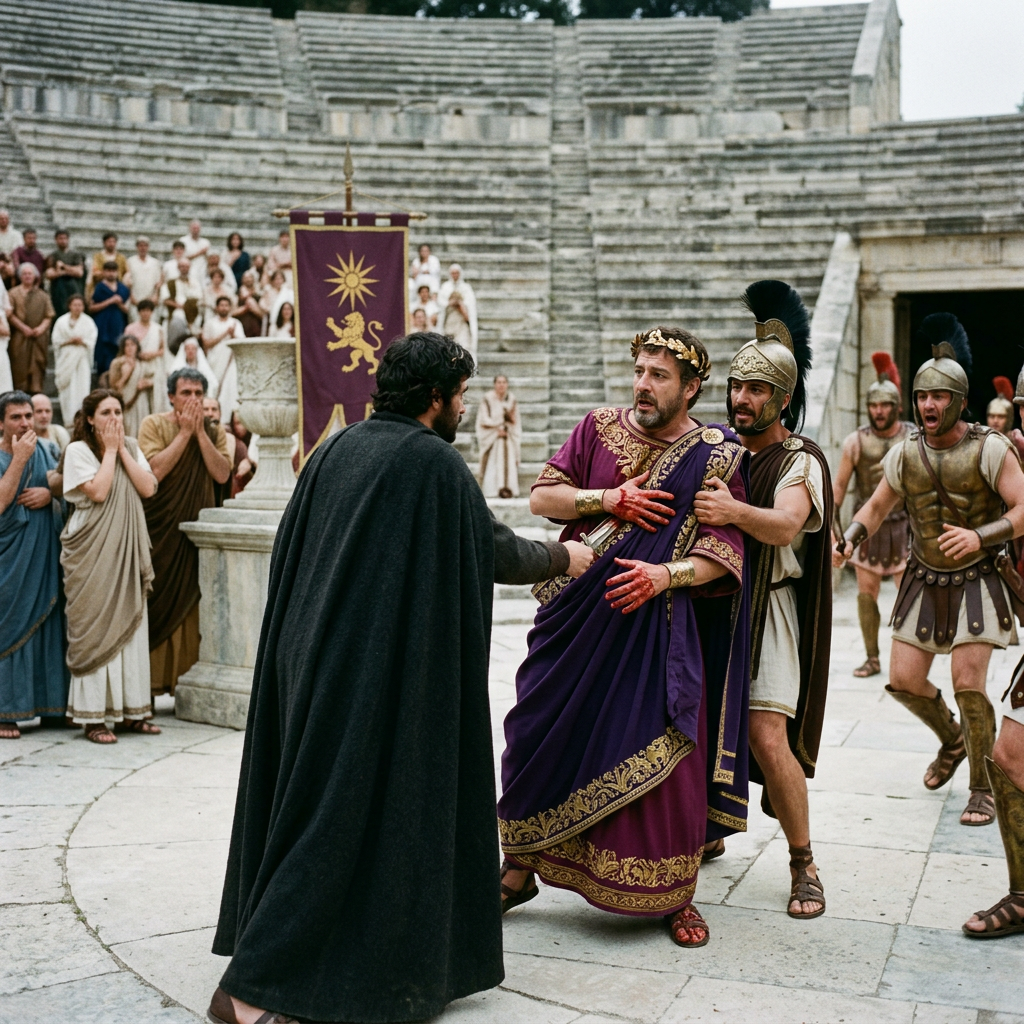
The assassination of King Philip II of Macedon remains one of the most consequential political murders in ancient history. On a celebratory day in 336 BCE, Philip entered the theater at Aegae, surrounded by nobles, diplomats, and members of the royal court. Moments later, one of his own trusted bodyguards, Pausanias of Orestis, rushed forward and stabbed the king to death.
Philip’s murder instantly transformed the ancient world. Within hours, the ruler who had united Greece and prepared an unprecedented invasion of the Persian Empire was dead. Within months, his twenty-year-old son, **Alexander III—better known as Alexander the Great—**had secured the throne. Less than a decade later, Alexander would conquer the largest empire the world had yet seen.
But why did Philip II die? Was the assassination motivated by personal revenge, political conspiracy, dynastic rivalry, or a combination of all three? More than 2,300 years later, historians continue to debate these questions.
This article explores the events leading to Philip II’s assassination, the role of Pausanias, competing conspiracy theories, and the lasting consequences of one of history’s most influential murders.
Who Was King Philip II of Macedon?
Before examining the assassination itself, it’s important to understand Philip’s extraordinary achievements.
Ascending to the Macedonian throne in 359 BCE, Philip inherited a kingdom threatened by foreign enemies and internal instability. Through military innovation, diplomatic marriages, and political reform, he transformed Macedon into the dominant power in Greece.
Among his greatest accomplishments were:
- Reforming the Macedonian army.
- Developing the famous Macedonian phalanx.
- Expanding Macedonian territory.
- Defeating the combined forces of Athens and Thebes at the Battle of Chaeronea in 338 BCE.
- Establishing the League of Corinth to unite the Greek city-states under his leadership.
By 336 BCE, Philip was preparing an ambitious campaign against the Persian Empire, a project that would later be completed by his son Alexander.
The Wedding at Aegae
Philip’s assassination occurred during what should have been a joyous occasion.
The royal capital of Aegae hosted the wedding celebrations of Philip’s daughter, Cleopatra, who was marrying Alexander I of Epirus. Kings, ambassadors, generals, and representatives from across Greece gathered to witness the event.
Ancient sources describe Philip entering the theater without his bodyguards immediately surrounding him. Confident in his popularity and eager to display his authority, he walked ahead of his escort before the assembled crowd.
This decision proved fatal.

Who Was Pausanias of Orestis?
Pausanias was no ordinary citizen.
He belonged to Philip’s elite corps of royal bodyguards, known as the Somatophylakes. These men were among the king’s closest companions, trusted with protecting his life and enjoying exceptional access to the royal court.
The fact that Pausanias served in this prestigious position made the assassination even more shocking. Rather than an external enemy, Philip was killed by someone entrusted with his personal safety.
The Personal Grievance
According to the ancient historian Diodorus Siculus, the assassination began with a bitter personal feud.
Confusingly, there were two men named Pausanias connected to Philip’s court.
The bodyguard reportedly insulted another Pausanias, who was associated with the powerful Macedonian noble Attalus. The insult questioned the man’s courage and honor.
The second Pausanias later died heroically in battle while protecting Philip.
Seeking revenge, Attalus allegedly devised a brutal punishment.
According to Diodorus, Attalus invited Philip’s bodyguard to a banquet, encouraged excessive drinking, and then handed him over to a group of attendants who sexually assaulted him. The attack was intended not merely as physical violence but as public humiliation, permanently damaging Pausanias’s honor within Macedonian aristocratic society.
Philip’s Failure to Deliver Justice
After surviving the assault, Pausanias appealed directly to King Philip.
Ancient writers claim Philip sympathized with his bodyguard but declined to punish Attalus.
Several reasons have been suggested:
- Attalus had become one of Philip’s most influential generals.
- Philip had recently married Attalus’ niece, Cleopatra Eurydice.
- Punishing Attalus risked weakening political alliances before the Persian campaign.
Instead, Philip reportedly promoted Pausanias within the royal guard.
For Pausanias, however, promotion was no substitute for justice.
Many ancient historians present this failure as the principal motive behind the assassination.
The Assassination of Philip II
On the day of the wedding celebration, Pausanias positioned himself along Philip’s route into the theater.
As the king walked past the assembled guests, Pausanias rushed forward and stabbed him with a dagger.
Philip collapsed and died almost immediately.
The assassin attempted to flee toward waiting horses, suggesting he may have planned an escape.
However, ancient accounts state that Pausanias stumbled—possibly tripping over a vine or uneven ground—and was quickly overtaken by fellow bodyguards.
Before he could be interrogated, he was killed.
His immediate death permanently prevented investigators from determining whether he acted alone.

Was There a Political Conspiracy?
The mystery surrounding Philip’s assassination has fascinated historians for centuries.
Because Pausanias died before questioning, numerous conspiracy theories emerged.
Olympias
One of the leading suspects is Olympias, Philip’s former wife and Alexander’s mother.
Relations between Philip and Olympias had deteriorated after Philip married Cleopatra Eurydice, raising fears that any future son from the new marriage might replace Alexander as heir.
Ancient writers report that Olympias honored Pausanias after the assassination and may even have placed a crown upon his grave.
Some later historians interpreted these actions as evidence of prior involvement.
However, no surviving source provides definitive proof that she organized the murder.
Alexander the Great
Some ancient authors also suspected Alexander.
At the time of Philip’s death, Alexander’s succession appeared less secure than before. Philip’s new marriage threatened to produce another legitimate male heir.
Despite occasional tensions between father and son, modern historians generally reject the theory that Alexander participated directly in the assassination.
No contemporary evidence conclusively links him to the crime.
Instead, most scholars believe Alexander simply benefited from events he did not orchestrate.
Persian Involvement
Another theory suggests agents of the Persian Empire orchestrated Philip’s murder.
Philip was preparing a massive invasion of Persian territory.
Eliminating him before the campaign began would have served Persian interests.
Despite this apparent motive, ancient evidence supporting Persian involvement is extremely limited, and most historians regard the theory as speculative.
Ancient Sources
Much of what historians know comes from writers who lived centuries after the assassination.
Important sources include:
- Diodorus Siculus
- Plutarch
- Justin
- Aristotle
Diodorus provides the most detailed account of Pausanias’ grievance and the assault that preceded the murder.
Because these authors wrote long after the events occurred, historians compare their narratives carefully and remain cautious about accepting every detail.
Why Historians Still Debate the Motive
The assassination combined several factors rarely found together:
- Personal humiliation
- Court politics
- Dynastic succession
- Military ambition
- International diplomacy
Pausanias clearly possessed a personal grievance according to multiple ancient accounts.
Yet Philip’s death also benefited several powerful political figures.
This overlap makes it difficult to determine whether Pausanias acted entirely alone or whether others quietly encouraged his actions.
The absence of direct evidence ensures the debate continues.
The Immediate Aftermath
Philip’s assassination created a dangerous power vacuum.
Potential rivals could have plunged Macedon into civil war.
Instead, Alexander moved with remarkable speed.
Within days he secured the support of the Macedonian army.
Potential rivals were eliminated.
Greek rebellions were suppressed.
Within two years, Alexander crossed into Asia to begin the conquest his father had planned.
Ironically, Philip’s murder accelerated the rise of one of history’s greatest military commanders.

Why Philip II’s Assassination Changed History
Few assassinations have altered world history so dramatically.
Had Philip lived, he likely would have led the invasion of Persia himself.
Alexander may never have become “Alexander the Great.”
The Hellenistic kingdoms that spread Greek culture across Egypt, the Near East, and Central Asia might never have emerged in the same form.
The assassination therefore reshaped politics, warfare, language, philosophy, and culture across three continents.
One man’s act of violence transformed the ancient world.
Frequently Asked Questions
Who assassinated King Philip II of Macedon?
King Philip II was assassinated in 336 BCE by Pausanias of Orestis, one of his own royal bodyguards.
Why did Pausanias kill Philip II?
Ancient sources state that Pausanias sought revenge after Philip failed to punish Attalus for orchestrating a brutal sexual assault against him. Some historians also believe political conspiracies may have influenced the assassination.
Did Alexander the Great kill Philip II?
There is no conclusive evidence that Alexander participated in his father’s assassination. Most modern historians consider the claim unproven.
Where was Philip II assassinated?
Philip II was murdered at the theater in Aegae, the ancient ceremonial capital of Macedon, during the wedding celebrations of his daughter Cleopatra.
Why is Philip II’s assassination important?
The assassination brought Alexander the Great to the throne, enabling the conquest of the Persian Empire and permanently changing the course of world history.
Conclusion
The assassination of King Philip II of Macedon remains one of antiquity’s greatest mysteries. Ancient sources consistently identify Pausanias as the killer and describe a deeply personal grievance rooted in humiliation and Philip’s failure to provide justice. Yet the turbulent politics of the Macedonian court, dynastic rivalries, and the ambitions of powerful figures such as Olympias have ensured that questions of conspiracy persist.
Although historians may never know whether Pausanias acted entirely alone, the consequences of his actions are unmistakable. Philip’s death elevated Alexander the Great to the throne, launched one of history’s greatest military campaigns, and reshaped the political and cultural landscape of the ancient world.
Fortisetliber’s View
Philip II conquered kingdoms but may have overlooked the danger closest to him. Ancient sources suggest that after his bodyguard, Pausanias, suffered a brutal assault, the king failed to bring the perpetrators to justice.
Whether that grievance alone led to Philip’s assassination remains debated, but the lesson endures.
History repeatedly shows that leaders who ignore injustice within their own ranks often create greater threats than any external enemy.
Armies can defend borders, but they cannot compensate for a loss of trust at the heart of power.
Philip built the Macedonian Empire. Yet his reign ended not on the battlefield, but at the hands of one of his own guards.
It is a reminder that a state’s greatest vulnerabilities often come from within—and that justice is not merely a moral virtue, but a pillar of stable leadership.
Leave a Reply