
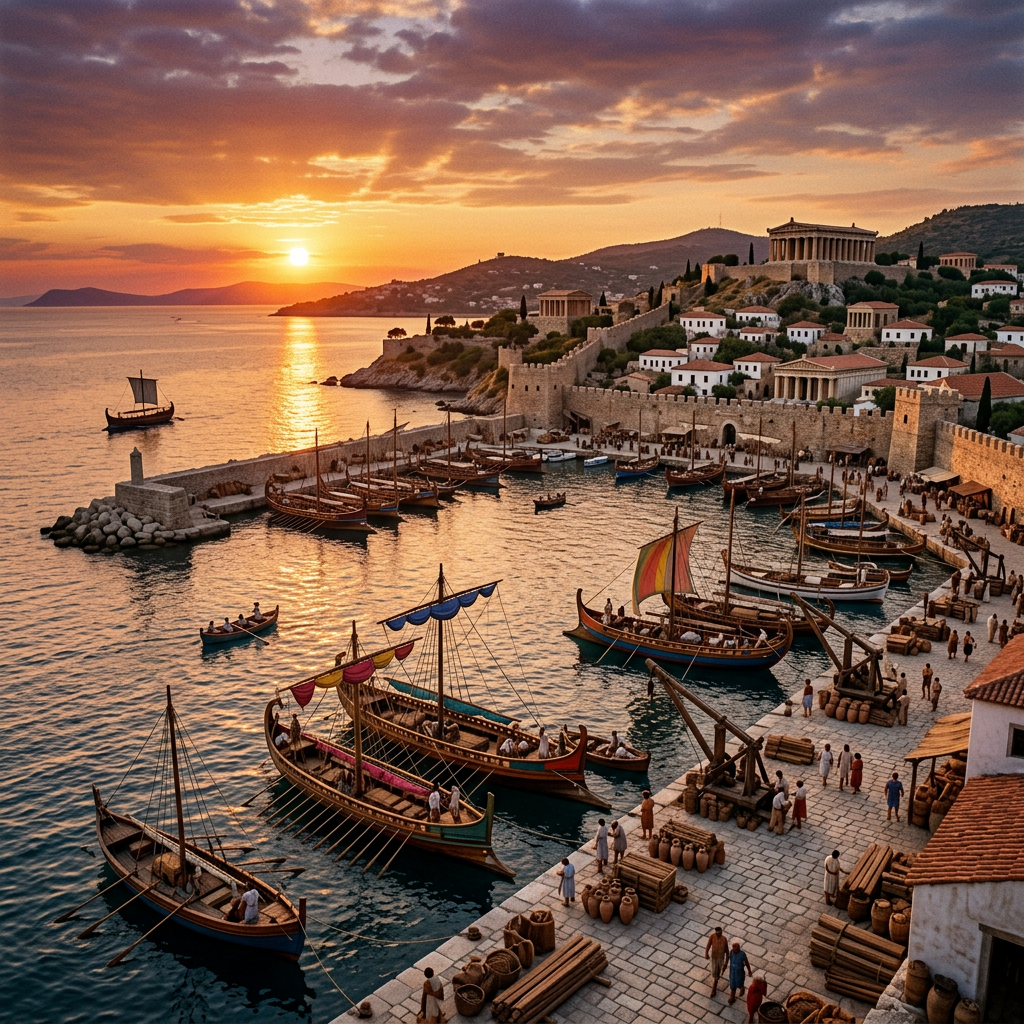
The ancient city of Abdera was one of the most important Greek colonies on the coast of Thrace, renowned for its strategic location, thriving economy, and remarkable intellectual legacy. Best known as the birthplace of the philosophers Democritus and Protagoras, Abdera flourished as a center of commerce and culture for centuries, playing a significant role in the political and economic history of the northern Aegean.
Situated in what is now northeastern Greece, Abdera served as a gateway between the Greek world and the Thracian interior. Its fertile surroundings, access to maritime trade routes, and multicultural population enabled the city to prosper despite periods of warfare and political upheaval.
Today, the archaeological remains of Abdera offer visitors a fascinating glimpse into a city that helped shape classical philosophy while standing at the crossroads of civilizations.
Where Was Abdera Located?
Abdera was located on the northern coast of the Aegean Sea in present-day Xanthi Regional Unit, eastern Macedonia and Thrace, Greece.
Its position near the mouth of the Nestos River gave the city several strategic advantages:
- Access to fertile agricultural land.
- A natural harbor for maritime trade.
- Connections with inland Thrace.
- Control of important commercial routes linking the Aegean with the Balkans.
This favorable location transformed Abdera into one of the wealthiest Greek colonies in northern Greece.
The Founding of Abdera
According to ancient tradition, Abdera was first established during the seventh century BC by settlers from Clazomenae in Ionia. This early colony struggled to survive and was eventually abandoned.
A second and more successful foundation took place around 545 BC, when refugees from the Ionian city of Teos fled the expanding Achaemenid Persian Empire under Cyrus the Great. Rather than submit to Persian rule, the Teians crossed the Aegean and rebuilt Abdera, laying the foundations for the prosperous city that would flourish during the Classical period.
The city’s name is linked in Greek mythology to Abderus, a companion of Heracles, who was said to have been killed by the man-eating horses of Diomedes. In his honor, Heracles was believed to have founded the city, giving Abdera both historical and legendary significance.
Abdera During the Persian Wars
Abdera occupied an important position during the Greco-Persian Wars.
In 480 BC, the forces of Xerxes I passed through the region during their invasion of Greece. Ancient sources indicate that the Persian king was welcomed by the inhabitants, likely reflecting the political realities faced by Greek cities under Persian influence.
Following the Persian defeat, Abdera joined the Delian League, the alliance led by Athens. Membership brought economic opportunities through maritime trade while also drawing the city into the political rivalries of the Greek world.
Its tribute payments recorded by Athens demonstrate that Abdera had become one of the wealthier cities in the northern Aegean.

A Center of Trade and Prosperity
Abdera’s prosperity rested upon its strategic location and commercial activity.
The city exported:
- Grain
- Wine
- Olive oil
- Timber
- Livestock
- Fish products
Its merchants traded extensively throughout the Aegean and the eastern Mediterranean.
The fertile plains surrounding Abdera supported intensive agriculture, while its harbor connected local producers with international markets.
Archaeological discoveries of imported pottery, amphorae, and coins illustrate the city’s participation in a wide-ranging commercial network stretching from mainland Greece to Asia Minor and beyond.
The Birthplace of Great Philosophers
Abdera’s greatest claim to fame is undoubtedly its contribution to ancient philosophy.
Democritus
The philosopher Democritus (c. 460–370 BC) was born in Abdera and became one of antiquity’s most influential thinkers.
Known as the “Laughing Philosopher,” Democritus developed the atomic theory, proposing that all matter consists of tiny, indivisible particles called atoms moving through empty space.
Although his ideas were philosophical rather than scientific by modern standards, they anticipated concepts that would not be confirmed until more than two millennia later.
Protagoras
Another celebrated native was Protagoras, one of ancient Greece’s leading Sophists.
His famous statement—
“Man is the measure of all things.”
—became one of the defining ideas of Greek philosophy.
Protagoras influenced education, rhetoric, ethics, and political thought throughout the Classical world.
The fact that two of Greece’s greatest intellectuals came from Abdera highlights the city’s vibrant cultural environment.
Urban Life in Abdera
Excavations reveal that Abdera was a well-planned Greek city.
Its features included:
- Defensive walls.
- A carefully organized street grid.
- Public squares (agora).
- Temples.
- Residential neighborhoods.
- Workshops.
- Cemeteries.
The city’s architecture reflects both Greek urban planning and local Thracian influences.
Public buildings demonstrate the wealth generated through trade, while private homes reveal a comfortable standard of living for many residents.
Religion and Culture
Like most Greek cities, Abdera worshipped the Olympian gods.
Evidence points to the veneration of:
- Apollo
- Athena
- Dionysus
- Artemis
- Demeter
Local Thracian religious traditions also influenced civic life, illustrating the cultural interaction between Greek settlers and indigenous populations.
Festivals, athletic competitions, and theatrical performances formed an essential part of community life.

Abdera During the Hellenistic and Roman Periods
After the rise of Alexander the Great, Abdera became part of the Hellenistic kingdoms that succeeded his empire.
Although political control changed several times, the city remained an important regional center.
Under Roman rule, Abdera continued to function as a prosperous provincial town.
Roman administration improved roads and trade while preserving many aspects of Greek civic life.
Over time, however, changes in trade routes, natural silting of the harbor, and repeated invasions contributed to the city’s gradual decline.
By the Byzantine period, much of the ancient city had been abandoned.
Archaeological Discoveries
Modern excavations have uncovered extensive remains that illuminate the city’s history.
Among the most important discoveries are:
- Fortification walls.
- Residential houses.
- Public buildings.
- Streets.
- Ceramic workshops.
- Coins.
- Sculptures.
- Funerary monuments.
The nearby Archaeological Museum of Abdera preserves many of these finds, offering visitors an excellent introduction to the city’s long history.
Artifacts reveal both local craftsmanship and imported luxury goods, reflecting Abdera’s role in Mediterranean commerce.
Visiting Abdera Today
Today, the archaeological site of Abdera is one of northern Greece’s most rewarding historical destinations.
Visitors can explore:
- Ancient city walls.
- Residential quarters.
- Sections of the street network.
- Necropolis.
- Archaeological Museum.
The peaceful setting allows travelers to appreciate the city’s historical importance while enjoying the natural beauty of the Thracian coast.
Abdera also serves as an excellent base for exploring the wider region of eastern Macedonia and Thrace.
Legacy of Abdera
Abdera’s influence extends far beyond its physical remains.
Its legacy includes:
- The birthplace of Democritus.
- The home of Protagoras.
- A major Greek trading center.
- A bridge between Greek and Thracian cultures.
- An important member of the Delian League.
- A thriving city that endured for nearly a millennium.
Its philosophical heritage alone secures Abdera a lasting place in world history.

Frequently Asked Questions
Where was Abdera located?
Abdera was situated on the northern Aegean coast in present-day northeastern Greece, within the Xanthi Regional Unit.
Who founded Abdera?
The successful colony was established around 545 BC by refugees from the Ionian city of Teos after fleeing Persian expansion.
Why is Abdera famous?
Abdera is best known as the birthplace of the philosophers Democritus and Protagoras and as an important commercial center in ancient Thrace.
Can you visit Abdera today?
Yes. Visitors can explore the archaeological site and the Archaeological Museum of Abdera, both of which preserve the city’s rich history.
Why was Abdera important?
Its strategic location, thriving trade, intellectual achievements, and role in regional politics made it one of the leading Greek cities of ancient Thrace.
Conclusion
Abdera stands as one of the most remarkable cities of the ancient Greek world.
Its prosperity was built on trade, its influence strengthened by strategic geography, and its reputation secured through the extraordinary achievements of its philosophers.
From the bustling harbor that connected the Aegean with Thrace to the ideas of Democritus and Protagoras that continue to shape philosophical thought, Abdera left a legacy far greater than its size might suggest.
Today, its archaeological remains and museum preserve the memory of a city where commerce, culture, and intellectual curiosity flourished side by side.
For anyone interested in ancient Greece, philosophy, or the history of the northern Aegean, Abdera remains a destination—and a story—well worth discovering.
Fortisetliber’s View
Ancient Abdera reminds us that a city’s greatest legacy is not always measured by its armies or its monuments, but by the ideas it leaves behind.
While its walls have weathered the passage of time, the intellectual contributions of Democritus and Protagoras continue to influence philosophy, science, and critical thought more than two thousand years later.
Abdera thrived because it embraced exchange—of goods, cultures, and ideas. Positioned between the Greek world and Thrace, it became a place where different traditions met and innovation flourished.
Its story demonstrates that prosperity is often built not only through commerce but also through curiosity and openness to new perspectives.
For modern readers, Abdera offers a timeless lesson: civilizations achieve their greatest victories when they invest in knowledge as much as power.
Empires may rise and fall, but ideas have the remarkable ability to cross borders, outlast generations, and continue shaping the future long after the stones of a city have crumbled.
Leave a Reply