
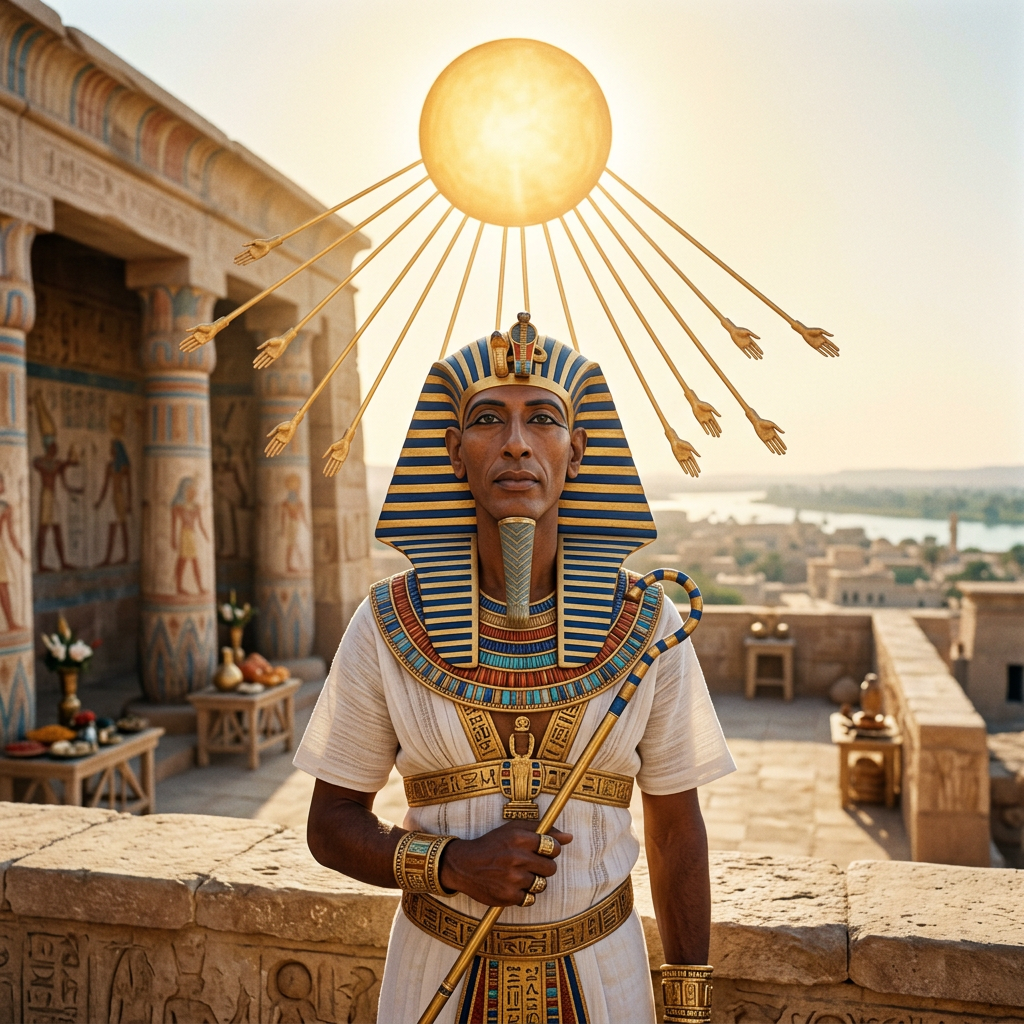
Introduction: The King Who Challenged the Gods
For more than a thousand years, the civilization of Ancient Egypt had been built upon an unshakable religious foundation.
Hundreds of gods governed every aspect of life.
Magnificent temples honored powerful deities such as Amun, Ra, Osiris, Isis, and Horus.
The pharaoh served as the divine bridge between humanity and the gods, preserving Ma’at—the sacred balance that maintained order throughout the universe.
Then, in the 14th century BCE, one ruler attempted the unimaginable.
He challenged the authority of Egypt’s most powerful priesthood, abandoned centuries of religious tradition, founded an entirely new capital city, transformed Egyptian art, and proclaimed that a single deity—the radiant Aten, represented by the life-giving sun disk—should stand above all others.
That ruler was Akhenaten.
Revered by some as history’s first great religious reformer and criticized by others as a visionary whose policies weakened Egypt, Akhenaten remains one of the most fascinating and controversial figures of the ancient world.
His reign, lasting from 1353 to 1336 BCE, reshaped Egypt in ways unmatched by almost any other pharaoh.
Egypt at the Height of the New Kingdom
When Akhenaten ascended the throne, Egypt stood among the greatest powers of the ancient world.
The New Kingdom (c. 1550–1070 BCE) represented the golden age of Egyptian civilization.
Its armies controlled territories stretching into Nubia and the Levant.
Its wealth flowed from gold mines, international trade, tribute from conquered lands, and agricultural abundance along the Nile.
Akhenaten was born as Amenhotep IV, the son of the powerful Amenhotep III, whose reign had brought prosperity, monumental building projects, and diplomatic prestige.
Yet beneath this prosperity, another force had grown increasingly influential: the priesthood of Amun.
Centered at Thebes, the temples of Amun possessed immense wealth, extensive landholdings, and significant political power. In many respects, the high priests rivaled the authority of the pharaoh himself.
It was within this environment that the young Amenhotep IV inherited the throne—and began to envision a radically different Egypt.
The Rise of Aten
Early in his reign, Amenhotep IV displayed an unusual devotion to Aten, the visible disk of the sun.
Unlike traditional Egyptian gods, who were represented in human or animal forms, Aten was depicted as a radiant solar disk whose rays ended in human hands, symbolizing life and divine blessing.
At first, Aten existed alongside the traditional gods.
Gradually, however, the new king elevated Aten above every other deity.
Around the fifth year of his reign, Amenhotep IV took an extraordinary step.
He changed his royal name to Akhenaten, meaning “Effective for Aten” or “One Who Is Beneficial to Aten.”
This was more than a symbolic gesture.
It marked the beginning of one of history’s most remarkable religious revolutions.

A Religious Revolution Unlike Any Before
Akhenaten’s reforms challenged beliefs that had shaped Egyptian civilization for centuries.
The powerful temples of Amun were closed.
Their wealth was redirected.
The names of traditional gods began disappearing from monuments.
Official inscriptions increasingly emphasized Aten as the supreme divine force responsible for sustaining all life.
Although scholars continue to debate whether Akhenaten created the world’s first true monotheistic religion or promoted an extreme form of henotheism, there is little doubt that his policies fundamentally altered Egyptian religious practice.
The consequences reached every level of society.
Priests lost influence.
Traditional rituals disappeared from royal ceremonies.
The relationship between the king and the divine was redefined around Aten alone.
Akhetaten: The City of the Sun
Perhaps Akhenaten’s boldest decision was the construction of an entirely new capital.
Rather than ruling from Thebes, he ordered the creation of Akhetaten—modern Amarna—on a previously undeveloped stretch of the Nile.
The city’s name meant “Horizon of Aten.”
Built specifically to honor the sun god, Akhetaten differed dramatically from older Egyptian capitals.
Its temples were open to sunlight rather than enclosed in dark sanctuaries.
Its palaces emphasized natural light and spacious courtyards.
The city became the physical expression of Akhenaten’s revolutionary vision.
For little more than a decade, Akhetaten served as the religious and political heart of Egypt.
The Artistic Revolution of Amarna
Akhenaten transformed not only religion but also Egyptian art.
For centuries, pharaohs had been portrayed as eternally youthful, physically perfect, and emotionally distant.
The Amarna Period introduced an entirely new artistic style.
Royal family members appeared in intimate scenes.
Akhenaten was depicted with elongated facial features, narrow shoulders, wide hips, and a distinctive body unlike any earlier pharaoh.
Images showed him embracing Nefertiti and playing with his daughters beneath Aten’s rays.
This remarkable artistic realism remains one of the most recognizable features of his reign.

Nefertiti: The Queen Beside the Sun King
No discussion of Akhenaten is complete without mentioning his extraordinary queen, Nefertiti, one of the most iconic women of the ancient world.
Unlike previous Egyptian queens, Nefertiti occupied an unusually prominent role in royal art and religious ceremonies. She frequently appeared beside Akhenaten performing rituals dedicated to Aten, and in some depictions she is shown wearing the royal blue crown traditionally associated with kingship.
These images have led many historians to suggest that Nefertiti exercised considerable political influence and may even have acted as co-ruler during the later years of Akhenaten’s reign.
Together, Akhenaten and Nefertiti became the visible representatives of Aten on Earth, reinforcing the idea that divine authority flowed directly through the royal family.
A Kingdom Facing Growing Challenges
While Akhenaten devoted enormous energy to his religious reforms and the construction of Akhetaten, Egypt’s international position began to weaken.
The famous Amarna Letters—a remarkable collection of diplomatic tablets discovered at the ancient capital—reveal repeated pleas for military assistance from Egypt’s allies and vassal rulers across the Levant.
These documents suggest that local rulers struggled against expanding rivals, including the Hittite Empire, while appealing to the pharaoh for support.
Many historians believe Akhenaten focused far more on religious transformation than on maintaining Egypt’s traditional foreign policy.
Although debate continues regarding the extent of this decline, there is little doubt that Egypt’s influence abroad diminished during the final years of his reign.
The Fall of Atenism
When Akhenaten died around 1336 BCE, the future of his religious revolution quickly became uncertain.
The system he had created depended heavily upon his personal authority.
Without the king to sustain it, opposition emerged rapidly.
The priesthood of Amun, whose influence had been dramatically reduced during Akhenaten’s reign, gradually regained its former position.
Temples dedicated to the traditional gods reopened.
Religious ceremonies that had been abandoned returned.
Within only a few years, Egypt had begun moving back toward its ancient beliefs.
The city of Akhetaten was gradually abandoned, its monuments dismantled, and many of its stones reused in later construction projects.

Tutankhamun and the Restoration of the Old Gods
Among Akhenaten’s successors, none is more famous than Tutankhamun.
Originally named Tutankhaten, meaning “Living Image of Aten,” the young king changed his name to Tutankhamun, replacing Aten with Amun as Egypt officially restored its traditional religion.
Royal decrees condemned many of Akhenaten’s reforms.
The royal court returned to Thebes and Memphis, while official support for Aten rapidly disappeared.
Later Egyptian rulers went even further.
Akhenaten’s monuments were deliberately dismantled, his name was removed from king lists, and his memory was systematically erased in an effort to restore religious continuity.
For centuries, it was as though the “Heretic Pharaoh” had never ruled Egypt at all.
Rediscovering the Heretic Pharaoh
Modern archaeology transformed our understanding of Akhenaten.
The excavations at Amarna revealed an entirely different Egypt—one filled with open-air temples, elegant palaces, remarkable artworks, and detailed diplomatic archives.
Perhaps the greatest discovery connected to his family came in 1922, when Howard Carter uncovered the nearly intact tomb of Tutankhamun.
Although Akhenaten’s own tomb had been heavily damaged, the discovery of Tutankhamun’s burial renewed worldwide interest in the Amarna Period and inspired generations of research into the revolutionary pharaoh.
Today, Akhenaten remains one of the most studied rulers of the ancient world.
Akhenaten’s Legacy
Few rulers have inspired as much debate as Akhenaten.
To some scholars, he represents history’s first great advocate of religious monotheism.
Others argue that Atenism was not true monotheism but rather an exclusive royal cult centered on one supreme deity.
Regardless of interpretation, Akhenaten permanently changed the study of ancient Egypt.
His reign demonstrated that even one of history’s most conservative civilizations could experience profound ideological transformation.
His artistic revolution introduced unprecedented realism.
His religious reforms challenged traditions that had endured for centuries.
His capital at Akhetaten remains one of archaeology’s most important windows into New Kingdom Egypt.
Even though his revolution ultimately failed, its boldness continues to fascinate historians, archaeologists, theologians, and visitors alike.

Conclusion
The story of Akhenaten (1353–1336 BCE) is unlike that of any other Egyptian pharaoh.
Rather than expanding his empire through conquest, he sought to reshape Egypt through ideas. He challenged powerful priesthoods, transformed royal art, established a new capital, and placed the worship of Aten at the center of Egyptian life.
Although many of his reforms were reversed after his death, his reign remains one of the most remarkable episodes in ancient history.
Akhenaten proved that even the mightiest civilizations could be transformed by a single visionary ruler.
Whether remembered as a revolutionary, a reformer, or a controversial idealist, his influence continues to illuminate our understanding of Ancient Egypt, reminding us that the greatest revolutions are often those fought not with armies, but with beliefs.
More than three thousand years later, the sun of Aten still shines across the ruins of Amarna, carrying the memory of the pharaoh who dared to challenge eternity itself.
Fortisetliber’s View
Among the countless rulers of Ancient Egypt, few remain as fascinating and controversial as Akhenaten. While most pharaohs sought immortality through military conquest, monumental architecture, or dynastic power, Akhenaten attempted something far more ambitious—he sought to transform the spiritual identity of an entire civilization.
During his reign, the traditional pantheon of Egyptian gods gave way to the worship of Aten, the radiant sun disk that Akhenaten proclaimed as the supreme divine force. He abandoned the ancient religious centers, founded the new city of Akhetaten (Amarna), and introduced an artistic style unlike anything Egypt had seen before. Royal images became strikingly human, depicting moments of affection, family life, and devotion beneath the life-giving rays of the sun.
Yet every great revolution comes with resistance.
By challenging the powerful priesthood of Amun, Akhenaten disrupted a religious system that had guided Egypt for centuries. His reforms depended heavily on his personal authority, and after his death they were rapidly dismantled. Temples were restored, Aten’s cult faded, and later rulers sought to erase his memory from history, earning him the title of the “Heretic Pharaoh.”
From the perspective of FortisLiber, Akhenaten’s story is not one of simple success or failure. It is the story of a ruler who dared to question traditions that seemed unchangeable. Whether his vision represented true monotheism or an extraordinary form of royal religious reform, it demonstrated that even the most ancient civilizations were capable of profound change.
More than three thousand years later, the ruins of Amarna continue to speak of a king whose ideas outlived the city he built. Though his revolution was reversed, his reign remains one of the most remarkable experiments in political, religious, and artistic history.
Akhenaten reminds us that the greatest legacy of a ruler is not always measured by the empire he leaves behind, but by the questions he dares to ask—and by the courage to challenge a world that believes it cannot change.
Leave a Reply