
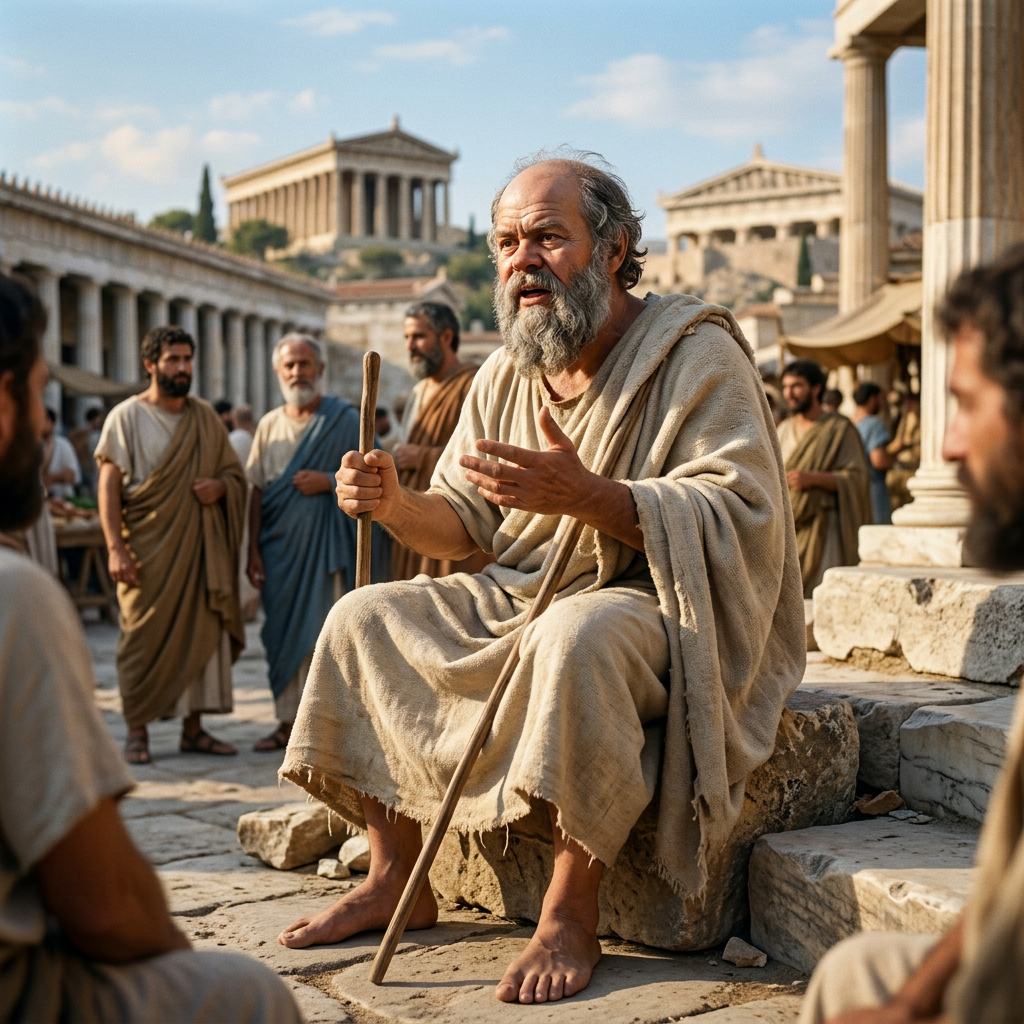
Few people have influenced human thought as profoundly as Socrates. He wrote no books, founded no formal school, and never claimed to possess all the answers. Yet more than 2,400 years after his death, he remains one of the most famous philosophers in history.
Born in Athens around 470 BC, Socrates spent his life asking questions about truth, morality, justice, knowledge, and the meaning of a good life. His approach to philosophy was simple but revolutionary: instead of accepting what people believed, he encouraged them to examine their beliefs.
The Socratic method, based on careful questioning and dialogue, remains influential in education, law, philosophy, and critical thinking.
But Socrates was more than a teacher of questions. His life and death created a powerful example of intellectual independence, courage, and commitment to one’s principles.
Who Was Socrates?
Socrates was born in Athens around 470 BC, during the height of ancient Greek civilization. Athens was a center of politics, art, drama, science, and philosophy.
Unlike many philosophers who came before him, Socrates was less interested in studying the physical universe and more interested in human beings.
He wanted to understand questions such as:
- What is justice?
- What is courage?
- What is virtue?
- What is knowledge?
- What makes a person good?
- How should we live?
Socrates believed that examining these questions was essential to living a meaningful life.
He famously associated wisdom with recognizing one’s own ignorance. Rather than pretending to know everything, he believed that recognizing what we do not know is the beginning of genuine understanding.
This attitude became one of the defining characteristics of Socrates’ philosophy.
Socrates and the Socratic Method
The most famous contribution of Socrates is the Socratic method.
Instead of giving lectures, Socrates engaged people in conversations. He would ask a series of questions designed to examine their beliefs.
Someone might claim to know what justice means. Socrates would ask for a definition. Then he would present another question or example that challenged that definition.
Eventually, the person might discover that their original belief contained contradictions.
The purpose was not simply to embarrass someone.
Socrates wanted people to think more carefully.
The Socratic method is still used today because it encourages critical thinking rather than passive learning. Teachers, lawyers, philosophers, and educators continue to use questioning as a way to help people examine assumptions and reach better conclusions.
The method also carries an important lesson:
A good question can sometimes be more valuable than an easy answer.

Socrates and the Search for Truth
Socrates believed that human beings should actively search for truth.
He was suspicious of people who claimed certainty without being able to explain why they believed something.
For him, philosophy was not simply an academic subject. It was a way of life.
A person should examine their beliefs, actions, desires, and values.
This is connected to one of the most famous ideas associated with Socrates: the importance of an examined life.
The basic principle is simple. If we never question ourselves, we may spend our entire lives following assumptions that we have never truly considered.
Socrates challenged his fellow Athenians to look inward.
What do you really know?
Why do you believe what you believe?
Are you living according to your principles?
These questions remain relevant thousands of years later.
Socrates and Morality
A major theme in Socrates’ philosophy was morality.
Socrates believed that being a good person was more important than possessing wealth, fame, political power, or social status.
He argued that people should focus on developing their character.
For Socrates, virtue was closely connected to knowledge. If a person genuinely understood what was good, he believed, they would have a stronger reason to act accordingly.
This idea became the foundation for many later discussions about ethics.
Socrates therefore shifted philosophical attention toward a question that remains central today:
What kind of person should we become?

Socrates and Plato
One of the most important relationships in ancient philosophy was that between Socrates and Plato.
Plato was a student of Socrates and later became one of the greatest philosophers in Western history.
Socrates himself left no written works. Much of what we know about his ideas comes from the writings of Plato and other ancient authors.
Plato presented Socrates as the central character in many philosophical dialogues.
This creates a historical challenge. It is difficult to know exactly which ideas belong to the historical Socrates and which were developed by Plato.
Nevertheless, the connection between the two is fundamental.
Socrates provided the inspiration.
Plato transformed that inspiration into a philosophical tradition.
Socrates and Ancient Athens
Socrates lived during a turbulent period in Athenian history.
Athens experienced war, political conflict, and changes in its democratic system. Socrates’ habit of questioning politicians, teachers, poets, and influential citizens made him a controversial figure.
He did not appear interested in making people comfortable.
He challenged those who believed they possessed wisdom and exposed weaknesses in their arguments.
For some Athenians, this made Socrates an important intellectual figure.
For others, it made him dangerous.
His reputation became especially complicated because some of his former associates became involved in controversial political movements.
Eventually, Socrates was brought to trial.

The Trial of Socrates
The trial of Socrates took place in Athens in 399 BC.
He was accused of two main offenses: corrupting the youth and failing to respect the city’s traditional religious beliefs.
Socrates defended himself rather than abandoning his philosophical principles.
According to Plato’s Apology, Socrates argued that his role was to encourage the people of Athens to examine their lives and beliefs.
He refused to simply stop philosophizing in order to save himself.
The trial ended with Socrates being found guilty and sentenced to death.
His death became one of the most famous events in the history of philosophy.
The Death of Socrates
Socrates was given the opportunity to escape before his execution, but he refused.
According to Plato’s Crito, his friends attempted to persuade him to leave Athens.
Socrates rejected the idea.
For him, living according to his principles was more important than preserving his life at any cost.
He ultimately accepted the sentence and drank poison made from hemlock.
The death of Socrates became a symbol of philosophical courage.
He did not die because he had conquered a kingdom or commanded an army.
He died because he refused to abandon the principles by which he had chosen to live.
Socrates’ Famous Quotes
Several statements associated with Socrates have survived through the writings of Plato and later traditions.
One of the most famous is:
“The unexamined life is not worth living.”
This statement captures the spirit of Socrates’ philosophy.
Another famous idea associated with him is the recognition of one’s own ignorance.
The precise wording of many quotations attributed to Socrates varies between translations and later sources, so readers should be cautious about quotes presented online as exact historical statements.
What matters most is the philosophical principle behind them: wisdom begins with intellectual humility.

Why Did Socrates Write Nothing?
One of the unusual things about Socrates is that he did not leave behind any books.
This is remarkable because many philosophers are remembered primarily through their writings.
Socrates preferred dialogue.
He believed philosophy was something people should practice together through conversation and questioning.
As a result, we encounter Socrates through the writings of others, particularly Plato.
This makes Socrates both fascinating and mysterious.
We know a great deal about the image of Socrates, but we can never be completely certain where the historical person ends and later interpretations begin.
Socrates’ Influence on Western Philosophy
The influence of Socrates is enormous.
His approach helped inspire Plato, who went on to develop one of the most influential philosophical systems in history.
Plato later influenced Aristotle, and through them the Socratic tradition became deeply connected to the development of Western philosophy.
Socrates also influenced later thinkers who emphasized ethics, rational inquiry, and the importance of examining one’s beliefs.
His legacy can be seen in modern education, where teachers use questioning to encourage students to think independently.
His influence can also be found in discussions about ethics, politics, law, psychology, and critical reasoning.
What Can Socrates Teach Us Today?
Despite living more than two thousand years ago, Socrates remains surprisingly relevant.
Modern society gives us access to an enormous amount of information. But having information does not necessarily mean having wisdom.
Socrates reminds us to ask:
How do we know what we think we know?
This question is especially important in an age of social media, artificial intelligence, political arguments, advertising, and constant streams of information.
It is easy to repeat something because everyone else is repeating it.
It is harder to stop and ask whether it is actually true.
The Socratic method teaches us to slow down, ask questions, examine evidence, and recognize the limits of our knowledge.
That is a valuable skill in any age.

The Legacy of Socrates
Socrates left behind no empire and no fortune.
His legacy was an idea.
He showed that philosophy could be a way of living rather than simply a subject of study.
He demonstrated that questioning authority can be intellectually valuable, that admitting ignorance can be a form of wisdom, and that personal integrity can matter more than comfort.
His influence continues through Plato, Aristotle, and the countless philosophers who followed them.
More importantly, his method survives whenever someone refuses to accept an assumption without examining it.
Every time a teacher asks a student to explain why they believe something, the spirit of Socrates is present.
Every time someone questions a popular opinion instead of simply following the crowd, Socrates is present.
And every time a person examines their own life and asks whether they are living according to their values, Socrates is present.
Conclusion
Socrates changed philosophy without writing a single book.
He changed it through conversation.
He asked questions that exposed assumptions, challenged conventional wisdom, and encouraged people to examine their lives.
His trial and death transformed him into a symbol of intellectual freedom and personal integrity.
For more than two thousand years, his example has reminded humanity that wisdom does not begin with believing we know everything.
It begins with the courage to admit that we may be wrong.
And perhaps that is why Socrates remains one of history’s greatest philosophers.
The questions he asked are still our questions.
Fortisetliber’s View
For FortisLiber, Socrates represents something greater than philosophy.
He represents intellectual courage.
Socrates did not possess armies, wealth, or political authority. His power came from something much simpler: the courage to ask questions.
He understood that the strongest person is not necessarily the one who can defeat others.
Sometimes strength means being able to stand alone.
Socrates challenged the comfortable beliefs of his society. He questioned people who considered themselves wise and forced them to examine what they believed.
That made him unpopular.
But he did not stop.
His death is perhaps the clearest expression of his philosophy.
When given the possibility of escaping his sentence, he chose to remain faithful to the principles he had spent his life defending.
For FortisLiber, this is where Socrates becomes more than an ancient philosopher.
He becomes an example of character.
In a world where popularity can be mistaken for truth and confidence can be mistaken for knowledge, Socrates reminds us of the value of humility.
We do not need to know everything.
But we should be willing to question what we think we know.
We should be willing to change our minds when evidence demands it.
And we should have the courage to defend what we genuinely believe is right.
Socrates’ greatest lesson may therefore be surprisingly simple:
Think for yourself. Question deeply. Live honestly.
More than two thousand years after his death, that lesson remains alive.
Leave a Reply