
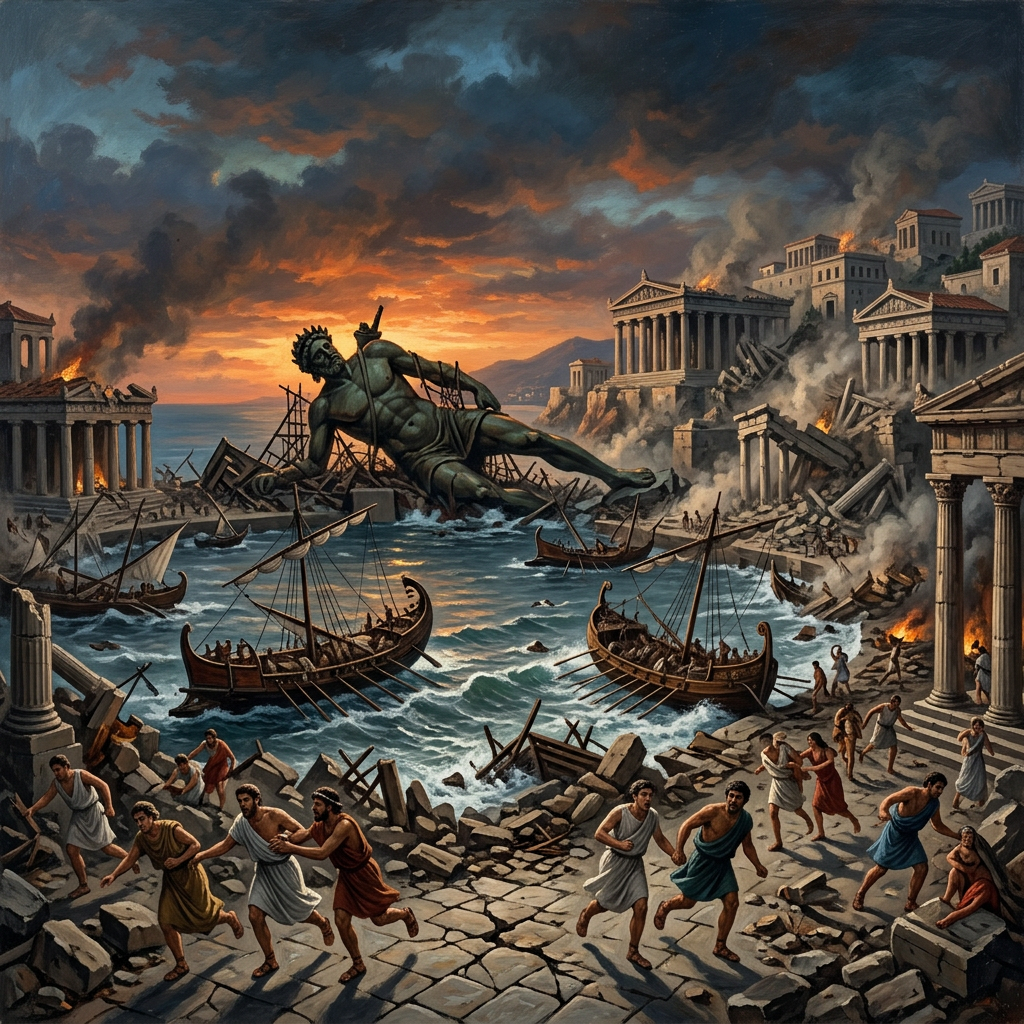
The 227 BC earthquake of Rhodes was one of the most devastating natural disasters to strike the ancient Greek world. In a matter of moments, a powerful earthquake damaged the prosperous city of Rhodes, destroyed sections of its walls and harbor facilities, and brought down the famous Colossus of Rhodes, one of the Seven Wonders of the Ancient World.
The catastrophe was particularly significant because Rhodes was not an insignificant island community. By the late third century BC, ancient Rhodes had become one of the most important maritime, commercial, and political centers of the Hellenistic Mediterranean. Its strategic position between the Aegean, Anatolia, Cyprus, Egypt, and the Levant had made it wealthy and influential.
The Rhodes earthquake of 227 BC therefore represented more than a natural disaster. It was a crisis for one of the Mediterranean’s great cities—and an extraordinary example of how an ancient society could recover from destruction through international diplomacy, wealth, and political cooperation.
Rhodes Before the Earthquake
To understand the impact of the 227 BC Rhodes earthquake, it is important to understand the city before disaster struck.
Rhodes had been founded in 408/407 BC through the synoecism of three older Rhodian cities: Lindos, Ialysos, and Kameiros. The new city was strategically positioned on the northern tip of the island and developed into a major naval and commercial power.
By the third century BC, Rhodes was famous for its powerful fleet, sophisticated harbor infrastructure, political institutions, and commercial connections throughout the eastern Mediterranean.
The city’s prosperity was closely connected to its maritime position. Ships arriving from Egypt, the Aegean, Anatolia, and the wider Mediterranean passed through Rhodian waters, while the island itself became renowned for its merchants, sailors, shipbuilders, and craftsmen.
This prosperity also helped create the cultural environment in which the Colossus of Rhodes was constructed.
The Colossus of Rhodes
The Colossus was a gigantic bronze statue dedicated to Helios, the sun god and principal deity of Rhodes.
The monument was created by the sculptor Chares of Lindos after Rhodes successfully resisted the siege of Demetrius I of Macedon around 305–304 BC. The Rhodians reportedly sold abandoned siege equipment and used the proceeds to finance the extraordinary statue.
Modern scholarship places the construction of the Colossus approximately between 295 and 283 BC. Oxford University Press describes it as approximately 34 meters high, although ancient measurements and modern reconstructions vary.
The Colossus became one of the most famous monuments of the Hellenistic world.
However, one popular image of the statue is almost certainly wrong.
The Colossus did not stand with its legs spread across the entrance to the harbor. Ancient literary evidence does not support this famous medieval and modern artistic image. Instead, the statue is generally thought to have stood somewhere within the city or harbor district, although its exact location remains uncertain.
Its importance, however, is beyond doubt.
The Colossus represented Rhodian independence, wealth, technological skill, and devotion to Helios.
And then came the earthquake.

The 227 BC Earthquake
The traditional date for the catastrophic earthquake is 227 BC, although ancient chronology and modern scholarship have produced some uncertainty over the exact year.
For decades, 227/226 BC was widely accepted as the date. A recent study published in Chiron has proposed 223/222 BC, based particularly on evidence from Eusebius’ Chronici Canones. The question remains an important example of how historical chronology can change when scholars reassess ancient evidence.
Regardless of the precise year, the event was devastating.
Ancient sources describe major destruction throughout Rhodes. According to the historical tradition, sections of the city walls, dockyards, and arsenals were thrown down. The earthquake also affected areas beyond Rhodes, including parts of southwestern Anatolia.
The disaster demonstrated the vulnerability of even the most prosperous ancient cities.
Buildings that represented generations of investment could be destroyed within seconds.
For the Rhodians, however, the most famous casualty was the Colossus.
The Fall of the Colossus
The enormous statue could not withstand the earthquake.
Its knees failed, sending the bronze giant crashing to the ground.
The collapse of the Colossus of Rhodes became one of the most famous stories of the ancient world.
Yet ancient writers emphasized something remarkable: even after falling, the statue remained an astonishing sight.
The fallen Colossus apparently remained at Rhodes for centuries. Ancient visitors could still see its enormous bronze fragments lying where the earthquake had brought it down.
The statue was never reconstructed.
According to the tradition preserved by ancient writers, an oracle was interpreted as a warning against rebuilding it. Whether this explanation reflects genuine religious belief, political decisions, or later storytelling is difficult to establish.
What is certain is that the Colossus of Rhodes was never restored to its original position.
Its destruction consequently became part of the monument’s identity.
The Colossus was famous not only because it had been built, but also because it had fallen.

A City in Ruins
The earthquake’s consequences extended far beyond one statue.
Rhodes had invested heavily in its maritime infrastructure. The harbor was fundamental to the city’s economy, and damage to the dockyards and naval facilities threatened both commerce and military power.
Archaeological research into the ancient harbor has provided additional evidence for seismic activity during this period. Studies of the Rhodian harbor have identified evidence suggesting that an earthquake caused significant subsidence in the ancient shipsheds, possibly by approximately one meter.
This is particularly important because it connects the literary descriptions of ancient authors with physical evidence preserved beneath and around the modern coastline.
The ancient Rhodes earthquake was therefore not simply a story transmitted by historians. Geological and archaeological research also reveals evidence of major seismic disturbances affecting the island.
The International Response
Perhaps the most remarkable part of the story came after the destruction.
Rhodes was wealthy, but even a wealthy city could struggle to rebuild after a catastrophe of this scale.
Help came from abroad.
Hellenistic rulers and other political powers contributed substantial financial assistance to the Rhodians. Cambridge University Press describes the recovery of Rhodes as being supported by an extraordinary level of international aid from Hellenistic kings.
This response reveals something important about the ancient Mediterranean.
The Hellenistic world was politically fragmented, but it was also deeply interconnected.
Kings competed with one another for influence, prestige, and diplomatic relationships. Supporting Rhodes therefore had both humanitarian and political value.
Contributions to reconstruction could demonstrate generosity while simultaneously strengthening alliances.
The disaster consequently transformed Rhodes into a stage for international diplomacy.
Why Did Other Kingdoms Help Rhodes?
There were several reasons.
First, Rhodes occupied a strategically important location.
Its harbor connected major maritime routes between the Aegean and eastern Mediterranean. A weakened Rhodes could affect regional commerce.
Second, the city had a reputation for political stability and commercial importance.
Third, rulers could gain prestige by associating themselves with the reconstruction of a famous city.
Finally, Rhodes itself had diplomatic importance.
The island had frequently attempted to maintain a balance between competing Hellenistic powers. Supporting its recovery could therefore be a useful political investment.
The reconstruction of Rhodes demonstrates how ancient disaster recovery could depend on networks that extended far beyond the affected city.

The Recovery of Hellenistic Rhodes
Rhodes did not remain a ruined city.
It recovered.
Its harbor facilities were repaired, buildings were reconstructed, and economic activity resumed.
The city’s resilience was extraordinary.
Rather than marking the end of Rhodian prosperity, the earthquake became another chapter in a much longer history of commercial and political success.
This is one of the most fascinating aspects of the history of ancient Rhodes.
The city had survived war.
It had survived siege.
It survived a catastrophic earthquake.
And it continued to play an important role in the Mediterranean.
The reconstruction also illustrates the flexibility of Hellenistic cities. Their prosperity depended not only on buildings and monuments but on institutions, trade networks, skilled populations, and diplomatic relationships.
The physical city could be damaged.
The political and economic system behind it could survive.
The Earthquake and the Seven Wonders
The destruction of the Colossus also reminds us that the Seven Wonders of the Ancient World were not necessarily permanent monuments.
The wonders represented extraordinary achievements of human civilization, but they existed within a world vulnerable to earthquakes, warfare, fire, flooding, and political upheaval.
The Colossus had stood for only several decades before its destruction.
Its relatively short life makes its fame even more remarkable.
For generations after the earthquake, travelers continued to speak about the enormous statue.
Its ruins became a wonder in their own right.
This is one reason why the Colossus of Rhodes earthquake remains such a powerful historical subject today.
The disaster did not erase the monument from history.
It transformed the way history remembered it.
What Did the Earthquake Mean for the Rhodians?
For ordinary people, an earthquake was an intensely personal catastrophe.
Homes collapsed.
Public buildings were damaged.
Harbor facilities were destroyed.
Families lost possessions and livelihoods.
The psychological impact must have been enormous.
Ancient societies interpreted earthquakes through religious and supernatural frameworks. A catastrophe of this magnitude could easily be understood as a divine warning or judgment.
At the same time, Rhodian society responded pragmatically.
The city organized reconstruction.
Foreign assistance was accepted.
Economic networks were restored.
The disaster therefore reveals two sides of ancient life: religious interpretation and practical resilience.
The Rhodians could believe that the gods had shaken their city while simultaneously rebuilding its walls and harbor.

A New View of the 227 BC Earthquake
Modern research has added another dimension to the story.
Today, scientists can investigate earthquakes through geology, geomorphology, archaeology, and historical documentation.
Research on Rhodes has demonstrated that the island occupies a seismically active region. Evidence from ancient harbor structures indicates that earthquake-related changes affected coastal infrastructure during the Hellenistic period.
This interdisciplinary approach allows historians to compare ancient literary accounts with physical evidence.
The result is a more nuanced picture.
We should not imagine the earthquake as a single dramatic moment followed by immediate recovery.
Instead, it was likely part of a longer process involving destruction, displacement, reconstruction, environmental change, and economic adaptation.
The Date of the Earthquake: 227 BC or 223/222 BC?
One of the most interesting modern developments concerns the date itself.
For many years, historians commonly referred to the event as the 227 BC earthquake or 226 BC earthquake.
A 2026 study by Stella Skaltsa has challenged this chronology and proposed that the earthquake occurred around 223/222 BC. The argument draws attention to Eusebius and suggests that the chronology of Polybius may be better understood when read alongside this evidence.
This does not mean that the traditional date should simply be discarded.
Rather, it demonstrates why historical scholarship remains an evolving discipline.
Ancient history often depends on incomplete literary traditions, conflicting chronological systems, inscriptions, archaeology, and later copies of earlier works.
The safest approach is therefore to recognize the conventional terminology—227 BC earthquake of Rhodes—while acknowledging that the exact dating is debated.
The Legacy of the Rhodes Earthquake
More than two thousand years later, the 227 BC earthquake in Rhodes remains one of the best-known ancient earthquakes in Mediterranean history.
Its fame is partly due to the Colossus.
But the deeper historical significance lies in the city’s recovery.
Rhodes demonstrated that an ancient city could experience catastrophic destruction without losing its political and economic importance.
The disaster also illustrates the interconnected nature of the Hellenistic world. Financial assistance crossed political boundaries, demonstrating how kings, cities, merchants, and maritime networks were connected.
The earthquake destroyed monuments and infrastructure, but it did not destroy the identity of Rhodes.
Instead, the city’s ability to recover became part of its historical legacy.

Conclusion: When the Earth Shook Rhodes
The 227 BC earthquake of Rhodes was a catastrophe that changed the physical landscape of one of the ancient Mediterranean’s most important cities.
The Colossus of Rhodes collapsed.
Harbors and arsenals were damaged.
Walls fell.
Buildings were destroyed.
Yet Rhodes survived.
With the assistance of foreign rulers and the determination of its own population, the city rebuilt itself and continued its remarkable history.
The story of the earthquake is therefore not simply a story about destruction.
It is a story about resilience.
The fallen Colossus became a symbol of the unpredictable power of nature, while the rebuilt city became a symbol of human endurance.
Today, the ruins and archaeological remains of Rhodes offer only fragments of the world that existed before the earthquake. Yet through ancient historians, archaeological discoveries, geological research, and modern scholarship, the event can still be reconstructed.
The Rhodes earthquake of 227 BC reminds us that civilizations are not defined only by the monuments they build. They are also defined by what they do when those monuments fall.
And in that sense, the greatest legacy of the ancient earthquake may not be the destruction of the Colossus.
It may be the survival of Rhodes itself.
Fortisetliber’s View
There are moments in history when nature becomes more powerful than kings, armies, and monuments. The earthquake that struck Rhodes in the late 3rd century BC was one such moment.
At the time, Rhodes was one of the great maritime powers of the Hellenistic Mediterranean. Wealthy, independent, and strategically positioned between the Aegean and the eastern Mediterranean, the city had become a symbol of commercial success and political resilience.
Above this magnificent city stood the Colossus of Rhodes, the enormous bronze image of Helios and one of the Seven Wonders of the Ancient World. Created by Chares of Lindos, the statue was roughly 34 meters high and had been completed only decades before the disaster.
Then the earth moved.
The earthquake caused extensive destruction in Rhodes, damaging parts of the city, its walls, harbor, and commercial infrastructure. Most famously, the Colossus collapsed. Ancient tradition describes the giant statue breaking at the knees and falling to the ground.
Yet the most fascinating part of the story is not the destruction.
It is what happened afterward.
Rhodes did not disappear.
The city received extraordinary assistance from the wider Hellenistic world and rebuilt its damaged infrastructure. Its commercial importance and maritime position allowed it to recover from a catastrophe that could easily have destroyed a less prosperous city.
The fallen Colossus, meanwhile, became a monument to the unpredictable power of nature. It was never rebuilt, but its enormous remains continued to attract visitors for centuries. Even in its broken state, the statue remained a wonder.
There is also a fascinating uncertainty surrounding the date. 227/226 BC has traditionally been associated with the earthquake, and modern geological research has used approximately 227 BC as a reference point for the seismic event associated with the collapse of the Colossus. A recent scholarly study, however, has proposed 223/222 BC, reopening the chronological question.
For FortisLiber, this is what makes the story of the Rhodes earthquake so compelling.
The Colossus fell.
The harbor was damaged.
The city was shaken.
But Rhodes endured.
History often remembers civilizations through their greatest monuments—the temples, statues, palaces, and walls they built. Yet perhaps we should also remember them for what they did when those monuments were destroyed.
The Colossus did not survive the earthquake. Rhodes did.
And perhaps that is the greater wonder.
Leave a Reply