
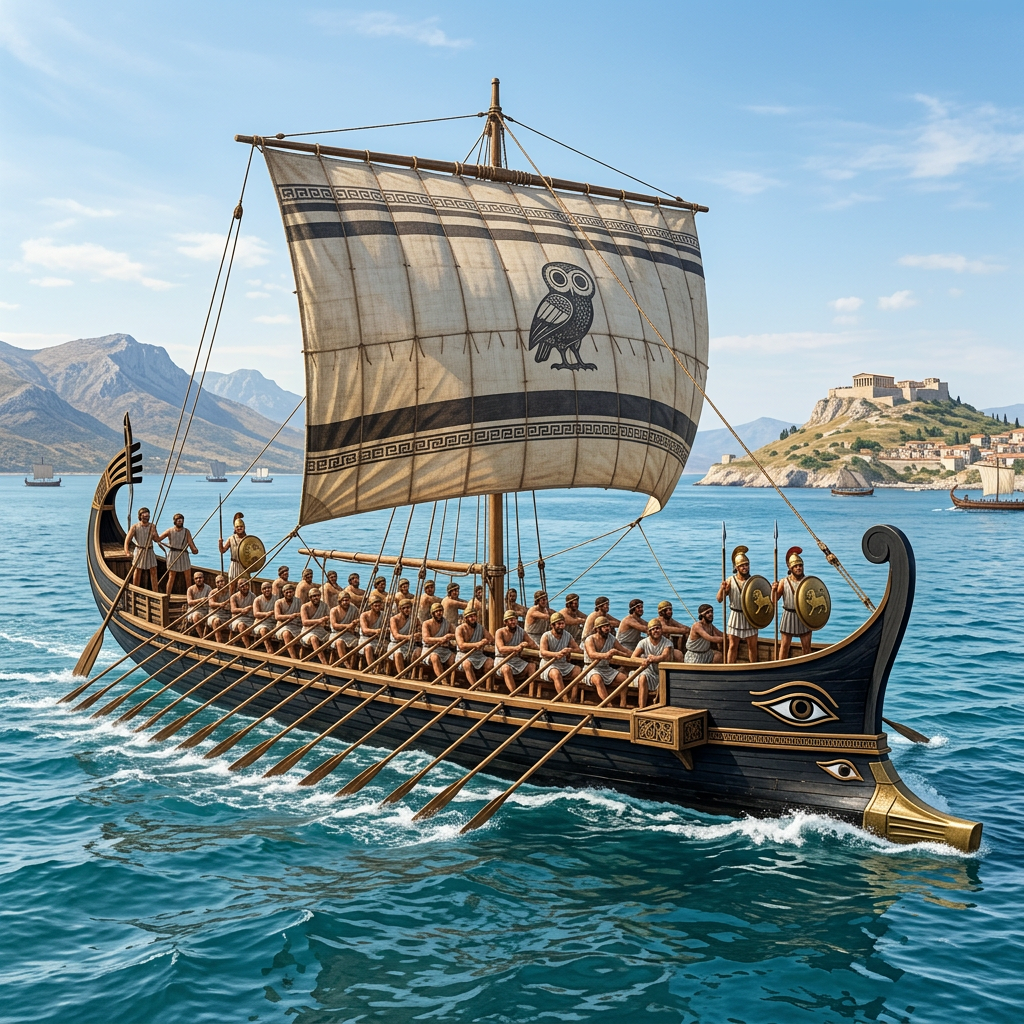
The Pentacontor, also known as the penteconter, was one of the most important types of ancient Greek ship used during the early development of Mediterranean naval warfare and long-distance seafaring. Fast, relatively light, and powered by fifty oarsmen, the pentacontor became an important link between the earliest Greek ships and the sophisticated war galleys that would later dominate the Mediterranean.
Although no complete pentacontor has survived, ancient literature, archaeology, vase paintings, and comparisons with later Mediterranean vessels allow historians to reconstruct much of its design and purpose.
The ancient Greek pentacontor was more than a means of transportation. It was a technological response to a world in which control of the sea could determine the success of trade, colonization, piracy, exploration, and warfare.
For early Greek communities, mastering the sea meant opening routes to distant islands and coastlines. It meant establishing colonies, transporting soldiers, carrying valuable goods, and confronting rival maritime powers.
The pentacontor helped make this possible.
What Was a Pentacontor?
The name pentacontor comes from the Greek word pentēkóntoros, meaning essentially “fifty-oared” or “fifty-rowed.”
The name itself tells us the most important characteristic of the vessel.
A traditional pentacontor was powered by fifty rowers, commonly arranged as twenty-five on each side.
Unlike later triremes, which had multiple levels of rowers, the pentacontor was generally conceived as a single-banked galley.
This gave the ship a relatively simple and efficient design.
The vessel was long and narrow, with a hull designed to reduce resistance and allow it to move quickly through the water.
A mast and sail could also be used when wind conditions were favorable.
But oars remained crucial.
The ability to row meant that the ship could maintain movement even when the wind was weak or unfavorable.
That made the pentacontor particularly valuable for warfare and coastal operations.

The Design of the Ancient Pentacontor
The exact dimensions of a pentacontor are uncertain because no complete ancient example has survived.
However, scholars generally envision a long, narrow hull with a high ratio of length to beam.
This shape was ideal for speed.
The vessel needed to move efficiently through the water while carrying its crew, weapons, supplies, and potentially soldiers.
The ship’s lightweight construction was another advantage.
Ancient Mediterranean shipbuilders primarily relied on wooden construction, using sophisticated techniques that developed over centuries.
The hull had to be strong enough to survive waves and impacts but light enough to be propelled by human muscle.
This created a fundamental engineering challenge:
How do you build a strong ship without making it too heavy?
The pentacontor represented one of the early solutions to this problem.
Fifty Oars and the Power of Human Muscle
The greatest source of propulsion was the ship’s rowers.
With approximately fifty oarsmen working together, the pentacontor could achieve impressive speeds for an ancient vessel.
The organization of the rowers was extremely important.
A ship moving under oars depended on coordination.
If the rowers lost rhythm, efficiency decreased.
If they moved together, the combined force of fifty people could propel the ship rapidly.
This made discipline essential.
The ancient Mediterranean galley was therefore not merely a technological achievement.
It was also a social and organizational one.
A successful pentacontor required:
- experienced rowers;
- a skilled helmsman;
- a captain;
- sailors;
- soldiers when used for warfare;
- and a crew capable of responding quickly to commands.
The ship transformed individual human effort into collective mechanical power.

Was the Pentacontor a Warship?
Yes—but its role was broader than that.
The pentacontor ancient ship could be used for warfare, transport, exploration, raiding, and perhaps piracy.
During the early periods of Greek maritime history, there was not necessarily the same strict distinction between commercial and military ships that developed in later naval systems.
A vessel capable of moving quickly and carrying armed men could serve multiple purposes.
The pentacontor’s speed made it particularly useful for raids.
A crew could approach an enemy coastline quickly, land troops, seize supplies, and withdraw before a larger force could respond.
The ship could also transport warriors between islands and mainland territories.
This was especially important in the fragmented geography of the Aegean.
The Pentacontor and Greek Colonization
One of the most important developments in early Greek history was the expansion of Greek communities throughout the Mediterranean and Black Sea.
From approximately the 8th century BC onward, Greek settlers established colonies in places such as southern Italy, Sicily, the Black Sea, North Africa, and the western Mediterranean.
This expansion required maritime technology.
The sea was not simply an obstacle.
It was a highway.
Ships allowed people to move between distant settlements, transport agricultural products, establish trade networks, and maintain connections with their homelands.
The pentacontor was well suited to this maritime world.
Its ability to combine sailing with rowing gave crews flexibility.
When winds were favorable, the sail reduced the physical burden on the rowers.
When winds failed, the oars provided propulsion.
This combination was ideal for navigating the unpredictable waters of the Mediterranean.

The Pentacontor in Greek Mythology
The pentacontor also appears indirectly in ancient Greek literary traditions.
Homer’s epics contain numerous references to ships, voyages, and maritime warfare.
Although Homeric descriptions should not automatically be treated as technical manuals, they provide important evidence about how ancient Greeks imagined seafaring.
The famous Argo, the ship of Jason and the Argonauts, is traditionally associated with a large crew of heroes and is often imagined as a fifty-oared vessel.
The legendary voyage of the Argonauts therefore provides a cultural connection between the fifty-oared ship and the heroic maritime world of Greek mythology.
Whether the mythical Argo should be identified directly with a historical pentacontor is another question.
But the connection is revealing.
The fifty-oared ship became part of the Greek imagination as a symbol of adventure, exploration, warfare, and heroic journeys.
The Pentacontor and the Argo
The Argo is perhaps the most famous legendary ship in Greek mythology.
According to the myth, Jason and his companions—the Argonauts—sailed aboard the Argo in search of the Golden Fleece.
The ship was constructed with the assistance of the goddess Athena in some traditions and was described as an exceptional vessel.
The Argonauts were among the greatest heroes of Greek mythology.
They included figures such as Heracles, Castor, Pollux, Orpheus, and Atalanta in different versions of the tradition.
The story combines mythological adventure with realistic elements of Bronze Age and early Iron Age seafaring.
The idea of a large crew working together to propel a vessel across the Mediterranean fits the general concept of the ancient fifty-oared galley.
The Argo may therefore preserve a mythological memory of early long ships.

Pentacontor vs. Trireme
It is important not to confuse the pentacontor with the later trireme.
The two vessels belonged to different stages of ancient naval development.
A pentacontor was generally a single-banked vessel with approximately fifty rowers.
A trireme, by contrast, had three levels or banks of oars and became one of the most sophisticated warships of the Classical Mediterranean.
The trireme was designed specifically for naval warfare and could achieve remarkable maneuverability and speed.
The pentacontor was simpler.
But this simplicity was part of its strength.
It was versatile, relatively easy to operate compared with more complex later warships, and suitable for a wide range of activities.
In the history of Greek naval technology, the pentacontor can therefore be understood as part of the evolutionary path toward more specialized galleys.
How Fast Was a Pentacontor?
The exact speed of an ancient pentacontor is impossible to determine with complete certainty.
Experimental archaeology, however, provides useful clues.
Ancient galley designs could achieve impressive speeds under favorable conditions.
A fifty-oared vessel was designed for propulsion by synchronized human power, allowing it to accelerate rapidly.
Its long, narrow hull reduced drag.
The combination of rowing and sailing allowed the crew to exploit different conditions.
Speed was particularly important in warfare.
A ship needed to approach an enemy quickly.
It also needed to maneuver close to shore.
And after a raid, it needed to escape.
The pentacontor’s performance therefore made it much more than a basic transport vessel.
It was an instrument of maritime power.

The Pentacontor and Ancient Naval Warfare
Before the development of the classical trireme, naval combat was likely less standardized than the spectacular fleet battles of the 5th century BC.
Ancient ships could be used to transport warriors to enemy territory, conduct raids, attack merchant vessels, and engage opposing ships.
The pentacontor’s long hull and substantial crew made it capable of transporting armed men.
Over time, naval warfare increasingly emphasized maneuverability and ramming.
This evolution eventually led to specialized warships with reinforced bows and carefully designed hulls.
The pentacontor represents an important stage in this process.
It was fast enough to attack and flexible enough to perform different maritime missions.
Greek Shipbuilding Technology
The success of vessels such as the pentacontor depended on advanced shipbuilding traditions.
Ancient Greek shipwrights developed sophisticated methods for constructing wooden hulls.
One important technique was mortise-and-tenon construction, in which wooden planks were joined using projecting pieces that fitted into corresponding slots.
These joints could then be secured with wooden fastenings.
The result was a relatively strong and flexible hull.
Shipbuilders also needed to understand the behavior of wood, the distribution of weight, and the relationship between hull shape and stability.
These skills were passed through generations.
Much of ancient Greek maritime technology was therefore based on accumulated practical knowledge rather than written engineering theory.
The Mediterranean: A World Connected by Ships
The importance of the pentacontor becomes clearer when we look at the Mediterranean itself.
The Mediterranean is divided by thousands of islands, peninsulas, bays, and narrow passages.
Communities could be separated by mountains and difficult terrain.
The sea often provided the fastest route.
A capable ship could connect distant communities far more efficiently than an overland journey.
This transformed the ancient Mediterranean into an interconnected world.
Goods traveled.
People traveled.
Ideas traveled.
Religions traveled.
Military forces traveled.
And ships like the pentacontor made these connections possible.

The Pentacontor and Phoenician Seafaring
Greek sailors were not the only maritime experts of the ancient Mediterranean.
The Phoenicians developed powerful maritime networks across the Mediterranean and were particularly famous for their shipbuilding and navigation.
Greek communities interacted extensively with Phoenician traders and sailors.
Ancient ship design therefore developed within a broader Mediterranean technological environment.
Greek shipbuilders could adopt, adapt, and improve ideas from other maritime cultures.
The history of the pentacontor is consequently not an isolated Greek story.
It belongs to the much larger history of ancient Mediterranean seafaring.
Why No Complete Pentacontor Has Survived
One of the biggest challenges for historians is the lack of complete ancient Greek warships from the early period.
Wood is vulnerable to decay.
Unless a ship sinks in unusually favorable environmental conditions, organic materials can disappear over centuries.
The Mediterranean’s underwater environment is not always ideal for preserving wooden ships.
Consequently, much of what we know about the pentacontor comes from indirect evidence.
This includes:
- ancient literature;
- Greek pottery;
- artistic representations;
- archaeological ship remains;
- later ancient warships;
- and experimental reconstruction.
Historians must therefore combine multiple types of evidence.
Experimental Archaeology and the Ancient Greek Ship
Modern experimental archaeology has played an important role in understanding ancient Greek ships.
The reconstruction and operation of the famous Olympias, a modern reconstruction of a Classical Greek trireme, demonstrated how coordinated rowing could propel a large ancient galley.
Although the Olympias represents a trireme rather than a pentacontor, experiments like this provide valuable information about ancient rowing techniques, crew coordination, ship handling, and human-powered propulsion.
Such projects remind us that ancient ships were not primitive.
They were carefully engineered machines designed around the technologies and materials available to ancient societies.

The Legacy of the Pentacontor
The pentacontor occupies an important position in the development of Mediterranean naval technology.
It belongs to an era when ships were becoming increasingly capable of long-distance travel, organized warfare, and large-scale maritime operations.
Later Greek warships became more specialized.
The trireme eventually became the iconic warship of Classical Athens.
But vessels such as the pentacontor helped establish the technological and organizational traditions that made those later developments possible.
Without mastery of rowing, hull design, navigation, shipbuilding, and crew organization, the great fleets of Classical Greece could never have existed.
Conclusion: The Fifty Oars That Changed the Mediterranean
The Pentacontor may not be as famous as the Greek trireme, but its importance should not be underestimated.
This ancient fifty-oared vessel belonged to a period when Greek communities were learning to transform the Mediterranean from a barrier into a network of routes.
Its long hull, powerful rowing crew, sail, and versatility made it suitable for warfare, exploration, trade, colonization, and raiding.
It connected communities.
It carried warriors.
It transported goods.
And it helped create the maritime world from which later Greek naval power emerged.
The pentacontor also represents something fundamental about ancient technology.
Innovation does not always arrive as a spectacular invention.
Sometimes it develops gradually through generations of practical knowledge.
A better hull.
A stronger joint.
A more efficient oar.
A better organized crew.
A faster ship.
Together, these small improvements can transform an entire civilization.
The ancient Greek pentacontor was one such transformation.
It was a vessel powered by fifty people—but its historical impact reached far beyond those fifty oars.
Across the ancient Mediterranean, the sea was the road. The pentacontor was one of the ships that made that road possible.
Fortisetliber’s View
Before the great Athenian triremes ruled the Mediterranean, there were simpler ships that helped create the foundations of Greek maritime power.
One of them was the Pentacontor.
A long, narrow vessel powered by approximately fifty oarsmen, the ancient Greek pentacontor was more than a ship. It was an instrument of movement, exploration, warfare, and ambition.
Imagine standing on an ancient shoreline.
There are no engines.
No compass as we know it.
No modern navigation equipment.
Only wood, rope, sail, oars—and fifty people pulling together.
When the wind was favorable, the sail carried the ship forward. When the wind disappeared, the rowers took over.
That simplicity was its strength.
The Pentacontor could move along coastlines, cross open stretches of the Aegean, transport warriors, raid enemy settlements, carry goods, and connect distant communities.
The Mediterranean was not an empty space separating civilizations.
It was a highway.
And the pentacontor was one of the vehicles that opened that highway.
Its importance goes beyond naval warfare. Ships like this helped make Greek colonization possible, connecting the Aegean with Sicily, southern Italy, North Africa, the Black Sea, and other regions of the Mediterranean.
Every voyage carried more than people.
It carried language.
Religion.
Technology.
Stories.
Trade.
And ideas.
In Greek mythology, the legendary Argo of Jason and the Argonauts is traditionally associated with a fifty-oared ship. Whether the mythical vessel reflects an actual historical pentacontor is impossible to prove, but the connection reveals how deeply the image of the fifty-oared ship had entered the Greek imagination.
The ship represented adventure.
It represented danger.
And above all, it represented the possibility of going somewhere unknown.
For FortisLiber, that is where the story becomes particularly powerful.
The ancient Greeks did not conquer the Mediterranean simply because they possessed powerful armies. They developed the ability to move.
Movement creates opportunity.
A ship can transport soldiers.
But it can also transport merchants.
A merchant can establish a trading relationship.
A trading relationship can create a settlement.
A settlement can become a city.
And a city can become part of an entirely new world.
The pentacontor therefore belongs to a much larger story—the story of how the Mediterranean became interconnected.
Eventually, more sophisticated ships such as the trireme would dominate Greek naval warfare.
But every great technological achievement has ancestors.
The trireme did not appear from nowhere.
Centuries of experimentation with hulls, oars, sails, navigation, and crew organization helped create the maritime technology of Classical Greece.
The pentacontor was part of that evolution.
Perhaps its greatest lesson is surprisingly simple.
Fifty people pulling together can move something enormous.
That principle applies far beyond an ancient ship.
Civilizations advance when individual effort becomes collective power.
The pentacontor transformed fifty rowers into a single machine.
And that machine helped transform the Mediterranean.
The original ships have disappeared beneath the centuries.
Their wooden hulls have rotted away.
Their sails have vanished.
Their oars have turned to dust.
But the routes they opened remained.
The colonies they helped establish became cities.
The trade networks expanded.
And the maritime culture of the ancient Mediterranean continued to evolve.
So when we imagine the Pentacontor, we should not see merely an old wooden warship.
We should see fifty oars striking the water in perfect rhythm.
We should hear the commands of the helmsman.
We should feel the wooden hull moving beneath our feet.
And beyond the bow, we should see the endless Mediterranean.
Fifty oars. One ship. And an entire world waiting beyond the horizon.
Leave a Reply