
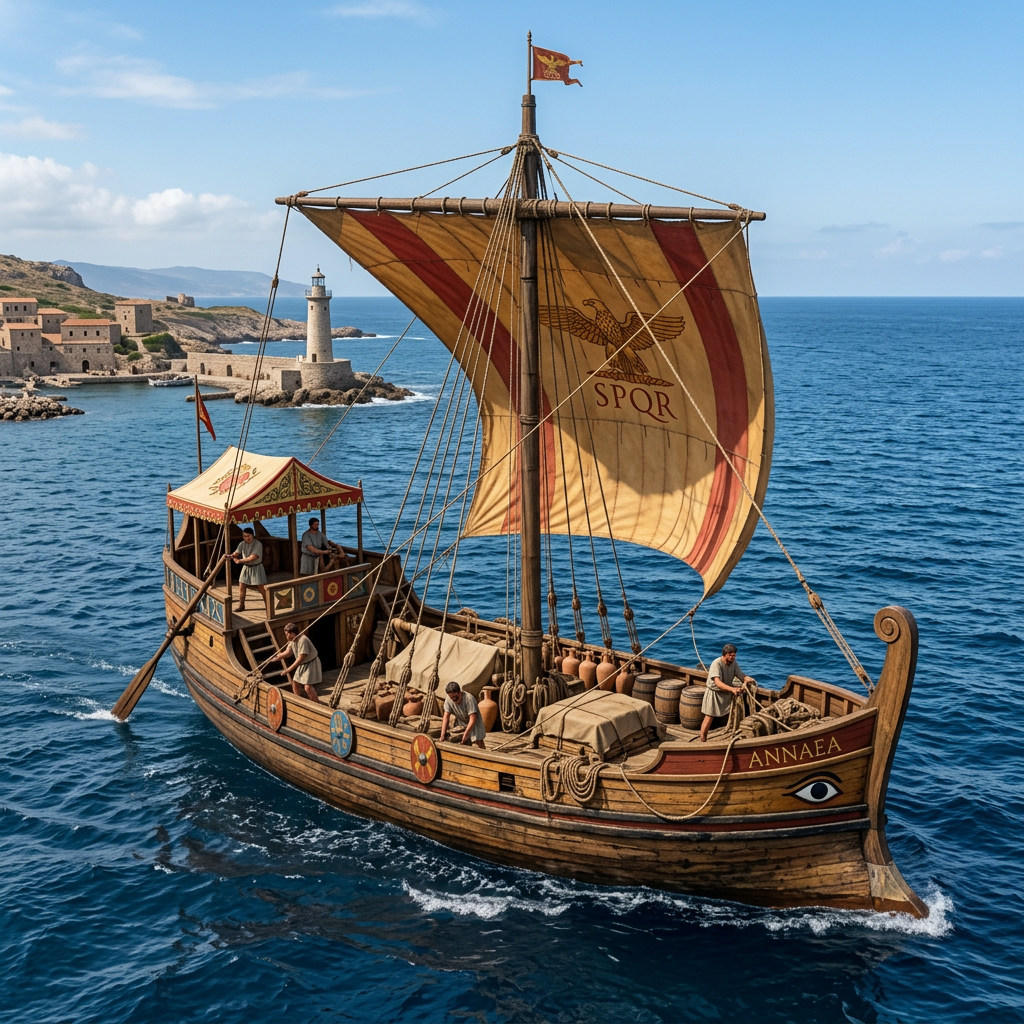
The Roman corbita was one of the most important types of ancient Roman merchant ship, designed primarily to transport grain, wine, olive oil, building materials, and other goods across the vast waters of the Mediterranean. Unlike the famous Roman warships that carried soldiers and fought naval battles, the corbita belonged to a different but equally important world: the world of commerce.
The Roman Empire depended on ships.
Its cities needed food. Its armies needed supplies. Its markets demanded wine, olive oil, marble, ceramics, metals, and countless other products. Roads connected the provinces by land, but the Mediterranean was often the fastest and most economical route for moving enormous quantities of cargo.
The Roman corbita ship was part of this maritime network.
Slow compared with a war galley but capable of carrying substantial cargo, the corbita represented an essential principle of Roman power: an empire cannot survive on conquest alone—it must also be supplied.
What Was a Roman Corbita?
The corbita was a Roman commercial sailing vessel used primarily for transporting cargo.
Ancient sources and artistic representations indicate that the term was associated with merchant ships characterized by their broad, rounded hulls.
Unlike a military galley, the corbita was not designed around large numbers of rowers.
Its primary source of propulsion was the wind.
This made the ship particularly suitable for long-distance commercial voyages.
The basic philosophy was simple:
Carry as much cargo as possible while using as little human labor as necessary.
A merchant ship did not need to accelerate rapidly into battle or perform complicated maneuvers.
It needed to carry goods safely from one port to another.
This difference shaped its design.
The corbita was therefore broader and deeper than many warships, with substantial cargo capacity and a hull optimized for stability and transport.

The Corbita and the Roman Economy
The importance of the Roman corbita ship becomes clear when we consider the scale of the Roman Empire.
At its height, the Roman Empire contained tens of millions of inhabitants spread across Europe, North Africa, the Middle East, and the Mediterranean islands.
Large cities required enormous quantities of food.
Rome was the greatest example.
The capital depended heavily on imported grain, particularly from provinces such as Egypt and North Africa.
This created an enormous maritime transportation system.
Grain was loaded onto merchant vessels.
Ships crossed the Mediterranean.
Cargo was unloaded at major ports.
It was then distributed to urban populations.
The corbita and similar Roman cargo ships were therefore part of an economic system that connected distant provinces to the imperial capital.
Without merchant shipping, the Roman Empire would have struggled to feed its largest cities.
Roman Merchant Ships vs. Roman Warships
It is important to distinguish a corbita from famous Roman warships such as the trireme or other oared galleys.
A warship was built around speed and maneuverability.
A merchant ship was built around cargo.
The difference could be dramatic.
A military galley needed large numbers of rowers.
Every additional rower required food, water, space, and equipment.
A merchant ship could dedicate much more of its internal volume to cargo.
Instead of using dozens or hundreds of rowers, it relied primarily on sails.
This made the corbita more economical for commercial transportation.
Its wide hull also provided stability in the open sea.
For merchants, that mattered more than the ability to turn quickly.

The Design of the Ancient Roman Corbita
The exact dimensions of individual corbitae varied, and our knowledge comes from archaeological remains, literary references, coins, mosaics, and ship depictions.
The general image is of a broad-beamed sailing ship with a rounded hull.
The vessel could carry a substantial cargo below deck.
A large central mast supported the main sail.
Roman merchant ships could also use additional sails to improve maneuverability and performance under different wind conditions.
The stern was usually raised relative to the central body of the ship, while the bow was designed to rise above the water.
The ship’s shape was not intended to be elegant in the modern sense.
It was practical.
Every aspect of the vessel had an economic purpose.
More cargo meant greater potential profit.
Greater stability meant fewer losses.
Efficient sailing meant reduced voyage times.
How Roman Merchant Ships Were Built
Roman shipbuilding inherited and adapted centuries of Mediterranean maritime traditions.
Shipwrights worked primarily with timber, carefully selecting different types of wood for different components.
The hull consisted of interconnected planks supported by internal structural elements.
Roman builders used sophisticated joining techniques that had evolved from earlier Greek and Mediterranean traditions.
The construction of a large merchant ship required considerable skill.
The ship needed to be strong enough to withstand waves, storms, and the stress caused by a heavy cargo.
At the same time, excessive weight had to be avoided.
A merchant ship was essentially a floating economic machine.
If its hull failed, the cargo—and potentially the entire investment of its owners—could disappear beneath the waves.

What Did Roman Corbita Ships Carry?
The cargo of a Roman merchant ship could vary enormously.
One of the most important commodities was grain.
The Roman state depended heavily on the movement of grain from productive agricultural regions to urban centers.
But grain was only one part of Mediterranean commerce.
Roman merchant vessels could transport:
- olive oil;
- wine;
- wheat and other grains;
- pottery;
- marble;
- metals;
- timber;
- fish products;
- spices;
- textiles;
- glass;
- building materials;
- and luxury goods.
Large cargoes were often transported in amphorae, ceramic containers designed for storing and transporting liquids and other products.
Archaeologists have recovered enormous quantities of amphorae from ancient shipwrecks.
These underwater discoveries provide some of the best evidence for the scale of Roman maritime trade.
The Roman Grain Fleet
Perhaps the most important cargo associated with Roman merchant shipping was grain.
Rome was an enormous city, and its population could not be supplied entirely from the surrounding Italian countryside.
Grain therefore arrived from distant provinces.
Egypt became particularly important after its incorporation into the Roman Empire.
North Africa also became one of the great agricultural regions supplying Rome.
Merchant ships carried enormous quantities of grain across the Mediterranean.
The voyage from Egypt to Italy could be difficult and dangerous.
Ships had to navigate changing winds, currents, storms, and seasonal weather patterns.
Yet the economic rewards were substantial.
A successful voyage could produce considerable profit.
A failed voyage could result in financial catastrophe.

The Port of Ostia
The story of the Roman corbita cannot be separated from Ostia, the great port of Rome.
Located near the mouth of the Tiber River, Ostia became one of the most important commercial centers in the Roman world.
Ships arriving from across the Mediterranean unloaded their cargoes there.
Grain, wine, oil, marble, and countless other products passed through the port.
Warehouses stored goods before they continued toward Rome.
The archaeological remains of Ostia provide an extraordinary picture of Roman commercial life.
Its streets, warehouses, markets, apartment buildings, temples, and administrative structures reveal how deeply maritime commerce was integrated into Roman society.
The corbita was one of the vessels that made this system possible.
The Mediterranean as a Roman Highway
Modern people often imagine the Roman Empire primarily through its roads.
Roman roads were indeed extraordinary.
But for heavy cargo, the sea was often more efficient.
A ship could carry enormous quantities of goods that would have required hundreds of carts on land.
This gave maritime transportation a major economic advantage.
The Mediterranean effectively became an imperial highway.
Ports functioned as its major stations.
Merchant ships became its vehicles.
And the Roman corbita was one of the workhorses of this maritime system.
From Spain to Egypt and from North Africa to the Levant, ships connected the provinces to one another.

Roman Trade Routes
Roman merchant shipping operated along numerous routes.
One major network connected North Africa with Italy.
Another connected Egypt with the eastern Mediterranean and Rome.
Spanish ports exported products such as olive oil and metals.
Gaul supplied wine and other goods.
The eastern Mediterranean connected Rome with the prosperous cities of Greece, Asia Minor, Syria, and the Levant.
These routes were not always direct.
Ships often stopped at several ports.
A merchant vessel might load one cargo in one region and acquire additional goods elsewhere.
This created a highly interconnected commercial system.
The Roman Empire was therefore not simply a political structure.
It was also a gigantic economic network held together by roads, rivers, and ships.
Navigation Without Modern Technology
Roman sailors did not possess modern navigation instruments.
They could not rely on GPS.
They did not have accurate modern marine charts.
Instead, they depended on accumulated experience.
Sailors studied:
- coastal landmarks;
- stars;
- winds;
- currents;
- seasonal weather;
- known harbors;
- and traditional sailing routes.
Experienced captains possessed valuable knowledge that could determine whether a voyage succeeded.
Mediterranean sailors also understood seasonal wind patterns.
Some routes were easier during particular parts of the year.
Others became dangerous during periods of severe storms.
Roman maritime commerce was therefore highly dependent on both technology and environmental knowledge.

The Dangers of Roman Sea Travel
The Mediterranean may look relatively calm today, but ancient sailors faced serious dangers.
Storms could appear suddenly.
Strong winds could damage sails.
Waves could overwhelm ships.
Navigation errors could send vessels toward rocky coastlines.
Piracy was another danger.
Although Roman authorities eventually took major measures against piracy, commercial vessels could still be vulnerable in certain periods and regions.
A merchant ship also faced the constant possibility of mechanical failure.
A damaged mast or leaking hull could become a life-threatening emergency.
For these reasons, successful ancient sailors were highly skilled professionals.
Roman Shipwrecks and Archaeological Evidence
One of the greatest sources of information about ancient Roman ships comes from shipwreck archaeology.
When a merchant vessel sank, its cargo sometimes became preserved underwater.
Amphorae remained on the seabed.
Wooden components could occasionally survive under favorable conditions.
Anchors, ceramics, coins, and other objects provide clues about the vessel and its voyage.
Shipwrecks have allowed archaeologists to reconstruct aspects of Roman trade that are difficult to see in written sources.
A single wreck can reveal:
- the type of cargo;
- the origin of goods;
- the construction methods;
- the approximate route;
- and sometimes the economic organization behind the voyage.
In this sense, Roman shipwrecks are underwater archives.
The Corbita in Roman Art
Representations of merchant ships appear in Roman mosaics, reliefs, pottery, and other forms of art.
These images are valuable because they provide visual evidence for ship design.
They show details such as:
- large sails;
- masts;
- rigging;
- steering oars;
- raised bows and sterns;
- and broad hulls.
Some Roman mosaics depict ships entering ports or sailing through the Mediterranean.
These images demonstrate how familiar merchant shipping was within Roman culture.
The ship was not an exotic object.
It was part of everyday imperial life.
People depended on the arrival of ships even if they never personally traveled aboard one.

The Crew of a Roman Merchant Ship
A corbita required a professional crew.
The captain, often called the magister navis, was responsible for the voyage.
Other crew members handled sailing, steering, loading, maintenance, and other tasks.
Unlike a military galley, the crew did not consist primarily of rowers.
Their work revolved around sailing and cargo management.
The ship also required people capable of repairing equipment during a voyage.
A damaged sail or broken piece of rigging could threaten the entire journey.
Commercial voyages therefore depended on teamwork and experience.
The Economics of a Roman Merchant Voyage
Roman maritime commerce could be highly profitable.
But it was also risky.
A merchant had to invest money in:
- the ship;
- crew wages;
- cargo;
- port fees;
- supplies;
- and insurance or financial arrangements where available.
If the ship reached its destination safely and the cargo sold at a favorable price, the voyage could produce significant returns.
If the ship sank, the losses could be enormous.
This explains why Roman merchants developed sophisticated financial practices.
The Mediterranean economy depended upon entrepreneurs willing to accept maritime risk.
The Corbita and Roman Power
The importance of the corbita extends beyond commerce.
It was indirectly connected to Roman military power.
Armies require food.
Food requires agriculture.
Agricultural regions need transportation.
Transportation requires ships.
The Roman military presence in distant provinces therefore depended partly on maritime logistics.
A merchant vessel carrying grain might never have carried soldiers, yet its cargo could help sustain the cities and armies that maintained Roman imperial power.
This is one of the most important lessons of ancient logistics.
Empires are built by armies, but they are sustained by supply chains.

The Legacy of the Roman Corbita
The Roman corbita represents a fascinating chapter in the history of maritime technology.
It demonstrates that the most historically important ships are not always the ships that fought the most famous battles.
Roman warships defended imperial waters.
But merchant ships fed cities.
They carried raw materials.
They moved luxury goods.
They connected distant provinces.
They created commercial opportunities.
And they helped turn the Mediterranean into an integrated economic system.
The corbita was therefore a symbol of Roman commerce as much as Roman technology.
Conclusion: The Merchant Ship Behind the Empire
The ancient Roman corbita may lack the dramatic reputation of the Roman war galley, but its historical importance was enormous.
It was a ship designed not for glory but for usefulness.
Its purpose was to carry.
To connect.
To supply.
To trade.
And to return.
Every successful voyage strengthened the network that connected the Roman provinces.
Grain from Egypt could reach Rome.
Oil from Spain could reach distant markets.
Wine from Gaul could appear on Italian tables.
Marble from distant quarries could become part of monumental Roman architecture.
All of this depended on ships.
The corbita was one of the vessels that carried the Roman economy across the Mediterranean.
And that gives the ship a special place in history.
The Roman Empire is often remembered for its emperors, legions, roads, battles, and monuments.
But beneath all of those achievements was another world—the world of merchants, sailors, shipwrights, dockworkers, and cargo vessels.
The Roman corbita belonged to that world.
It reminds us that history is not created only by people who conquer territories.
It is also created by those who move the goods that make civilization possible.
Across the ancient Mediterranean, the corbita sailed quietly from port to port. It carried no emperor and conquered no kingdom—but without ships like it, Rome could never have become Rome.
Fortisetliber’s View
The Roman corbita was not a warship. It carried no legions and won no famous battles.
It carried something even more essential: food, trade, and supplies.
These broad sailing vessels crossed the Mediterranean carrying grain, olive oil, wine, marble, pottery, and other goods between the provinces of the Roman Empire.
For Rome, the Mediterranean was a highway—and the corbita was one of its most important vehicles.
A single voyage could connect distant provinces with the imperial capital, helping feed enormous cities and supply growing markets. Yet every journey was dangerous. Roman sailors faced storms, piracy, difficult navigation, and the constant risk of losing both ship and cargo.
For FortisLiber, the corbita represents the quieter side of Roman power.
Empires are not sustained only by soldiers and emperors. They are sustained by people who transport what everyone else needs.
The corbita may have disappeared beneath the waves, but its legacy remains in the ancient ports, shipwrecks, and trade routes that reveal how deeply the Roman world depended on the sea.
No battle was fought from its deck. But without ships like the corbita, Rome could never have become Rome.
Leave a Reply