
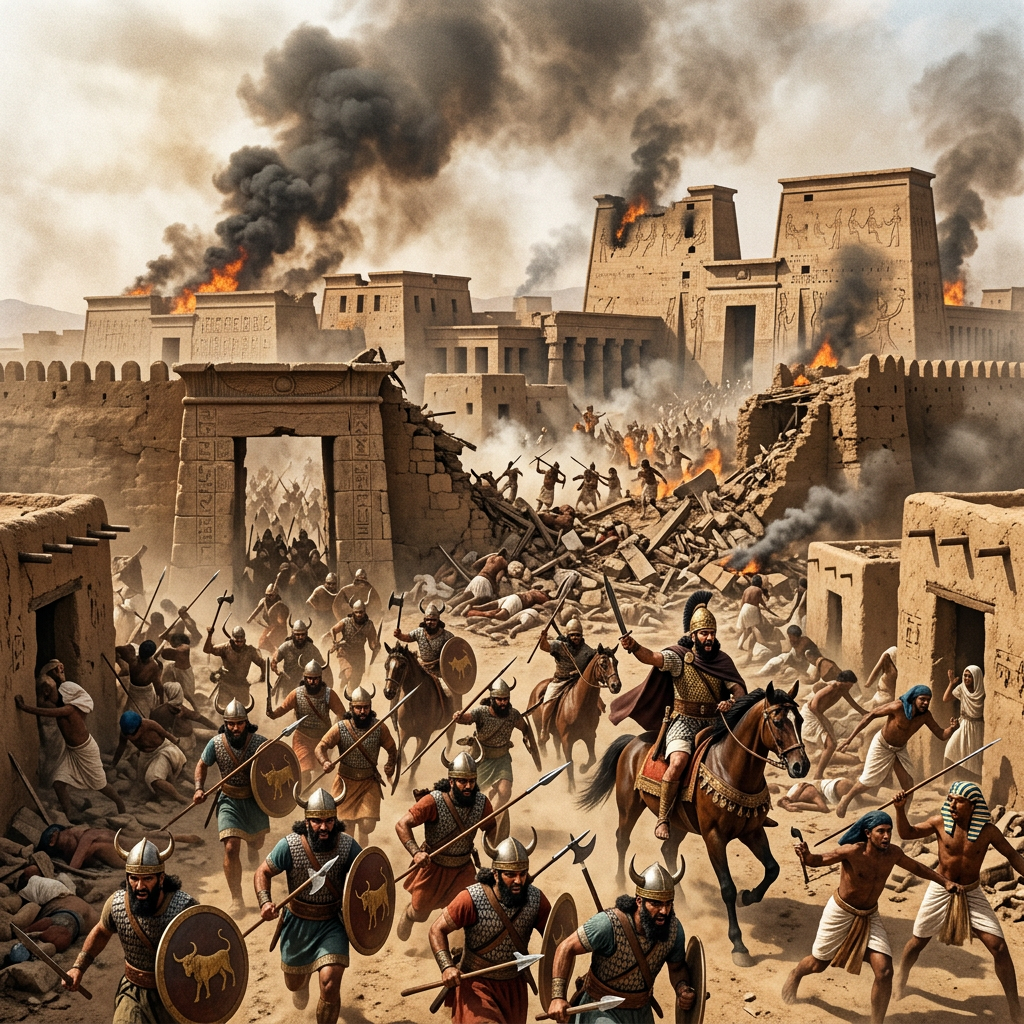
The Sack of Thebes in 663 BC was one of the most dramatic events of the ancient Near East. In that year, the army of the Neo-Assyrian Empire, under King Ashurbanipal, captured the great Egyptian city of Thebes after defeating the Kushite ruler Tantamani.
The Assyrian victory marked a decisive moment in the long struggle between Assyria and the Twenty-fifth Dynasty of Egypt, while also contributing to the eventual rise of the Saite pharaoh Psamtik I and the beginning of Egypt’s Late Period.
The fall of Thebes was particularly shocking because Thebes—known to the Egyptians as Waset and in Assyrian sources as Ni’—was one of the most prestigious religious and political centers in Egypt. It was the great city of the god Amun, home to enormous temple complexes, wealthy priesthoods, royal monuments, and generations of pharaonic tombs.
For the Assyrians, however, Thebes represented the southern heartland of their Kushite enemies.
Its capture demonstrated the extraordinary reach of the Neo-Assyrian Empire. An empire based in northern Mesopotamia had marched deep into the Nile Valley and plundered one of Egypt’s greatest cities.
The event also left a remarkable literary legacy. The biblical Book of Nahum later referred to the destruction of Thebes as an example of how even a powerful and seemingly secure city could fall.
Yet the story is more complicated than the simple image of a city being completely destroyed. Assyrian royal inscriptions boast of enormous plunder, while archaeological evidence from Thebes suggests considerable continuity before and after 663 BC.
The Sack of Thebes 663 BC therefore provides a fascinating window into imperial warfare, Egyptian history, Kushite power, Assyrian expansion, and the politics of the ancient Mediterranean and Near East.
Thebes: The Great City of Upper Egypt
To understand why the Sack of Thebes was so significant, it is necessary to understand the importance of the city itself.
Thebes stood in Upper Egypt along the Nile.
For much of ancient Egyptian history, it was one of the country’s most important religious and political centers. The city was especially associated with Amun, one of the most powerful gods in the Egyptian pantheon.
The great temple complexes of Karnak and Luxor transformed Thebes into a monumental religious landscape.
Across the Nile, the western bank contained royal and elite cemeteries, including famous monuments in the Valley of the Kings and surrounding necropolises.
By the seventh century BC, Thebes was no longer the permanent political capital of a unified Egypt. Nevertheless, it remained immensely important.
Its religious institutions possessed enormous wealth and influence.
Its temples contained precious metals, textiles, sculptures, ceremonial objects, and other treasures accumulated over centuries.
For an invading army, Thebes was therefore both a strategic target and an extraordinarily valuable prize.

Egypt and the Rise of Kushite Power
The political background to the Sack of Thebes in 663 BC goes back to the rise of Kushite rule over Egypt.
The kingdom of Kush, centered farther south in Nubia, had developed into a powerful state with its political center at Napata.
During the eighth century BC, Kushite rulers expanded northward into Egypt.
This eventually produced the Twenty-fifth Dynasty, sometimes called the Kushite Dynasty.
Kushite kings such as Piye, Shabaka, Shebitku, and Taharqa ruled large portions of Egypt.
They presented themselves as legitimate pharaohs and embraced many Egyptian religious and royal traditions.
The relationship between Kush and Egypt was therefore not simply one of foreign occupation.
Kushite rulers became deeply integrated into Egyptian political and religious traditions.
Thebes was particularly important because of its close relationship with the cult of Amun.
The Kushite kings promoted the worship of Amun and maintained strong connections with the Theban priesthood.
But Kushite control of Egypt brought them into conflict with another rising power.
That power was Assyria.
The Neo-Assyrian Empire
During the eighth and seventh centuries BC, the Neo-Assyrian Empire became the dominant military power of the ancient Near East.
Its territories stretched across much of Mesopotamia and the Levant.
Assyrian kings developed highly organized armies capable of conducting long-distance campaigns.
They used infantry, cavalry, chariots, siege engines, engineers, and specialized troops.
Assyria’s expansion brought it into increasing contact with Egypt.
Egyptian and Kushite rulers supported resistance to Assyrian authority in the Levant.
The Assyrians therefore regarded Egyptian influence as a threat to their control of the region.
The conflict was not simply about Egypt itself.
It was also about control of the eastern Mediterranean, the Levant, and the political loyalty of smaller kingdoms.

Taharqa and the Assyrian-Egyptian Conflict
One of the most important figures in this conflict was Taharqa, one of the greatest rulers of the Twenty-fifth Dynasty.
Taharqa attempted to maintain Kushite control over Egypt while supporting resistance to Assyrian influence.
The Assyrian king Esarhaddon launched campaigns against Egypt, but the struggle was difficult.
In 671 BC, Esarhaddon invaded Egypt and captured Memphis.
The Assyrians temporarily imposed their authority over parts of Lower Egypt.
But Kushite resistance continued.
Taharqa managed to regain influence in Egypt after the Assyrian king’s withdrawal.
The conflict therefore remained unresolved.
When Esarhaddon died in 669 BC, his successor Ashurbanipal inherited the problem.
Ashurbanipal and the Second Assyrian Campaign
Ashurbanipal, who ruled the Neo-Assyrian Empire from approximately 669 to 631/627 BC depending on chronology, became one of the most famous Assyrian kings.
He is remembered not only for military campaigns but also for his extraordinary library at Nineveh.
His reign was nevertheless dominated by warfare.
Egypt was among his major challenges.
In 667 BC, Ashurbanipal launched another campaign into Egypt.
The Assyrians defeated Kushite forces and re-established their influence in Lower Egypt.
Local rulers were restored to power, including Necho I of Sais, who became an important Assyrian ally.
But the situation remained unstable.
Taharqa continued to resist Assyria until his death in 664 BC.
His successor, Tantamani, would make one final attempt to restore Kushite control over Egypt.
Tantamani’s Attempt to Reconquer Egypt
After Taharqa’s death, Tantamani became ruler of Kushite Egypt.
He immediately attempted to reverse the gains made by Assyria.
Tantamani marched north from Nubia.
His forces moved through Upper Egypt and eventually reached Memphis.
The Kushite ruler succeeded in defeating and killing Necho I, the Assyrian-backed ruler of Sais.
This was a serious blow to Assyrian authority.
Tantamani then attempted to consolidate his control over Lower Egypt.
But the Assyrians responded.
Ashurbanipal sent another army southward.
The result would be catastrophic for Kushite power.

The Battle for Egypt
The Assyrian army, supported by forces loyal to Psamtik, the son of Necho I, confronted Tantamani’s forces.
Psamtik would later become known as Psamtik I, founder of Egypt’s Twenty-sixth Dynasty.
He had escaped to Assyria after the death of his father and eventually returned with Assyrian support.
The decisive fighting took place near Memphis.
Tantamani was defeated.
He retreated southward toward Upper Egypt.
The Assyrians pursued him.
The road now led toward Thebes.
The Sack of Thebes in 663 BC
The Assyrian army reached Thebes in 663 BC.
By the time the Assyrians arrived, Tantamani had already fled farther south toward Nubia.
Thebes was therefore left vulnerable.
The Assyrian royal inscriptions describe the city’s capture in triumphant language.
Ashurbanipal claimed that he conquered the entire city and seized enormous quantities of wealth.
The reported booty included:
- silver;
- gold;
- precious stones;
- royal possessions;
- luxurious clothing;
- horses;
- male and female attendants;
- temple equipment;
- and two enormous obelisks.
The Assyrian king also claimed that temple door fittings were removed and carried back to Assyria.
The scale of the claimed booty was enormous.
Ashurbanipal’s inscription states that the two obelisks alone weighed 2,500 talents, an immense quantity of metal. The precise modern conversion is debated, but the figure was clearly intended to emphasize extraordinary wealth.
The Assyrian account was not merely a military report.
It was imperial propaganda.
By describing the destruction and plunder of Thebes, Ashurbanipal demonstrated the power of Assyria to audiences throughout the empire.

Was Thebes Completely Destroyed?
This is where the historical picture becomes particularly interesting.
The Assyrian inscriptions present the campaign as an overwhelming victory.
But modern archaeological evidence does not necessarily support the idea that Thebes was completely destroyed.
Archaeologists have found evidence of continuity in Theban administration and religious activity after 663 BC.
Some officials who held positions before the Assyrian campaign appear to have continued afterward, while activity in the Theban necropolises also continued. This has led scholars to question how literally the Assyrian claims of total destruction should be understood.
It is possible that the Assyrians concentrated their efforts on the city’s richest temple and palace districts.
In the ancient world, “sacking a city” did not necessarily mean demolishing every building.
A victorious army could plunder the wealthy religious centers, seize valuable objects, deport people, and leave much of the urban population and infrastructure intact.
The Sack of Thebes 663 BC may therefore have been devastating without being an absolute destruction of the entire city.
The Wealth of Amun
One reason Thebes was such an attractive target was its extraordinary religious wealth.
The cult of Amun had accumulated enormous resources over centuries.
The temples of Karnak and other religious institutions possessed land, livestock, precious objects, workshops, and large numbers of workers.
For an invading empire, these resources represented a vast economic prize.
The Assyrian seizure of Theban wealth was therefore both symbolic and practical.
By attacking the center of Kushite religious authority, the Assyrians demonstrated that even Egypt’s most sacred institutions were vulnerable.
The Fall of Kushite Power in Egypt
The capture of Thebes had enormous political consequences.
The Twenty-fifth Dynasty effectively lost its last major base in Egypt.
Tantamani retreated into Nubia.
His successors continued to rule the Kingdom of Kush, but Kushite rulers would no longer successfully control Egypt north of the First Cataract for an extended period.
This was a major turning point.
The long period of Kushite rule over Egypt was coming to an end.
The political future of Egypt now belonged increasingly to local rulers in the north.
Among them, one figure would become particularly important.
Psamtik.

The Rise of Psamtik I
Psamtik I initially owed his position to Assyrian support.
He became ruler of Sais in the Nile Delta and gradually expanded his influence.
But the political relationship between Egypt and Assyria changed rapidly.
Assyria was facing major conflicts elsewhere in its empire.
Its armies were increasingly occupied with wars against powers such as Elam and other enemies.
This gave Psamtik an opportunity.
He gradually freed Egypt from Assyrian control.
By the middle of the seventh century BC, Psamtik had consolidated power over much of Egypt.
The Twenty-sixth Dynasty had begun.
The Sack of Thebes therefore stands near the beginning of a profound political transformation in Egyptian history.
Thebes Under Psamtik
Thebes did not immediately disappear after the Assyrian attack.
Instead, it remained an important religious center.
In 656 BC, Psamtik sent forces south and received the submission of Thebes.
He also used religious diplomacy to strengthen his authority.
His daughter, Nitocris I, was adopted by Amenirdis II, a powerful woman associated with the office of God’s Wife of Amun.
This allowed Psamtik to establish stronger political and religious connections with Thebes.
The episode demonstrates that the city retained considerable importance even after the Assyrian campaign.
The Sack of Thebes and the Book of Nahum
The fall of Thebes also became important beyond Egyptian and Assyrian history.
The Book of Nahum in the Hebrew Bible refers to a city called No-Amon, widely identified with Thebes.
Nahum uses the fate of Thebes as a warning to another great imperial city: Nineveh, the capital of Assyria.
The argument is powerful.
If Thebes—with Egypt and Kush behind it—could fall, then Nineveh was not invincible.
The reference is historically significant because it demonstrates that the Sack of Thebes was remembered beyond Egypt.
It became an example of imperial vulnerability.

The Irony of Thebes and Nineveh
History contains a remarkable irony here.
In 663 BC, the Assyrians celebrated their victory over Thebes.
Ashurbanipal’s inscriptions presented the event as evidence of Assyrian supremacy.
But less than half a century later, the Neo-Assyrian Empire itself would collapse.
In 612 BC, Nineveh was captured and destroyed by a coalition led by the Medes and Babylonians.
The great Assyrian capital that had celebrated victories over distant peoples suffered the fate that Assyrian kings had inflicted upon other cities.
This makes the reference in Nahum especially striking.
The fall of Thebes became a warning:
No empire is permanently invincible.
Why the Sack of Thebes Matters
The Sack of Thebes in 663 BC matters because it connects several major civilizations and historical developments.
It was:
- a major Assyrian military victory;
- a decisive defeat for Kushite power in Egypt;
- a turning point in the history of the Twenty-fifth Dynasty;
- a step toward the rise of Psamtik I;
- an important event in the transition toward Egypt’s Late Period;
- and an event remembered in biblical literature.
It also demonstrates how interconnected the ancient world had become.
A conflict that began with Assyria’s struggle for influence in the Levant eventually reached deep into Egypt.
The Legacy of the Sack of Thebes
The Assyrian attack did not erase Thebes from history.
The city remained an important religious center for centuries.
Its temples continued to function.
Its cemeteries continued to develop.
Its monuments survived.
But 663 BC marked the end of an era.
The Kushite attempt to dominate Egypt had failed.
Assyria had demonstrated its extraordinary military reach.
And the political balance of Egypt was shifting toward the north.
Within a few decades, Egypt would experience a new period of independence under the Saite kings.
The great powers of the ancient Near East would continue to rise and fall.
And Thebes would remain as a monumental reminder of the civilizations that had fought to control the Nile Valley.

Conclusion: The City That Fell, but Did Not Disappear
The Sack of Thebes 663 BC was one of the most dramatic moments in the history of ancient Egypt and the Neo-Assyrian Empire.
The army of Ashurbanipal defeated the Kushite ruler Tantamani, marched deep into Upper Egypt, and captured the great city of Thebes.
The Assyrians carried away enormous quantities of wealth, including precious metals and monumental objects, while their inscriptions celebrated the victory as proof of Assyria’s overwhelming power.
Yet Thebes survived.
Its temples continued.
Its religious traditions endured.
Its officials remained active.
And its monuments still dominate the landscape of modern Luxor.
Perhaps this is the most important lesson of the Sack of Thebes.
Empires can conquer cities.
Armies can carry away treasures.
Kings can claim total victory.
But history is rarely erased completely.
Thebes endured beyond the armies of Assyria, beyond the Kushite kings, and beyond the pharaohs who ruled it.
The city that fell in 663 BC never truly disappeared.
The Assyrians could carry away the treasures of Thebes—but they could not carry away its place in history.
Fortisetliber’s View
In 663 BC, one of ancient Egypt’s greatest cities experienced a devastating moment.
Thebes, the magnificent religious center of Amun, was captured by the army of the Assyrian king Ashurbanipal after the defeat of the Kushite ruler Tantamani.
For the Assyrians, Thebes was more than a city.
It was a symbol of Kushite power, Egyptian wealth, and religious authority.
The Assyrians plundered its treasures, taking gold, silver, precious objects, and other riches from the city’s wealthy temples and palaces.
Yet there is an important lesson hidden behind the Assyrian victory.
Thebes survived.
Its temples continued to function. Its priests remained influential. Its monuments endured.
And eventually, Assyria itself would disappear.
Less than fifty years later, Nineveh, the mighty Assyrian capital, would fall to its enemies.
For FortisLiber, this is what makes the Sack of Thebes in 663 BC so powerful.
History constantly reminds us that power is temporary.
Kings can conquer cities.
Empires can collect enormous treasures.
Armies can appear unstoppable.
But no empire lasts forever.
The Assyrians could take the treasures of Thebes, but they could not destroy the city’s memory.
Today, the temples of Karnak and Luxor still stand as silent witnesses to thousands of years of history.
Thebes fell in 663 BC—but it was never defeated by time.
Leave a Reply