
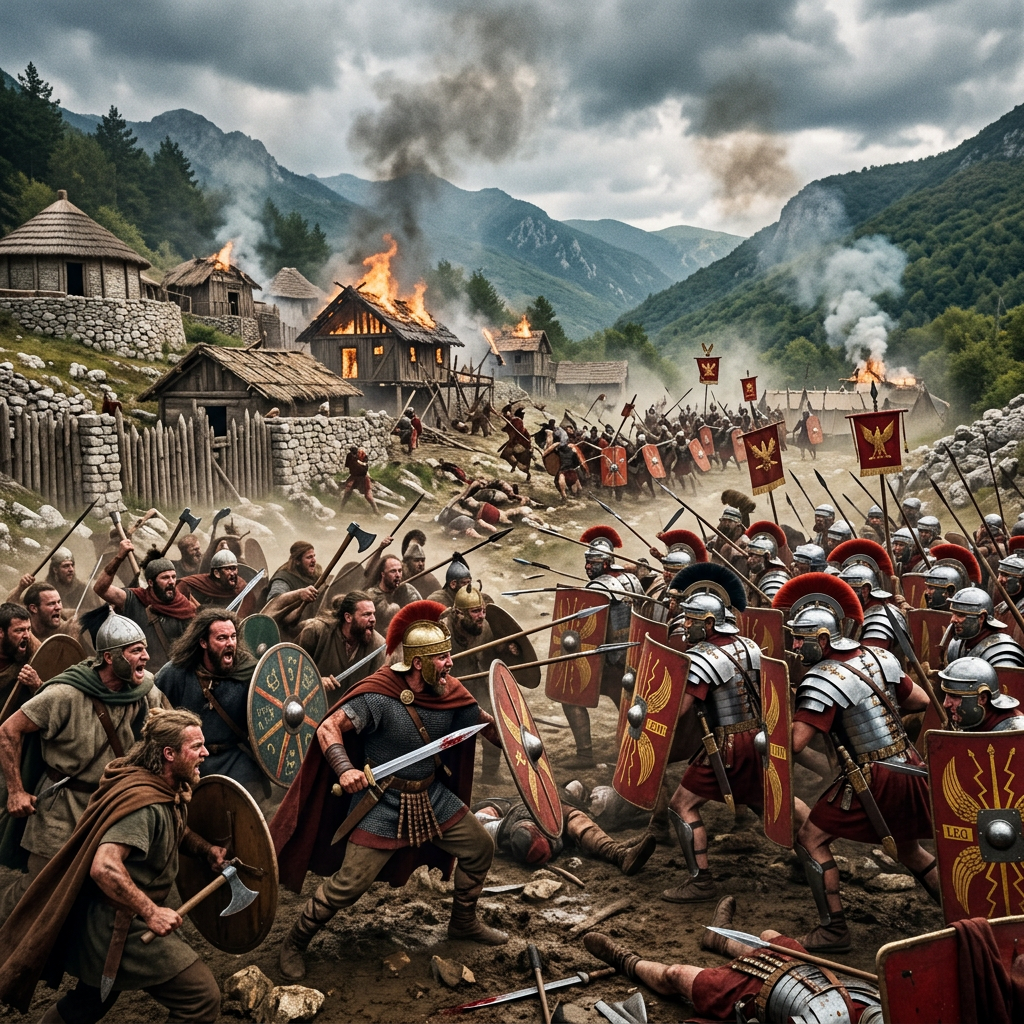
The Great Illyrian Revolt, also known as the Pannonian Revolt or Bellum Batonianum, was one of the most serious uprisings faced by the Roman Empire during the reign of Emperor Augustus. Beginning in AD 6 and continuing until AD 9, the revolt engulfed large parts of the Balkans and forced Rome to divert enormous military resources to suppress it.
Led primarily by two leaders named Bato—Bato the Daesitiate and Bato the Breucian—the rebellion brought together different peoples of Illyria and Pannonia who opposed Roman taxation, military recruitment, administration, and political domination.
The timing made the revolt particularly dangerous.
Rome was already engaged in major military operations along the northern frontier, while Augustus was attempting to consolidate Roman control over territories beyond the Danube and toward the Germanic lands.
The Great Illyrian Revolt of AD 6–9 threatened to destabilize the entire Roman position in southeastern Europe.
At one point, Roman commanders reportedly faced a crisis so severe that Augustus feared the rebels might advance toward Italy itself.
Ultimately, Rome prevailed.
But the rebellion had an unexpected consequence: it helped prevent the Roman Empire from concentrating sufficient forces in Germania. Only months after the revolt ended, the catastrophic Battle of the Teutoburg Forest in AD 9 destroyed three Roman legions under Publius Quinctilius Varus.
The Great Illyrian Revolt therefore belongs to a much larger story about the limits of Roman expansion.
What Was the Great Illyrian Revolt?
The Great Illyrian Revolt was a large-scale rebellion against Roman rule that erupted in AD 6.
The revolt primarily affected the regions of Illyria and Pannonia, roughly corresponding to parts of the modern western Balkans and Central Europe.
Rome had been expanding and reorganizing these territories for decades.
Following earlier Roman victories, many local communities had been incorporated into the Roman political and military system.
At first, Roman authority appeared increasingly secure.
But beneath the surface, resentment was growing.
Local communities faced taxation, military obligations, administrative interference, and the disruption of traditional political structures.
When Rome attempted to recruit large numbers of local men for military service, resistance exploded.
The result was an uprising far larger than Rome had anticipated.

The Roman Conquest of Illyria
The background to the revolt stretches back to the Roman conquest of the eastern Adriatic and Balkan regions.
Rome had fought numerous wars against Illyrian peoples during the Republic.
The Illyrian Wars established Roman influence along the Adriatic coast, but large inland territories remained difficult to control.
The mountainous geography of the Balkans created enormous challenges for Roman armies.
Rome gradually expanded its authority through military campaigns, alliances, client rulers, and provincial administration.
By the time of Augustus, much of the region had become incorporated into the Roman imperial system.
But conquest did not automatically create stability.
Roman rule required taxation, roads, military recruitment, courts, and administrative structures.
These changes affected local societies profoundly.
Why Did the Illyrian Revolt Begin?
There was no single cause.
Several factors combined to create the conditions for rebellion.
Military Recruitment
One of the most important triggers was the demand for troops.
Rome needed soldiers for its expanding frontier wars.
Local populations were increasingly expected to provide recruits.
This became particularly unpopular when large numbers of men were called away from their communities.
Taxation
Roman taxation placed financial pressure on local populations.
Taxes were necessary for maintaining the imperial administration and army, but they could generate resentment when collected harshly or perceived as unfair.
Roman Administration
The expansion of Roman authority also weakened traditional local elites and political structures.
Communities that had previously governed themselves were now subject to Roman officials and military commanders.
Cultural and Political Pressure
Roman rule did not necessarily mean the immediate destruction of local cultures.
However, the incorporation of the region into the empire altered political relationships and traditional patterns of power.
The revolt therefore represented a combination of economic, military, and political grievances.

The Two Leaders Named Bato
One of the most unusual features of the Great Illyrian Revolt is that two of its principal leaders were named Bato.
The first was Bato the Daesitiate, a leader from central Illyria.
The second was Bato the Breucian, associated with the Breuci, an important people of Pannonia.
Their cooperation demonstrates the remarkable geographical reach of the rebellion.
The uprising was not simply a small tribal revolt.
It involved multiple communities and threatened Roman authority across a large portion of the Balkans.
Bato the Daesitiate eventually became the most prominent leader of the rebellion.
His ability to coordinate resistance made him a serious opponent for Rome.
The Revolt Explodes in AD 6
The crisis began when Rome attempted to mobilize troops for military operations.
The Roman commander Valerius Messalla Messallinus was preparing for campaigns against the Germanic peoples.
Instead of supplying troops peacefully, the local population rebelled.
The rebels attacked Roman forces and rapidly expanded their movement.
The Roman military presence in the region was insufficient to deal with the scale of the uprising.
This created a dangerous situation.
Roman armies were already spread across the empire.
Augustus could not simply withdraw every force from other frontiers.
The revolt therefore threatened to become a strategic disaster.

Augustus Faces a Major Crisis
The seriousness of the rebellion is emphasized by the reaction of Emperor Augustus.
Ancient sources describe the emperor as deeply concerned.
The Roman government mobilized enormous resources to suppress the revolt.
Augustus’ steps included calling upon veteran soldiers, mobilizing additional troops, and reorganizing the military command structure.
According to the ancient historian Velleius Paterculus, Rome was so alarmed that the situation was compared to earlier moments of national danger.
The fear was not entirely irrational.
The rebels controlled difficult mountainous terrain.
They had local knowledge.
They could move rapidly.
And Roman forces had to operate across a huge region.
Tiberius Takes Command
The Roman commander who ultimately became the central figure in suppressing the revolt was Tiberius, the future emperor.
Tiberius was one of Rome’s most experienced generals.
He understood that attempting to destroy the rebellion through a single massive battle would be dangerous.
Instead, Roman strategy relied heavily on gradual advances, fortified positions, supply lines, and the isolation of rebel groups.
The Romans also exploited divisions among the insurgents.
This combination of military pressure and diplomacy gradually weakened the rebellion.
Roman Military Strategy
The Roman army possessed several advantages.
First was organization.
Roman legions were highly disciplined and supported by auxiliary troops.
Second was engineering.
Roman soldiers could construct roads, forts, bridges, camps, and defensive works.
Third was logistics.
The Romans could maintain armies in the field for extended periods.
But the rebels possessed advantages of their own.
They knew the terrain.
They could conduct ambushes.
They could retreat into mountainous areas.
They could rely on local support.
Rome therefore had to transform the war from a rapid military campaign into a systematic counterinsurgency.

The Balkans Become a Battlefield
The geography of the Balkans played a major role in the conflict.
The region contains:
- mountains;
- forests;
- valleys;
- rivers;
- narrow passes;
- and difficult communication routes.
For an ancient army, such terrain could be extremely challenging.
A large Roman army needed food, weapons, animals, and supplies.
Moving through mountainous territory could slow its progress.
The rebels could exploit this environment to attack Roman columns and supply routes.
The war consequently became a struggle not only between armies but between Roman logistics and local geography.
The Capture of Bato the Breucian
The Roman strategy gradually produced results.
Bato the Breucian eventually captured and surrendered to Roman forces.
This weakened the rebellion among the Breuci.
But Bato the Daesitiate continued the struggle.
The resistance remained dangerous.
Rome therefore continued its campaign.
Tiberius and his subordinate commanders gradually tightened their control.
By AD 8, the rebellion was increasingly isolated.

The Final Phase of the Revolt
By the final stage of the war, the Roman military machine had gained the upper hand.
Roman forces systematically reduced rebel territory.
The insurgents were increasingly deprived of food and reinforcements.
The conflict had lasted several years, exhausting both sides.
Eventually, Bato the Daesitiate surrendered to Tiberius.
The Great Illyrian Revolt was over.
Rome had regained control.
But the consequences of the war were enormous.
What Happened to Bato?
After his surrender, Bato was brought before Tiberius.
Ancient sources preserve an interesting exchange between the two men.
According to Cassius Dio, Tiberius asked Bato why he and his people had rebelled.
Bato reportedly answered that the Romans were responsible because they sent wolves instead of shepherds to govern them.
Whether the quotation preserves Bato’s exact words is impossible to know.
But the story is historically valuable because it reflects a powerful Roman perception of the rebellion.
The rebels did not necessarily see themselves as criminals.
They saw themselves as resisting an oppressive system.
Bato was spared execution and apparently lived out the remainder of his life in captivity.
The Cost of the Great Illyrian Revolt
The war was enormously expensive.
Rome committed a large number of troops.
The campaign required enormous quantities of supplies.
Roads and fortifications had to be constructed.
Veteran soldiers were recalled.
Military resources were diverted from other frontiers.
The rebellion demonstrated that Roman conquest did not automatically guarantee political stability.
A region could appear pacified and still possess enormous potential for resistance.

The Great Illyrian Revolt and the Teutoburg Forest
The timing of the revolt is particularly important.
The rebellion ended in AD 9.
That same year, three Roman legions under Publius Quinctilius Varus were destroyed in the Battle of the Teutoburg Forest in Germania.
The two events are connected strategically.
The Great Illyrian Revolt had required Rome to concentrate significant forces in the Balkans.
This limited the troops available for operations elsewhere.
The Romans therefore faced two major strategic problems almost simultaneously.
First, they had to suppress the massive Balkan rebellion.
Then, almost immediately, the Germanic disaster occurred.
The empire survived both crises.
But Augustus’ expansionist ambitions in Central Europe were permanently affected.
Did the Revolt Save Germania from Rome?
It is tempting to argue that the Great Illyrian Revolt directly “saved” Germania from Roman conquest.
The reality is more complicated.
Rome had already established significant influence east of the Rhine.
The Roman military had conducted repeated campaigns in Germania.
The defeat at Teutoburg Forest was therefore not caused solely by the Illyrian rebellion.
However, the revolt undoubtedly consumed military resources and attention.
The empire could not deploy unlimited forces everywhere.
The Balkan crisis therefore formed part of the broader strategic circumstances surrounding the Roman defeat in AD 9.

The Creation of the Roman Provinces of Dalmatia and Pannonia
The aftermath of the rebellion led to significant administrative changes.
Rome reorganized the territories more systematically.
The provinces of Dalmatia and Pannonia became important parts of the Roman imperial frontier.
Roman roads and military settlements expanded.
The region became one of the most heavily militarized areas of the empire.
This was especially important because the Balkans occupied a strategic position between Italy, the Danube frontier, Greece, and the eastern provinces.
Control of the region was essential to imperial security.
The Romanization of the Balkans
Following the revolt, Roman influence continued to expand.
Roman towns developed.
Military colonies and settlements appeared.
Latin became increasingly important in administration.
Road networks connected the region to the rest of the empire.
Trade expanded.
Yet Romanization was not instantaneous.
Local languages, traditions, religious practices, and identities continued for centuries.
The Balkans remained culturally diverse throughout Roman rule.
The Great Illyrian Revolt therefore should not be viewed as the moment when local culture disappeared.
Instead, it was one stage in a long process of interaction between Roman and indigenous societies.
Why the Great Illyrian Revolt Matters
The Great Illyrian Revolt AD 6–9 is sometimes overshadowed by better-known Roman conflicts.
But it deserves greater attention.
The rebellion reveals the difficulties Rome faced when integrating newly conquered territories.
It demonstrates the limits of imperial power.
It highlights the importance of logistics and geography.
And it shows how quickly a regional uprising could become a strategic crisis for a global empire.
Most importantly, it changed Roman military priorities at a crucial moment.

Legacy of the Bellum Batonianum
The Romans eventually suppressed the revolt and strengthened their control over the Balkans.
But the conflict left a lasting impression.
The Bellum Batonianum demonstrated that Rome could be challenged even in territories it considered conquered.
It also helped shape the military geography of southeastern Europe for centuries.
The Danube frontier became one of the most important defensive systems of the Roman Empire.
Cities, roads, forts, and military settlements transformed the region.
The Roman Balkans would later become the birthplace of several Roman emperors, including Diocletian, Constantine the Great, and Justinian I.
The region that once resisted Rome eventually became one of the most important centers of the later Roman world.
Conclusion: Rome’s Forgotten Balkan War
The Great Illyrian Revolt of AD 6–9 was one of the most dangerous rebellions faced by Augustus.
Led by Bato the Daesitiate and Bato the Breucian, the uprising challenged Roman authority across Illyria and Pannonia.
Rome responded with an enormous military effort under commanders including Tiberius.
After several years of fighting, the rebellion was finally defeated.
But its consequences reached far beyond the Balkans.
The revolt consumed Roman military resources at precisely the moment when Augustus was attempting to expand Roman power in Germania.
Only months after the rebellion ended, three Roman legions were destroyed at the Teutoburg Forest.
The Great Illyrian Revolt therefore stands at a fascinating crossroads in Roman history.
It marked the consolidation of Roman power in the Balkans while simultaneously helping shape the limits of Roman expansion elsewhere.
The story also reminds us that the Roman Empire was not built simply because Rome possessed powerful armies.
It was built through negotiation, administration, roads, logistics, diplomacy—and, when necessary, enormous military force.
The peoples of Illyria and Pannonia resisted because Roman rule disrupted their political and economic world.
Rome eventually won.
But the rebellion forced the empire to recognize a fundamental truth:
Conquering a land is one thing. Holding it is another.
And between AD 6 and 9, the mountains of the Balkans taught Rome that lesson at a tremendous cost.
Fortisetliber’s View
Between AD 6 and 9, Rome faced a rebellion that is surprisingly little remembered today.
The Great Illyrian Revolt spread across Illyria and Pannonia, forcing Emperor Augustus to commit enormous military resources to the Balkans.
At the heart of the rebellion were two leaders named Bato, who united different communities against Roman taxation, military recruitment, and imperial control.
Rome eventually won.
But victory came at a price.
The rebellion consumed troops and resources at exactly the moment Rome was attempting to expand its power elsewhere. When the revolt finally ended in AD 9, another disaster was approaching: the destruction of three Roman legions in the Teutoburg Forest.
For FortisLiber, the story of the Illyrian Revolt is about something deeper than battles.
It is about the limits of power.
Rome could conquer territories with its legions, but controlling those territories required something much harder: winning the loyalty of the people who lived there.
The Illyrians and Pannonians resisted because Roman rule changed their taxes, military obligations, political structures, and traditional way of life.
They eventually lost the war, but their resistance shaped Roman policy in the Balkans for generations.
The mountains, valleys, and roads of the region became heavily militarized, and Dalmatia and Pannonia became crucial provinces of the Roman Empire.
The forgotten lesson of the Great Illyrian Revolt is therefore simple:
An empire may possess the strongest army in the world, but every conquest creates another responsibility.
Rome won the battlefield.
But the Balkans reminded Rome that power is easiest to gain—and hardest to keep.
Leave a Reply