
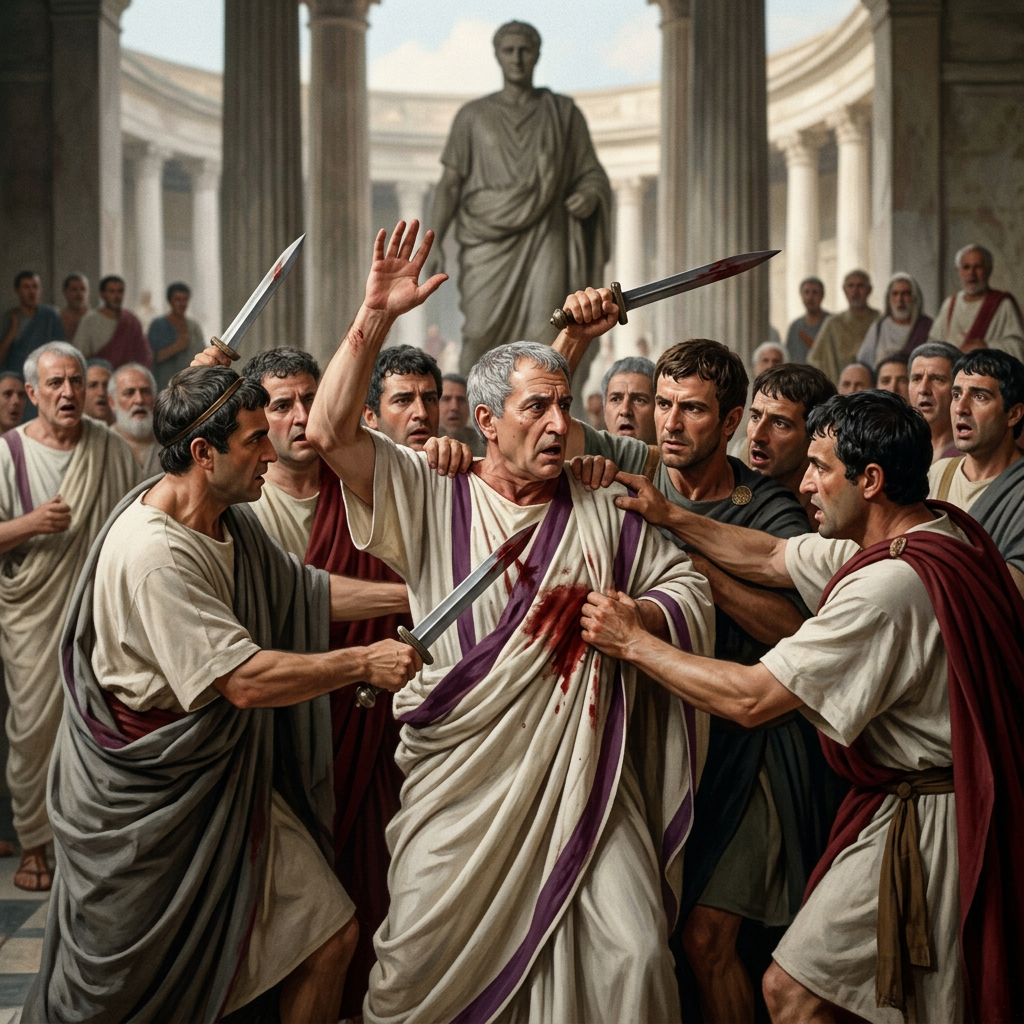
The assassination of Julius Caesar is one of the most famous political murders in history. On March 15, 44 BC, known to the Romans as the Ides of March, a group of Roman senators surrounded Julius Caesar during a meeting at the Curia of Pompey in Rome and attacked him with daggers.
But who were the assassins of Julius Caesar, and why did they decide to kill one of the most powerful men in the ancient world?
The answer is more complicated than the famous story of Brutus simply betraying Caesar. The conspiracy involved dozens of Roman senators, politicians, military commanders, and former allies of Caesar. Among the most important were Marcus Junius Brutus, Gaius Cassius Longinus, Decimus Junius Brutus Albinus, Gaius Trebonius, Publius Servilius Casca Longus, and Lucius Tillius Cimber.
Ancient sources indicate that more than 60 men were involved in the wider conspiracy, although the exact number varies between accounts. Suetonius identifies Cassius and Marcus and Decimus Brutus as leading figures in the plot.
The conspirators claimed that they were acting to defend the Roman Republic. They feared that Caesar’s extraordinary accumulation of power would destroy Rome’s republican system and turn Caesar into a king or permanent dictator.
Ironically, the assassination of Julius Caesar did not save the Republic. Instead, it triggered another series of civil wars and helped create the conditions for the rise of Augustus and the Roman Empire.
Who Were the Assassins of Julius Caesar?
The assassins of Julius Caesar were primarily members of the Roman political elite who participated in a conspiracy against Caesar in 44 BC.
The most prominent conspirators included:
- Marcus Junius Brutus — one of the most famous leaders of the conspiracy.
- Gaius Cassius Longinus — an experienced military commander and major organizer of the plot.
- Decimus Junius Brutus Albinus — a trusted friend and general of Caesar who played a crucial role in bringing him to the Senate.
- Gaius Trebonius — a former Caesar supporter who helped prevent Mark Antony from intervening.
- Publius Servilius Casca Longus — traditionally identified as the first conspirator to physically attack Caesar.
- Lucius Tillius Cimber — helped create the situation that allowed the attack to begin.
These were not random criminals or outsiders. They were members of Rome’s political and military establishment.
Many had personal connections to Caesar. Some had previously fought against him. Others had served under him and had benefited from his victories.
That is one of the most fascinating aspects of the Julius Caesar assassination: some of the men who killed him had once been his allies.

Why Was Julius Caesar Assassinated?
To understand why Julius Caesar was assassinated, it is necessary to understand the political crisis of the Roman Republic.
Rome had spent decades experiencing political violence, social conflict, military competition, and civil war.
The traditional Roman Republic was built around elected officials, the Senate, assemblies, and the principle that political power should not permanently belong to one individual.
Caesar’s career challenged this system.
He became enormously powerful after winning a series of military campaigns, especially his conquest of Gaul. His army was personally loyal to him, and his military success gave him enormous political influence.
The situation became even more dangerous after Caesar crossed the Rubicon in 49 BC, beginning a civil war against his political rival Pompey and Pompey’s supporters.
Caesar eventually defeated Pompey and became the dominant political figure in Rome.
He was appointed dictator several times and, in 44 BC, received the title dictator perpetuo, meaning dictator in perpetuity.
For Caesar’s supporters, this represented stability after years of civil war.
For his enemies, it looked like the destruction of the Republic.
Fear of a Roman King
One of the biggest fears among Caesar’s opponents was that he intended to become king.
The Romans had a deep cultural hatred of monarchy. According to traditional Roman history, the Roman Republic had been established after the expulsion of Rome’s kings centuries earlier.
The title “king” was therefore politically dangerous.
Caesar accumulated honors that made some senators uncomfortable. He received extraordinary political powers, public honors, and unprecedented personal authority.
Some of his opponents believed that the Republic was being replaced by personal rule.
The conspirators therefore presented themselves as liberators.
Their argument was simple: if Caesar was removed, traditional Roman government could be restored.
History would ultimately prove that their solution was far more complicated than they expected.

Marcus Junius Brutus
When people ask who killed Julius Caesar, the name Marcus Junius Brutus is usually the first answer.
Brutus was a Roman senator from an influential family. He had originally supported Pompey during the civil war against Caesar.
After Caesar defeated Pompey, however, Caesar pardoned Brutus.
This was important because Caesar could have treated Brutus as an enemy. Instead, he allowed him to return to political life and gave him important responsibilities.
Brutus therefore had a complicated relationship with Caesar.
He was not simply an enemy who had hated Caesar for years.
The ancient sources portray Brutus as deeply concerned with the political future of Rome. He appears to have believed that Caesar’s continued rule threatened republican government.
His involvement also gave the conspiracy legitimacy.
Brutus came from a family associated with the defense of the Republic. His ancestor, Lucius Junius Brutus, was traditionally credited with helping overthrow Rome’s last king.
This family history made Marcus Brutus an especially powerful symbol for the conspirators.

Gaius Cassius Longinus
If Brutus became the symbolic face of the conspiracy, Gaius Cassius Longinus was one of its principal organizers.
Cassius was an experienced military commander and politician.
Like Brutus, he had been associated with Pompey’s side during the civil war. Caesar eventually pardoned him as well.
Cassius was deeply suspicious of Caesar’s growing authority.
Ancient sources portray him as determined and practical. He was instrumental in bringing other conspirators into the plot.
Cassius also had a complicated personal history with Caesar.
He had once served under Caesar, but his political ambitions and disagreements with Caesar’s growing power eventually placed him among the dictator’s most dangerous opponents.
Plutarch and other ancient writers emphasize Cassius’s influence on Brutus and the conspiracy.
The partnership between Brutus and Cassius became the core of the assassination plot.

Decimus Brutus: The Forgotten Assassin
One of the most important names in the assassination of Julius Caesar is also one of the least remembered.
That man was Decimus Junius Brutus Albinus.
Decimus was not the same person as Marcus Junius Brutus.
He was a Roman politician and military commander who had been closely associated with Caesar.
In fact, Decimus was one of Caesar’s trusted commanders.
This made his betrayal particularly important.
According to ancient accounts, Caesar hesitated about attending the Senate meeting on the Ides of March. Decimus Brutus was sent to persuade him to go.
Cassius Dio describes Decimus as someone who was considered a devoted friend of Caesar and says he persuaded Caesar to attend the meeting when the conspirators feared their plan might fail.
This was a critical part of the conspiracy.
The assassins needed Caesar to appear in a location where they could surround him.
Decimus helped make that possible.
This is why modern historians often emphasize Decimus when discussing the real mechanics of the Julius Caesar assassination.

Gaius Trebonius
Another important conspirator was Gaius Trebonius.
Trebonius had served under Caesar and had been involved in Caesar’s military and political world.
However, he eventually joined the conspiracy.
His role during the assassination was particularly important because Mark Antony, Caesar’s colleague and ally, represented a potential threat to the assassins.
According to ancient accounts, Trebonius helped keep Antony away from Caesar at the critical moment.
This was an important tactical decision.
If Antony had remained next to Caesar, he might have tried to defend him or immediately attacked the conspirators.
The assassins therefore needed to isolate Caesar before launching the attack.

Publius Servilius Casca
Publius Servilius Casca Longus is another important name in the story.
Casca is traditionally associated with the first physical attack against Caesar.
According to Suetonius, after Tillius Cimber grabbed Caesar’s toga, one of the Cascas attacked Caesar near the throat. Caesar reportedly resisted the initial blow before the other conspirators joined the attack.
This moment transformed the conspiracy from a political plot into an assassination.
Once the first blow was delivered, the conspirators attacked together.
Caesar was surrounded by senators who had concealed their weapons.
The attack was chaotic and extremely violent.

Lucius Tillius Cimber
Lucius Tillius Cimber played another crucial role.
Cimber approached Caesar with a request concerning his brother, who had been exiled.
Caesar apparently refused to grant the request.
Cimber then seized Caesar’s toga.
This action helped signal the beginning of the attack.
Suetonius describes the conspirators gathering around Caesar as if they were paying their respects before Cimber took the lead and grabbed Caesar’s clothing.
The scene demonstrates how carefully the conspirators had planned the attack.
They could not simply walk into Rome and attack Caesar.
They needed to get close to him.
The Senate meeting provided the perfect opportunity.
The Conspiracy Was Larger Than Brutus and Cassius
Popular culture often reduces the assassination to three characters: Caesar, Brutus, and Cassius.
The historical conspiracy was much larger.
Ancient sources indicate that more than 60 men participated in the conspiracy, although the exact number and list of participants vary among ancient writers.
The conspirators came from different political backgrounds.
Some wanted to restore republican government.
Some had personal grievances against Caesar.
Some feared that Caesar’s political reforms would reduce the power of the traditional aristocracy.
Others may simply have believed that Caesar had become too powerful.
This means there was no single motivation shared equally by every assassin.

The Ides of March
The assassination occurred on March 15, 44 BC.
The Romans called this date the Ides of March.
The date became famous because it represented the moment when the conspiracy finally succeeded.
According to ancient accounts, Caesar had received warnings about possible danger.
One famous warning came from the soothsayer Spurinna, who reportedly warned Caesar to beware of danger around the Ides of March.
The story became famous partly because Caesar encountered the soothsayer on the day itself.
Plutarch records a tradition in which Caesar joked that the Ides had arrived, to which the seer supposedly responded that they had arrived but had not yet passed.
There were also stories about Caesar receiving a warning about the conspiracy.
According to Suetonius, a note revealing the plot was handed to Caesar, but he did not read it before entering the Senate.
These stories have become part of the mythology surrounding the assassination.
Where Was Julius Caesar Assassinated?
Despite popular artistic representations, Caesar was not assassinated inside the famous Roman Senate House that tourists often associate with the event.
The Senate was meeting at the Curia of Pompey, part of the Theatre of Pompey complex.
The location was politically and symbolically significant.
Pompey had once been Caesar’s great rival.
Caesar had defeated Pompey during the civil war, and Pompey had ultimately been murdered in Egypt.
Now Caesar was attacked near a monument associated with his former enemy.
Ancient sources emphasize the dramatic symbolism of the location.
How Was Julius Caesar Killed?
When Caesar arrived at the meeting, the conspirators gathered around him.
They apparently approached him under the appearance of making a request.
Cimber initiated the physical confrontation.
Casca then struck Caesar.
The other conspirators joined.
Caesar was stabbed repeatedly.
Suetonius reports that Caesar received 23 wounds, although ancient sources are not completely consistent about the precise number.
The attack was not the work of one assassin.
It was a coordinated assault by numerous conspirators.
Caesar eventually collapsed and died at the scene.
The precise details of his final moments remain uncertain because our sources were written after the event and contain different versions.

Did Julius Caesar Say “Et Tu, Brute?”
Probably not in the exact form made famous by Shakespeare.
The phrase “Et tu, Brute?” comes from William Shakespeare’s play Julius Caesar.
The historical sources provide different accounts of Caesar’s final words.
Suetonius says Caesar may have died without speaking, although he records another tradition in which Caesar addressed Brutus in Greek with words that can be translated approximately as “You too, child?”
The exact historical truth is impossible to establish with certainty.
Shakespeare transformed this uncertainty into one of the most memorable moments in literature.
Today, “Et tu, Brute?” has become a phrase representing betrayal by someone trusted.
Why Did Brutus Betray Caesar?
The relationship between Brutus and Caesar is one of the most fascinating elements of the story.
Caesar had shown Brutus mercy after the civil war.
He had allowed him to live and continue his political career.
So why would Brutus participate in Caesar’s murder?
The answer appears to involve Brutus’s political philosophy and his perception of Caesar’s power.
Brutus believed that Rome was becoming dangerously dependent on one man.
He may have concluded that killing Caesar was a necessary sacrifice for the survival of the Republic.
This creates one of the central ironies of ancient Roman history.
Brutus killed Caesar because he believed Caesar’s rule threatened Roman liberty.
But Caesar’s death did not restore liberty.
Instead, it helped create another civil war.
What Happened Immediately After Caesar’s Death?
The assassins did not immediately become masters of Rome.
They had killed Caesar, but they had not created a workable political settlement.
Rome was now politically unstable.
Mark Antony survived.
Caesar’s supporters survived.
And Caesar had left behind a powerful network of political allies and soldiers.
The assassins apparently hoped that killing Caesar would cause Rome to return quickly to republican government.
Instead, political competition intensified.
The conspirators eventually left Rome and established themselves in the eastern provinces.
Brutus and Cassius raised armies.
Meanwhile, Mark Antony and Caesar’s adopted heir Octavian emerged as major political forces.

What Happened to Brutus and Cassius?
Brutus and Cassius eventually became the leaders of the forces opposing Antony and Octavian.
Their armies met the forces of Antony and Octavian at Philippi in 42 BC.
The battles were disastrous for the assassins.
Cassius died by suicide after mistakenly believing that his forces had suffered a decisive defeat.
Brutus fought on but was eventually defeated.
He also died by suicide.
The deaths of Brutus and Cassius effectively ended the main military resistance of Caesar’s assassins.
Other conspirators met different fates.
Some died in the wars that followed.
Others were captured or killed.
The political movement that had begun with the assassination had failed to restore the old Republic.
Did the Assassins Achieve Their Goal?
This is perhaps the most important question surrounding the assassination of Julius Caesar.
The conspirators wanted to prevent Caesar from establishing permanent personal rule.
But their assassination did not accomplish that objective.
Instead, Caesar’s death created another power struggle.
Octavian eventually defeated Mark Antony and became the dominant political figure in Rome.
In 27 BC, Octavian received the title Augustus.
He became the first Roman emperor, although he maintained many republican institutions and presented his political system as a restoration of order.
The Roman Republic had therefore entered its final transformation.
The assassins had killed one dictator, but they had not eliminated the political conditions that allowed one-man rule to emerge.
The Great Irony of Caesar’s Assassination
The assassination of Julius Caesar is remembered as an attempt to save the Republic.
But the result was almost the opposite.
The murder destabilized Rome.
It contributed to another round of civil wars.
It allowed Octavian to build political power.
Eventually, Rome became an empire.
This does not mean that the assassins were simply wrong about everything.
Caesar really had accumulated extraordinary powers.
The Roman Republic really was under enormous strain.
And many Roman elites genuinely feared that Caesar intended to establish a permanent form of personal rule.
The tragedy is that removing Caesar did not solve the deeper structural problems of Roman politics.
Julius Caesar Assassination: Historical Fact vs. Popular Myth
Over the centuries, the story of Caesar’s death has been dramatically transformed.
Shakespeare’s play is largely responsible for the popular image of the assassination.
In movies, paintings, novels, and television shows, Caesar is often shown surrounded by dozens of senators who repeatedly stab him while he cries out dramatically.
The real event was probably more complicated.
Ancient accounts were themselves written after the assassination and contain differences in detail.
The exact number of assassins, the number of wounds, Caesar’s final words, and several other details are debated.
What historians can say with confidence is that a large group of Roman senators conspired to kill Caesar on March 15, 44 BC, and that Brutus, Cassius, and Decimus Brutus were among the central figures.

Frequently Asked Questions About the Assassins of Julius Caesar
Who were the main assassins of Julius Caesar?
The principal conspirators included Marcus Junius Brutus, Gaius Cassius Longinus, and Decimus Junius Brutus Albinus. Other important participants included Gaius Trebonius, Publius Servilius Casca, and Lucius Tillius Cimber.
How many people assassinated Julius Caesar?
Ancient accounts differ, but Suetonius states that more than 60 people joined the conspiracy. The exact number of men who physically attacked Caesar is less certain.
Who stabbed Julius Caesar first?
Ancient accounts associate Publius Servilius Casca with the first attack. Suetonius describes one of the Cascas stabbing Caesar after Tillius Cimber grabbed his toga.
Why did Brutus kill Julius Caesar?
Brutus appears to have believed that Caesar’s growing political power threatened the Roman Republic. His decision was influenced by republican ideals, political concerns, and the belief that Caesar’s rule could lead to permanent one-man government.
Was Cassius the leader of the assassination?
Cassius was one of the conspiracy’s principal organizers and leaders. However, the plot involved numerous conspirators, and it is misleading to describe it as the work of only one man.
Where was Julius Caesar killed?
Caesar was assassinated at the Curia of Pompey, a meeting place associated with the Theatre of Pompey in Rome, during a Senate meeting.
What day was Julius Caesar assassinated?
Julius Caesar was assassinated on March 15, 44 BC, the Roman Ides of March.
Did Julius Caesar really say “Et tu, Brute?”
There is no certainty that he did. The famous phrase comes from Shakespeare. Ancient sources provide different accounts of Caesar’s final words, including a tradition that he may have addressed Brutus in Greek.
What happened to Caesar’s assassins?
Many of the conspirators eventually fought against Caesar’s supporters. Brutus and Cassius were defeated at Philippi in 42 BC and died by suicide. Other conspirators suffered different fates during the civil wars that followed.
Conclusion: Who Were the Assassins of Julius Caesar?
So, who were the assassins of Julius Caesar?
They were not simply a handful of jealous politicians. They were a large group of Roman senators and political figures who believed that Caesar’s extraordinary power threatened the Roman Republic.
At the center of the conspiracy were Marcus Junius Brutus, Gaius Cassius Longinus, and Decimus Junius Brutus Albinus. They were supported by other important figures, including Gaius Trebonius, Publius Servilius Casca, and Lucius Tillius Cimber. Ancient sources indicate that more than 60 men joined the wider conspiracy.
Their motivations were complicated.
Some were genuinely concerned about the future of republican government. Others had personal or political grievances against Caesar. Some feared that Caesar intended to become king or establish permanent personal rule.
The Ides of March, March 15, 44 BC, became the moment when these fears turned into action.
The conspirators surrounded Caesar during a Senate meeting at the Curia of Pompey and attacked him with daggers. Caesar suffered multiple wounds and died at the scene.
Yet the assassins failed to achieve their ultimate objective.
They had hoped that Caesar’s death would restore the Roman Republic. Instead, his assassination produced political chaos, renewed civil war, and eventually the rise of Octavian, who became Augustus.
In one of history’s greatest ironies, the men who killed Caesar in the name of republican freedom helped create the circumstances in which the Roman Republic finally disappeared.
The assassination of Julius Caesar therefore remains important not merely because Caesar was killed, but because his death reveals the deep political crisis of ancient Rome. The conspirators could eliminate a man, but they could not eliminate the social, military, and political forces that had made Caesar so powerful in the first place.
That is why the story of who were the assassins of Julius Caesar continues to fascinate historians and readers more than two thousand years later. Brutus, Cassius, Decimus Brutus, and their fellow conspirators believed that one dramatic act could save Rome.
Instead, the daggers of the Ides of March helped open the door to the Roman Empire.
And that is the ultimate tragedy of Julius Caesar’s assassination: the men who believed they were killing a dictator to save the Republic may have helped ensure that the Republic would never return.
Fortisetliber’s View
The assassination of Julius Caesar is often presented as a heroic attempt to save the Roman Republic. Brutus, Cassius, and their fellow conspirators claimed that Caesar had become too powerful and that his rule threatened Roman freedom.
From a FortisLiber perspective, however, the story deserves a more critical reading.
Caesar certainly accumulated extraordinary power. By 44 BC, he had defeated his political enemies, commanded enormous military influence, and been appointed dictator for life. The fear that Rome was moving toward one-man rule was not entirely imaginary.
But murdering Caesar was not the same thing as restoring liberty.
The conspirators had a political grievance, but they lacked a convincing plan for what would come next. They removed the most powerful individual in Rome without resolving the deeper problems that had weakened the Republic for decades: political rivalry, economic inequality, military loyalty to individual commanders, and the growing influence of powerful generals.
This is where the assassination becomes a lesson in political history.
The conspirators succeeded in killing Caesar, but they failed to kill the conditions that had made Caesar possible.
Brutus is particularly interesting. He has traditionally been portrayed as the noble republican who chose Rome over personal loyalty. Yet Caesar’s death did not bring political stability. Instead, it contributed to another round of civil wars, eventually allowing Octavian to emerge as the dominant ruler of Rome.
The result was almost the opposite of what the assassins intended.
Rather than restoring the old Republic, the assassination helped accelerate Rome’s transformation into an empire.
This does not necessarily mean that Caesar’s rule was desirable or that the conspirators had no legitimate concerns. Their fear of concentrated power was understandable. Their mistake was believing that political freedom could be restored through assassination alone.
The history of Caesar therefore offers a powerful warning:
Removing a leader does not automatically remove the political system, institutions, ambitions, and social conditions that allowed that leader to become powerful.
The Ides of March was supposed to be a victory for the Republic.
Instead, it became one of the final steps toward the Empire.
For FortisLiber, that is the most important lesson of Caesar’s assassination: liberty cannot survive on the courage to oppose a powerful ruler alone. It also requires strong institutions, political responsibility, and a workable vision for what comes after the struggle.
Caesar was killed in the name of the Republic.
But the Republic did not survive him.
Leave a Reply