
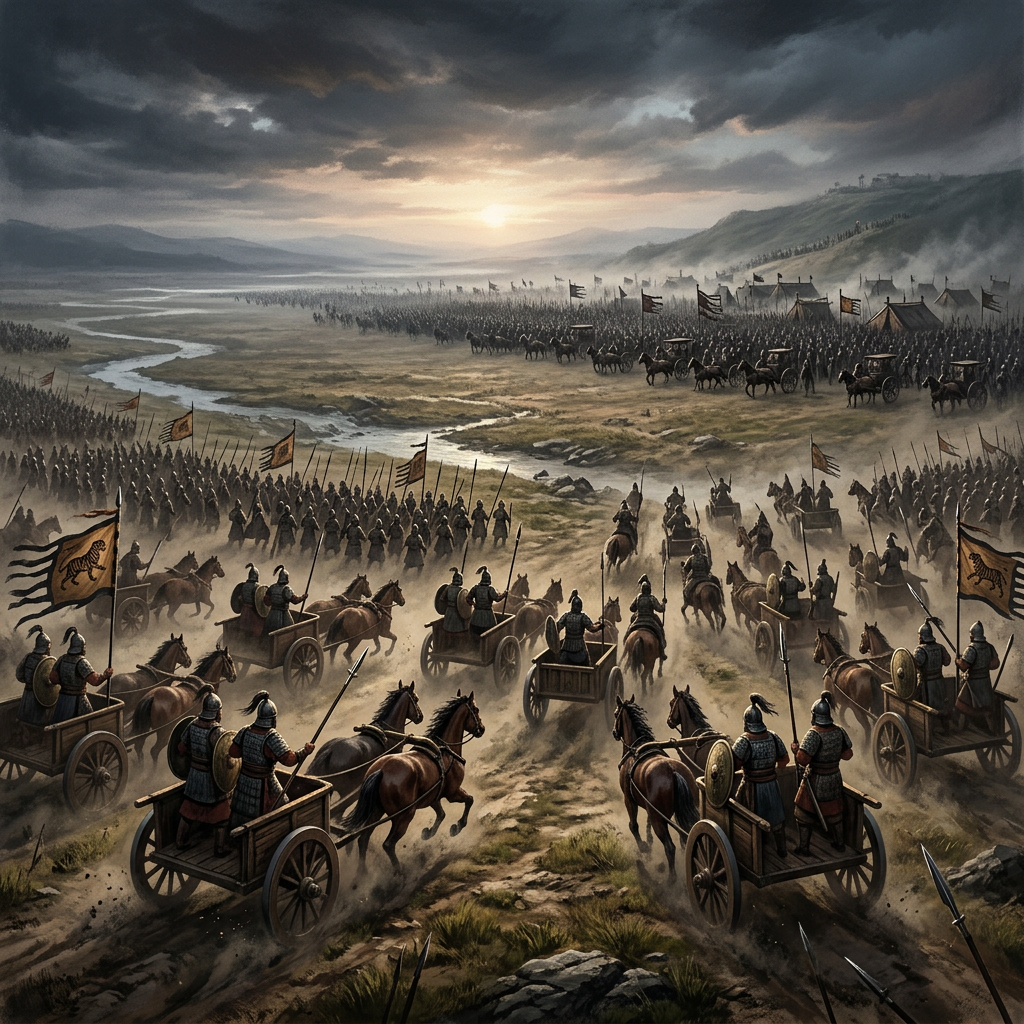
The Battle of Muye, fought around 1046 BCE, was one of the most consequential battles in the history of ancient China. In a single campaign, the rising Zhou state defeated the ruling Shang dynasty, captured the Shang political center at Yin, and opened the way for a new dynasty that would dominate China for almost eight centuries.
The battle was fought between the forces of King Wu of Zhou and King Di Xin of Shang, often known in later tradition simply as King Zhou. The Zhou victory became much more than a military event. Later Chinese historians interpreted it through the idea of the Mandate of Heaven—the principle that Heaven could withdraw its support from an unjust ruler and grant legitimate authority to a new one.
Yet the Battle of Muye is also surrounded by uncertainty. Ancient sources provide dramatic accounts of enormous armies, defections, chariot warfare, and the collapse of Shang authority, while modern historians question some of the traditional numbers and details. Even the exact date of the battle has been debated, although 1046 BCE is the date associated with the Xia–Shang–Zhou Chronology Project.
For that reason, the Battle of Muye 1046 BCE should be understood both as a historical military confrontation and as one of the foundational stories of Chinese political thought.
China Before the Battle of Muye
To understand why the Battle of Muye was so important, it is necessary to look at the political world of the late Shang period.
The Shang dynasty was one of the earliest historically documented dynasties of China. It controlled a large portion of the Yellow River region and developed a sophisticated political and religious culture.
Shang civilization is particularly famous for its bronze technology, royal tombs, oracle-bone inscriptions, ancestor worship, and powerful kingship.
The Shang capital eventually became established at Yin, near modern Anyang in Henan Province. Archaeological discoveries at Yinxu have provided extraordinary evidence for Shang civilization, including royal tombs, bronze vessels, weapons, and thousands of inscriptions.
By the final decades of the dynasty, however, the Shang faced growing political challenges.
One of the most important regional powers was the Zhou, originally based farther west in the Wei River valley. The Zhou had been subordinate to the Shang but gradually became more powerful.

The Rise of the Zhou
The Zhou were not initially the rulers of China.
They were a regional power whose territory lay to the west of the Shang heartland.
Under King Wen of Zhou, the Zhou state became increasingly influential.
According to traditional accounts, King Wen had originally been recognized by the Shang ruler as an important western leader. Yet the relationship between the two powers deteriorated as Zhou strength increased.
King Wen expanded Zhou territory and built alliances with neighboring states.
He also became famous in later Zhou tradition as a wise and virtuous ruler.
However, he died before he could complete the conquest of the Shang.
His son, Ji Fa, succeeded him and became known as King Wu of Zhou.
King Wu inherited both his father’s political ambitions and the growing network of alliances that had been created by the Zhou.
The stage was now set for a confrontation.
King Di Xin of Shang
The last ruler of the Shang dynasty was Di Xin.
Later Chinese traditions portray him as an exceptionally cruel and corrupt ruler.
Stories describe extravagant construction projects, excessive taxation, violence, and moral decadence.
The famous figure of Daji, traditionally described as his favorite consort, became closely associated with these stories.
However, historians must be careful when accepting this portrayal.
Much of the image of Di Xin as a uniquely evil ruler comes from sources written or transmitted after the Zhou conquest. The Zhou had an obvious political reason to portray the last Shang ruler as unworthy of Heaven’s support.
Nevertheless, the Shang dynasty was clearly facing serious political and military pressures by the time of its final conflict with Zhou.
The Zhou used these circumstances to present their rebellion not as an act of simple conquest, but as a justified overthrow of an illegitimate ruler.
The Mandate of Heaven
The Mandate of Heaven became one of the most important ideas associated with the Zhou conquest.
The basic concept was revolutionary.
A ruler did not possess unlimited authority simply because he belonged to a royal family.
Heaven could grant legitimate authority to a ruler—but it could also withdraw that authority.
If a king became unjust, incompetent, or destructive, his defeat could be interpreted as evidence that he had lost Heaven’s mandate.
This idea provided the Zhou with a powerful justification for overthrowing the Shang.
Rather than saying:
“We conquered the Shang because we were stronger,”
the Zhou tradition effectively argued:
“Heaven had abandoned the Shang, and we were chosen to restore order.”
The concept would influence Chinese political philosophy for thousands of years.

The March Toward Muye
King Wu eventually decided that the time had come to attack.
According to traditional accounts, the Zhou king assembled an alliance of regional powers and marched eastward.
The Book of Documents preserves the famous “Oath at Muye,” in which King Wu addressed his troops before the battle.
The Zhou army was not composed only of Zhou soldiers.
Several allied groups participated in the campaign.
Traditional sources name groups including Yong, Shu, Qiang, Mao, Wei, Lu, Peng, and Pu among the forces supporting the Zhou.
This alliance was strategically important.
The Zhou were challenging an established dynasty, so additional military support increased both their battlefield strength and political legitimacy.
The Armies at Muye
Ancient Chinese sources give extraordinarily large figures for the armies involved.
Some traditional accounts describe the Shang army as numbering hundreds of thousands of men.
Other traditions even give figures approaching 700,000 troops.
Modern historians generally regard these numbers with considerable skepticism.
One commonly cited modern estimate places the Shang force at roughly 50,000–70,000 troops, while traditional accounts give much larger figures.
The Zhou force is also described in traditional sources as containing tens of thousands of infantrymen, elite troops, and large numbers of chariots supplied by Zhou and allied forces.
The exact numbers remain uncertain.
What is much more important is that the battle involved a substantial coalition and that the Shang defenders suffered from serious problems of loyalty and morale.

The Battle of Muye Begins
The Zhou army reached the plain of Muye, located southwest of Yin.
The battlefield was close enough to the Shang political center that the outcome would have immediate consequences.
King Wu’s forces prepared for battle.
The Zhou army was smaller than the numbers later attributed to the Shang, but it had important advantages.
The Zhou coalition was highly motivated.
Its leaders believed that they were fighting a justified war.
The Shang army, meanwhile, was being asked to defend a dynasty whose political authority was increasingly contested.
This difference in morale would become critical.
The Famous Shang Defections
One of the most dramatic elements of the Battle of Muye is the story of Shang soldiers abandoning their king.
Traditional sources claim that Di Xin had been forced to mobilize large numbers of men who were poorly motivated or unwilling to fight for the Shang regime.
Some accounts describe prisoners or enslaved people being armed for the defense of the kingdom.
According to the traditional narrative, many of these men either refused to fight or defected to the Zhou.
Modern historians are cautious about accepting the details literally.
Nevertheless, the broader historical point is plausible: political loyalty mattered enormously in ancient warfare, and a collapsing regime could lose a battle even when it possessed substantial military resources.
The Zhou victory therefore appears to have depended not simply on battlefield tactics but on the weakening of Shang authority.

Zhou Chariots and Bronze Age Warfare
The Battle of Muye also provides an important glimpse into ancient Chinese warfare.
The Shang and Zhou operated in a Bronze Age military environment in which chariots played an important role.
Chariots were expensive and required considerable resources.
They could provide mobility, command platforms, and shock action on suitable terrain.
Bronze weapons were also central to elite warfare.
Axes, spearheads, dagger-axes, arrowheads, and other bronze weapons have been discovered at archaeological sites associated with the period.
However, armies were not composed exclusively of chariot warriors.
Infantry formed a crucial part of ancient Chinese armies.
The battle at Muye therefore represented a combination of chariot warfare, infantry combat, command organization, and coalition warfare.
The Collapse of Shang Resistance
Once the Zhou attack began, the Shang army reportedly began to collapse.
The precise tactical sequence is uncertain.
Later accounts emphasize the low morale of the Shang troops and their refusal to fight effectively.
As the Zhou army advanced, Shang resistance broke apart.
King Wu’s forces achieved a decisive victory.
The consequences were enormous.
The Shang dynasty, which had ruled for centuries, was effectively finished.
The Zhou army moved toward Yin, the Shang capital.
The old political order had collapsed.

The Death of Di Xin
The traditional story states that Di Xin retreated to his palace after the defeat.
He then gathered valuable objects around himself and set fire to the palace, dying in the flames.
This dramatic account became part of the enduring image of the final Shang ruler.
Other ancient traditions provide different versions of his death.
Because the sources were written or transmitted later, historians cannot treat every detail as certain.
What is much more secure is that the Shang dynasty lost political control and that the Zhou established itself as the new ruling power.
The End of the Shang Dynasty
The victory at Muye marked the end of the Shang Dynasty as the dominant political power.
The Zhou then established a new political order.
King Wu became the founding ruler of the Western Zhou Dynasty.
The transition was not necessarily instantaneous or peaceful everywhere.
Shang elites and territories continued to exist.
The Zhou had to consolidate their authority and deal with resistance.
But the balance of power had fundamentally changed.
The Zhou now stood at the center of the Chinese political world.

The Beginning of the Zhou Dynasty
The Zhou Dynasty would become the longest-lasting dynasty in traditional Chinese history, conventionally dated from about 1046 to 256 BCE.
Its political system was different from that of the Shang.
The Zhou distributed territories among relatives, allies, and subordinate rulers.
These regional states became increasingly important over time.
The system helped the Zhou control a large territory but also eventually contributed to political fragmentation.
Centuries later, competing Zhou states would fight one another during the Warring States period.
But all of this political history ultimately traces back to the Zhou victory over the Shang.
Why the Battle of Muye Was So Important
The significance of Muye goes far beyond the battlefield.
It changed Chinese political history in several fundamental ways.
1. The Shang Dynasty Fell
The battle brought an end to Shang political supremacy.
2. The Zhou Dynasty Rose
The Zhou became the new ruling house.
3. The Mandate of Heaven Became Central
The Zhou developed a powerful ideological justification for dynastic change.
4. Political Legitimacy Changed
Kingship was increasingly associated with moral responsibility.
5. Chinese Historical Thought Was Transformed
Later dynasties repeatedly used the idea that Heaven could remove an unjust ruler.
The concept became one of the most enduring ideas in Chinese political philosophy.

The Battle of Muye in Chinese Historical Memory
Later Chinese historians did not remember Muye simply as a military engagement.
They transformed it into a moral lesson.
The battle demonstrated, in traditional interpretation, that a ruler who abandoned justice could lose Heaven’s support.
This interpretation had enormous consequences.
Centuries later, Chinese rebels and dynastic founders could present their own victories as evidence that the existing ruler had lost the Mandate of Heaven.
Thus, the Battle of Muye became an example of a broader principle:
dynasties could rise and fall according to their moral and political legitimacy.
Historical Sources and Archaeological Evidence
The story of Muye comes from several important traditions, including the Book of Documents, the Shijing or Book of Songs, and later historical works such as Sima Qian’s Records of the Grand Historian.
These sources do not always agree perfectly.
Some contain speeches and dramatic details that historians cannot verify independently.
Archaeology provides another perspective.
The discoveries at Yinxu, the late Shang capital near Anyang, confirm the sophistication and power of Shang civilization.
Oracle-bone inscriptions demonstrate that the Shang possessed a highly organized royal government, religious system, and military structure.
Archaeology therefore confirms the broader historical setting even when it cannot independently verify every detail of the traditional battle narrative.

The Uncertain Date of Muye
Although 1046 BCE is the date most commonly associated with the Battle of Muye today, the chronology of the Shang-Zhou transition has been debated for centuries.
Earlier scholars proposed numerous possible dates for the conquest, ranging across more than a century.
The Xia–Shang–Zhou Chronology Project identified 1046 BCE as its preferred date for the Zhou conquest, but the dating remains subject to scholarly discussion.
Therefore, writing “Battle of Muye, c. 1046 BCE” is often more historically cautious than presenting the date as absolutely certain.
The Legacy of Muye
The Zhou victory at Muye established a political model that would influence China for generations.
The basic argument was powerful:
A dynasty ruled because it possessed Heaven’s approval.
If it became corrupt and failed to protect the people, Heaven could withdraw that approval.
A new ruler could therefore overthrow the old dynasty and claim legitimacy.
This idea became deeply embedded in Chinese history.
From the Zhou to the Han, Tang, Ming, and other dynasties, political change was frequently interpreted through the language of Heaven’s mandate.
The Battle of Muye was therefore remembered not simply as the moment when one army defeated another.
It became a model for understanding why dynasties rise and fall.

Conclusion: The Battle That Changed Ancient China
The Battle of Muye in 1046 BCE was one of the defining turning points of ancient Chinese history.
At Muye, the Zhou coalition led by King Wu of Zhou defeated the Shang forces of Di Xin.
The Shang dynasty collapsed.
The Zhou dynasty began.
But the battle’s greatest legacy was ideological.
The Zhou did not simply claim that they had won because they possessed the stronger army.
They argued that Heaven itself had withdrawn its support from the Shang.
The idea of the Mandate of Heaven transformed the meaning of political power in China.
It suggested that rulers had responsibilities as well as privileges—and that a dynasty could lose its right to rule.
The exact size of the armies, the precise tactical events, and even some details of the battle remain uncertain. Yet the historical consequences are unmistakable.
A Bronze Age battle on a plain near the Shang capital became the foundation for a political philosophy that would influence Chinese civilization for more than two thousand years.
Muye was not merely the battle that ended the Shang. It was the battle that gave China one of its most enduring ideas about power, legitimacy, and the rise and fall of dynasties.
Fortisetliber’s View
Around 1046 BCE, on a plain known as Muye, two powers faced one another in one of the most consequential battles of ancient China.
On one side stood the Shang Dynasty, an established Bronze Age power led by Di Xin. On the other stood the rising Zhou, led by King Wu of Zhou and supported by a coalition of allies. The Zhou victory brought the collapse of Shang political power and opened the way for the Zhou Dynasty.
But for FortisLiber, the most fascinating part of Muye is not simply who won.
It is why the Zhou believed they had the right to rule.
The Zhou developed the idea of the Mandate of Heaven: the belief that Heaven could grant legitimate authority to a ruler, but could also withdraw that authority from a corrupt or unsuccessful dynasty.
In this interpretation, the Zhou did not simply conquer the Shang.
Heaven had chosen a new ruler.
This idea would become one of the most influential concepts in Chinese political history, providing a framework through which later dynasties could explain their own rise and the fall of their predecessors.
Yet the real Battle of Muye remains partly hidden behind tradition. Ancient sources give dramatic accounts of enormous armies and Shang soldiers abandoning their king, while modern historians question some of the traditional numbers and details.
That uncertainty makes Muye even more fascinating.
We can never completely recover the voices of the soldiers who stood on that ancient battlefield.
But we can see the consequences of what happened there.
One dynasty disappeared.
Another began.
And from the battlefield of Muye emerged an idea that would shape Chinese civilization for centuries.
FortisLiber sees Muye not merely as the battle that ended the Shang, but as the moment when military victory became a new philosophy of power.
Empires fall. Dynasties change. But the ideas born from their struggles can survive for thousands of years.
Leave a Reply