
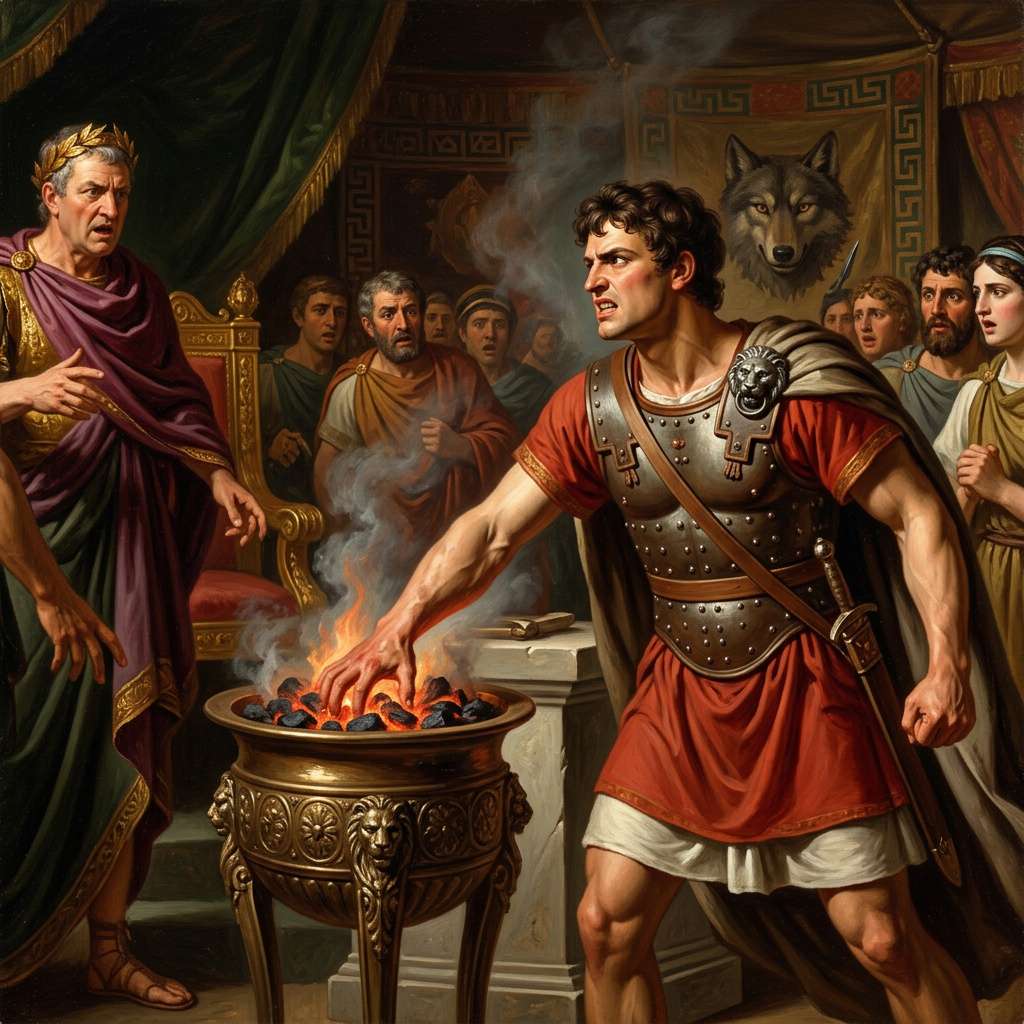
Few stories from the early Roman Republic capture the Roman ideal of courage as vividly as the legend of Gaius Mucius Scaevola. According to ancient tradition, this young Roman aristocrat attempted to assassinate the Etruscan king Lars Porsena, who was besieging Rome. When the attempt failed, Mucius demonstrated such extraordinary contempt for pain that his name became permanently associated with courage, sacrifice, and unwavering loyalty to Rome.
The story of Mucius Scaevola occupies a fascinating position between history and legend. Ancient authors such as Livy and Dionysius of Halicarnassus preserved the tale, while later scholarship has questioned how much of the episode can be regarded as historical fact. The legend was already circulating by the second century BCE, and Oxford Classical Dictionary describes it as part of the cycle of legends surrounding Lars Porsena.
Yet whether every detail happened exactly as Roman tradition claimed is almost beside the point. For generations of Romans, Gaius Mucius Scaevola represented something greater: the belief that an individual could place the survival of the Republic above his own body, his own fear, and even his own life.
Rome Under Threat: Lars Porsena and the Early Republic
To understand the legend of Gaius Mucius Scaevola, we must first return to the turbulent beginning of the Roman Republic.
Traditional Roman chronology places the expulsion of Lucius Tarquinius Superbus, the last king of Rome, around 509 BCE. The new Republic was immediately surrounded by enemies and political uncertainty. According to Roman tradition, the exiled Tarquin sought foreign assistance to regain his throne.
One of the most powerful rulers drawn into the conflict was Lars Porsena, the Etruscan ruler associated with the city of Clusium.
Ancient Roman historians portrayed Porsena as a formidable enemy who marched against Rome. The siege became one of the great formative episodes of early Roman history, producing several famous stories of Roman resistance, including those of Horatius Cocles, Cloelia, and Mucius Scaevola.
Modern historians are considerably more cautious. The historical circumstances surrounding Porsena’s intervention remain uncertain, and the heroic narratives preserved by later Roman writers were undoubtedly shaped by centuries of storytelling.
Nevertheless, the image of Rome standing alone against an Etruscan monarch became central to Roman historical memory.
And within that memory, Mucius became one of its most extraordinary heroes.

The Young Roman Who Chose Assassination
According to the famous legend, Gaius Mucius was a young Roman nobleman who believed that Rome could not survive while Porsena remained alive.
Rather than wait for the Roman army to defeat the Etruscan forces, Mucius decided to take the war directly into the enemy camp.
He entered the Etruscan camp intending to assassinate the king.
The mission was extraordinarily dangerous. Mucius had to penetrate the enemy’s defenses, locate Porsena, and strike before he could be captured.
But when he reached the royal presence, he made a fatal mistake.
Mucius did not recognize the king.
According to the tradition preserved by Livy and discussed by the Oxford Classical Dictionary, he mistakenly killed the king’s secretary, who was seated beside Porsena. The presence of the secretary is particularly interesting because scholars have noted that it may preserve a genuine detail concerning Etruscan royal ceremony.
The assassination had failed.
Mucius was immediately seized.
For most men, capture would have meant terror.
For Mucius, it became the moment that created his legend.
The Hand in the Fire
Brought before Porsena, Mucius openly admitted that he had intended to kill the Etruscan king.
He did not beg for mercy.
Instead, the young Roman demonstrated that the threat of torture could not break him.
According to the best-known version of the story, Mucius deliberately placed his right hand into a fire and allowed it to burn.
He showed no sign of fear.
This shocking act transformed the confrontation.
Mucius had failed to kill Porsena, but he had achieved something else: he demonstrated that Roman courage could not easily be defeated through physical suffering.
It was this legendary act that supposedly gave him the name Scaevola, meaning “left-handed” or “left-handed man.” His right hand had been destroyed, leaving his left hand to serve him instead.
The image is one of the most powerful in Roman heroic tradition.
The body could be damaged.
The hand could be burned.
The individual could be captured.
But the will could remain undefeated.

The Threat of Three Hundred Romans
The legend becomes even more dramatic after Mucius’ self-inflicted punishment.
He reportedly told Porsena that he was not the only Roman willing to attempt the assassination.
There were, he claimed, three hundred Roman youths who had sworn to kill the Etruscan king.
Mucius had simply been the first.
The message was clear.
Killing one Roman would not end the threat.
There were many more who were prepared to sacrifice themselves for Rome.
The psychological impact of this declaration supposedly frightened Porsena. Ancient tradition eventually connected Mucius’ courage with the decision of the Etruscan king to negotiate with Rome.
The story therefore transforms a failed assassination into a strategic victory.
Mucius did not kill Porsena.
But he convinced the king that Rome could not be intimidated.
Why Was Mucius Called Scaevola?
The surname Scaevola is one of the most famous elements of the story.
In Latin, scaeva is associated with the left side or left hand. The traditional explanation is straightforward: Mucius lost the use of his right hand after deliberately holding it in the fire.
From that moment, he became Gaius Mucius Scaevola.
The story therefore functions partly as an explanation of a famous Roman family name.
But there is an important historical problem.
The Mucius Scaevola family is well documented in later Roman history, but the earliest historically secure members of the family appear centuries after the legendary episode. Livius notes that the first historically attested Gaius Mucius Scaevola is much later, while the famous historical Scaevolae of the Republic were generally named Quintus or Publius.
This has led some scholars to question whether the character’s traditional name was retroactively constructed around an older heroic legend.

Legend or History?
This is where the story of Gaius Mucius Scaevola becomes especially fascinating.
Ancient Roman writers did not necessarily approach history in the same way modern historians do.
For Roman authors, the past was also a source of moral examples.
The stories of early Roman heroes demonstrated qualities that Romans were expected to admire: courage, discipline, loyalty, endurance, sacrifice, and devotion to the state.
Livy’s account of Mucius belongs to this wider tradition.
The Oxford Classical Dictionary describes the story as an old legend and notes that the episode appeared in the history of Cassius Hemina, a Roman historian of the second century BCE. It also observes that the burning of the right hand may have had a ritual significance.
Other versions of the story differ.
Dionysius of Halicarnassus, for example, does not include the famous self-mutilation in the same form. Other ancient writers provide variations concerning how Mucius made his mistake or behaved before Porsena.
There is therefore no reason to treat every detail as historical fact.
But dismissing the story entirely would also miss its importance.
The legend tells us something extraordinarily valuable about Roman culture and Roman identity.
The Roman Virtue of Courage
The Roman concept of virtus was closely associated with courage, excellence, and manly virtue.
Gaius Mucius Scaevola became one of the clearest embodiments of this ideal.
His courage was not merely military.
He was not celebrated because he defeated an army.
He was celebrated because he refused to allow fear to control him.
That distinction mattered.
Roman society repeatedly celebrated individuals who placed res publica—the public state—above personal interests.
Mucius therefore became more than an assassin.
He became a symbol of Roman self-sacrifice.
The famous image of his hand burning in the fire condensed this entire philosophy into one unforgettable scene.
The enemy could control his body.
The enemy could threaten him with death.
But the enemy could not control his will.
Mucius Scaevola and the Roman Republic
The legend also helped establish a broader narrative about the early Roman Republic.
Rome’s first generations were remembered as a time when citizens were willing to sacrifice everything for the survival of the state.
This was an important theme in Roman historical writing.
The early Republic was imagined as a period when Roman citizens possessed extraordinary discipline and courage. Later generations could look back to figures such as Mucius and ask whether they themselves still possessed the virtues of their ancestors.
In this sense, Mucius Scaevola was not simply a character from the distant past.
He became a standard against which Roman behavior could be measured.
His story asked a difficult question:
How much are you willing to sacrifice for the community to which you belong?

The Legacy of Gaius Mucius Scaevola
The legend of Mucius Scaevola survived for centuries because its imagery was so powerful.
A young Roman enters an enemy camp.
He fails.
He is captured.
He stands before the king who can torture or execute him.
And instead of surrendering to fear, he places his own hand into the flames.
Few images could communicate Roman virtus more effectively.
The story also became an enduring subject for European artists, writers, and historians. The dramatic moment of Mucius placing his hand into the fire offered artists an ideal scene in which physical pain, psychological strength, and political loyalty could be represented simultaneously.
But perhaps the most interesting aspect of the story is its uncertainty.
We cannot confidently reconstruct the historical Mucius Scaevola behind the legend. The siege of Rome by Porsena belongs to a period where historical evidence is limited and later Roman traditions are deeply intertwined with heroic storytelling.
Yet the story survived precisely because it represented something Romans wanted to believe about themselves.
Conclusion: The Man Who Could Not Be Broken
Gaius Mucius Scaevola stands at the border between Roman history and Roman legend.
He may not have existed exactly as Livy described him. Some details of the story almost certainly belong to later literary development. Scholars have identified inconsistencies surrounding his name and chronology, while different ancient authors preserved different versions of the episode.
But the legend remains historically important because it reveals how Romans imagined courage.
Mucius failed in his mission.
He did not assassinate Lars Porsena.
He did not win a battlefield victory.
Instead, his achievement was symbolic.
He demonstrated that courage could survive failure, that physical pain did not necessarily defeat the human will, and that the individual could place the fate of Rome above his own life.
That is why Gaius Mucius Scaevola became one of the great heroes of the early Roman Republic.
His story was never really about the hand.
It was about the will behind it.
A hand could burn. A body could suffer. A mission could fail. But, in the Roman imagination, courage could remain untouched.
Fortisetliber’s View
There are moments in history when the truth becomes difficult to separate from the story.
The legend of Gaius Mucius Scaevola is one of them.
In the turbulent early years of the Roman Republic, when Rome stood threatened by the Etruscan king Lars Porsena, a young Roman supposedly entered the enemy camp with a single purpose: to kill the king.
He failed.
Instead of Porsena, Mucius killed another man. Captured and brought before the Etruscan ruler, he faced the consequences of his failed mission. Yet what happened next transformed him from a failed assassin into one of Rome’s most enduring symbols of courage.
Mucius placed his hand into a fire and allowed it to burn without showing fear.
The gesture was extraordinary not because it changed the outcome of the war, but because it demonstrated something that ancient Romans valued above almost everything else: the ability to remain master of oneself even when confronted by pain and death.
Whether every detail of the story is historical remains uncertain. Ancient Roman writers preserved the episode generations after the supposed events, and different versions of the story emerged over time. But perhaps that uncertainty makes Mucius even more fascinating.
History remembers facts.
Civilizations remember symbols.
For Rome, Mucius Scaevola became a symbol.
His burned hand represented virtus—courage, determination, and the willingness to place duty above personal safety. His failure did not erase his courage. Instead, it became part of the lesson.
That may be the most powerful element of his story.
We often imagine heroes as people who never fail. Mucius reminds us of something different: heroism can exist even in failure.
He entered the enemy camp and missed his target. Yet when confronted with the consequences, he refused to surrender his dignity.
Centuries later, the image remained.
A young Roman.
A fire.
A king watching.
And a hand that became immortal through suffering.
From the perspective of FortisLiber, this is where history becomes more than a record of what happened. It becomes a reflection of what people believed they could become.
We may never know exactly who Gaius Mucius was.
But we know what Rome wanted him to represent.
Courage is not the absence of fear. It is the decision that fear will not be allowed to command you.
And sometimes, that idea survives longer than any monument.
FortisLiber — where the ancient world is remembered not only for what happened, but for what its stories still ask of us.
Leave a Reply