
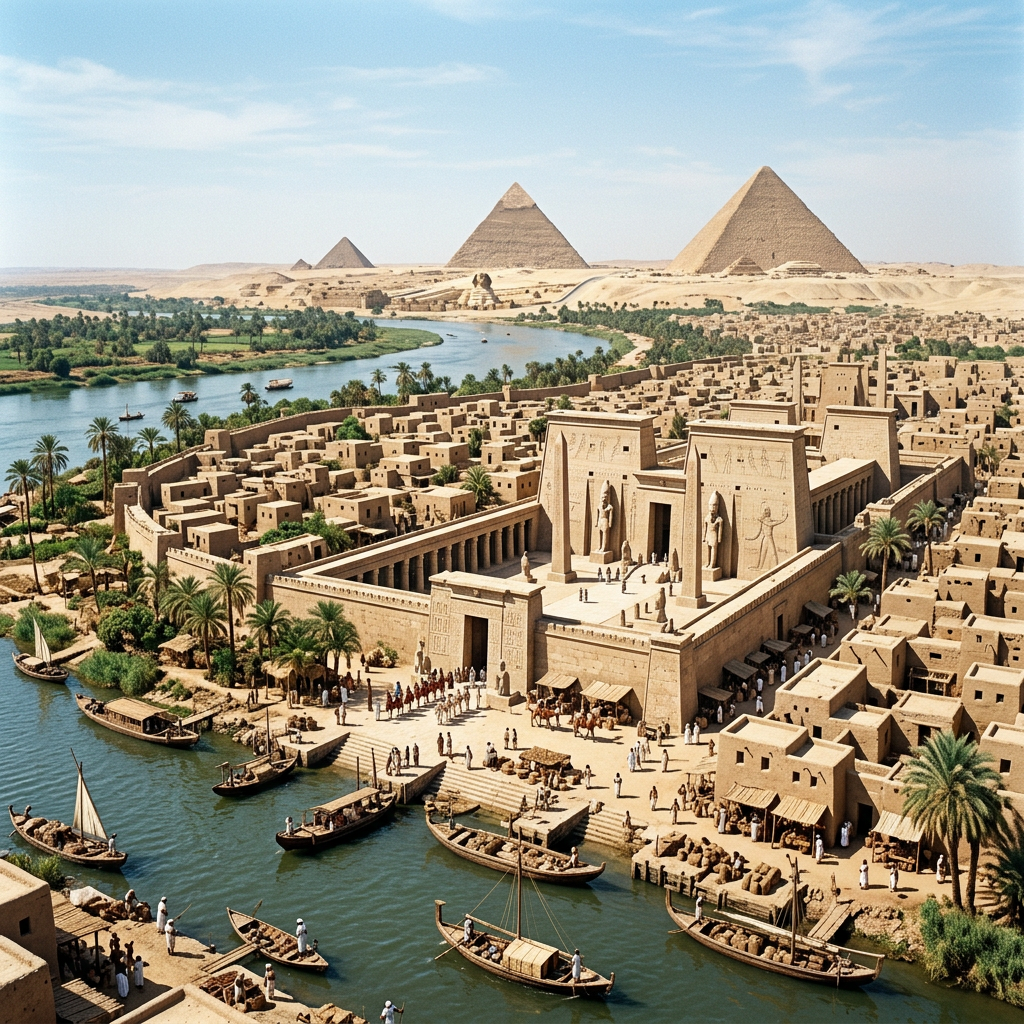
Long before Alexandria became one of the great intellectual centers of the Mediterranean, and centuries before Thebes rose to prominence as the religious heart of Egypt, ancient Memphis stood at the center of Egyptian civilization.
Located on the western bank of the Nile River, near the boundary between Upper and Lower Egypt, Memphis occupied one of the most strategically important positions in the ancient world. From this location, Egyptian rulers could control access to the Nile Delta while maintaining connections with Upper Egypt and the major trade routes that crossed the country.
Traditionally believed to have been founded around 3000 BCE, Memphis became the first capital of a politically unified Egypt and remained an important administrative and religious center for thousands of years. UNESCO describes Memphis as the first capital of ancient Egypt and emphasizes its exceptional geographical position at the meeting point of major routes between Upper Egypt and the Delta.
Today, very little of the ancient city survives above ground. Yet its legacy is enormous. The ruins of Memphis, together with the nearby pyramids and necropolises of Giza, Saqqara, Abusir, and Dahshur, form one of the greatest archaeological landscapes in the world.
To understand ancient Egypt, one must understand Memphis.
The Foundation of Ancient Memphis
The origins of Memphis, Egypt, disappear into the earliest chapters of Egyptian history.
According to later Egyptian tradition, the city was associated with the legendary unification of Upper and Lower Egypt and the reign of Narmer, although the precise historical circumstances surrounding the city’s foundation remain debated.
The location was exceptionally advantageous.
Memphis stood close to the point where the Nile Valley opened into the broad Delta. This gave the city access to both major geographical regions of Egypt. A ruler based at Memphis could therefore exercise authority over the agricultural wealth of the Delta while maintaining communication with Upper Egypt.
The city became known by several names throughout history. The ancient Egyptian name is commonly rendered as Men-nefer, while the Greek name Memphis eventually became the form by which the city entered classical historical tradition.
Its importance was not simply political.
Memphis became a sacred city dedicated particularly to the god Ptah, one of the most important deities of the Memphite religious tradition.

Memphis and the God Ptah
Religion was inseparable from political power in ancient Egypt, and Memphis was one of the country’s most important religious centers.
The principal deity of Memphis was Ptah, a god associated with creation, craftsmanship, artisans, and the creative power of thought and speech. UNESCO identifies Ptah as the local god of Memphis, the god of creation, and the patron of craftsmanship.
The great Temple of Ptah was therefore at the heart of Memphite religious life.
Although the temple complex has largely disappeared, its importance can be reconstructed through archaeological evidence and ancient texts. Memphis was home to priests, craftsmen, sculptors, administrators, and workers whose activities supported both the religious and political institutions of the city.
The theology associated with Ptah was particularly significant because it presented creation as an intellectual and verbal act. The god conceived things through his heart and brought them into existence through speech.
This association between thought, craftsmanship, and creation was perfectly suited to a city famous for its artisans.
Memphis was not merely a capital where kings governed.
It was also a place where the ideas, artistic traditions, and religious concepts of Egyptian civilization were developed and transmitted.
Memphis During the Old Kingdom
The greatest period of Memphis began with the rise of the Old Kingdom of Egypt.
During the Old Kingdom, approximately the third millennium BCE, Memphis served as the effective administrative capital of Egypt. From here, royal authority extended across the unified kingdom.
This was the age of the great pyramid builders.
The rulers of Egypt constructed enormous funerary monuments across the Memphite necropolis. The most famous were the pyramids of Giza, including the Great Pyramid of Khufu, but the wider Memphite landscape contains monuments from many different periods and dynasties.
UNESCO’s World Heritage property of Memphis and its Necropolis extends across a huge archaeological landscape from Giza through Saqqara, Abusir, and other sites toward Dahshur. More than thirty-eight pyramids are included within the property, alongside thousands of tombs and other monuments.
Memphis was therefore surrounded by a monumental landscape devoted to death, kingship, and eternal life.
The city of the living and the world of the dead existed side by side.

Saqqara and the Birth of the Pyramid
One of the most extraordinary parts of the ancient Memphis landscape is Saqqara, located south of the ancient capital.
Here stands the Step Pyramid of Djoser, constructed during the Third Dynasty.
The pyramid, designed by the famous architect Imhotep, represented a revolutionary development in Egyptian architecture. Instead of the earlier mastaba form, the royal tomb was transformed into a monumental stepped structure rising dramatically above the surrounding landscape.
UNESCO describes the Step Pyramid complex at Saqqara as the first pyramid ever built and one of the earliest monumental stone architectural achievements in human history.
The significance of Saqqara cannot be separated from Memphis.
The capital required a royal cemetery worthy of its rulers, while the royal tombs reinforced the ideological connection between kingship, religion, and eternal life.
Over centuries, Saqqara became one of the most important cemeteries in ancient Egypt.
Memphis as a Center of Egyptian Power
The greatness of Memphis was not based solely on pyramids.
It was a functioning city.
Its palaces, temples, workshops, docks, administrative buildings, and residential districts supported a complex urban society. UNESCO notes archaeological evidence for craftsmen’s workshops, dockyards, arsenals, palaces, temples, and residential areas within the wider Memphis archaeological property.
This is an important distinction.
When modern visitors imagine ancient Egypt, they often picture pyramids standing alone in the desert. But the pyramids were connected to a much larger economic and administrative system.
Behind every enormous monument stood thousands of workers, craftsmen, priests, administrators, transporters, farmers, and officials.
Memphis was one of the places where this immense machinery of the Egyptian state operated.
The city was effectively a political engine supporting one of the world’s earliest centralized civilizations.

Memphis, Kingship, and the Pharaohs
The relationship between Memphis and Egyptian kingship was particularly strong.
The city was closely associated with royal authority, and its religious institutions helped reinforce the divine status of the pharaoh.
The king was not simply a political ruler. Egyptian ideology presented him as a crucial intermediary between the human and divine worlds.
Memphis provided a powerful setting for this ideology.
Its temples connected the king with the gods, its palaces housed royal administration, and its surrounding necropolises preserved the memory of rulers and elites.
The city’s monumental landscape therefore served a political purpose as much as a religious one.
The dead pharaoh remained present in the ideological life of Egypt.
The Apis Bull and the Sacred Animals of Memphis
Another important feature of Memphis ancient Egypt was the cult of the Apis bull.
Apis was a sacred bull associated with Ptah and became one of the most important sacred animals in the Memphite religious tradition.
The burial place of the sacred Apis bulls was the Serapeum at Saqqara, a monumental underground complex that became an important part of the Memphite necropolis.
The cult illustrates how Egyptian religion connected gods, animals, temples, priests, and royal authority.
The sacred animal was not simply an object of worship. It was part of a highly organized religious institution involving ritual, burial, priesthood, and monumental architecture.
Through the Apis cult, Memphis remained an important religious center even after its political importance began to decline.

Memphis After the Old Kingdom
The history of Memphis did not end with the Old Kingdom.
Although Egypt’s political centers shifted at different times, Memphis continued to function as an important administrative and religious city.
During the Middle Kingdom, political power increasingly centered elsewhere, particularly at Itjtawy, while during the New Kingdom, Thebes became one of the most important royal and religious centers of Egypt.
Yet Memphis remained significant.
Its geographical position continued to make it valuable, and its temples and religious traditions remained influential.
During the Late Period, Memphis again played an important role, while under the Ptolemaic dynasty, it continued to exist alongside Alexandria.
UNESCO notes that Memphis served as an administrative capital during the Old Kingdom and remained important during parts of the Middle and New Kingdoms, the Late Period, and again in the Ptolemaic period.
This remarkable longevity is one of the defining characteristics of Memphis.
Few ancient cities remained relevant for such an extraordinary span of Egyptian history.

Alexander the Great and Memphis
In 332 BCE, another famous figure entered the story of Memphis: Alexander the Great.
After conquering Egypt from Persian rule, Alexander visited Memphis, the traditional Pharaonic capital. According to UNESCO‘s documentation, Alexander went to Memphis to honor the Egyptian gods and receive royal investiture as Pharaoh before traveling north and founding Alexandria.
This episode reveals how powerful the symbolism of Memphis remained.
Alexander could have treated the ancient capital simply as another conquered city.
Instead, he participated in Egyptian royal traditions.
By doing so, he presented himself not merely as a foreign conqueror but as the legitimate ruler of Egypt.
Memphis therefore continued to possess political and religious authority even as Alexandria was beginning its extraordinary rise.
The Decline of Ancient Memphis
Eventually, however, Memphis lost its central position.
The foundation and expansion of Alexandria under the Ptolemies shifted Egypt’s political, economic, and cultural focus toward the Mediterranean coast.
Later, the development of Fustat and eventually Cairo further reduced Memphis’s importance.
UNESCO notes that Memphis ultimately lost its prominence after the foundation of the Islamic garrison city of Fustat and the later development of Cairo.
The ancient capital gradually declined.
Its temples were dismantled or reused, monumental stone was carried away for later construction, and the once-great city slowly disappeared beneath the changing landscape.
Unlike Alexandria or Cairo, Memphis did not remain a major living metropolis.
Its survival became archaeological rather than urban.

Memphis Today: The Archaeological Legacy
Today, the archaeological site of Memphis is centered around Mit Rahina, south of modern Cairo.
Visitors can still encounter important remnants of the ancient city, including colossal statues associated with Ramesses II, architectural fragments, and remains connected with the great temple tradition of Ptah.
But Memphis is best understood not as a single ruin, but as part of a vast archaeological landscape.
Its history extends through Giza, Saqqara, Abusir, and Dahshur, where pyramids, mastabas, temples, tombs, and settlements preserve different chapters of ancient Egyptian civilization.
The wider property was inscribed on the UNESCO World Heritage List in 1979 as “Memphis and its Necropolis – the Pyramid Fields from Giza to Dahshur.”
This recognition reflects something important: Memphis cannot be separated from the monuments that surrounded it.
The city was the political and religious heart of a landscape that became one of humanity’s greatest centers of monumental architecture.
Why Ancient Memphis Still Matters
The story of ancient Memphis is ultimately the story of how geography, religion, political power, and human ambition came together.
Memphis stood where Egypt’s two great geographical worlds met. From there, rulers governed a unified kingdom, priests served powerful gods, craftsmen created extraordinary works, and royal architects transformed the landscape with monuments intended to survive for eternity.
The city witnessed the rise of the pyramids, the development of Egyptian kingship, the evolution of religious thought, the changing fortunes of dynasties, the arrival of Alexander the Great, and the gradual transformation of Egypt under Greek and Roman influence.
Yet perhaps the most remarkable aspect of Memphis is that its greatest monument is not one pyramid or temple.
It is the continuity of its influence.
For thousands of years, Memphis remained part of the story of Egypt.
Its temples disappeared. Its palaces collapsed. Its streets were buried.
But the civilization that grew around it left monuments that still dominate the imagination of the modern world.
Ancient Memphis was more than the first great capital of Egypt. It was one of the places where the political, religious, and artistic identity of ancient Egyptian civilization was forged.
And although the city itself has largely vanished, its shadow remains visible across the Nile Valley—in the pyramids of Giza, the Step Pyramid of Saqqara, the temples of the Memphite region, and the countless tombs that preserve the memory of a civilization determined to defeat time itself.

Conclusion
Ancient Memphis was more than a capital. It was one of the foundations upon which ancient Egyptian civilization was built.
For thousands of years, the city stood beside the Nile as a place where political authority, religion, craftsmanship, and royal ambition came together. From Memphis, pharaohs ruled a unified kingdom; in its temples, priests served gods such as Ptah; and across its surrounding necropolises, generations of Egyptians built monuments intended to carry their names into eternity.
The city’s greatest legacy can still be seen today.
The pyramids of Giza, the Step Pyramid of Djoser at Saqqara, the tombs of the Memphite necropolis, and the surviving monuments of Mit Rahina are fragments of a much larger world that once surrounded the ancient capital. They remind us that the pyramids were never isolated wonders in an empty landscape. They were part of a living civilization whose political and spiritual center was Memphis.
Eventually, Memphis disappeared as a great urban center. Alexandria rose, new capitals emerged, and the ancient city was gradually dismantled and buried beneath the changing landscape of Egypt. Yet its disappearance did not erase its importance.
Memphis endured through its influence.
It helped shape the religious traditions, political institutions, artistic achievements, and monumental architecture that made ancient Egypt one of the most remarkable civilizations in human history.
Today, standing among the remains of Memphis, it is difficult to see the enormous city that once existed there. But perhaps that is precisely what makes the site so powerful. The silence of the ruins forces us to imagine the temples, workshops, palaces, priests, craftsmen, and rulers who once filled this extraordinary city with life.
Memphis reminds us that even the greatest cities eventually become ruins.
But ideas, stories, and monuments can survive long after their creators are gone.
The city vanished. Egypt remained. And through the monuments that still rise from the desert, the spirit of ancient Memphis continues to speak across more than five thousand years of history.
Fortisetliber’s View
There are ancient cities that survive in stone.
And then there are cities that survive in memory.
Memphis belongs to the second kind.
For thousands of years, this ancient Egyptian capital stood beside the Nile at the crossroads of Upper and Lower Egypt. Pharaohs ruled from its palaces, priests served the god Ptah in its temples, and craftsmen created works that were meant to endure long after their creators had disappeared.
Around Memphis, the great necropolises grew.
At Saqqara, pyramids rose from the desert. At Giza, enormous monuments transformed the horizon. Tombs multiplied across the landscape, each one expressing the same ancient Egyptian belief: death was not the end, but a passage into eternity.
Memphis was the city that connected these worlds—the world of the living and the world of the dead.
Yet today, the city itself is almost gone.
Its temples have fallen. Its palaces have disappeared. Its streets have been swallowed by the landscape. What remains are fragments: enormous statues, broken columns, buried foundations, and scattered stones that offer only glimpses of the metropolis that once stood here.
And perhaps there is something profoundly fitting about that.
Memphis was built by a civilization obsessed with eternity, yet even Memphis could not escape time.
The pharaohs wanted their names to live forever. The priests sought to preserve ancient traditions. The builders raised monuments that seemed almost impossible to destroy.
Still, the city disappeared.
But it did not truly vanish.
Its legacy survives in the pyramids that still dominate the imagination of humanity, in the temples and tombs of the Memphite necropolis, and in every modern attempt to understand the extraordinary civilization that flourished along the Nile.
Memphis teaches us that permanence does not necessarily mean remaining unchanged.
Sometimes, survival means leaving behind something powerful enough to be remembered.
FortisLiber — where the silence of ancient ruins reminds us that civilizations may disappear, but the footprints they leave behind can cross thousands of years.
Leave a Reply