
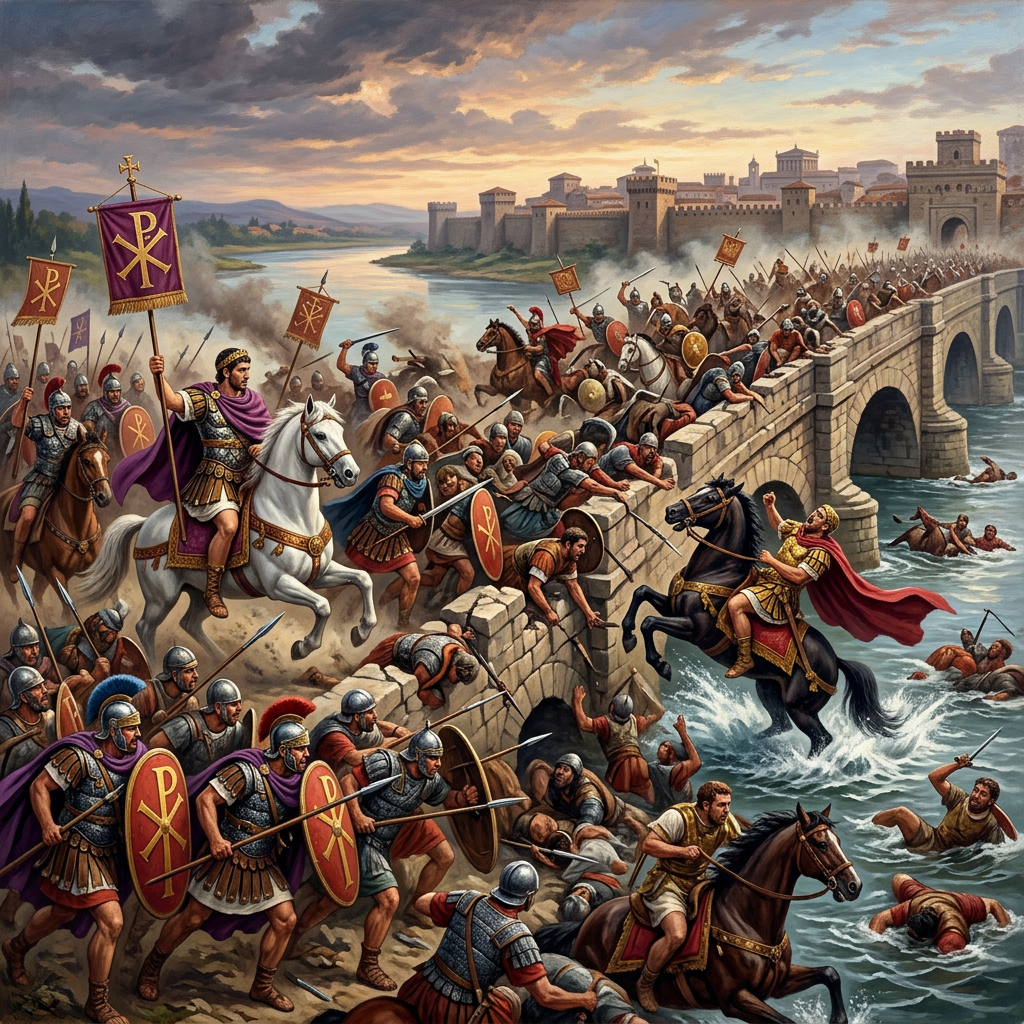
On 28 October 312 CE, two Roman armies met on the outskirts of Rome in a battle that would transform the history of the Roman Empire and, eventually, the history of Christianity.
The Battle of the Milvian Bridge was fought between the forces of Constantine the Great and those of his rival Maxentius during a period of political instability known as the Tetrarchy. Although the battle was part of a wider struggle for imperial power, its consequences reached far beyond the battlefield.
Constantine won a decisive victory.
Maxentius was killed while attempting to escape across the Tiber River, and Constantine entered Rome as the undisputed ruler of the western Roman Empire. In the years that followed, his relationship with Christianity would profoundly influence the religious and political development of the Roman world.
The battle therefore occupies a unique place in Roman military history. It was simultaneously a civil war, a struggle for imperial legitimacy, and—according to Christian tradition—a battle preceded by a divine vision that convinced Constantine that the Christian God would grant him victory.
The Battle of Milvian Bridge in 312 CE did not instantly make Christianity the official religion of Rome. But it helped create the political circumstances in which Christianity could move from a persecuted faith to one of the most influential religions in the Roman Empire.
Rome Before the Battle
To understand the importance of the Battle of the Milvian Bridge, it is necessary to understand the political crisis that had divided the Roman Empire.
By the beginning of the 4th century CE, the Roman Empire was too large and politically complex to be governed easily by a single emperor. In the late 3rd century, Emperor Diocletian introduced the Tetrarchy, a system in which four emperors shared responsibility for governing the empire.
The arrangement was intended to provide stability.
Instead, after the retirement and deaths of several emperors, rival claims to power multiplied.
Constantine had inherited imperial authority from his father, Constantius Chlorus, who died in 306 CE. Constantine was proclaimed emperor by his troops in Britain and gradually established control over Gaul and other western territories.
Meanwhile, Maxentius, the son of the former emperor Maximian, seized power in Rome in 306 CE.
For several years, Constantine and Maxentius avoided direct confrontation.
That changed in 312 CE.
Constantine decided to invade Italy and challenge Maxentius directly.

Constantine Marches on Rome
Constantine crossed the Alps with a relatively small but highly experienced army.
His campaign was remarkably successful.
He defeated forces loyal to Maxentius at Augusta Taurinorum, Verona, and elsewhere in northern Italy. With each victory, Constantine moved closer to Rome.
Maxentius now faced a difficult decision.
Rome possessed enormous defensive advantages. The city was protected by the Aurelian Walls, which had been constructed in the late 3rd century. Maxentius could potentially have remained inside the city and forced Constantine into a prolonged siege.
Instead, Maxentius chose to confront Constantine outside Rome.
Why he made this decision remains debated.
Ancient sources offer different explanations, and later Christian writers interpreted the events through the lens of divine providence. Whatever the precise reason, Maxentius eventually brought his army north of the city.
The decisive encounter would take place near the Milvian Bridge, an important crossing over the Tiber.
The Milvian Bridge
The Milvian Bridge, known in Latin as Pons Milvius, was one of the important bridges connecting Rome with the northern approaches to the city.
The bridge itself was ancient, but its strategic importance remained considerable.
Constantine’s army approached from the north.
Maxentius deployed his forces on the opposite side of the Tiber, attempting to prevent Constantine from reaching Rome.
According to the ancient sources, Maxentius constructed or used a temporary bridge alongside the existing Milvian Bridge so that his army could cross the river.
This decision would prove disastrous.
The battlefield became a confined space in which the retreating army had limited options.
Constantine’s forces attacked aggressively.
The battle quickly turned into a rout.

The Vision of Constantine
The most famous element of the Battle of Milvian Bridge is not a military maneuver.
It is Constantine’s alleged vision before the battle.
Several ancient Christian authors provide accounts of the event, although they differ in detail.
The most famous version comes from Eusebius of Caesarea, who later wrote a biography of Constantine. According to Eusebius, Constantine saw a heavenly sign and was instructed to use it as protection during the coming conflict.
Another important account, by Lactantius, associates Constantine’s preparation for battle with a Christian symbol.
Later Christian tradition connected the event with the Chi-Rho, a symbol formed from the first two Greek letters of the word Christos.
Constantine subsequently became closely associated with Christian symbolism.
The historical details surrounding the vision remain debated. Scholars have long discussed whether Constantine experienced a religious vision, interpreted a natural phenomenon as divine, or developed a Christian explanation of the event after his victory.
What is certain is that the story became enormously influential.
The Battle of Milvian Bridge and Constantine’s vision became inseparable in Christian memory.

The Battle Begins
The precise size of the two armies is uncertain, and ancient sources provide figures that modern historians consider difficult to verify.
Constantine’s troops were battle-hardened after the campaign through northern Italy.
Maxentius possessed a substantial force, including troops based around Rome.
As the armies engaged, Constantine’s forces gained the advantage.
Maxentius’s army began to retreat toward the Tiber.
This was the critical moment.
The temporary bridge and the crowded battlefield created a dangerous bottleneck. Soldiers attempted to escape while under pressure from Constantine’s advancing army.
The retreat became chaotic.
According to the traditional account, the bridge collapsed under the weight of the fleeing soldiers, sending many men into the river.
Maxentius himself was among those attempting to cross.
He fell into the Tiber and drowned.
His body was later recovered, and his head was reportedly carried through Rome as proof of Constantine’s victory.
The battle was over.
Constantine had won.

Constantine Enters Rome
The next day, Constantine entered Rome in triumph.
The city that Maxentius had controlled now belonged to his rival.
Constantine’s victory was more than a military success. It gave him enormous political legitimacy.
He was now the dominant emperor in the western Roman Empire.
The Senate recognized him, and monuments were soon erected celebrating his victory.
The most famous surviving monument is the Arch of Constantine, located near the Colosseum.
Completed in 315 CE, the arch commemorated Constantine’s victory and portrayed him as the legitimate ruler who had restored order to Rome.
The political message was clear.
Constantine had defeated a tyrant and brought peace back to the empire.
The Battle and the Rise of Christianity
The most enduring consequence of the Battle of the Milvian Bridge was its connection with Christianity.
Constantine’s victory was followed by a dramatic change in imperial policy.
In 313 CE, Constantine and Licinius issued what is commonly called the Edict of Milan, establishing a policy of religious toleration throughout the Roman Empire and allowing Christians to practice their faith openly.
It is important to understand the chronology.
The Battle of Milvian Bridge did not make Christianity the official religion of the Roman Empire.
Instead, Constantine’s victory helped create the political conditions for Christianity’s rapid advancement.
Constantine personally supported the Christian Church, returned confiscated property, sponsored churches, and became increasingly involved in Christian affairs.
He was baptized only near the end of his life, in 337 CE.
Under later emperors, Christianity became increasingly dominant, eventually becoming the official religion of the Roman Empire under Theodosius I in the late 4th century.
The road toward that transformation began, in part, with Constantine’s victory in 312 CE.

Why Maxentius Lost
From a military perspective, the defeat of Maxentius provides an important lesson.
His decision to fight outside Rome removed one of his greatest strategic advantages.
The city itself could have offered strong defensive protection. Instead, Maxentius placed his army in an exposed position near the river.
The retreat route was also dangerously constrained.
Constantine, meanwhile, had maintained momentum throughout his Italian campaign. His army had already defeated several opponents and possessed confidence from repeated victories.
The battle therefore illustrates the importance of mobility, morale, battlefield positioning, and command decisions in Roman warfare.
Numbers alone were not enough.
A large army can become vulnerable when its movements are restricted and its retreat becomes impossible.
At the Milvian Bridge, geography became a weapon.
The Political Consequences of Constantine’s Victory
The Battle of Milvian Bridge was one of several battles that transformed Constantine into the dominant ruler of the western empire.
But the struggle for imperial power was not yet finished.
Constantine and Licinius eventually became rivals themselves.
In 324 CE, Constantine defeated Licinius and became sole emperor of the Roman Empire.
The political transformation that began in 312 therefore culminated in the reunification of the empire under Constantine.
His reign would leave an extraordinary legacy.
He reorganized imperial government, supported Christianity, founded Constantinople, and established policies that profoundly influenced the later Roman and Byzantine worlds.
For these reasons, historians often regard Constantine as one of the most consequential emperors in Roman history.

The Legacy of the Battle of Milvian Bridge
Few battles have consequences that extend so far beyond their immediate military objectives.
The Battle of Milvian Bridge in 312 CE changed the political balance of the Roman Empire.
It ended Maxentius’s rule in Rome, secured Constantine’s position in the West, and became part of the foundation of Constantine’s Christian imperial identity.
The story of Constantine’s vision also became one of the most famous conversion narratives in history.
For Christians, the battle became evidence of divine intervention.
For historians, it represents a fascinating intersection between politics, military strategy, religious belief, and imperial propaganda.
The distinction between these perspectives is important.
The battlefield itself can be studied through military and archaeological evidence. The vision belongs to the realm of historical testimony, religious interpretation, and later tradition.
Together, however, they created a story that became far more powerful than the battle alone.
The Milvian Bridge Today
The Milvian Bridge in Rome still exists.
Although substantially modified over the centuries, the bridge remains a physical reminder of the confrontation that took place nearby in 312 CE.
Visitors can stand on the same crossing over the Tiber and look toward the northern approaches to Rome.
The landscape has changed enormously.
The armies are gone.
The imperial banners have disappeared.
The soldiers who fought there have been dead for more than seventeen centuries.
Yet the consequences of their battle remain visible.
The transformation of Constantine’s reign helped shape the religious identity of the late Roman Empire and profoundly influenced European history.
The Battle of the Milvian Bridge therefore belongs not only to the history of ancient Rome but also to the broader story of the transition from the classical Roman world to Late Antiquity.

Conclusion
The Battle of the Milvian Bridge began as a Roman civil war.
Two emperors fought for control of Rome, and one emerged victorious.
But history rarely ends where the battlefield ends.
Constantine’s victory changed the political structure of the Roman Empire, transformed his relationship with Christianity, and helped set in motion a religious transformation that would reshape Europe and the Mediterranean world.
The image of Constantine approaching Rome beneath the sign of the cross became one of the most enduring stories of Late Antiquity. Whether understood as a genuine religious experience, a political revelation, or a tradition shaped by later Christian writers, it became inseparable from the memory of the battle.
At the Milvian Bridge, an emperor defeated a rival.
But the consequences were much greater than the victory itself.
One battle decided who would enter Rome as emperor. Its legacy helped decide what Rome—and eventually much of Europe—would believe.
Fortisetliber’s View
On the morning of 28 October 312 CE, two Roman armies approached one another outside the walls of Rome.
For the soldiers, it was another civil war.
For history, it was something much larger.
The Battle of the Milvian Bridge would determine which emperor controlled Rome. Constantine would emerge victorious, while Maxentius would disappear beneath the waters of the Tiber.
But the most enduring consequence of the battle was not the death of an emperor.
It was what happened afterward.
Constantine entered Rome as victor, and with him came a new relationship between imperial power and Christianity. The famous story of the vision before the battle—whether understood as a genuine religious experience, a later interpretation, or a combination of faith and political symbolism—became part of one of the most extraordinary transformations in Roman history.
An empire that had once persecuted Christians would gradually become an empire in which Christianity possessed extraordinary influence.
That transformation did not happen in a single day.
But the road toward it passed through the Milvian Bridge.
There is something deeply symbolic about the location itself. A bridge exists to connect two sides.
In 312, the bridge stood between the old Roman world and something that had not yet fully emerged.
On one side was the familiar empire of emperors, legions, temples, and traditional Roman religion. On the other was a changing world in which Christianity would increasingly shape imperial politics, culture, and identity.
Constantine crossed that bridge as a military commander.
History remembers him for what he became.
The battle also reminds us that history rarely announces its greatest turning points. The soldiers who fought at the Milvian Bridge could not have known that their struggle would become part of a transformation lasting for centuries.
They fought for an emperor.
They unknowingly helped change an empire.
Today, the Tiber continues to flow beneath the ancient bridge. Rome remains, while the armies, banners, and voices of 312 CE have disappeared.
But the question raised by the battle remains timeless:
When does a victory become more than a victory?
Perhaps it happens when the battlefield changes not only who holds power, but what that power will mean.
FortisLiber — where the stones of Rome remind us that sometimes a battle ends in a single day, but its consequences can cross centuries.
Leave a Reply