
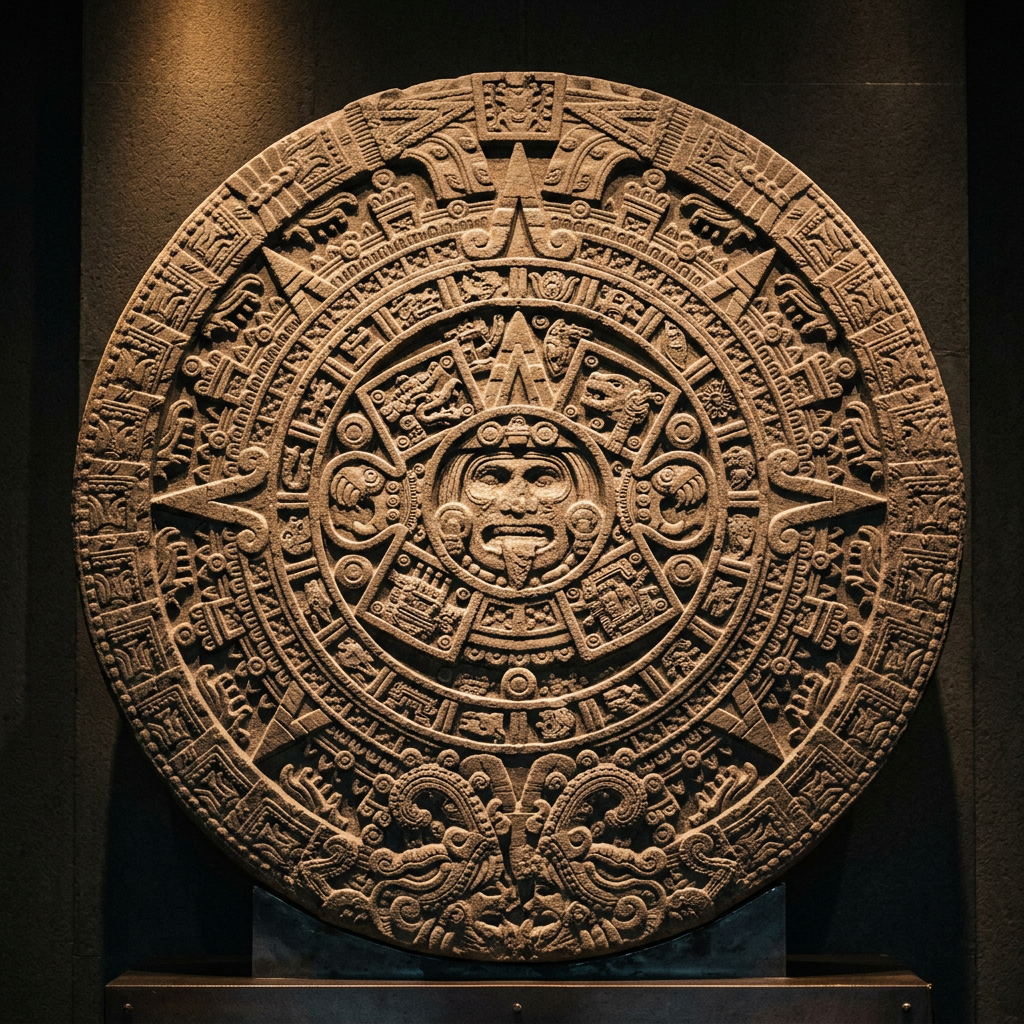
The Aztec Calendar is one of the most fascinating achievements of ancient Mesoamerican civilization. Often associated with the enormous stone monument known as the Aztec Sun Stone, the calendar reflects the Aztecs’ sophisticated understanding of time, religion, astronomy, and the natural world.
Created in the centuries before the arrival of the Spanish in the early 16th century, the Aztec calendar was far more than a system for counting days. Time was deeply connected to religion and everyday life. Religious ceremonies, agricultural activities, festivals, and important political events were all influenced by the way the Aztecs understood the movement of time.
Today, the Aztec Calendar remains an important symbol of Mexican history and indigenous heritage. Its intricate symbols and mysterious central face have inspired historians, archaeologists, artists, and travelers around the world.
What Is the Aztec Calendar?
The term Aztec Calendar is commonly used to describe the calendar systems used by the Aztec civilization. In reality, the Aztecs used more than one system to organize time.
The most important was the Tonalpohualli, a 260-day ritual calendar. It consisted of 20 periods, each associated with a particular symbol, combined with numbers from 1 to 13. The combination of these numbers and symbols created a repeating cycle of 260 unique days.
The Aztecs also used a 365-day agricultural and solar calendar called the Xiuhpohualli. This calendar was divided into 18 periods of 20 days, followed by a short five-day period.
These two calendar cycles worked together. When the 260-day and 365-day cycles coincided, a much longer cycle was completed. This complex approach demonstrates how important the measurement of time was within Aztec culture.

The Aztec Calendar Stone
Perhaps the most famous object associated with the calendar is the Aztec Calendar Stone, also commonly called the Aztec Sun Stone.
The massive stone monument was carved from volcanic rock and is approximately 3.6 meters (12 feet) in diameter. It weighs more than 20 tons and contains a remarkable collection of symbols, figures, and calendrical elements.
The stone was probably created during the reign of the Aztec ruler Moctezuma II, near the end of the 15th or beginning of the 16th century.
Despite its popular name, the Aztec Sun Stone should not simply be thought of as a giant calendar hanging on a wall. Scholars have debated its exact purpose and interpretation. It contains calendrical imagery, but its meaning also appears to be connected to Aztec cosmology, religion, and ideas about the cycles of creation and destruction.
Today, the famous stone is preserved at the National Museum of Anthropology in Mexico City, where it is one of the museum’s most recognizable artifacts.
The Meaning of the Aztec Calendar
Understanding the Aztec calendar meaning requires looking at the Aztec worldview.
For the Aztecs, time was not simply a straight line moving from the past into the future. Different periods of time were associated with gods, supernatural forces, ceremonies, and particular qualities.
The calendar helped determine when important religious rituals should take place. Certain days were considered favorable for particular activities, while others could be viewed as dangerous or unlucky.
This meant that the calendar played a role in decisions concerning agriculture, ceremonies, warfare, marriage, and other aspects of society.
Time was therefore closely connected with religion.
The Aztecs believed that maintaining the proper relationship between humans, gods, and the natural world was essential to the continuation of the universe. Calendrical rituals were part of this larger religious system.

Aztec Calendar Symbols
One of the most fascinating aspects of the Aztec Calendar Stone is its enormous collection of symbols.
At the center of the stone is a face generally identified as Tonatiuh, the Aztec sun deity, although interpretations of the central figure have been debated.
The central figure is surrounded by several rings containing symbols and representations associated with Aztec cosmology and calendrical systems.
Among the best-known Aztec calendar symbols are the 20 day signs associated with the 260-day ritual calendar. These include representations of animals, natural elements, and other important concepts.
Some of the signs include:
- Crocodile or caiman
- Wind
- House
- Lizard
- Serpent
- Death
- Deer
- Rabbit
- Water
- Dog
- Jaguar
- Reed
- Grass
- Flower
- Eagle
- Vulture
- Movement
- Flint
- Rain
- Flower
These symbols were combined with numbers from 1 through 13 to create the 260-day cycle.
The symbolism illustrates how closely the Aztec calendar was connected with the natural and spiritual worlds.
The Five Suns and Aztec Cosmology
Another important element associated with the Aztec Sun Stone is the concept of the Five Suns.
According to Aztec cosmology, the world had existed through several previous eras or creations. Each age was associated with a different sun and ended through a major catastrophe.
The current age was known as the Fifth Sun.
Different versions of the mythology describe the destruction of earlier worlds through events such as jaguars, wind, fire, and floods. The Fifth Sun was believed to exist in a world that could also eventually come to an end.
This belief helps explain why the Aztecs placed such importance on maintaining cosmic order.
The calendar was therefore not merely a method for recording dates. It was part of a larger understanding of the universe and humanity’s place within it.

The 260-Day Aztec Calendar
The 260-day calendar, or Tonalpohualli, was particularly important for religious and divinatory purposes.
Its structure was based on 20 day signs and 13 numbers. Each day therefore had a specific combination of a number and a symbol.
For example, a particular day might be represented by a number combined with the sign of the Jaguar. After 260 days, the complete sequence would repeat.
The Tonalpohualli was used by religious specialists to interpret dates and determine their significance.
This system demonstrates the mathematical sophistication of Mesoamerican societies. The calendar was carefully structured, and its cycles were integrated into religious and social life.
The 365-Day Solar Calendar
Alongside the ritual calendar, the Aztecs used the Xiuhpohualli, a 365-day calendar connected to the solar year.
It contained 18 periods of 20 days, giving a total of 360 days. Five additional days were then added to complete the 365-day cycle.
These final five days were known as Nemontemi and were regarded as an unusual or potentially dangerous period.
The solar calendar was particularly important for agriculture and seasonal activities.
The relationship between the 260-day ritual calendar and the 365-day solar calendar created a larger calendrical cycle lasting 52 solar years.
This 52-year period was extremely significant in Aztec religious thought.

The Aztec New Fire Ceremony
One of the most important rituals associated with the 52-year calendar cycle was the New Fire Ceremony, also known as the Ceremony of the New Fire.
When the 52-year cycle came to an end, the Aztecs feared that the world might not continue into another cycle.
A major ceremony was therefore performed to renew the cosmic order.
During the ritual, fires throughout the region were extinguished. A new sacred fire was then created on a mountain, traditionally associated with the ceremony, and the new flame was used to relight fires across the Aztec world.
The ritual illustrates the enormous religious importance of the calendar.
For the Aztecs, the completion of a calendrical cycle was not merely a mathematical event. It was connected with the survival and renewal of the world itself.
Aztec Gods and the Calendar
The Aztec calendar cannot be separated from Aztec religion.
Many gods were associated with aspects of time, nature, agriculture, warfare, fertility, rain, the sun, and cosmic creation.
Among the most important deities was Tonatiuh, associated with the sun. Another major figure was Huitzilopochtli, the patron deity of the Mexica people and a god strongly associated with warfare and the sun.
Quetzalcoatl, the Feathered Serpent, was another influential deity within the broader Mesoamerican religious tradition.
Different calendar dates could be associated with particular supernatural forces, making the calendar an important tool for religious specialists.

Was the Aztec Calendar Really a Calendar?
The popular expression “Aztec Calendar” can sometimes create confusion.
The famous stone does contain calendrical information, but researchers generally view it as more complex than a simple calendar.
Its imagery combines ideas about time, mythology, astronomy, religion, political power, and cosmology.
For this reason, terms such as Aztec Sun Stone and Aztec Calendar Stone are often used interchangeably in popular culture, even though the monument’s precise original purpose remains a subject of scholarly discussion.
The stone should therefore be understood as a powerful representation of the Aztec worldview rather than simply an ancient version of a modern calendar.
The Aztec Calendar and Astronomy
The Aztecs made extensive observations of the sky.
Like other Mesoamerican civilizations, they paid close attention to the movements of the sun, moon, and planets. Astronomical observations were important for agriculture, ritual activities, and the organization of ceremonial time.
The appearance and movements of celestial bodies could also carry religious significance.
This connection between astronomy and religion is one of the reasons the Aztec calendar history remains such an interesting field of study.
Rather than separating science, religion, agriculture, and politics into completely different areas, Aztec society integrated them into a broader understanding of the cosmos.
Where Is the Aztec Calendar Today?
The famous Aztec Calendar Stone was discovered in Mexico City in 1790, centuries after the Spanish conquest.
It was buried beneath the ground near the Plaza Mayor, now associated with the historic center of Mexico City.
The monument was eventually studied and displayed publicly.
Today, the original stone is housed at the National Museum of Anthropology in Mexico City.
Visitors can see the enormous carved monument and explore other archaeological objects from the Aztec and wider Mesoamerican world.
The museum provides important context for understanding the calendar, Aztec religion, architecture, art, and political organization.

Why Is the Aztec Calendar Important Today?
The fascination with the Aztec Calendar has continued long after the fall of the Aztec Empire.
Its imagery appears on artwork, jewelry, clothing, tattoos, educational materials, and cultural monuments. The distinctive circular design has become one of the most recognizable symbols associated with ancient Mexico.
However, its importance goes beyond its visual appearance.
The calendar provides historians and archaeologists with evidence about how the Aztecs understood time, religion, mathematics, nature, and the universe.
It also represents the remarkable achievements of indigenous civilizations in the Americas before European conquest.
Studying the Aztec Calendar therefore offers an opportunity to understand not only an ancient system of timekeeping but also the intellectual and spiritual world of the people who created it.
Frequently Asked Questions About the Aztec Calendar
What is the Aztec Calendar?
The Aztec Calendar refers broadly to the calendrical systems used by the Aztec civilization. The most important were the 260-day ritual calendar and the 365-day solar calendar.
What is the Aztec Calendar Stone?
The Aztec Calendar Stone, also known as the Aztec Sun Stone, is a massive carved volcanic-stone monument containing complex imagery related to Aztec cosmology, religion, and calendrical concepts.
What does the Aztec Calendar symbolize?
The Aztec Calendar symbolizes the Aztec understanding of time, cosmic cycles, religion, creation, destruction, and the relationship between humans and the supernatural world.
How many days were in the Aztec calendar?
The Aztecs used both a 260-day ritual calendar and a 365-day solar calendar. These cycles operated together and formed a larger 52-year calendrical cycle.
Where can I see the Aztec Calendar Stone?
The original Aztec Sun Stone is preserved at the National Museum of Anthropology in Mexico City.
Who was the Aztec Sun God?
Tonatiuh was an important Aztec solar deity and is commonly associated with the central figure of the Aztec Sun Stone, although interpretations of the monument’s imagery vary.

Conclusion
The Aztec Calendar is much more than an ancient method of measuring days. It represents a sophisticated system in which mathematics, astronomy, religion, agriculture, mythology, and politics were closely connected.
The famous Aztec Calendar Stone, or Aztec Sun Stone, remains one of the most remarkable surviving monuments of ancient Mexico. Its intricate symbols provide a window into the Aztec understanding of time and the universe.
From the 260-day Tonalpohualli to the 365-day solar calendar and the 52-year cycle, the Aztec approach to time was complex and deeply meaningful.
Today, the Aztec Calendar continues to fascinate people around the world because it represents both the extraordinary intellectual achievements of the Aztec civilization and a worldview in which every cycle of time had spiritual significance.
Understanding its symbols and history allows us to look beyond the familiar image of the stone and appreciate the complex civilization that created it.
Fortisetliber’s View
The Aztec Calendar is more than an extraordinary archaeological monument. It offers a glimpse into a civilization that understood time as something deeply connected to nature, religion, society, and the cosmos.
Today, we often think of time as something measured by clocks and calendars. We organize our lives around minutes, hours, deadlines, and appointments. The Aztecs approached the idea differently. Their understanding of time was based on cycles, ceremonies, celestial movements, agriculture, and the relationship between humanity and the forces of the universe.
The famous Aztec Sun Stone captures this philosophy in an extraordinary visual form. Its circular structure and intricate symbols reflect a complex understanding of cosmic order and the passage of time.
From a Fortisetliber View, perhaps the most interesting aspect of the Aztec Calendar is not simply how accurately the Aztecs organized their calendar systems, but what their concept of time can tell us about their worldview.
Time was not merely passing.
It was returning.
Cycles mattered. The seasons returned. Religious ceremonies returned. Calendrical periods came to an end and began again. The completion of major cycles could represent renewal, uncertainty, and the continuation of the world itself.
This way of thinking feels surprisingly relevant today.
Modern life encourages us to move constantly forward. We measure progress by what comes next: the next achievement, the next destination, the next year. The Aztec worldview offers a different perspective. It reminds us that human life also exists within cycles—of nature, history, generations, and renewal.
The Aztec Calendar therefore deserves to be understood as more than a remarkable artifact from ancient Mexico. It is a record of how one civilization attempted to understand its place in an enormous and mysterious universe.
The stone has survived for centuries. The world that created it has changed dramatically, but its central message remains compelling.
Time shapes civilizations, but civilizations also reveal how humanity chooses to understand time.
That is the enduring fascination of the Aztec Calendar—and, from a Fortisetliber View, perhaps its greatest lesson.
Leave a Reply