
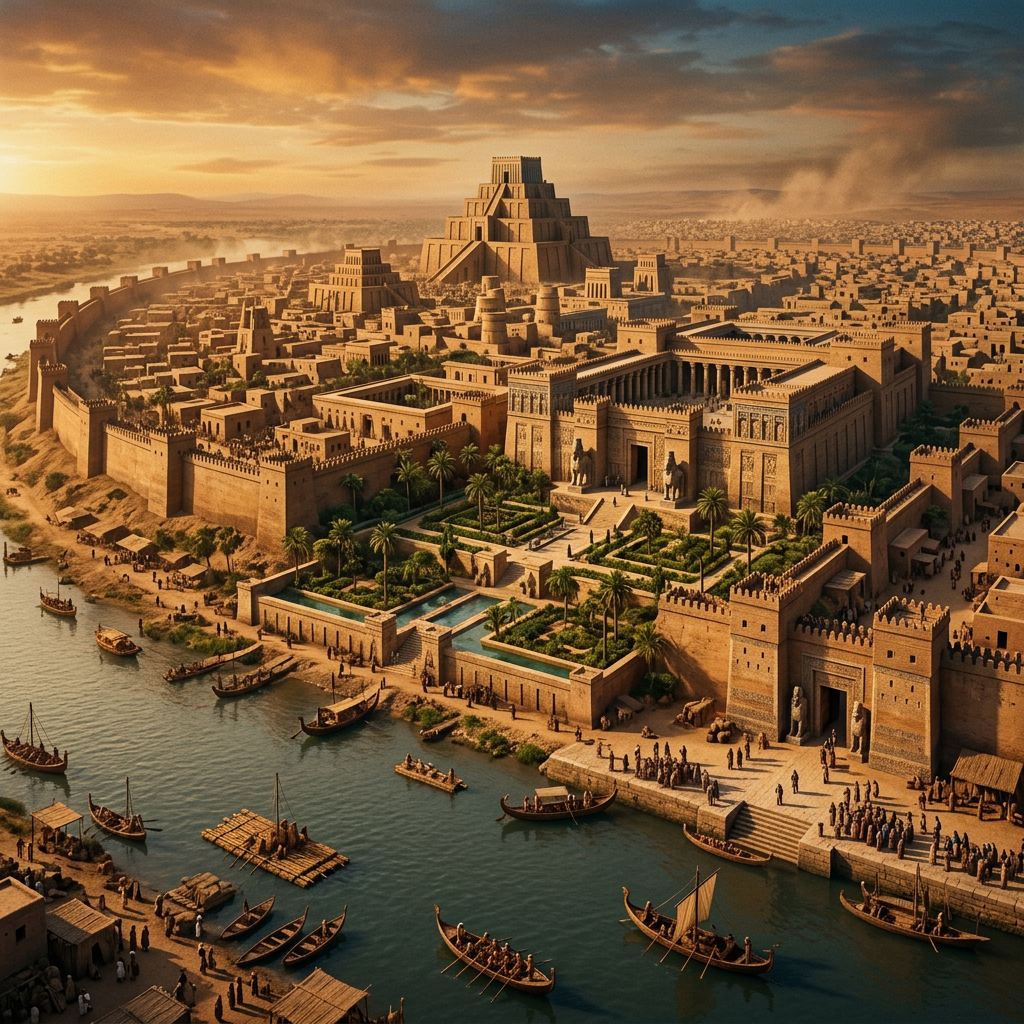
Few cities of the ancient world have captured the imagination like Nineveh, the magnificent capital of the Assyrian Empire in northern Mesopotamia. Located on the eastern bank of the Tigris River, near modern-day Mosul in Iraq, Nineveh became one of the largest and most important cities of the ancient Near East.
For centuries, it was a center of imperial power, architecture, warfare, art, literature, and learning. Its enormous walls protected palaces and temples, while royal libraries preserved thousands of cuneiform tablets.
Yet the story of ancient Nineveh is also a story of extraordinary destruction.
In 612 BCE, after a prolonged siege, Nineveh was captured by a coalition of Babylonian and Median forces. The city was plundered and heavily destroyed, marking the decisive collapse of Assyrian power. Although Assyria continued fighting for several years, the fall of Nineveh is conventionally regarded as the end of the Neo-Assyrian Empire.
Today, the ruins of Nineveh lie within modern Mosul, where archaeologists continue to uncover evidence of one of the greatest cities of the ancient world.
Where Was Nineveh?
Nineveh ancient city was located in northern Mesopotamia, on the eastern side of the Tigris River. Its archaeological remains are today incorporated into the modern urban landscape of Mosul, Iraq.
The ancient city covered an enormous area. Archaeological research places the Neo-Assyrian urban settlement at approximately 750 hectares, surrounded by an impressive defensive system extending for roughly 12 kilometers. Two major archaeological mounds, Kuyunjik and Nebi Yunus, dominate the site.
Nineveh’s position beside the Tigris helped make it an important center of communication, trade, agriculture, and military power.
The settlement itself was ancient long before the Assyrian Empire. Archaeological evidence indicates occupation in the area going back thousands of years, with settlement at Nineveh established by approximately the fourth millennium BCE and continuing through later periods.
But it was during the first millennium BCE that Nineveh reached its greatest fame.

The Rise of the Assyrian Capital
The Assyrians built one of the most powerful empires of the ancient Near East. Their territory eventually stretched across large parts of Mesopotamia and the Levant and, at its height, reached as far as Egypt.
Nineveh became the empire’s final great capital under King Sennacherib, who ruled from 704 to 681 BCE.
Sennacherib transformed the city on an enormous scale. He expanded its walls, developed its water-management systems, constructed monumental gateways, created ceremonial avenues, and built a vast royal palace known today as the Palace Without Rival.
Archaeological research has revealed an extraordinary urban environment. The city possessed massive defensive walls, monumental gates, canals, palaces, temples, gardens, and carefully planned infrastructure.
The scale of the construction reflected the power of the Assyrian monarchy.
Nineveh was not simply a royal residence. It was the administrative and political heart of an empire.
The Great Palaces of Nineveh
Among the most impressive discoveries at the Nineveh archaeological site are the remains of its royal palaces.
The walls were decorated with enormous stone reliefs showing royal ceremonies, military campaigns, religious imagery, hunting scenes, supernatural beings, and conquered peoples.
Some of the most famous Assyrian artworks discovered in the nineteenth century came from these palaces.
The reliefs were not merely decoration. They communicated the authority of the king and celebrated the military achievements of the Assyrian state.
One of the most famous themes is the royal lion hunt, particularly associated with King Ashurbanipal, who ruled Assyria in the seventh century BCE.
These extraordinary sculptures provide modern historians with detailed visual evidence about Assyrian warfare, clothing, weapons, rituals, animals, and royal life.

The Library of Ashurbanipal
Nineveh was also a major center of learning.
King Ashurbanipal, who ruled approximately 668–627 BCE, assembled one of the most famous collections of written material from the ancient Near East.
The Library of Ashurbanipal contained thousands of clay tablets written in cuneiform. Scholars collected and copied literary, religious, medical, astronomical, administrative, and scholarly texts.
Among the texts associated with the library is the famous Epic of Gilgamesh, one of humanity’s oldest surviving literary works.
Ashurbanipal’s collection has been enormously important for modern scholarship because it preserved texts that might otherwise have disappeared. The rediscovery of these tablets in the nineteenth century opened a remarkable window into ancient Mesopotamian intellectual life.
In many ways, Nineveh was both a military capital and a center of knowledge.
Why Was Nineveh Destroyed?
The destruction of Nineveh did not happen suddenly without warning.
By the late seventh century BCE, the Assyrian Empire was facing serious political and military pressure. Rebellions and conflicts weakened Assyrian control over its territories.
At the same time, two powerful enemies were rising: the Babylonian kingdom under Nabopolassar and the Medes, associated with King Cyaxares.
The Babylonian and Median forces eventually formed an alliance against Assyria.
The Assyrian heartland came under increasing attack. The ancient city of Ashur, one of Assyria’s most important religious and political centers, fell in 614 BCE. The destruction of Ashur represented a major blow to Assyrian power.
Two years later came the final assault on Nineveh.

The Siege and Fall of Nineveh in 612 BCE
In 612 BCE, Babylonian and Median armies surrounded Nineveh.
According to accounts based on the Babylonian Chronicles, the siege lasted approximately three months before the city was captured.
The exact details of the final assault remain a subject of historical discussion, but archaeological evidence confirms a violent destruction layer associated with the fall of the city.
Recent archaeological work at the Shamash Gate has uncovered evidence of fire and violent destruction associated with the 612 BCE catastrophe. Researchers found smashed stone fragments and traces of burning within the gate complex.
Some historical accounts describe flooding being used during the siege, potentially contributing to the collapse of the city’s defenses. Encyclopaedia Iranica describes an artificially engineered flood followed by an assault, although the precise mechanics of the attack remain debated.
What is clear is that the siege ended with the capture and plundering of Nineveh.
The city that had symbolized Assyrian imperial power was devastated.
The Destruction of the Assyrian Empire
The fall of Nineveh was one of the defining turning points in ancient Near Eastern history.
The Assyrian Empire did not disappear on the exact day Nineveh fell. Surviving Assyrian forces regrouped farther west, and an Assyrian successor state continued the struggle for several years.
The final collapse came after further fighting, with the Assyrians eventually defeated at the end of the seventh century BCE. The Met notes that the fall of Nineveh in 612 BCE is conventionally used as an end date for the Assyrian Empire, although the remaining Assyrian state survived until its final defeat in 605 BCE.
Power in the region subsequently shifted toward the Neo-Babylonian Empire.
Nineveh, once the center of an enormous empire, never again regained its former imperial importance.

What Happened to Nineveh After Its Destruction?
It is tempting to imagine that Nineveh was completely abandoned after 612 BCE, but archaeological evidence tells a more complicated story.
The city lost its political importance, but occupation and activity continued in the region for centuries. Archaeological evidence indicates that parts of the site remained inhabited into the Parthian and Sasanian periods.
Eventually, however, the ancient city disappeared from everyday knowledge beneath layers of earth and history.
For centuries, Nineveh was remembered largely through ancient texts, including the Bible and classical sources.
Its exact location became uncertain to later generations until European and Middle Eastern scholars began investigating the enormous mounds near Mosul.
The Rediscovery of Ancient Nineveh
The modern rediscovery of Nineveh ruins began in earnest during the nineteenth century.
In the 1840s and 1850s, European excavators began uncovering the remains of the Assyrian palaces.
Among the most important figures was Austen Henry Layard, whose excavations revealed monumental sculptures, reliefs, inscriptions, gateways, and palace remains.
The discoveries created enormous excitement in Europe.
The reliefs showed scenes from a civilization that had previously been known largely through ancient written traditions. Sculptures of kings, warriors, winged supernatural creatures, lions, and monumental human-headed winged bulls transformed the public understanding of ancient Assyria.
The discovery of the Library of Ashurbanipal was particularly significant, allowing scholars to study thousands of cuneiform tablets and reconstruct aspects of Mesopotamian literature and scholarship.

Nineveh and the Modern City of Mosul
Today, the archaeological remains of ancient Nineveh in Iraq are surrounded by the modern city of Mosul.
This creates both opportunities and challenges for archaeological preservation.
Modern construction, conflict, looting, and deliberate destruction have all affected the site.
Between 2014 and 2016, Nineveh suffered particularly serious damage during the occupation of Mosul by ISIS. Historic gates, sections of the ancient walls, palace reliefs, and other archaeological and religious monuments were deliberately damaged or destroyed. UNESCO condemned the destruction of the Mesqa and Adad gates and sections of the ancient ramparts.
Archaeological research has also documented extensive damage caused by construction, excavation, rubbish dumping, and other activities. A major archaeological survey found that approximately 17 percent of the ancient city’s archaeological area had been affected by documented damage during the period studied.
This modern damage adds another chapter to the long and complicated history of Nineveh.
Why Is Nineveh Important Today?
The importance of Nineveh ancient city goes far beyond its role as the capital of Assyria.
Its archaeological remains provide evidence about one of the world’s earliest great imperial civilizations.
The city’s palaces reveal the artistic sophistication of Assyrian sculptors. Its cuneiform tablets preserve ancient literature and scholarship. Its monumental walls demonstrate extraordinary engineering and urban planning. Its destruction layer provides evidence for the violent collapse of Assyrian imperial power.
Nineveh also demonstrates how civilizations can rise and disappear.
At its height, the city represented the immense power of the Assyrian Empire. Its rulers commanded armies, controlled territories across the Near East, and built monumental structures intended to communicate their authority for generations.
Yet within a relatively short period, the empire collapsed.
The walls that had protected the capital could no longer protect it.

The Legacy of Nineveh
The story of Nineveh’s destruction is therefore not simply a story about the end of an ancient city.
It is the story of the rise and fall of an empire.
From its ancient origins to its transformation under Sennacherib, from the intellectual achievements of Ashurbanipal to the devastating siege of 612 BCE, Nineveh experienced extraordinary changes over thousands of years.
Its destruction did not erase its legacy.
The ruins survived. The clay tablets survived. The palace reliefs survived. And eventually, archaeologists uncovered them again.
Today, Nineveh remains one of the most important archaeological sites in Iraq and one of the great cities of the ancient Near East.
Standing among its ruins, it is possible to imagine the monumental city that once dominated the Tigris—its palaces filled with royal officials, its streets crowded with people, and its walls protecting the heart of the Assyrian Empire.
Then, in 612 BCE, that world came crashing down.
Nineveh fell, but its story did not end.
More than 2,600 years later, its ruins, inscriptions, sculptures, and surviving texts continue to tell the story of one of antiquity’s most powerful civilizations.
Conclusion: Nineveh, A City That Refused to Disappear
The story of Nineveh is a powerful reminder that even the greatest cities can eventually fall. Once the magnificent capital of the Assyrian Empire, Nineveh was a city of enormous walls, royal palaces, impressive sculptures, and one of the ancient world’s greatest collections of written knowledge.
Its destruction in 612 BCE brought an end to its role as the heart of Assyrian power, but it did not erase the city’s legacy. Buried beneath the earth for centuries, its ruins and treasures eventually revealed the remarkable story of a civilization that shaped the ancient Near East.
Today, the ancient city of Nineveh remains more than an archaeological site. Its ruins connect the modern world with a distant past of kings, warriors, scholars, artists, and ordinary people.
Nineveh fell, but its story survived—and through its stones, sculptures, and ancient tablets, one of history’s greatest cities continues to speak to us.

Fortisetliber’s View
Once the magnificent capital of the Assyrian Empire, Nineveh was one of the greatest cities of the ancient world. Its enormous walls, royal palaces, extraordinary sculptures, and famous library reflected the power and sophistication of ancient Assyria.
But in 612 BCE, Nineveh was conquered by a coalition of Babylonian and Median forces. The city was plundered and destroyed, bringing the Assyrian capital’s long reign to a dramatic end.
Today, the ruins of Nineveh near modern Mosul, Iraq, tell the story of a civilization that once dominated the ancient Near East. For Fortisetliber, Nineveh offers more than a journey into the past—it is a reminder that even the most powerful cities can disappear, while their stories can survive for thousands of years.
Leave a Reply