
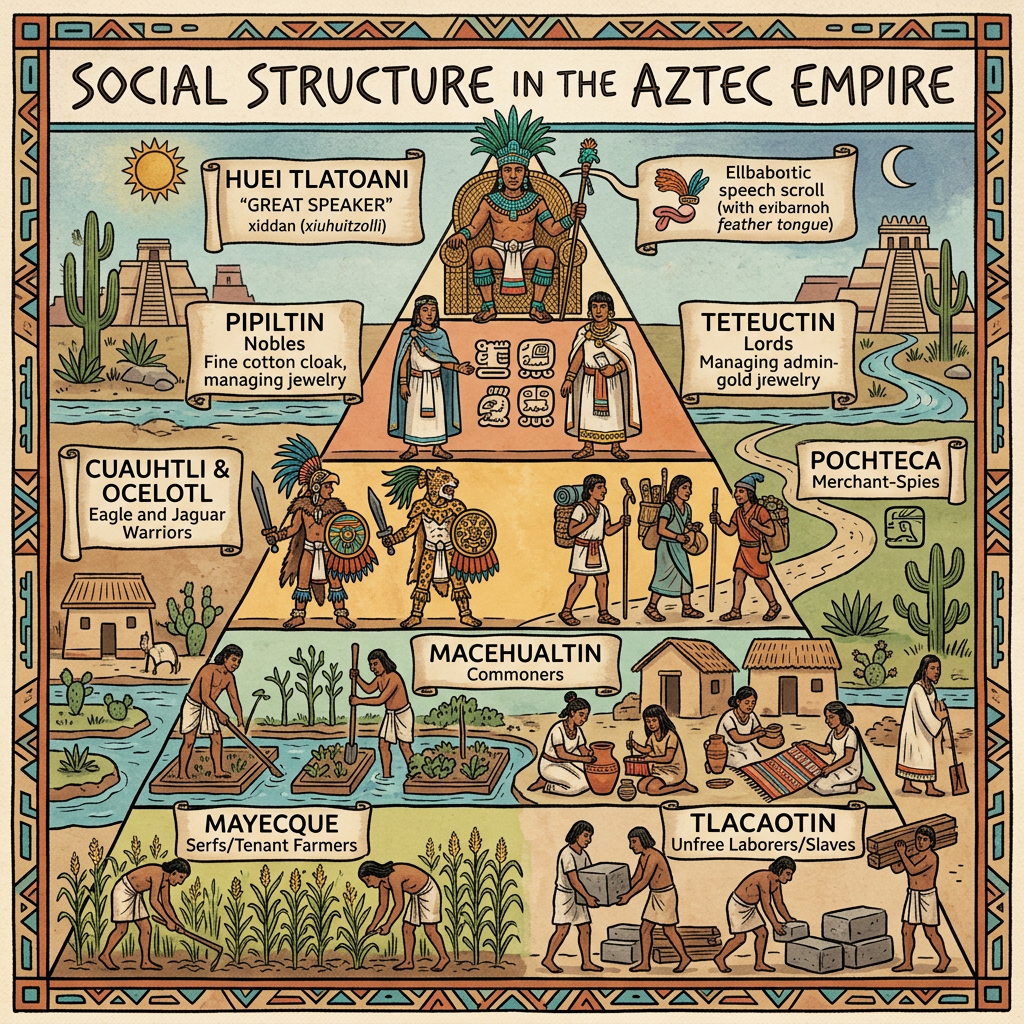
The social structure in the Aztec Empire was highly organized and hierarchical, with different groups playing specific political, religious, military, economic, and agricultural roles. At the top of Aztec society stood the ruler and the noble elite, while merchants, artisans, farmers, laborers, and enslaved people occupied different positions below them.
The Aztec Empire, more accurately associated with the Mexica and the Triple Alliance, developed a complex society in central Mexico before the Spanish conquest in 1521. Its capital, Tenochtitlan, became one of the largest and most important cities in the Americas. The empire was not simply a centralized state in which everyone followed the same system. Instead, conquered communities often retained their local rulers and institutions as long as they provided tribute and other forms of support to the imperial system.
Understanding the Aztec social hierarchy helps explain how this powerful civilization organized government, religion, warfare, trade, agriculture, and everyday life.
The Aztec Social Hierarchy
Aztec society was divided into several broad social groups. These included the tlatoani and royal family, nobles, priests, warriors, merchants, artisans, farmers and commoners, and enslaved people.
Social position could be influenced by birth, occupation, wealth, military achievement, and service to the state. Although Aztec society was strongly hierarchical, it was not completely rigid. Military success, for example, could provide opportunities for individuals to gain prestige and improve their social standing.
At the same time, the privileges of the elite were clearly visible. Nobles had access to better clothing, education, residences, food, and political opportunities than ordinary members of society.

1. The Tlatoani and Royal Family
At the top of the Aztec social structure was the tlatoani, often translated as ruler or speaker. The tlatoani was the highest political authority in the Mexica capital and held enormous influence over warfare, diplomacy, tribute, and religious affairs.
The ruler was supported by members of the royal family and a powerful group of nobles. Famous rulers included Moctezuma I and Moctezuma II, whose reigns were associated with major phases of imperial expansion.
The Aztec Empire was formed through the Triple Alliance of Tenochtitlan, Texcoco, and Tlacopan. Although Tenochtitlan became the dominant power, the empire was relatively flexible and often allowed conquered city-states to maintain their existing political structures.
The ruler therefore stood at the center of a political system that depended on military power, alliances, tribute, and the cooperation of local elites.
2. The Nobility: Pipiltin
Below the ruler were the pipiltin, the hereditary noble class. Nobles occupied important positions within the government, military, religious institutions, and administration.
They could own valuable property and enjoy privileges unavailable to most commoners. Noble families also had access to elite education. Young nobles could be educated in institutions associated with temples and trained for careers in government, religion, or warfare.
Nobility was particularly important because the Aztec Empire required a large administrative class to manage its expanding territories.
Nobles could serve as governors, military commanders, judges, priests, and advisers. Their power was therefore not based solely on wealth but also on their position within the political and religious system.
The distinction between nobles and commoners was reflected in clothing and other forms of material culture. Luxury materials such as finely woven cotton, precious stones, feathers, and elaborate ornaments were closely associated with elite status. Tribute flowing into Tenochtitlan helped support this elite culture.

3. Priests and Religious Leaders
Religion was fundamental to Aztec society, so priests occupied an important position.
Aztec priests conducted ceremonies, maintained temples, interpreted religious traditions, and participated in rituals that were considered essential to maintaining the relationship between humans and the gods.
The religious elite was closely connected with political authority. Major temples and ceremonial centers were located at the heart of Tenochtitlan. The Sacred Precinct included temples, priests’ quarters, schools, and other important institutions.
The Templo Mayor, or Great Temple, was particularly significant. Its twin sanctuaries were associated with Huitzilopochtli and Tlaloc, reflecting the close relationship between warfare, agriculture, religion, and imperial power.
Religious authority therefore formed an essential part of the Aztec social hierarchy.
4. Warriors and Military Society
Warfare played a central role in the expansion and maintenance of the Aztec Empire.
Successful warriors could gain considerable prestige. Military achievement was especially important in a society where warfare generated political power, captives, tribute, and opportunities for social advancement.
Elite warrior organizations included groups such as the Eagle Warriors and Jaguar Warriors, whose members were associated with military distinction and high status.
Military service was also connected to Aztec religion. Capturing enemies could bring honor to individual warriors while contributing to the political and ritual objectives of the state.
The importance of warfare can be seen in the empire’s expansion during the fifteenth and early sixteenth centuries. Under rulers such as Moctezuma I and Ahuitzotl, Aztec military power expanded over extensive parts of central and southern Mexico. Conquered communities were frequently required to provide tribute and, in some cases, military assistance.

5. Merchants and the Pochteca
Merchants, known as pochteca, occupied a distinctive position in Aztec society.
Long-distance merchants traded valuable goods over considerable distances and helped connect different regions of Mesoamerica. They dealt in luxury products and materials that were difficult to obtain locally.
The pochteca were more than ordinary traders. Their activities could have economic, political, and even intelligence-related importance because merchants traveled between different communities and became familiar with distant regions.
Markets were also central to the economy. The great market at Tlatelolco, adjacent to Tenochtitlan, was one of the most important commercial centers in central Mexico. The capital’s large population included numerous craft specialists, merchants, farmers, laborers, and other workers.
This demonstrates that the Aztec economy and social structure were closely connected.
6. Artisans and Skilled Workers
Artisans formed another important part of Aztec society.
Potters, weavers, sculptors, goldworkers, featherworkers, lapidaries, stonemasons, and other specialists produced objects used in households, markets, temples, and elite ceremonies.
Some artisans created highly sophisticated luxury goods for the nobility and religious institutions. Feathers, textiles, precious stones, and other materials were particularly valued by the elite.
The growth of Tenochtitlan created enormous demand for skilled labor. The city contained specialized communities of workers whose products contributed to both the local economy and the prestige of the imperial capital.

7. Commoners and the Macehualtin
The majority of the Aztec population belonged to the commoner class, often described using the term macehualtin.
Commoners worked as farmers, laborers, craftspeople, soldiers, and other productive members of society. Agriculture was especially important because the empire depended on a reliable food supply to support its large urban population and military system.
Many commoners were organized into communities known as calpulli. A calpulli could function as a neighborhood, social group, economic unit, and community organization.
In Tenochtitlan, commoners lived in neighborhoods that had their own local institutions, markets, and temples. This organization helped connect ordinary households to the broader political and economic system.
The common population was therefore not simply an undifferentiated mass. People had occupations, community identities, family responsibilities, and relationships with local authorities.
8. The Calpulli System
The calpulli was one of the most important elements of Aztec community organization.
Calpulli groups helped organize land, labor, religious activities, and community responsibilities. Members could cooperate in agricultural production and participate in local institutions.
This organization gave ordinary people a social identity beyond their individual households. It also helped the state mobilize labor and collect obligations.
The calpulli therefore demonstrates an important feature of Aztec social organization: society operated simultaneously at several levels, from the household and neighborhood to the city and the empire.

9. Enslaved People
At the bottom of many descriptions of the Aztec social structure were enslaved people, although Aztec slavery differed in important ways from the hereditary racial slavery that developed in later Atlantic societies.
People could become enslaved for various reasons, including certain crimes, debts, or other circumstances. Captives could also enter systems of servitude.
Importantly, Aztec slavery was not necessarily permanent or automatically passed from parent to child. Some enslaved people could eventually regain their freedom, depending on their circumstances.
The existence of slavery nevertheless demonstrates the significant inequalities within Aztec society. Status, freedom, wealth, and political power were distributed very unevenly.
Social Mobility in the Aztec Empire
Although Aztec society was hierarchical, social mobility was possible.
Military achievement was one important route to increased prestige. A commoner who demonstrated exceptional ability as a warrior could gain recognition and potentially improve his social position.
Economic success could also influence status. Successful merchants could accumulate wealth and prestige, while specialized artisans could produce highly valued goods.
Education was another important factor. Different educational institutions prepared young people for different social roles, helping reproduce the political, religious, and military structures of Aztec society.
Nevertheless, birth remained extremely important. A person born into a noble family generally enjoyed privileges that were unavailable to most commoners.

Women in Aztec Society
Women played essential roles in Aztec society, particularly within households, agriculture, textile production, markets, and religious life.
Women could participate in commerce and were important producers of textiles and household goods. Mothers also played a major role in raising children and transmitting cultural traditions.
The roles of men and women were often differentiated, but this does not mean women were absent from economic or social life. Their work was essential to household survival and the wider economy.
Elite women could also participate in political and religious networks through family relationships and marriage alliances.
Tribute and the Aztec Social System
One of the most important features connecting the different levels of Aztec society was the tribute system.
The empire expanded by conquering or subordinating numerous communities. Rather than replacing every local government, the Aztec rulers frequently allowed conquered city-states to retain their local leadership while requiring regular tribute.
Tribute could include textiles, food, feathers, precious materials, weapons, and other products. The Codex Mendoza, produced after the Spanish conquest, provides detailed evidence about the types of goods demanded from different provinces.
This tribute supported the imperial capital and helped maintain the wealth and power of the ruling elite.
Consequently, the Aztec class system cannot be understood separately from imperial expansion. Military conquest generated tribute; tribute supported the capital; the capital supported the elite, military, religious institutions, and urban population.

Tenochtitlan: A Reflection of Aztec Social Structure
The physical organization of Tenochtitlan reflected the social structure of the Aztec Empire.
At the center stood the Sacred Precinct and major temples. Nearby were royal palaces, administrative buildings, and elite residences. Further away were neighborhoods where commoners lived and worked.
The city also contained markets, workshops, canals, roads, and agricultural areas. At its height, Tenochtitlan-Tlatelolco may have had around 200,000 inhabitants, making it one of the largest cities of its era.
The city was therefore not simply a political capital. It was a social and economic system in miniature, bringing together rulers, nobles, priests, warriors, merchants, artisans, farmers, and laborers.
Conclusion
The social structure in the Aztec Empire was complex, hierarchical, and closely connected to political power, religion, warfare, agriculture, and trade.
At the top stood the tlatoani and the noble elite, supported by priests, military leaders, and administrators. Merchants and skilled artisans occupied specialized positions, while farmers, laborers, and other commoners formed the majority of the population. Enslaved people occupied a lower and less secure position within the social order.
Yet Aztec society was more than a simple pyramid of classes. Institutions such as the calpulli, the tribute system, religious organizations, markets, and military institutions connected different groups together.
The empire’s strength depended on these relationships. Conquest brought tribute, tribute supported Tenochtitlan, and the wealth of the capital helped sustain the political, religious, military, and economic institutions of the state.
Studying Aztec social hierarchy, Aztec social classes, Aztec society, the calpulli system, Aztec nobles, commoners, warriors, merchants, and tribute therefore provides a clearer picture of how one of the most powerful civilizations in pre-Columbian Mesoamerica functioned before the Spanish conquest in 1521.
Fortisetliber’s View
The social structure in the Aztec Empire reveals a civilization built on organization, responsibility, hierarchy, and collective strength. Aztec society was not simply divided into rich and poor. Every group had a role within a wider system that connected government, religion, warfare, agriculture, trade, and community life.
At the top stood the ruler and the noble elite, who directed political and military affairs. Priests maintained religious institutions, while warriors protected and expanded the empire. Merchants connected distant regions through trade, artisans produced valuable goods, and farmers and laborers provided much of the food and physical work that sustained society.
From a Fortis et Liber perspective—strong and free—the most interesting lesson is that a powerful civilization depends on more than its leaders. The strength of the Aztec Empire came from the interaction of thousands of people performing different responsibilities. The empire could expand because farmers produced food, merchants moved goods, warriors fought campaigns, priests maintained religious traditions, and administrators organized tribute.
At the same time, Aztec society reminds us that strength can coexist with inequality. Social privileges were distributed unevenly, and nobles possessed opportunities and comforts that ordinary people did not. The empire’s tribute system also placed significant demands on conquered communities.
The Aztec experience therefore presents a complicated picture of civilization. Strength without balance can create inequality, while organization without freedom can create dependence. Understanding Aztec society means recognizing both its remarkable achievements and its limitations.
Ultimately, the history of the Aztec Empire shows that civilizations are built by people at every level of society. Its legacy is not only found in its rulers and monumental temples, but also in the farmers, craftsmen, merchants, warriors, families, and communities whose daily lives made the empire possible.
Leave a Reply