
Introduction: The Beginnings of Brain Surgery in Ancient Greece
The history of brain surgery in ancient Greece reveals a remarkable chapter in the development of medicine. Long before modern hospitals, advanced imaging technology, and sophisticated surgical instruments existed, ancient Greek physicians attempted to treat serious head injuries through observation, practical experience, and carefully developed surgical techniques.
One of the most significant procedures was trepanation, also known as trephination, which involved creating an opening in the skull. Although this operation was practiced in different parts of the world long before classical Greek civilization, ancient Greek medical writers provided some of the earliest detailed descriptions of cranial surgery.
From Bronze Age archaeological discoveries to the medical teachings associated with Hippocrates, the history of ancient Greek neurosurgery demonstrates how early physicians approached head trauma, skull fractures, and potentially life-threatening injuries.
Understanding brain surgery in ancient Greece also helps explain how medical practice gradually moved toward systematic observation and rational explanations of disease, laying important foundations for later developments in surgical medicine.
1. The Origins of Ancient Neurosurgery in Greece
Surgical intervention involving the skull existed in Greece long before the famous physicians of the classical period. Archaeological evidence indicates that cranial procedures were performed during prehistoric times, including the Bronze Age.
A notable example comes from Kirra, near Delphi, in central Greece. Researchers examined a skull dating to approximately 1900–1600 BC that displayed evidence of trepanation. The bone around the opening showed signs of healing, suggesting that the individual survived the operation for some period.
This discovery is important because it demonstrates that cranial surgery in Greece predates the written medical descriptions associated with Hippocrates by more than a millennium.
However, archaeologists cannot always determine precisely why a particular operation was performed. Possible explanations include treating traumatic head injuries, removing damaged bone, or addressing other conditions. In some ancient societies, skull openings may also have had ritual significance.
Consequently, prehistoric trepanation should not automatically be interpreted as modern-style brain surgery. Nevertheless, the archaeological evidence provides compelling insight into the early history of neurosurgery and the development of surgical practices in ancient Greece.

2. What Was Trepanation in Ancient Greek Medicine?
Trepanation was one of the most important procedures in the history of ancient cranial surgery. It involved creating an opening in the skull using techniques such as scraping, cutting, or drilling.
Ancient physicians could use this procedure when treating certain skull fractures and head injuries. Depending on the injury, removing damaged bone or creating an opening could potentially relieve pressure or provide access to an affected area.
The operation required considerable practical skill. A surgeon needed to understand the shape of the skull, recognize the location and severity of an injury, and avoid causing further damage.
Ancient surgical instruments were much simpler than those used in modern operating rooms. Nevertheless, archaeological evidence and medical texts indicate that physicians developed techniques suited to the materials and knowledge available to them.
It is important to distinguish trepanation from contemporary neurosurgery. Ancient practitioners did not possess modern anesthesia, sterile operating environments, antibiotics, or diagnostic imaging. The procedure therefore carried substantial risks, including bleeding, infection, and injury to underlying tissues.
Even so, evidence of healing on some ancient skulls demonstrates that survival after cranial surgery was possible.
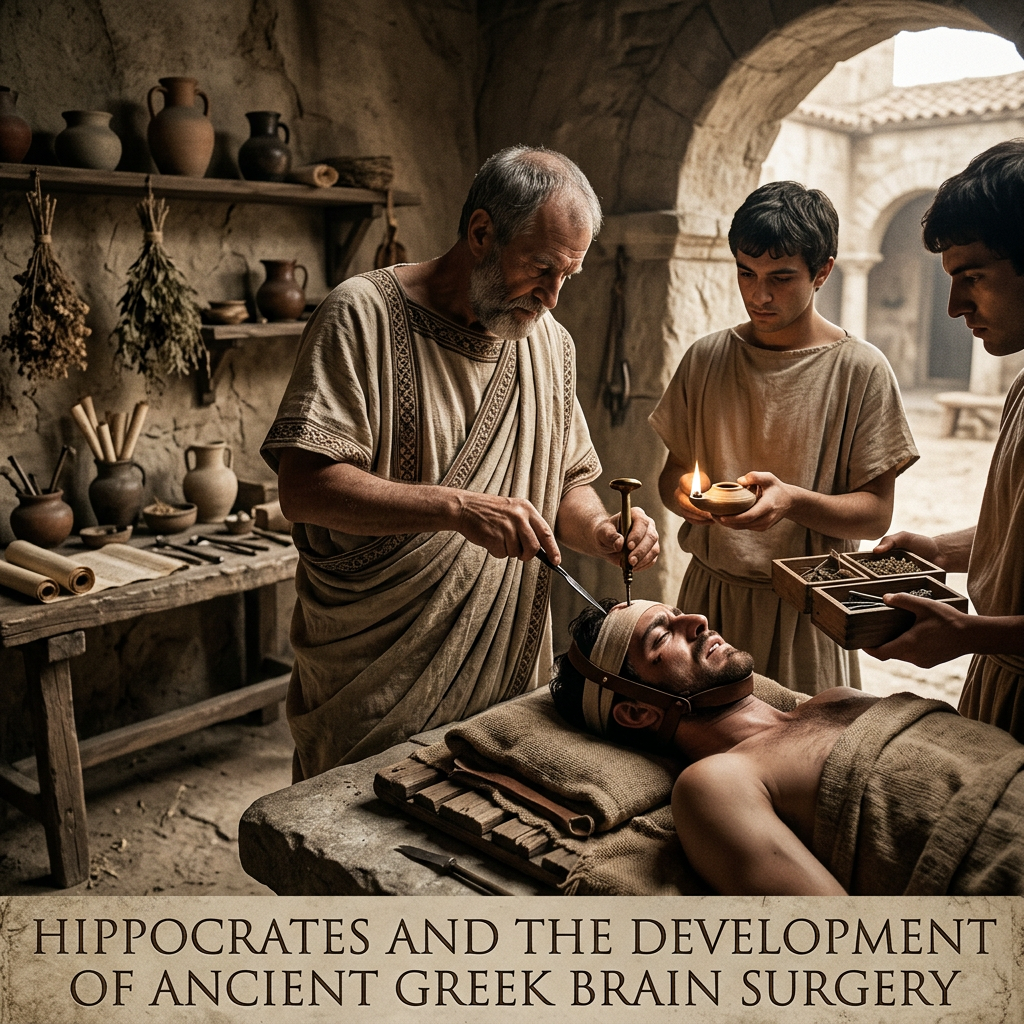
3. Hippocrates and the Development of Ancient Greek Brain Surgery
Hippocrates, traditionally dated to approximately 460–370 BC, is one of the most influential figures in the history of ancient Greek medicine. Although many medical writings associated with his name were produced by different authors, the Hippocratic tradition helped establish a systematic approach to examining and treating illness.
A particularly important text is On Head Wounds, part of the Hippocratic Corpus. It discusses injuries to the skull, methods of examination, and surgical approaches to certain cranial fractures.
The Hippocratic writers emphasized careful observation of the wound, its location, and the symptoms experienced by the patient. They also recognized that head injuries could be complex and that the appearance of an external wound did not necessarily reveal the full extent of the damage beneath the skull.
Their writings describe techniques for managing cranial injuries, including the use of instruments to work on damaged bone. They also reflect caution about when and how to intervene surgically.
This approach represents a significant milestone in the history of brain surgery. Rather than relying exclusively on supernatural explanations, Hippocratic medicine increasingly emphasized physical signs, clinical experience, and reasoned judgments.
Although these physicians lacked modern knowledge of brain anatomy and physiology, their detailed observations influenced medical thinking for centuries.

4. Ancient Greek Surgical Instruments and Techniques
The tools used in ancient Greek surgery were relatively basic compared with modern neurosurgical equipment, but they were designed to perform specific tasks.
Depending on the period and procedure, surgeons could use metal instruments for cutting, scraping, probing, and manipulating bone. Textual descriptions of cranial surgery provide evidence of specialized instruments and carefully considered methods.
Two important approaches to trepanation were drilling and scraping. Drilling created an opening through controlled penetration of the bone, while scraping gradually removed bone from the affected area.
The technique selected depended on the nature of the injury, the physician’s experience, and the equipment available. The objective in cases of trauma could include addressing damaged bone or treating a fracture.
Ancient medical writers also warned about the dangers of operating too deeply or damaging sensitive structures beneath the skull. Their recommendations reveal an awareness that cranial surgery required precision and restraint.
Nevertheless, ancient Greek surgeons faced serious limitations. They could not use X-rays, CT scans, MRI examinations, or modern monitoring systems to assess internal injuries. Decisions had to rely on external examination, symptoms, experience, and the information available during the operation.
These limitations made ancient neurosurgery unpredictable, but the surviving medical descriptions show that practitioners developed a meaningful body of surgical knowledge.

5. Religion, Healing Temples, and Medical Practice
Medicine in ancient Greece existed within a culture where religious belief and practical treatment frequently overlapped.
The god Asclepius was associated with healing, and sanctuaries dedicated to him, known as Asclepieia, attracted people seeking relief from illness. These sites played an important role in ancient Greek healing culture.
Patients visiting an Asclepieion might participate in religious rituals, seek guidance from attendants, or follow customary healing practices. The relationship between these sanctuaries and technical surgery, however, remains a subject of scholarly investigation.
Some researchers have proposed that particular surgical techniques, including trepanation, may have been practiced or systematized within healing environments connected to the cult of Asclepius. This interpretation is an interesting possibility rather than a universally established fact.
The broader picture is that ancient Greek medicine was not divided neatly into modern categories of science and religion. Physicians, religious healers, and communities could approach illness through overlapping traditions.
Over time, medical authors increasingly emphasized practical examination and explanations based on observable physical processes. This intellectual development helped shape the medical tradition for which ancient Greece became famous.

6. Archaeological Discoveries Reveal Ancient Cranial Surgery
Archaeology provides essential evidence for understanding how brain surgery developed in ancient Greece. Medical texts explain what physicians recommended, while human remains can reveal whether cranial procedures were actually performed.
One important example is the Bronze Age skull discovered at Kirra near Delphi. Its healed opening offers evidence of cranial intervention thousands of years before the classical Hippocratic tradition.
Other discoveries have expanded knowledge of skull surgery during later periods. Research published in 2021 examined trepanations from the ancient Greek settlement of Akanthos, dating broadly from the fifth to the first centuries BC. The study reported seven trepanations involving four individuals and compared the skeletal evidence with Hippocratic medical writings.
Researchers identified different techniques, including drilling and scraping. Some remains showed significant healing, while others suggested that survival after the operation may have been brief.
Such findings help historians investigate the relationship between written medical recommendations and actual surgical practice. They also demonstrate that outcomes varied and that not every operation resulted in long-term survival.
Archaeological evidence must be interpreted carefully. A healed skull opening can demonstrate that a person survived the procedure, but it cannot always establish the original diagnosis, the surgeon’s intentions, or the exact circumstances of treatment.
Despite these uncertainties, discoveries across Greece provide valuable evidence of the long history of cranial surgery.
7. Did Ancient Greek Brain Surgery Work?
Whether ancient Greek brain surgery was successful depends on the procedure, the patient’s injury, and what is meant by success.
Evidence of bone healing indicates that some patients survived trepanation. In certain cases, surgery may have helped address traumatic injuries or remove damaged bone. However, survival alone does not prove that the operation cured the underlying condition or restored the patient’s previous health.
The absence of modern anesthesia, infection control, and reliable diagnostic methods made cranial operations particularly dangerous. Bleeding, infection, and damage to the brain or its surrounding tissues could have fatal consequences.
Ancient physicians also had limited understanding of many neurological conditions. They could observe symptoms and injuries, but they could not diagnose brain disorders with the precision available to contemporary specialists.
Nevertheless, the development of written surgical guidance was significant. Hippocratic medical authors recorded observations, discussed techniques, and recognized the importance of individual injuries and careful surgical judgment.
The legacy of ancient Greek brain surgery is therefore not that it achieved modern medical results. Rather, it shows how systematic observation, technical experimentation, and the preservation of medical knowledge contributed to the long-term development of surgery.

8. The Legacy of Ancient Greek Neurosurgery
The influence of ancient Greek medicine extended beyond its original historical setting. Hippocratic writings and other classical medical traditions were transmitted, studied, and adapted by later Greek, Roman, Byzantine, Arabic-speaking, and European medical communities.
The Roman medical writer Celsus and the physician Galen contributed to the broader history of cranial surgery and medical knowledge. Their writings helped preserve and develop ideas about anatomy, injuries, and treatment.
Over many centuries, medical practice changed as anatomical research, surgical instruments, scientific methods, anesthesia, antisepsis, and modern imaging transformed the treatment of head injuries.
Contemporary neurosurgery is vastly more advanced than ancient trepanation. Yet its history provides an important reminder that surgical knowledge developed gradually through accumulated experience, observation, debate, and experimentation.
Ancient Greek physicians and prehistoric practitioners did not possess today’s scientific tools, but the surviving evidence shows that people were already attempting to understand and treat serious injuries to the head thousands of years ago.
Conclusion: How Ancient Greece Contributed to the History of Brain Surgery
Brain surgery in ancient Greece represents an important chapter in the evolution of medicine. Archaeological discoveries demonstrate that cranial procedures were performed in prehistoric Greece, while Hippocratic medical writings provide detailed descriptions of skull injuries and surgical techniques during classical antiquity.
Trepanation, ancient surgical instruments, and the careful observation of head trauma reveal both the ingenuity and the limitations of early practitioners. Although their procedures were dangerous and their understanding of neurological disease remained incomplete, they developed methods that became part of the wider history of cranial surgery.
Today, the study of ancient Greek neurosurgery combines archaeology, medical history, and modern scientific analysis to reconstruct how these operations were performed and how patients responded.
The story of ancient brain surgery is ultimately a story of human curiosity: the enduring effort to understand the body, relieve suffering, and improve the chances of survival in the face of serious injury.

Frequently Asked Questions About Brain Surgery in Ancient Greece
Did ancient Greeks perform brain surgery?
Yes. Archaeological evidence confirms that cranial procedures, including trepanation, were performed in Greece thousands of years ago. Ancient Greek medical writers later described techniques for treating skull injuries.
What was trepanation in ancient Greece?
Trepanation was a procedure in which a surgeon created an opening in the skull through drilling, scraping, or another method. It was used in the treatment of certain head injuries, although the purpose of individual prehistoric procedures is not always known.
Did Hippocrates perform brain surgery?
Hippocrates is traditionally associated with medical writings that discuss cranial injuries and surgical treatment. However, it is difficult to attribute every procedure in the Hippocratic Corpus to Hippocrates personally, and the texts do not establish which operations he performed himself.
Did patients survive brain surgery in ancient Greece?
Yes. Some ancient skulls show evidence of healing after trepanation, indicating that patients survived the operation. Survival did not necessarily mean complete recovery, and outcomes likely varied considerably.
How did ancient Greek surgeons operate on the skull?
Ancient surgeons used metal instruments and techniques such as drilling and scraping to work on cranial bone. They relied on physical examination and practical experience because modern imaging, anesthesia, and infection-control methods were unavailable.
Why is ancient Greek brain surgery important today?
It provides evidence of early surgical practice and the development of medical observation. Studying ancient procedures helps historians understand how knowledge of head injuries and cranial surgery evolved over time.
Fortisetliber’s View
Long before modern medicine, ancient Greece played an important role in the history of surgery. From prehistoric skull operations to the medical writings of Hippocrates, ancient Greek medicine reveals humanity’s early attempts to understand and treat serious head injuries.
One of the earliest cranial procedures was trepanation, an operation involving the creation of an opening in the skull. Archaeological discoveries in Greece show that this technique was practiced thousands of years ago. Later, the Hippocratic medical tradition documented methods for examining skull fractures and treating head wounds.
Although ancient surgeons lacked modern anesthesia, antibiotics, and medical imaging, their observations contributed to the gradual development of surgical knowledge. Today, archaeological evidence and ancient medical texts help historians reconstruct these remarkable practices.
The story of brain surgery in ancient Greece is a testament to human curiosity, medical ingenuity, and the enduring pursuit of knowledge that continues to shape modern neurosurgery.
Sources and Further Reading
- Neurosurgery During the Bronze Age: A Skull Trepanation in 1900 BC Greece — PubMed . Research examining archaeological evidence from Kirra near Delphi.
PubMed
- Trepanations in the Ancient Greek Colony of Akanthos: Skull Surgery in the Light of Hippocratic Medicine — PubMed . Research comparing skeletal evidence with Hippocratic medical writings.
- Hippocrates, Galen, and the Uses of Trepanation in the Ancient Classical World — PubMed . A historical study of cranial surgery in ancient medicine.
Leave a Reply