
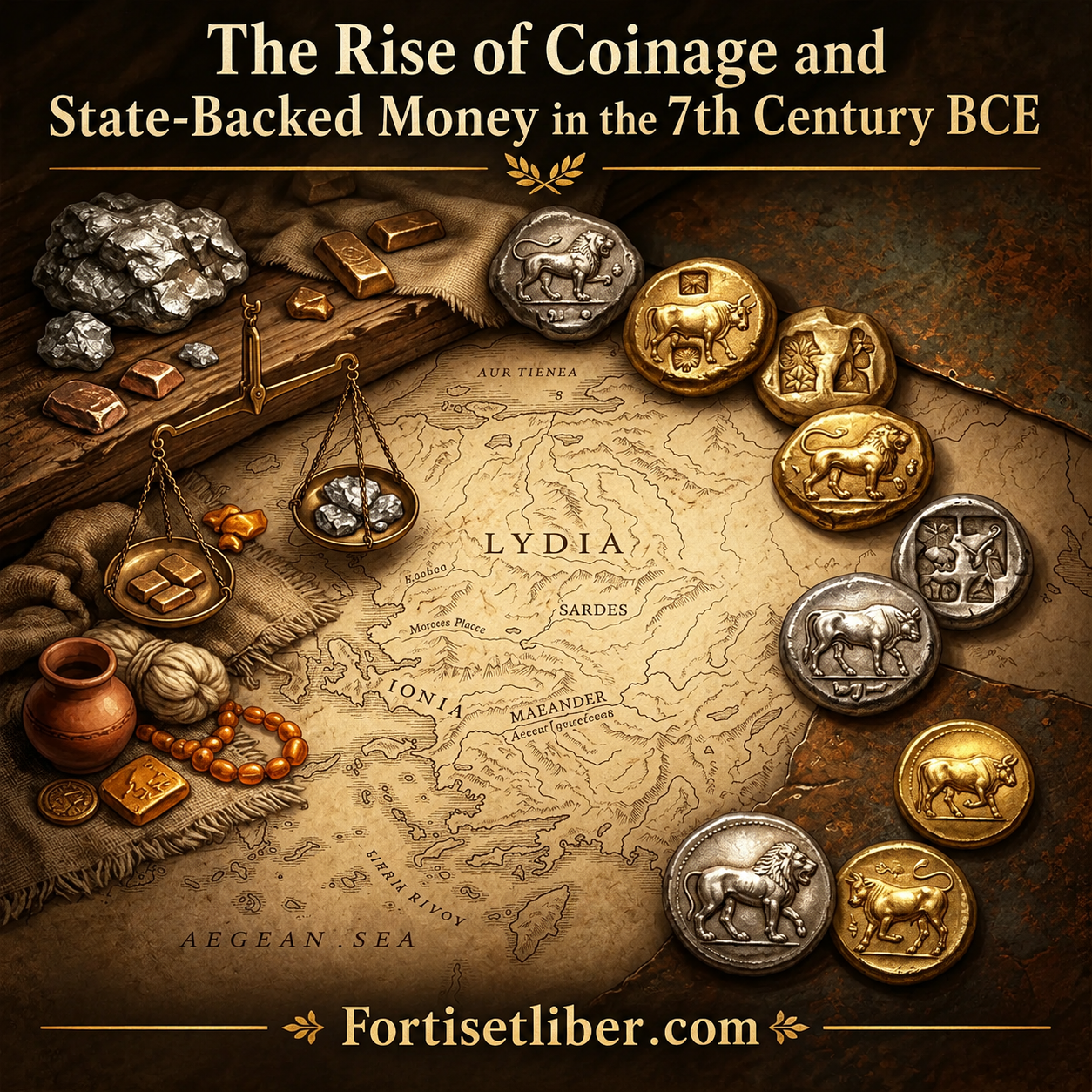
Introduction: The Birth of Coinage
The rise of coinage in the 7th century BCE marked a major turning point in the history of money. In the ancient kingdom of Lydia, located in modern-day western Türkiye, people began producing stamped pieces of precious metal that helped transform trade, payments, and economic organization. These early coins introduced a new approach to exchange by combining standardized metal with official markings that helped identify their origin.
Money existed long before coins. Ancient civilizations used silver, grain, livestock, and other commodities to measure value and settle obligations. However, the invention of coinage introduced a more recognizable form of currency that could simplify certain transactions and connect monetary exchange with political authority.
The emergence of state-backed money changed how people understood the relationship between currency, commerce, and government. It created new possibilities for public payments, commercial exchange, and the organization of economic activity. Although the first coins were not identical to modern money, they helped establish monetary practices that influenced civilizations for centuries.
1. The History of Money Before Coinage
Before the first coins appeared, ancient societies already had sophisticated systems for exchanging goods and measuring wealth. In Mesopotamia, silver served as a unit of account, while grain and other commodities played important roles in wages, taxation, and economic administration.
Precious metals were particularly useful because they were durable, divisible, and relatively easy to transport. However, transactions involving unmarked silver or gold often required weighing and assessing the quality of the metal. This could make exchanges more complicated, especially when trading partners used different standards.
The history of money therefore did not begin with coins. Instead, coinage developed from existing practices involving commodities, weighed metals, and recorded obligations.
The innovation of early coinage was the creation of standardized metal objects bearing recognizable impressions. These marks helped distinguish minted pieces from ordinary metal and could signal that an issuing authority stood behind their production.

2. Lydia: The Birthplace of the First Coins
Lydia is widely associated with the invention of coinage in the ancient Western world. Located in western Anatolia, the kingdom occupied a strategic position between inland regions and the Aegean coast. Its capital, Sardis, became an important center of political power and economic activity.
The earliest known Lydian and neighboring Ionian coins appeared during the late 7th century BCE, with some evidence suggesting that coinage began around the middle of that century. The exact date and identity of the first issuer remain subjects of scholarly debate.
Lydia’s political influence, access to precious metals, and connections with regional trade networks provided favorable conditions for the development of early currency.
These first coins were small pieces of metal with official impressions. Some featured animal imagery, including lions associated with Lydian royal authority. Their reverse sides commonly displayed punch marks created during the minting process.
The first coins in history were not necessarily designed for every type of everyday purchase. Historians have suggested that early coinage may have served several purposes, including official payments, rewards, military expenditure, and commercial transactions. The evidence does not establish one single explanation for its invention.
Nevertheless, Lydian coinage became an influential innovation that neighboring Greek-speaking communities adopted and adapted to their own economic and political needs.
3. Electrum Coins and Their Historical Significance
One of the defining features of early Lydian currency was the use of electrum coins. Electrum is an alloy consisting mainly of gold and silver. It can occur naturally, although ancient coin producers also developed methods for controlling its composition.
Electrum was valuable and durable, making it suitable for producing small pieces of precious-metal currency. Early coins were generally manufactured by preparing metal blanks and striking them with engraved dies or punches.
However, electrum presented a significant challenge: its gold content could vary. Two coins of equal weight might contain different proportions of gold and silver, affecting their intrinsic value.
Standardized production offered a way to manage this uncertainty. By controlling the composition, weight, and markings of coins, an issuing authority could make its currency more recognizable and potentially easier to use.
This process illustrates why the invention of coinage involved more than simply shaping metal into discs. It required metallurgical knowledge, production standards, and a degree of institutional organization.
Early electrum coins also reveal the connection between money and political authority. Their imagery could identify an issuer, while their standardized production could encourage confidence in the currency.

4. The Rise of State-Backed Money
The emergence of state-backed money was a crucial development in monetary history. Before standardized coinage, the value of a piece of precious metal depended heavily on its weight, purity, and acceptance by the people involved in a transaction.
Official coinage introduced another factor: the authority responsible for producing and validating the currency.
By issuing coins according to particular standards, rulers and other authorities could create recognizable monetary objects. Official markings helped users identify a coin’s origin, while consistent weights and production methods could reduce the need to assess every piece of metal independently.
Early state-backed money still depended substantially on its precious-metal content. It should not be confused with modern fiat currency, whose value does not depend on the metal from which it is made.
Instead, early coinage combined material value with institutional recognition.
This relationship offered several potential advantages:
- Standardization: Recognizable coins could simplify certain transactions.
- Public finance: Currency could support government payments and the settlement of obligations.
- Trust and recognition: Official markings helped identify the issuing authority.
- Political influence: Coin designs communicated royal or civic identity.
The extent of these advantages varied across communities. Even so, coinage established a lasting relationship between monetary systems and political institutions.
5. How Coinage Transformed Ancient Trade and Commerce
The spread of coinage created new opportunities for ancient trade and commerce. Merchants needed practical ways to assess value, transport wealth, and conduct transactions with people from different communities.
Recognizable coins could make some exchanges easier by reducing the time required to weigh and test precious metal. They also offered a portable means of transferring wealth between locations.
However, early coinage did not eliminate all uncertainty. Different cities issued coins according to different standards, and unfamiliar currency might still need to be weighed, tested, or exchanged.
Nor did coins immediately replace barter or other forms of payment. Commodity exchange and weighed silver continued alongside coinage in many ancient societies.
The impact of coinage was therefore gradual rather than universal. Its adoption depended on local institutions, trading relationships, political conditions, and the availability of suitable metals.
Over time, however, coins became increasingly important in several ancient Mediterranean economies. Their standardized denominations helped make monetary exchange more recognizable and supported the development of increasingly complex commercial networks.

6. Coinage, Taxation, and Government Power
The relationship between coinage and government was one of the most important developments in the history of state-backed money.
Ancient rulers needed resources to maintain armies, administer territories, support officials, and fulfill political obligations. A recognized currency could help organize some of the payments required for these activities.
Governments could potentially use coins to pay soldiers, compensate workers, and settle obligations with suppliers. They could also influence monetary practices through the standards and designs they authorized.
Nevertheless, it would be inaccurate to claim that coins were invented exclusively for taxation. Scholars continue to debate the original purposes of Lydian and Ionian coinage, and early monetary practices varied across communities.
The broader significance is that coinage and state power became increasingly interconnected. Political authorities could influence the production of money, while the use of standardized currency could make certain administrative and financial activities more manageable.
Coinage also served as a form of communication. Symbols associated with rulers, cities, or religious traditions appeared on coins, allowing political messages to circulate alongside monetary value.
7. From Lydia to Ancient Greece
Following the emergence of Lydian and Ionian coinage, the practice spread throughout the Greek world. During the 6th and 5th centuries BCE, numerous Greek city-states developed their own monetary systems.
Athens became particularly famous for its silver coins, which featured the goddess Athena and an owl. These coins gained broad recognition and became important in regional trade.
The development of Greek silver coinage represented an important stage in the evolution of ancient currency. Unlike the earliest electrum issues, silver coins allowed communities with access to silver resources to develop their own monetary systems without relying on the same gold-silver alloy.
Coin designs also expressed civic identity. Images of gods, animals, and local symbols distinguished one city’s currency from another and communicated cultural and political associations.
Later, the Achaemenid Persian Empire adopted coinage after conquering Lydia in the 6th century BCE. Royal coinage subsequently developed across several ancient empires and kingdoms.
This expansion demonstrates how the original innovation of coin production evolved into a range of monetary systems shaped by different political and economic needs.

8. The Legacy of the First Coins
The rise of coinage in the 7th century BCE laid important foundations for the development of later monetary systems. Over time, coins became central to commercial transactions, government payments, military expenditure, and the expression of political authority across much of the ancient Mediterranean.
The process was not immediate or universal. Different civilizations adopted coins at different times, while others continued using weighed metals, commodities, and accounting systems.
Nevertheless, coinage established an influential model: an issuing authority could produce recognizable units of currency according to defined standards.
Modern currencies differ significantly from ancient electrum coins. Today, money can take the form of banknotes, bank deposits, and digital balances supported by financial institutions and legal frameworks. Its value generally depends on confidence in the monetary system rather than the intrinsic value of a precious metal.
Yet one principle remains relevant: money works most effectively when people recognize and trust the institutions and arrangements that support its use.
The earliest coins were therefore more than valuable metal objects. They represented an important stage in the development of standardized currency, institutional credibility, and the relationship between money and government.
Conclusion: Why the Rise of Coinage Still Matters
The rise of coinage and state-backed money in the 7th century BCE was a defining moment in ancient economic history. Emerging in Lydia and neighboring Ionian communities, early electrum coins combined precious metal, standardized production, and recognizable markings to create a new instrument of exchange.
Their significance extended beyond commercial convenience. Coinage connected monetary practices with political authority, offered governments new ways to organize payments, and allowed communities to communicate identity through currency.
Although the first coins differed greatly from modern money, their development helped shape the long history of currency and financial institutions.
Understanding the origins of coinage provides valuable insight into how societies developed systems for measuring value, settling obligations, and organizing economic activity. From ancient Lydian coins to modern digital payments, the history of money reflects humanity’s continuing efforts to make exchange more reliable, recognizable, and efficient.

Frequently Asked Questions
Where were the first coins invented?
The earliest known coinage emerged in Lydia and neighboring Ionian communities in western Anatolia, in modern-day Türkiye, during the 7th century BCE.
What were the first coins made of?
Many early coins were made from electrum, an alloy consisting mainly of gold and silver.
Why was coinage important in ancient history?
Coinage created recognizable units of precious-metal currency that could simplify certain transactions and connect monetary exchange with political authority.
What is state-backed money?
State-backed money is currency whose production, standards, or acceptance are supported by a political authority. Early precious-metal coins differed from modern fiat currency because their metal content contributed directly to their value.
Did coins replace barter?
No. Coinage expanded the available methods of payment, but barter, commodity exchange, and payments using weighed metals continued alongside coins.
Fortisetliber’s View
The rise of coinage in the 7th century BCE marked a turning point in economic history. In ancient Lydia, in modern-day Türkiye, early electrum coins introduced a new way to exchange value, combining precious metals with recognizable official markings.
Before coins, societies relied on weighed silver, commodities, and other forms of payment. The invention of coinage helped make certain transactions more convenient while connecting money to political authority.
From a Fortis et Liber perspective — Strong and Free — the history of money raises an enduring question: how does currency influence economic independence and the power of the state?
Early state-backed money offered advantages through standardized weights, recognizable symbols, and greater confidence in transactions. Yet the relationship between money and authority also created an important tension: the institutions that issue currency can influence how wealth circulates and how economic obligations are fulfilled.
The first Lydian coins were made from electrum, a natural alloy of gold and silver. Their emergence helped inspire monetary developments throughout the ancient Greek world, eventually contributing to the broader evolution of coinage and public finance.
Today, money has evolved from precious-metal coins to banknotes and digital payments. However, the fundamental issues of trust, value, institutional responsibility, and economic freedom remain relevant.
The Fortis et Liber View: Understanding the origins of money helps us understand the relationship between financial systems, individual freedom, and state power. History reminds us that money is more than a medium of exchange; it is also an institution that shapes economic life.
Fortis et Liber — Strong and Free.
References and Further Reading
- Kroll, John H. — “The Monetary Background of Early Coinage.” In The Oxford Handbook of Greek and Roman Coinage, edited by William E. Metcalf, Oxford University Press, 2012.
Examines the monetary practices that preceded coinage and explains the importance of electrum and state involvement in the development of early currency.
https://doi.org/10.1093/oxfordhb/9780195305746.013.0003 - Schaps, David M. — The Invention of Coinage and the Monetization of Ancient Greece. University of Michigan Press, 2004.
Explores how coinage emerged and how money influenced the economic and social development of ancient Greek society. - Melitz, Jacques — “A Formal Analysis of the Beginnings of Coinage in Antiquity.” CEPR Discussion Paper No. 10795, 2015.
Investigates possible economic and political explanations for the emergence of early Lydian and Ionian coinage.
https://cepr.org/publications/dp10795
Leave a Reply