
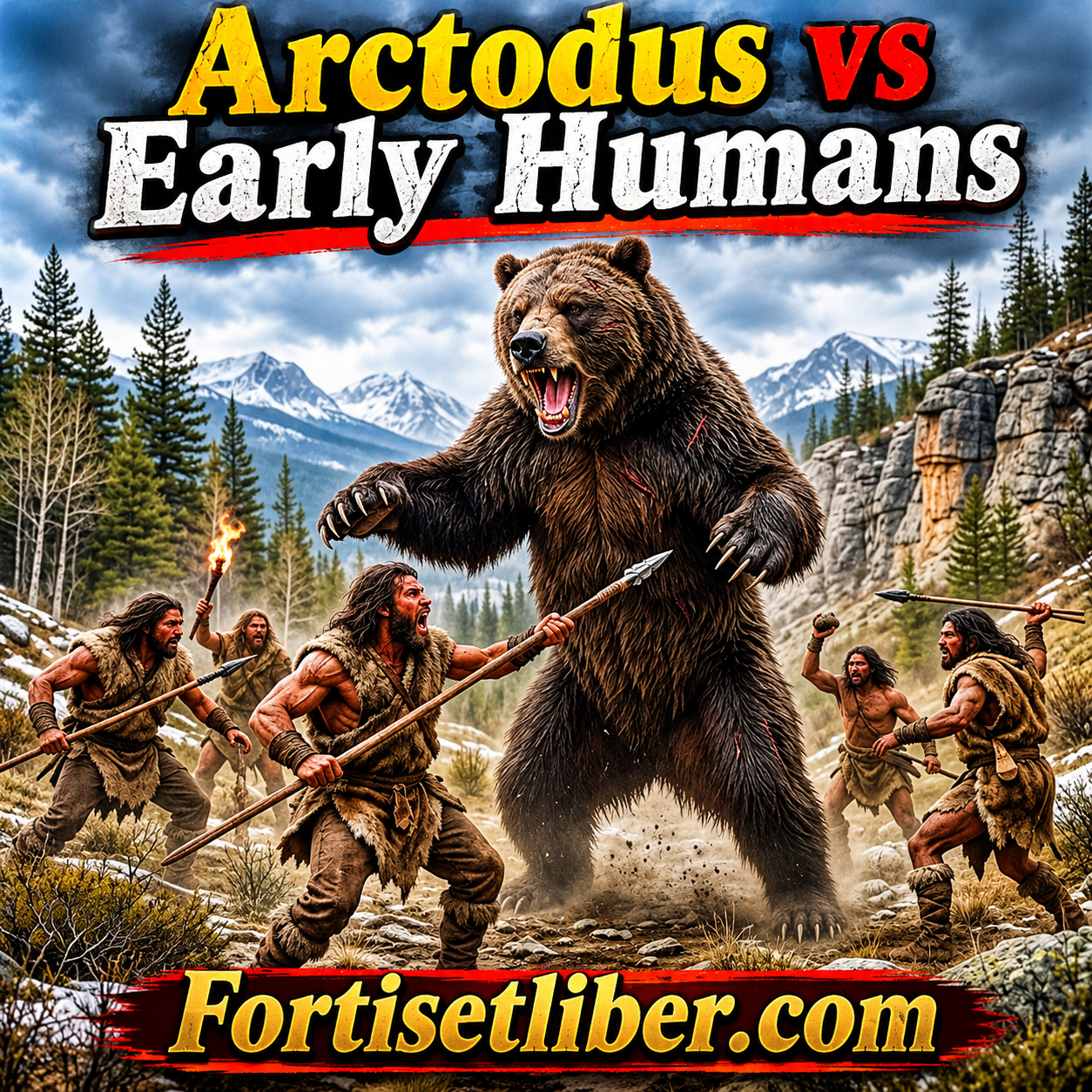
Imagine walking across the frozen wilderness of Ice Age North America. Snow covers the ground, icy winds sweep across the plains, and enormous prehistoric animals roam the landscape. Mammoths, giant ground sloths, saber-toothed cats, and ancient wolves dominate this dangerous world.
But among these incredible creatures, one animal stood out as particularly intimidating: Arctodus simus, the giant short-faced bear.
This enormous prehistoric predator was one of the largest land-dwelling carnivorous mammals ever to live in North America. Standing on its powerful hind legs, it could appear absolutely enormous compared with a human being. Its massive body, strong jaws, and impressive physical strength made it a formidable animal in the Ice Age ecosystem.
During the Late Pleistocene, early humans and giant short-faced bears occupied parts of North America at the same time. This raises an exciting question: what would happen if an early human encountered an Arctodus in the wilderness?
Could prehistoric humans defend themselves against such a powerful animal, or would the giant short-faced bear have an overwhelming advantage?
Let’s explore the fascinating relationship between Arctodus and early humans, comparing their physical abilities, survival strategies, weapons, and chances of surviving a dangerous encounter.

1. What Was Arctodus? Meet the Giant Short-Faced Bear
Arctodus simus, commonly known as the giant short-faced bear, lived throughout much of North America during the Pleistocene epoch.
Its fossils have been discovered across a huge geographical area, stretching from Alaska to Mexico and from the Pacific coast to the eastern United States.
This prehistoric bear belonged to the family Ursidae, making it a relative of modern bears. However, its body proportions were quite different from those of today’s brown and polar bears.
One of its most remarkable characteristics was its relatively short facial structure, combined with long limbs and an enormous body.
Adult males may have weighed approximately 700–800 kilograms, although body size varied considerably between individuals and populations. Some estimates suggest that particularly large individuals could have been even heavier.
Its physical characteristics included:
- A massive muscular body.
- Long, powerful limbs.
- Large paws and strong claws.
- Powerful jaws and teeth.
- An impressive shoulder and body structure.
- The ability to stand on its hind legs.
Arctodus was not simply a larger version of a modern bear. Its unusual anatomy made it one of the most fascinating mammals of prehistoric North America.
Scientists still debate its feeding behavior. Some researchers have suggested that it was an active predator, while other evidence supports a significant scavenging and omnivorous component in its diet.
This distinction is important because the giant short-faced bear may not have hunted in the same way as modern big cats or wolves.

2. Early Humans in Ice Age North America
While Arctodus roamed North America, early human communities were developing impressive survival skills.
These people lived in an environment where finding food, avoiding predators, locating water, and surviving freezing temperatures were daily challenges.
Some of the best-known prehistoric North American hunters belonged to the Clovis archaeological tradition, associated with distinctive stone tools and hunting technologies.
Clovis groups lived approximately 13,000 years ago, although the broader history of human occupation in the Americas extends earlier.
Their survival depended on several important abilities:
Stone weapons: Early humans manufactured sharp stone tools, including projectile points that could be attached to hunting weapons.
Cooperation: Working together allowed groups to hunt large animals, defend themselves, and share resources.
Fire: Controlled fire provided warmth, protection, cooking opportunities, and improved survival during cold periods.
Knowledge of the environment: Understanding animal behavior, migration routes, water sources, and dangerous locations gave humans an important advantage.
Unlike Arctodus, humans did not possess enormous physical strength or natural weapons such as claws and powerful jaws.
Instead, their greatest advantage was intelligence combined with cooperation and technology.

3. Arctodus vs Early Humans: Comparing Their Physical Abilities
When comparing Arctodus with early humans, the physical differences are extraordinary.
A prehistoric human was physically vulnerable compared with a giant short-faced bear.
| Physical characteristic | Arctodus simus | Early human |
|---|---|---|
| Body weight | Around 700–800 kg for large adult males | Much lighter |
| Natural weapons | Claws, teeth, powerful jaws | Hands and manufactured weapons |
| Physical strength | Enormous | Limited compared with the bear |
| Speed and mobility | Powerful terrestrial animal | Good endurance and mobility |
| Intelligence | Bear-level animal cognition | Advanced planning and cooperation |
| Defense | Massive body and natural weapons | Weapons, teamwork and fire |
The giant short-faced bear would have had a tremendous advantage in a direct physical confrontation.
Its powerful body and natural weapons could cause devastating injuries.
A human attempting to fight such an animal without weapons would have very little chance of surviving a serious attack.
However, physical strength was not the only factor determining survival in the prehistoric world.
Humans could recognize danger, communicate with one another, prepare defensive strategies, and use weapons from a distance.
These abilities changed the balance of power.

4. Would Arctodus Have Hunted Early Humans?
This is one of the most interesting questions surrounding the relationship between giant short-faced bears and prehistoric humans.
Would Arctodus have considered humans potential prey?
The honest scientific answer is that we do not know for certain.
Arctodus was an enormous carnivoran, but scientists have not established that it regularly hunted humans.
Research into its feeding ecology suggests that its diet may have been flexible. Depending on location and environmental conditions, it may have consumed meat from carcasses, hunted animals, and eaten other available foods.
One important possibility is that Arctodus frequently competed with other large carnivores for food.
Imagine an early human hunting party bringing down a large animal. The smell of blood and fresh meat could attract scavengers from considerable distances.
An enormous bear approaching the carcass would create a dangerous situation.
The humans would have to decide whether to abandon their food, attempt to defend it, or move away before the bear became aggressive.
For a small human group, confronting an animal weighing several hundred kilograms would have been extremely risky.
However, there is no strong evidence that Arctodus regularly targeted humans as a preferred food source.

5. Could Early Humans Defeat a Giant Short-Faced Bear?
Could a group of early humans defeat Arctodus?
In theory, humans equipped with weapons and working together could injure or potentially kill a giant bear.
But this would be an extremely dangerous undertaking.
The biggest problem would be the bear’s physical power.
A single charge could knock down a person, while its claws and jaws could inflict serious injuries.
Even experienced hunters would face considerable danger if they approached too closely.
Early humans would probably have relied on several strategies to reduce the risk.
1. Keeping their distance
Avoiding close contact would be one of the most effective survival strategies. A dangerous animal becomes much harder to confront when it can reach its opponents with its claws and teeth.
2. Using stone-tipped spears
Stone weapons could potentially cause serious injuries. However, their effectiveness against an animal as massive as Arctodus would depend on distance, accuracy, weapon construction, and circumstances.
3. Working as a group
Several people could communicate, watch different directions, and coordinate their actions more effectively than a single individual.
4. Avoiding unnecessary confrontation
The safest option would often be to leave the area rather than risk fighting an enormous bear.
It is important to remember that we do not have direct archaeological evidence documenting a battle between Clovis hunters and Arctodus.
The scenario is a reconstruction based on what we know about their overlapping existence and the capabilities of prehistoric humans.

6. Who Had the Advantage: Arctodus or Early Humans?
The answer depends entirely on the situation.
In a one-on-one physical confrontation, Arctodus would have an overwhelming advantage.
Its enormous size, powerful muscles, claws, and teeth would make it a terrifying opponent.
However, humans possessed several advantages that could help them avoid direct conflict.
| Situation | Likely advantage |
|---|---|
| Unarmed physical confrontation | Arctodus |
| Close-range surprise encounter | Arctodus |
| Human group using weapons | More balanced, but extremely dangerous |
| Long-distance planning | Humans |
| Environmental knowledge | Humans |
| Avoiding dangerous encounters | Humans |
The most important difference was not simply strength.
It was the ability of humans to think ahead.
Arctodus was physically impressive, but early humans could develop strategies, communicate danger, and make decisions that reduced their exposure to predators.
This is why prehistoric human survival should not be measured only by physical fighting ability.
7. Why Did the Giant Short-Faced Bear Become Extinct?
The giant short-faced bear eventually disappeared as the Pleistocene came to an end.
Scientific research indicates that Arctodus survived close to the Pleistocene-Holocene transition, with reliable radiocarbon evidence placing some individuals around 10,800–11,000 radiocarbon years before present.
This means that giant short-faced bears overlapped with Clovis-era humans.
But why did this enormous animal become extinct?
Researchers have considered several possible explanations.
Climate change: The end of the Ice Age brought significant environmental changes that transformed North American ecosystems.
Changes in food availability: Shifting animal populations and changing habitats may have affected the availability of food.
Competition: Other large carnivores, including brown bears, may have competed for resources in some regions.
Human influence: Increasing human presence and hunting may have contributed to broader megafaunal pressures, although direct evidence that humans caused the extinction of Arctodus remains limited.
It is unlikely that one single factor explains every aspect of its disappearance.
Instead, several environmental and ecological changes may have combined to make survival increasingly difficult.
The extinction of Arctodus remains an important part of the larger story of North America’s prehistoric megafauna.

8. What Would Happen If a Human Met Arctodus Today?
Imagine encountering an adult Arctodus while walking through an Ice Age forest.
The animal emerges from behind the trees. Its enormous body, powerful legs, and intimidating appearance immediately reveal that this is no ordinary bear.
For an unarmed human, the situation would be extremely dangerous.
The best chance of survival would be to avoid provoking the animal, maintain distance, and retreat if a safe opportunity presented itself.
An aggressive encounter could end very badly for the human.
Even modern humans equipped with advanced technology would need to treat such an animal with enormous caution.
The giant short-faced bear reminds us that prehistoric North America was not simply a world of primitive humans hunting large animals.
It was a complex ecosystem filled with enormous mammals, powerful predators, and constant competition for survival.

9. Arctodus vs Early Humans: Who Would Win?
If we imagine a direct confrontation between one giant short-faced bear and one early human, the result would almost certainly favor Arctodus.
The bear possessed an enormous physical advantage that no unarmed human could realistically overcome.
However, the situation becomes more complicated when several humans are involved.
A coordinated hunting group equipped with spears could potentially defend itself against the animal. Their intelligence, communication, and ability to use weapons would provide advantages that the bear did not possess.
Nevertheless, defeating an Arctodus would be a dangerous challenge, even for experienced prehistoric hunters.
The verdict: Arctodus would dominate in physical combat, while humans would have the advantage in planning, cooperation, and intelligent survival strategies.
Ultimately, avoiding a confrontation would probably be the smartest decision.
Frequently Asked Questions (FAQ)
1. Was Arctodus bigger than modern bears?
Arctodus simus was among the largest bears ever to exist. Large adult males are estimated to have weighed approximately 700–800 kilograms, making it considerably heavier than most modern bears.
2. Did giant short-faced bears live alongside early humans?
Yes. Scientific dating confirms that Arctodus simus survived until close to the end of the Pleistocene and overlapped with humans belonging to the Clovis cultural period in North America.
3. Could Arctodus kill a human?
Yes. Given its enormous size, powerful jaws, and claws, an aggressive encounter could easily be fatal to an unarmed human.
4. Was Arctodus a predator or a scavenger?
Its feeding behavior remains debated. Research suggests that it may have combined scavenging, hunting, and other feeding strategies depending on environmental conditions and food availability.
5. Did early humans hunt Arctodus?
There is currently no conclusive evidence establishing that early humans regularly hunted giant short-faced bears. Their coexistence is supported by fossil dating, but direct evidence of human hunting of Arctodus remains limited.
6. When did Arctodus become extinct?
The giant short-faced bear disappeared around the end of the Pleistocene, approximately 12,000–13,000 calendar years ago, although the precise timing varies between fossil records.

Conclusion: The Giant Bear That Challenged Ice Age Survival
The story of Arctodus vs early humans reveals just how dangerous life could be during the Ice Age.
The giant short-faced bear was an extraordinary animal, combining enormous physical strength with an impressive body structure. It was one of the most remarkable carnivorous mammals ever to inhabit North America.
Early humans, on the other hand, survived through intelligence, cooperation, technological innovation, and their ability to adapt to changing environments.
A direct physical confrontation would strongly favor Arctodus. However, human intelligence and teamwork provided survival advantages that physical strength alone could not replace.
Although we cannot know exactly how frequently these animals encountered prehistoric people, their overlapping existence places them in the same fascinating chapter of North American prehistoric history.
Perhaps the most important lesson is that surviving the Ice Age was not simply about being the strongest animal in the wilderness.
It was about knowing when to fight, when to retreat, and how to adapt.
What do you think? Could a group of Clovis hunters defend themselves against a giant short-faced bear, or would Arctodus have been simply too powerful?
Share your thoughts in the comments!
Fortisetliber View
Imagine facing one of the largest bears ever to walk the Earth. The giant short-faced bear, Arctodus simus, was a terrifying presence in prehistoric North America. With its enormous body, powerful limbs, and sharp claws, it was an animal that early humans had every reason to fear.
But the Ice Age was not a world ruled by strength alone.
Early humans possessed something equally important: intelligence, teamwork, and the ability to create weapons. While an unarmed human would have stood little chance against an adult Arctodus, a coordinated group of hunters could use strategy and stone-tipped spears to defend themselves.
This fascinating comparison reveals two very different approaches to survival. Arctodus relied on physical power, while humans depended on cooperation and adaptability.
In the dangerous wilderness of the Ice Age, survival belonged not necessarily to the strongest, but to those who could adapt.
Arctodus was a giant of prehistoric nature. Early humans were the beginning of a different kind of power: intelligence.
References and Further Reading
- Schubert (2010), Late Quaternary Chronology and Extinction of North American Giant Short-Faced Bears. Read the scientific study.
- Demythologizing Arctodus simus, the ‘short-faced’ long-legged and predaceous bear that never was. Read the research.
- Scientific research on the discovery of Arctodus remains at an early human occupation site on the California Channel Islands. Read the study.
Leave a Reply