
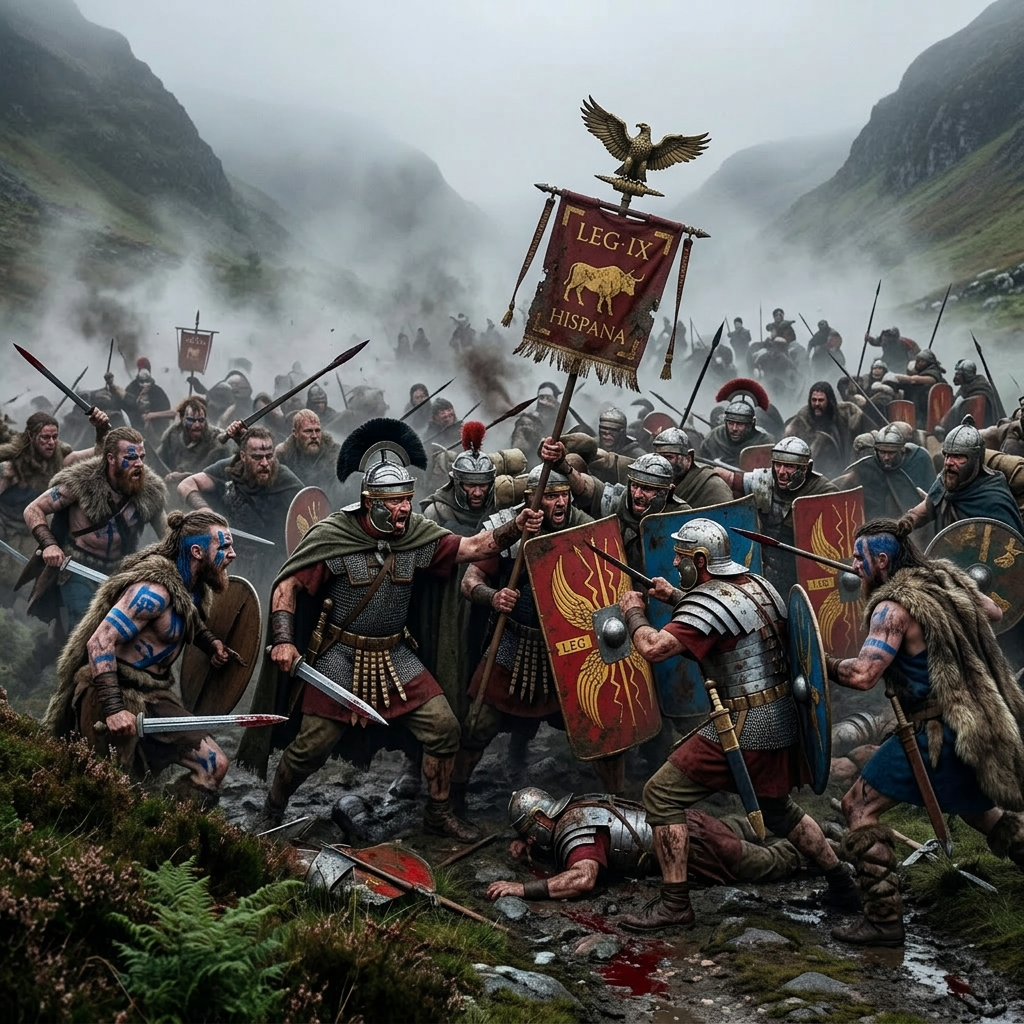
For centuries, the fate of Rome’s Ninth Legion has fascinated historians, writers, and history lovers. Once a proud unit of the Roman army, the Legio IX Hispana seems to disappear from the historical record, leaving behind one of Rome’s greatest military mysteries: what really happened to the Ninth?
Origins of the Ninth Legion
The Ninth Legion, known as Legio IX Hispana (“the Spanish Ninth Legion”), was probably formed during the late Roman Republic, perhaps by Julius Caesar himself. It fought in several key campaigns:
- Caesar’s Gallic Wars in the 50s BCE, where it helped conquer much of what is now France and Belgium.
- Battles of the Roman civil wars, supporting Caesar and later his heir, Augustus.
- Campaigns in Hispania (modern Spain and Portugal), which gave the legion its official nickname, Hispana.
By the 1st century CE, the Ninth was a veteran legion with a long, proud history.
The Ninth in Britain
The legion is best known for its time in Roman Britain. It was stationed at:
- Lindum (modern Lincoln)
- Later at Eboracum (modern York), an important Roman city in the north.
In Britain, the Ninth helped build roads, forts, and towns, but it also fought against local tribes who resisted Roman rule. The north of Britain was particularly unstable and dangerous, with frequent uprisings against Roman authority.

The Disappearance from History
The real mystery begins when the Ninth Legion vanishes from the historical record.
We have solid evidence of the legion in Britain in the late 1st century CE. An inscription from around 108 CE, found in York, shows that the Ninth was still there at that time, working on major building projects.
After that, the trail grows cold.
By the mid-2nd century CE, the Ninth is no longer listed among Rome’s legions. New legions appear in Britain instead. Somewhere between about 110 and 130 CE, the Ninth Legion seems to disappear.
What Might Have Happened?
Historians have proposed several main theories to explain the Ninth’s disappearance. None can be proven with certainty, but each has some clues in its favor.
1. Destroyed in a British Uprising
One popular theory is that the Ninth was wiped out during a rebellion in northern Britain. The idea is that:
- The legion marched north from York to put down an uprising.
- It was ambushed or overwhelmed far from support.
- Few men survived, and the legion was later quietly removed from the official lists.
This theory fits the picture of Britain as a difficult and dangerous frontier. It also matches the romantic image of a legion marching into the mist and never returning. However, we lack clear archaeological or written evidence of such a disaster—no detailed Roman account has survived.
2. Transferred and Destroyed Elsewhere
Another strong theory suggests that the Ninth was moved away from Britain and later destroyed in another part of the empire, such as:
- Along the Rhine frontier in Germany
- Or in the eastern provinces, possibly fighting Parthians or local revolts
Some records hint that the Ninth may have been present in the Netherlands or along the Rhine after its time in Britain. It’s possible the legion was later destroyed in a poorly documented campaign, or slowly disbanded and merged into other units.

3. Gradual Disbandment
A third possibility is less dramatic: the Ninth may not have died in a single disaster at all. Instead, it might have been gradually reduced, merged, or disbanded:
- Soldiers could be transferred to other legions over time.
- Losses might not have been replaced, leading to the unit shrinking.
- Eventually, the legion’s name simply disappears from official lists.
This is the least romantic theory, but it reminds us that not every historical mystery ends in a heroic last stand.
Sources and Evidence
Our knowledge of the Ninth Legion comes from a mix of:
- Inscriptions on stone, such as building dedications and tombstones.
- Roman military lists, which record the legions at different times.
- Later writings, though these are often silent about the Ninth’s final fate.
The lack of firm evidence is what makes the story so compelling. Historians must piece together fragments, and reasonable people can disagree about the most likely solution.
The Ninth Legion in Popular Culture
The mystery of the lost Ninth has inspired many works of modern fiction, including:
- Novels, such as Rosemary Sutcliff’s The Eagle of the Ninth, which imagines a young Roman officer searching for the lost legion’s standard in northern Britain.
- Films and TV adaptations, where the legion’s disappearance is dramatized as a doomed expedition beyond the edge of Roman control.
These stories usually favor the most dramatic version: a legion marching into hostile territory, never to return. While this isn’t proven history, it keeps the legend alive.
Why the Story Still Matters
Even if we never know exactly what happened, the Ninth Legion’s story raises important questions about:
- The limits of historical knowledge – what we can and cannot know from fragmentary evidence.
- The nature of empire and conquest – Roman power was enormous, but not invincible.
- The way myths form – how a gap in the historical record can become the seed of powerful legends.
The Ninth Legion reminds us that even in the well-documented world of Rome, there are still mysteries, silences, and stories lost to time.

Conclusion
The Legio IX Hispana marched with the Roman army for generations, from the wars of Julius Caesar to the far frontiers of Britain. Then, sometime in the early 2nd century CE, it simply disappears from the record.
Was it destroyed in a bloody uprising in northern Britain? Transferred and lost on another distant frontier? Quietly disbanded and forgotten by the scribes of the empire?
We may never know for sure. But the legend of the lost Ninth Legion continues to live—in the minds of historians, in works of fiction, and now, in this article on your site.
Fortisetliber’s View
At Fortisetliber, the story of the Ninth Legion is less about finding a single “correct” answer and more about learning to live with uncertainty. The gap in the evidence forces us to admit what we do not know—and that is a healthy discipline for any serious thinker. History is not a collection of simple stories, but a puzzle of fragments that we must handle with honesty and care.
The legend of the lost legion also warns us about the limits of power. Rome was the greatest military machine of its time, yet even one of its legions could vanish from the record. Empires like to present themselves as eternal and unshakable, but the silence around the Ninth shows how fragile their memory can be.
Finally, the Ninth Legion reminds us that myth rushes in wherever facts are thin. Novels, films, and modern retellings fill the space that the sources leave empty. This is not wrong by itself—but we should always keep a line between what we know and what we imagine. To be fortis et liber—strong and free—means respecting that line, even when the mystery is tempting.
Leave a Reply