
Introduction
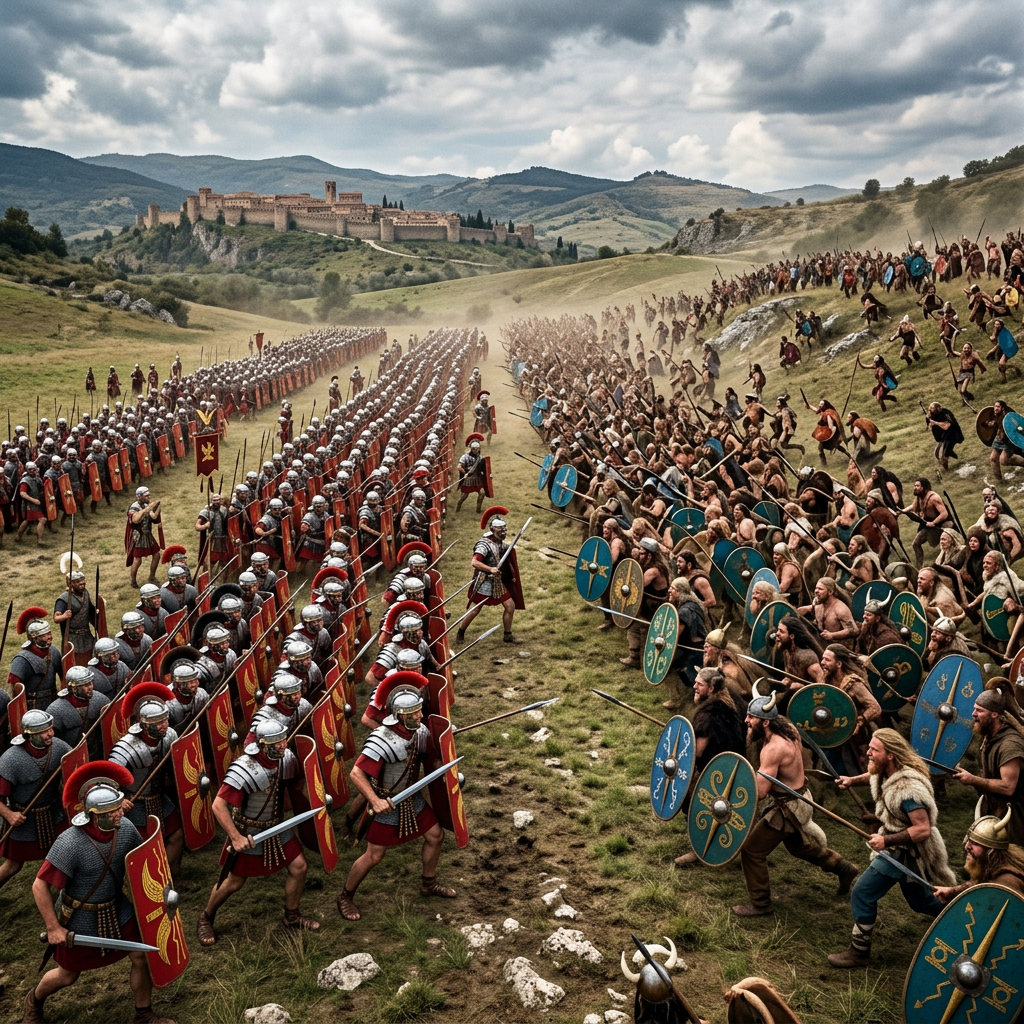
The Battle of Clusium (225 BC) is one of the important early clashes in Rome’s long struggle against northern Gallic tribes during the Roman-Gallic War of 225 BC. While often overshadowed by the decisive Battle of Telamon, the engagement near Clusium played a critical role in shaping the Roman response to one of the largest Gallic invasions of the Italian peninsula since the sack of Rome in 390 BC.
This confrontation occurred at a time when Rome was no longer a fragile city-state but a rising regional power with expanding control over Italy. Yet, the Gallic tribes of northern Italy—particularly the Boii, Insubres, and allied groups—still posed a significant existential threat. The events around Clusium reveal both the scale of the Gallic invasion and the growing sophistication of Roman military organization.
Historical Context: Italy in 225 BC
By the late 3rd century BC, the Italian peninsula was undergoing rapid transformation. Rome had already subdued much of central Italy through the Samnite Wars and was extending its influence northward into Etruria.
However, the north remained unstable. The Po Valley was dominated by powerful Gallic tribes who had settled in Italy over previous centuries. These tribes were culturally distinct from Rome and frequently engaged in raiding and warfare.
The Gallic Coalition
The invasion of 225 BC was not a small raid but a large-scale coordinated movement involving multiple tribes:
- The Insubres
- The Boii
- The Taurisci
- Mercenary Gaesatae warriors from beyond the Alps
This coalition represented one of the most serious military threats Rome had faced in generations.
Roman Strategic Concerns
Rome was alarmed by the size and coordination of the invasion. Memories of earlier disasters—especially the sack of Rome in 390 BC—still shaped Roman military psychology. The Senate responded by mobilizing massive forces, including citizen levies and allied Italian troops.
Causes of the Conflict
Several factors contributed to the outbreak of the Gallic invasion and the subsequent clash near Clusium:
1. Roman Expansion into Northern Italy
Rome’s increasing influence in Etruria and beyond threatened Gallic territories and disrupted traditional power balances.
2. Economic Pressure and Raiding Culture
Gallic tribes often relied on raiding wealth from southern territories. Roman expansion reduced opportunities for such raids.
3. Alliances Among Tribes
Facing Roman pressure, several Gallic groups formed a temporary coalition to push southward and reassert dominance.
4. Fear of Roman Encirclement
Gallic leaders likely perceived Rome’s expansion as a long-term existential threat to their presence in Italy.

The March Toward Clusium
The Gallic invasion force advanced south through Etruria, approaching the important city of Clusium. This region was strategically significant due to its location between northern and central Italy.
Roman and allied forces moved quickly to intercept the advancing tribes. The result was a series of engagements in the region surrounding Clusium, where reconnaissance, skirmishing, and ambush tactics played a major role.
The Battlefield Environment
Clusium and its surroundings offered a mix of terrain:
- Rolling hills
- Forested areas
- Narrow roads and passes
- Agricultural land
This environment was critical in shaping the battle. Unlike open-field engagements favored by Gallic shock tactics, the terrain around Clusium allowed Roman forces to use ambushes and coordinated maneuvers.
Forces Involved
Although exact numbers vary in ancient sources, the engagement near Clusium involved significant forces on both sides.
Roman Forces
- Roman legions composed of citizen soldiers
- Allied Latin and Etruscan contingents
- Increasingly standardized manipular formations
- Strong logistical coordination
Gallic Forces
- Large tribal warbands
- Highly mobile infantry units
- Gaesatae mercenary warriors fighting without heavy armor
- Emphasis on shock combat and psychological intimidation
The Gallic forces were formidable in open battle but vulnerable to coordinated Roman tactics in restricted terrain.
Course of the Battle
The engagement near Clusium is typically described as part of a broader Roman response to the Gallic invasion rather than a single decisive battle. However, several key phases can be identified.
Initial Skirmishes
Roman advance forces likely engaged Gallic scouts and forward units near Clusium. These encounters helped Rome gather intelligence on the size and movement of the invading force.
Roman Tactical Positioning
Roman commanders used the terrain to their advantage, positioning troops to restrict Gallic movement and disrupt their formations. This approach limited the effectiveness of Gallic charges.
Gallic Pressure and Mobility
The Gauls attempted to use their numerical strength and aggressive assault tactics to break Roman positions. However, the uneven terrain reduced their ability to form effective mass charges.
Roman Coordination
Roman forces increasingly relied on:
- Layered infantry lines
- Rotational fighting units
- Controlled counterattacks
- Allied cavalry support
This coordination gradually shifted the balance in Rome’s favor.
Transition Toward Larger Conflict
While the fighting near Clusium was significant, it was part of a larger campaign that culminated in the decisive Battle of Telamon. The Clusium engagements helped delay and disrupt the Gallic advance, giving Rome time to concentrate its forces.

Strategic Importance of Clusium
The importance of the Battle of Clusium (225 BC) lies not in its scale alone, but in its strategic consequences.
1. Delaying the Gallic Invasion
Roman resistance near Clusium slowed the Gallic advance toward central Italy, preventing a rapid breakthrough.
2. Intelligence Gathering
Roman forces gained critical information about Gallic troop movements, composition, and strategy.
3. Preparation for Telamon
The engagement helped Rome coordinate its larger armies, which later converged at Telamon, where the invasion was decisively crushed.
4. Psychological Impact
Early resistance demonstrated to both Romans and Gauls that the invasion would not be easy or swift.
The Role of Roman Military Evolution
The Clusium campaign highlights the evolution of Roman military structure by 225 BC.
Manipular Flexibility
Rome’s shift from rigid formations to manipular tactics allowed greater adaptability in uneven terrain.
Allied Integration
Rome’s ability to integrate Latin and Etruscan allies into a unified command structure was crucial.
Command Efficiency
Roman consuls coordinated large multi-army operations across different regions, demonstrating improved strategic planning.
Aftermath of the Clusium Engagement
Following the fighting near Clusium, the Gallic forces continued their advance but faced increasing resistance. The Roman army regrouped and prepared for a decisive confrontation.
The most significant consequence was the eventual confrontation at Telamon, where the Gallic coalition was decisively defeated, ending the immediate threat to central Italy.
Historical Sources and Interpretation
Accounts of the Battle of Clusium come primarily from Roman historians such as Polybius and Livy. However, interpretations vary:
- Some sources emphasize Clusium as a major battle
- Others describe it as a series of skirmishes within the broader invasion campaign
- Numbers and details are often exaggerated in later Roman tradition
Modern historians generally view Clusium as an important prelude to Telamon rather than a standalone decisive battle.
Long-Term Impact on Rome
Even as part of a larger campaign, the Clusium engagements contributed to long-term Roman development.
Consolidation of Northern Italy
Rome’s success against Gallic invasions helped secure Etruria and expand influence northward.
Military Confidence
Repeated success against Gallic coalitions reinforced Roman confidence in its military system.
Precursor to Mediterranean Expansion
By neutralizing northern threats, Rome freed resources for future conflicts beyond Italy, including wars with Carthage.

Why the Battle of Clusium Still Matters
The Battle of Clusium (225 BC) is significant because it represents the transitional phase of Roman military dominance.
It illustrates key historical themes:
- The decline of tribal coalition warfare in Italy
- The rise of Roman operational coordination
- The importance of campaign logistics over single battles
- The shift from defensive survival to strategic control
In many ways, Clusium reflects Rome in transition—no longer vulnerable, but not yet fully hegemonic.
Conclusion
The Battle of Clusium in 225 BC was a crucial episode in Rome’s struggle against the Gallic invasion of Italy. While not always treated as a single decisive battle, its importance lies in its role within the broader campaign that secured Roman dominance in the region.
By slowing the Gallic advance, improving Roman coordination, and setting the stage for the victory at Telamon, Clusium became a vital stepping stone in Rome’s rise to supremacy in Italy.
Ultimately, the engagement demonstrates how Rome’s strength was not only in winning major battles, but in managing entire campaigns with increasing strategic sophistication—an ability that would define its imperial future.
Fortisetliber’s View
From a FortisLiber perspective, the Battle of Clusium (225 BC) is best understood not as a singular clash, but as a diagnostic moment in Rome’s campaign against the Gallic invasion—a point where the system reveals its level of maturity under large-scale stress.
What is striking here is that Rome is no longer reacting as a city threatened by sudden catastrophe, but as a coordinated territorial power managing an incoming strategic wave. The Gallic coalition still carries the force of mass and momentum, but it lacks coherence once it enters the layered geography of Roman-controlled Italy. Clusium becomes the space where that mismatch begins to show itself clearly.
Rome’s advantage at this stage is less about battlefield brilliance and more about operational continuity. Even when individual engagements are uncertain or fluid, the Roman system maintains direction: delay, absorb, fragment, and converge. Clusium contributes to that process by slowing the invasion and forcing it into increasingly constrained conditions.
In FortisLiber terms, Clusium represents a shift in the nature of Roman security. Survival is no longer dependent on preventing invasion outright, but on managing invasion as a controllable process that can be dismantled over time. The outcome is not just military pressure applied to the Gauls, but a demonstration that Rome’s structure is now more stable than the volatility of its enemies.
Leave a Reply