
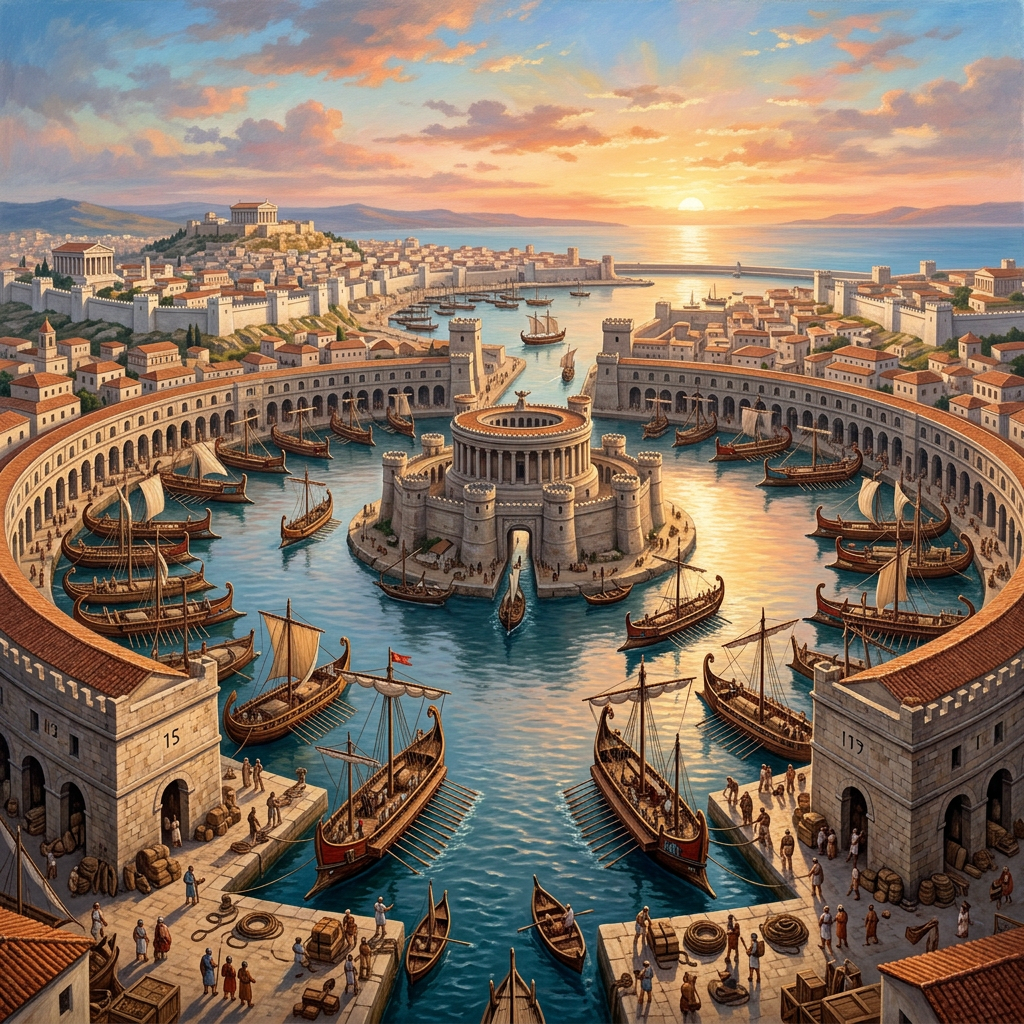
Ancient Carthage was one of the most powerful and influential city-states of the ancient Mediterranean world. For centuries it dominated trade routes, commanded a formidable navy, and rivaled the rising power of Rome. Though ultimately destroyed, Carthage left a lasting legacy in commerce, warfare, and cultural exchange between Africa and the wider Mediterranean.
Origins and Foundation
Carthage was founded by Phoenician settlers from the city of Tyre, in present-day Lebanon, around the late 9th or early 8th century BCE. According to later Greek and Roman tradition, its legendary founder was Queen Dido (also called Elissa), who fled Tyre and established a new city on the North African coast.
The site of Carthage, in what is now Tunisia, was ideal: a peninsula with natural harbors, close to major sea routes between the eastern and western Mediterranean. From the beginning, Carthage was shaped by its Phoenician heritage—seafaring, trading, and city-building—but quickly developed its own identity and political ambitions.
Rise as a Maritime Power
By the 6th century BCE, Carthage had become the leading Phoenician city in the western Mediterranean. As Tyre and other Near Eastern centers came under the control of great empires like Assyria and Babylon, Carthage gained relative independence and room to expand.
Carthage built a network of colonies and trading posts across:
- North Africa (modern Tunisia, Algeria, and beyond)
- Sardinia and Corsica
- Western Sicily
- The Balearic Islands
- Southern Iberia (Spain)
Its economy depended heavily on maritime trade. Carthaginian merchants dealt in metals (especially silver from Spain), grain, olive oil, wine, textiles, timber, and luxury goods such as ivory and purple-dyed fabrics. The city’s powerful navy protected these routes and enforced commercial monopolies in certain regions.
Political System and Government
Carthage was an oligarchic republic rather than a monarchy. Political power was concentrated in the hands of wealthy families, many of whom traced their origins to the original Phoenician settlers.
Key institutions included:
- The Suffetes: Two chief magistrates, somewhat comparable to the Roman consuls, who served as leading officials and judges.
- The Senate (Council of Elders): A powerful body of aristocrats who guided foreign policy, military decisions, and major internal affairs.
- Popular Assemblies: Citizen gatherings that could vote on important issues, especially when elites were divided, though their power was more limited compared to the aristocracy.
This system balanced elite control with some elements of broader civic participation. Greek observers, like Aristotle, even praised Carthage’s constitution as relatively stable and effective.

Economy and Society
Carthaginian wealth came from a combination of trade, agriculture, and tribute from subject territories.
Agriculture and Land
The countryside around Carthage was fertile, benefiting from both good soil and careful management. Carthaginian farmers cultivated:
- Wheat and barley
- Olives and grapes
- Figs, dates, and other fruits
Ancient sources mention a Carthaginian agricultural writer, Mago, whose treatise on farming was so respected that the Romans had it translated after the fall of Carthage.
Social Structure
Carthaginian society was hierarchical, with:
- Wealthy merchant-aristocrats at the top, controlling politics and long-distance trade.
- Small landowners, artisans, and traders forming a middle echelon of free citizens.
- Laborers, foreign residents, and slaves at the bottom, many of whom worked in agriculture, mines, or as rowers and soldiers.
Women in Carthage, especially from elite families, appear in inscriptions and religious dedications, suggesting they held visible roles in religious and social life, though political power remained largely in male hands.
Religion and Ritual
Carthaginian religion was deeply rooted in its Phoenician origins, with a pantheon of gods and goddesses linked to the forces of nature, war, and fertility.
Major deities included:
- Baal Hammon – often regarded as a chief god associated with fertility and the sky.
- Tanit – a prominent goddess linked with fertility, protection, and possibly the moon.
Temples, shrines, and sacred precincts (tophets) were important centers of community life. Archaeological evidence from Carthaginian sites shows a rich religious culture, with votive inscriptions, offerings, and carefully arranged burial areas.
The question of child sacrifice in Carthaginian religion has long been debated. Greek and Roman sources accuse Carthaginians of sacrificing children to their gods, especially in times of crisis. Some modern scholars see archaeological evidence that might support this, while others argue the remains represent special cemeteries for infants and young children rather than proof of systematic sacrifice. The truth may never be fully resolved, but the controversy shows how strongly Carthaginian religious practices impressed—and disturbed—their neighbors.

Military Strength and the Punic Wars
Carthage’s military power rested largely on its navy and on armies that combined citizen leadership with large numbers of foreign mercenaries and allied troops. Carthaginian generals often came from prominent families and were expected to secure victory, wealth, and prestige abroad.
As Carthage expanded into Sicily and Spain, it collided with another rising power: Rome. Their rivalry produced three major conflicts known as the Punic Wars (from Punicus, Latin for “Phoenician”).
First Punic War (264–241 BCE)
The First Punic War began over control of Sicily. Rome, initially a land power, built a large fleet to challenge Carthage at sea. After decades of bitter fighting, Rome emerged victorious. Carthage lost Sicily and later had to give up Sardinia and Corsica as well, paying a heavy indemnity.
Second Punic War (218–201 BCE)
The Second Punic War is the most famous, largely because of Hannibal Barca, one of history’s greatest generals. To strike at Rome, Hannibal led a multinational army—including war elephants—over the Alps into Italy. He won several stunning victories, such as the Battle of Cannae in 216 BCE, where his forces annihilated a much larger Roman army.
However, despite these victories, Hannibal could not force Rome to surrender. Rome adapted its strategy, avoided major battles with Hannibal, and attacked Carthaginian holdings elsewhere, especially in Spain and North Africa. The war ended with the Roman general Scipio Africanus defeating Hannibal at the Battle of Zama (202 BCE). Carthage lost its empire, navy, and freedom of independent military action.
Third Punic War (149–146 BCE)
Although weakened, Carthage recovered economically, worrying some Roman politicians. Influential figures, such as Cato the Elder, famously urged, “Carthage must be destroyed.” Eventually, Rome seized on a conflict between Carthage and a neighboring African kingdom as a pretext for war.
The Third Punic War ended with a brutal Roman siege. After fierce resistance, Carthage fell in 146 BCE. The city was destroyed, its population killed or enslaved, and its territory turned into the Roman province of Africa.

Legacy of Carthage
Despite Rome’s efforts to erase it, Carthage’s legacy endured.
- Commercial and Maritime Heritage: Carthage helped connect the western Mediterranean, North Africa, and parts of Atlantic Europe through trade. Techniques of navigation, shipbuilding, and commercial organization developed there influenced later societies.
- Cultural Exchange: Carthage was a crossroads where Phoenician, North African, Iberian, and, later, Greek and Roman cultures met. This blending shaped art, religion, and everyday life across the region.
- Military History: Hannibal’s campaigns continue to be studied in military academies around the world. His daring strategies, especially the crossing of the Alps and the tactics at Cannae, remain classic examples of bold and imaginative warfare.
In later centuries, the Romans themselves rebuilt a new city of Carthage on the same site, which became an important center in the Roman and then early Christian world. Today, the ruins of Carthage near Tunis stand as a reminder of a once-mighty power that shaped the history of the ancient Mediterranean.
Fortisetliber’s View
From the vantage point of Fortisetliber, Carthage is a reminder that history is rarely written by the losers, yet it is often enriched by them. Most of what we know comes through Roman eyes—hostile, anxious, and eager to justify conquest. Behind those accounts, however, we can glimpse a sophisticated commercial civilization, a culture that tied together Africa and the wider Mediterranean with ships, markets, and ideas.
To study Carthage, then, is to practice a discipline of humility. We read its story through the filter of its enemies, and must constantly ask: what has been exaggerated, what has been omitted, and what alternative futures vanished when the city burned in 146 BCE? For Fortisetliber, Carthage stands as a symbol of how fragile greatness can be—and how necessary it is to listen for the voices that history tried to silence.
Leave a Reply