
Introduction
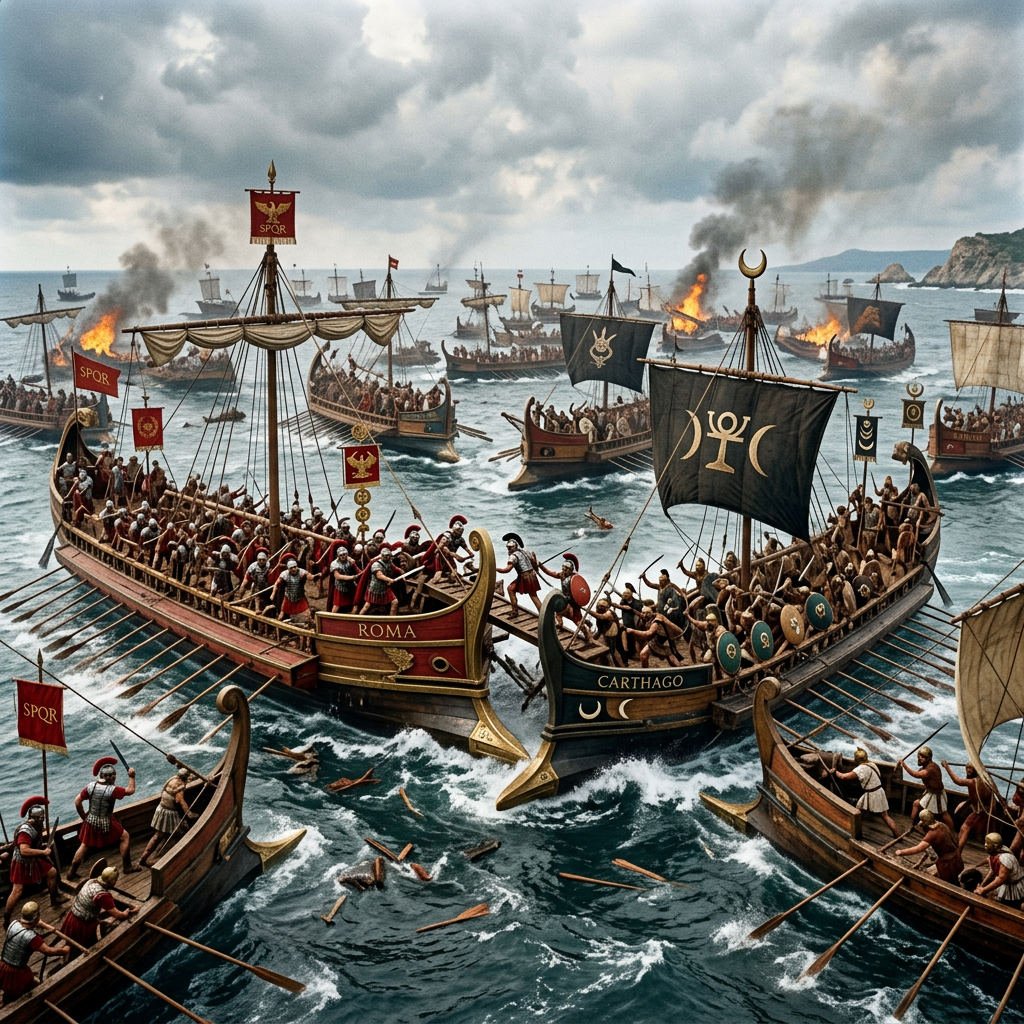
The Battle of Cape Ecnomus (256 BC) was one of the most significant naval engagements of the ancient world and a defining moment in the First Punic War (264–241 BC). Fought off the southern coast of Sicily between the fleets of the Roman Republic and Carthage, the battle demonstrated Rome’s growing naval capabilities and paved the way for its ambitious invasion of North Africa.
Often regarded as one of the largest naval battles in history by the number of ships and personnel involved, Cape Ecnomus showcased the strategic ingenuity, discipline, and determination of two Mediterranean superpowers locked in a struggle for dominance. The Roman victory not only secured temporary control of the sea but also shifted the war from Sicily to the Carthaginian homeland.
This article explores the origins of the battle, the opposing fleets, tactical innovations, the course of the engagement, and its lasting legacy in military history.
The First Punic War: A Struggle for Mediterranean Supremacy
The First Punic War erupted in 264 BC between the expanding Roman Republic and the maritime empire of Carthage. The immediate cause of the conflict was control of Sicily, an island strategically located at the center of the Mediterranean.
While Rome possessed the strongest land army in the western Mediterranean, Carthage had centuries of naval experience. Its fleets dominated maritime trade routes and protected a vast commercial empire extending across North Africa, Spain, Sardinia, Corsica, and parts of Sicily.
Recognizing that victory in Sicily required control of the sea, Rome undertook one of history’s most remarkable military transformations by constructing a powerful navy almost from scratch.
Rome Builds a Navy
Before the war, Rome had limited naval experience. According to ancient historians, the Romans copied the design of a captured Carthaginian quinquereme and rapidly built hundreds of warships.
More importantly, Roman engineers introduced an innovation that compensated for their lack of naval expertise: the corvus, a boarding bridge fitted with a large iron spike.
The corvus allowed Roman marines to grapple enemy vessels and turn naval engagements into infantry battles, where Roman soldiers excelled.
This invention fundamentally altered naval warfare during the early years of the First Punic War.
The Roman Plan
By 256 BC, Rome sought to end the war decisively.
Rather than continue costly campaigns in Sicily, the Roman Senate approved an invasion of North Africa itself.
The plan required transporting tens of thousands of soldiers across the Mediterranean under the protection of an enormous fleet.
The Roman expedition was commanded jointly by the consuls:
- Marcus Atilius Regulus
- Lucius Manlius Vulso Longus
Their objective was to defeat the Carthaginian fleet, cross safely to Africa, and threaten Carthage directly.

Carthage Responds
Carthage understood the danger.
Allowing a Roman invasion would expose the heart of its empire.
The Carthaginian fleet sailed to intercept the Romans near Cape Ecnomus, located on the southern coast of Sicily.
The fleet was commanded by:
- Hamilcar
- Hanno
Both commanders possessed extensive naval experience and intended to destroy the Roman invasion force before it reached Africa.
Opposing Fleets
Roman Fleet
Ancient sources report approximately:
- 330 quinqueremes
- Around 140,000 men
- Roughly 40,000 soldiers and marines
- About 100,000 rowers and sailors
The Roman fleet also escorted transport vessels carrying supplies for the invasion.
Carthaginian Fleet
The Carthaginian navy deployed approximately:
- 350 warships
- Nearly 150,000 personnel
Its advantages included:
- Superior seamanship
- Faster maneuvering
- Experienced crews
- Highly trained naval commanders
Despite Rome’s growing fleet, Carthage remained the Mediterranean’s premier naval power.
The Battlefield
Cape Ecnomus lay near the modern town of Licata on Sicily’s southern coast.
The open waters offered ample space for large fleets to maneuver, making the battle one of the largest naval confrontations of antiquity.
Roman Formation
The Romans adopted an unusual formation designed to protect their transports.
Instead of a single battle line, they arranged their fleet into a massive wedge.
The formation consisted of:
- Two leading squadrons forming the point
- A third squadron protecting transport ships
- A fourth squadron guarding the rear
This arrangement allowed mutual support while safeguarding the invasion force.
Carthaginian Strategy
The Carthaginians planned to exploit their superior maneuverability.
Their fleet was divided into multiple divisions tasked with:
- Drawing the Roman vanguard away
- Separating Roman squadrons
- Attacking isolated formations
- Destroying transport ships
Their objective was to break Roman cohesion before the corvus could be employed effectively.

The Battle Begins
The Carthaginian center deliberately retreated.
Believing the enemy to be withdrawing, the Roman leading squadrons advanced.
This maneuver stretched the Roman formation and created gaps between its divisions.
The Carthaginians then launched coordinated attacks against the separated Roman squadrons.
Multiple Battles at Sea
Rather than a single clash, Cape Ecnomus became several simultaneous naval battles.
The Roman Vanguard
The leading Roman squadrons pursued the retreating Carthaginian center.
When the Carthaginians turned to fight, fierce boarding actions followed.
Roman marines repeatedly used the corvus to capture enemy ships.
The Roman Rear
Meanwhile, Carthaginian divisions attacked the Roman transports and rear guard.
Heavy fighting erupted as Roman reserve squadrons struggled to protect vulnerable supply vessels.
Boarding Actions
Once ships were locked together by the corvus, the battle resembled combat on land.
Roman legionaries overwhelmed many Carthaginian crews through superior close-quarters fighting.
The Romans transformed naval warfare into infantry combat—a decisive tactical advantage.
Roman Victory
Despite initial Carthaginian success, Roman discipline gradually prevailed.
As individual engagements concluded, victorious Roman squadrons reinforced their comrades elsewhere.
Eventually, the Carthaginian fleet began to withdraw.
Ancient sources claim:
- Around 30 Carthaginian ships sunk
- More than 60 captured
- Roman losses significantly lower
The victory secured Roman command of the sea long enough to continue the invasion.
The Invasion of Africa
Following Cape Ecnomus, the Roman expedition crossed safely into North Africa.
Initially, the campaign achieved remarkable success.
Roman forces defeated Carthaginian armies and threatened the city itself.
However, the invasion ultimately failed after Carthage reorganized its military under the Spartan mercenary commander Xanthippus, who decisively defeated Regulus.
Nevertheless, none of this would have been possible without the victory at Cape Ecnomus.

Why Rome Won
Several factors explain the Roman success.
Tactical Innovation
The corvus neutralized Carthaginian naval superiority.
Leadership
The Roman consuls maintained fleet cohesion despite Carthaginian attempts to divide them.
Discipline
Roman crews remained organized even after the formation became fragmented.
Infantry Superiority
Roman marines consistently outperformed Carthaginian boarding parties.
Historical Sources
Our understanding of the battle comes primarily from Polybius, whose detailed account remains one of the finest descriptions of ancient naval warfare.
Modern historians generally consider Polybius to be among the most reliable ancient military historians, although exact casualty figures remain debated.
The Legacy of Cape Ecnomus
The Battle of Cape Ecnomus marked a turning point in the First Punic War.
It demonstrated:
- Rome’s emergence as a naval power
- The adaptability of Roman military doctrine
- The strategic importance of sea control
- The effectiveness of combined naval and land operations
Although the First Punic War continued for another fifteen years, Cape Ecnomus proved that Carthage could no longer rely solely on naval superiority.
The battle also influenced later Roman naval doctrine and showcased the Republic’s ability to learn rapidly from its enemies.
Visiting the Historic Region Today
Travelers exploring southern Sicily can visit areas associated with the battle, including:
- Licata
- Southern Coast of Sicily
- Valley of the Temples
Although no visible remains of the naval engagement survive beneath the Mediterranean, the coastline continues to evoke the scale of this extraordinary clash between two ancient empires.

Frequently Asked Questions (FAQ)
Where was the Battle of Cape Ecnomus fought?
It took place off Cape Ecnomus on the southern coast of Sicily in 256 BC, during the First Punic War.
Who fought in the Battle of Cape Ecnomus?
The battle was fought between the Roman Republic, commanded by Marcus Atilius Regulus and Lucius Manlius Vulso Longus, and the Carthaginian fleet under Hamilcar and Hanno.
Why is the Battle of Cape Ecnomus important?
It enabled Rome to invade North Africa and demonstrated that the Republic had become a formidable naval power capable of challenging Carthage at sea.
Was Cape Ecnomus the largest naval battle in history?
It is widely considered one of the largest naval battles of the ancient world, involving nearly 700 warships and hundreds of thousands of personnel.
What was the Roman corvus?
The corvus was a boarding bridge fitted with an iron spike that allowed Roman soldiers to grapple enemy ships and fight hand-to-hand, transforming naval combat into infantry combat.
Conclusion
The Battle of Cape Ecnomus (256 BC) remains one of antiquity’s greatest demonstrations of military innovation, strategic ambition, and determination. Facing the Mediterranean’s most experienced naval power, the Romans overcame their disadvantages through disciplined formations, tactical ingenuity, and the revolutionary use of the corvus.
Although the First Punic War continued for many years, Cape Ecnomus marked the moment when Rome proved it could challenge—and defeat—Carthage on the open sea. The battle not only opened the path to the Roman invasion of North Africa but also signaled the rise of a naval empire that would eventually dominate the Mediterranean for centuries.
Today, Cape Ecnomus stands as a powerful reminder that adaptability and disciplined leadership can alter the course of history, transforming a land-based republic into one of the greatest maritime powers the ancient world had ever known.
Fortisetliber’s View
From a FortisLiber perspective, the Battle of Cape Ecnomus (256 BC) represents one of history’s greatest examples of adaptation overcoming tradition. It was not merely a clash between two enormous fleets but a contest between an established maritime empire and an ambitious republic determined to learn, innovate, and challenge the balance of power in the ancient Mediterranean.
For centuries, Carthage had dominated the seas through superior seamanship, experienced sailors, and an unmatched naval tradition. Rome, by contrast, had built its reputation on disciplined legions and victories fought on land. Yet rather than accepting its weakness at sea, the Roman Republic transformed it into an opportunity. By constructing a powerful fleet and introducing the revolutionary corvus boarding bridge, Rome demonstrated that military success depends not only on experience but also on the willingness to innovate.
The Battle of Cape Ecnomus illustrates a timeless principle of warfare: technology alone does not guarantee victory, nor does numerical strength. Success belongs to those who combine effective leadership, disciplined forces, and strategic flexibility. While the Carthaginians sought to exploit their superior maneuverability, the Romans reshaped naval combat into the type of close-quarters battle in which their legionaries excelled. In doing so, they turned their greatest weakness into a decisive advantage.
From the FortisLiber viewpoint, Cape Ecnomus also symbolizes a pivotal shift in Mediterranean history. Had Carthage destroyed the Roman invasion fleet, the First Punic War—and perhaps the future of Western civilization—might have unfolded very differently. Instead, Rome secured control of the sea, laying the foundations for its eventual transformation into the dominant naval and political power of the Mediterranean world.
Today, the waters off southern Sicily appear calm and timeless, yet beneath them lies the memory of one of antiquity’s most extraordinary naval confrontations. The Battle of Cape Ecnomus reminds us that civilizations rise not only through strength, but through resilience, innovation, and the courage to challenge seemingly insurmountable odds.
Leave a Reply