
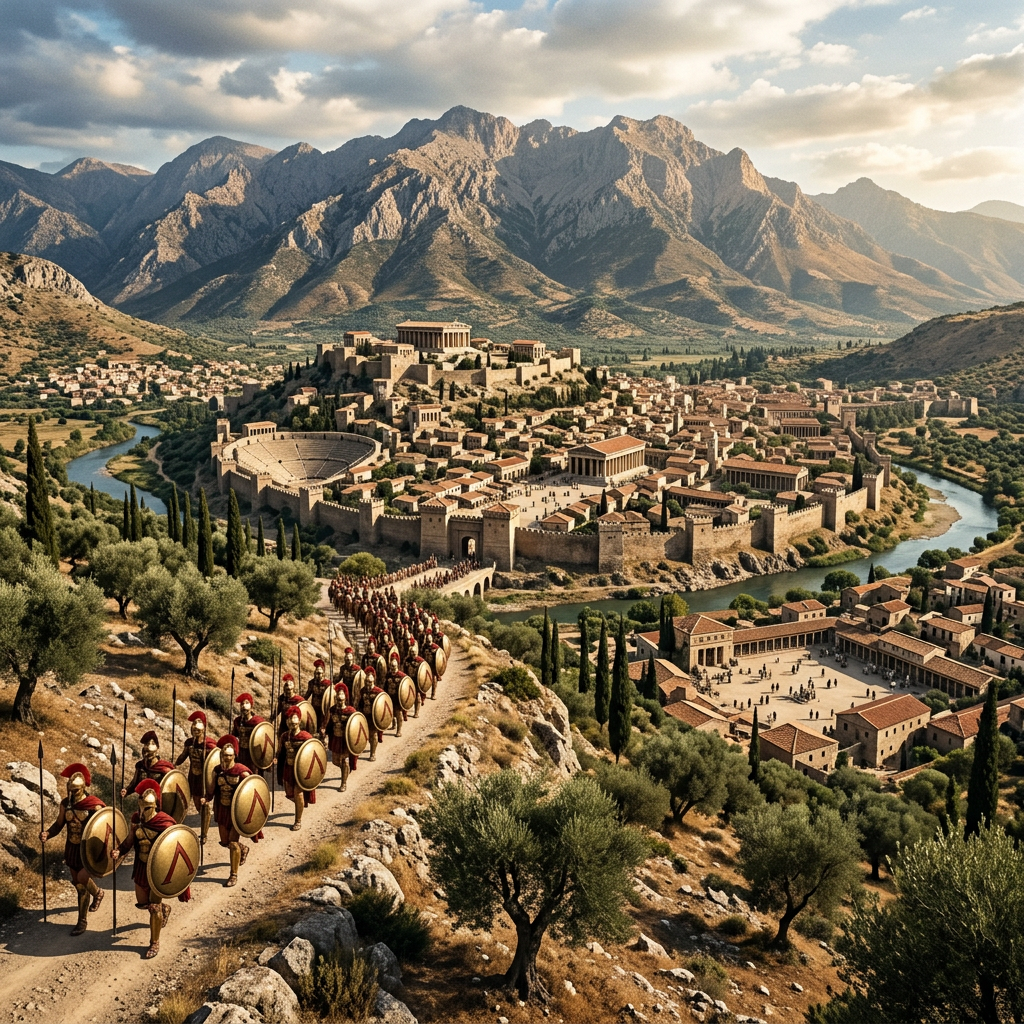
Ancient Sparta was one of the most powerful city‑states of ancient Greece, renowned for its military strength, strict discipline, and unique way of life. While Athens became famous for philosophy, democracy, and art, Sparta built its identity on obedience, austerity, and excellence in warfare. Understanding Sparta helps us see that not all Greek cities shared the same values or goals.
Geography and Origins
Sparta was located in the region of Laconia in the southeastern Peloponnese. Protected by mountains and surrounded by fertile plains, it was naturally defended and well‑placed for agriculture.
According to tradition, the Spartans were Dorian Greeks who migrated into the Peloponnese around the 10th century BCE. Over time, they conquered neighboring populations and formed a rigid social hierarchy that would define Spartan society for centuries.
Social Structure: Spartiates, Perioikoi, and Helots
Spartan society was sharply divided into distinct groups:
Spartiates (Full Citizens)
The Spartiates were the elite warrior class and the only full citizens. They devoted their lives to military service and political participation. In theory, they were equal among themselves, owning land granted by the state and eating together in common messes.
Their main duty was to be professional soldiers, always ready for war.
Perioikoi (“Those Who Live Around”)
The Perioikoi were free but not full citizens. They lived in surrounding towns and villages and handled much of the trade, craftsmanship, and local administration. They also served in the army, but they did not share the same political rights as the Spartiates.
Helots
At the bottom were the Helots, an unfree population primarily made up of conquered peoples, especially from Messenia. They farmed the land and produced food for the Spartan state.
Helots were essential to Spartan society: by working the land, they allowed Spartiates to focus on training and warfare. At the same time, the Spartans lived in constant fear of Helot revolts and used terror and violence to keep them under control.

Government and Political System
Sparta’s government combined elements of monarchy, oligarchy, and limited democracy.
- Dual Kingship: Sparta had two hereditary kings from two royal families. They led the army in war and performed religious functions, but their power was checked by other institutions.
- Gerousia (Council of Elders): This council included 28 elders over the age of 60 plus the two kings. It proposed laws and served as a high court, holding significant influence.
- Ephors: Five ephors were elected each year. They supervised the kings, oversaw education and everyday governance, and could even bring kings to trial. In practice, they were among the most powerful figures in Sparta.
- Apella (Assembly): The assembly of Spartan citizens voted on proposals and decided on matters like war and peace. However, its power was limited compared to the Gerousia and the ephors.
This mixed system aimed to balance authority, prevent tyranny, and preserve stability.
The Agoge: Education and Training
The Spartan educational system, known as the agoge, was central to Spartan identity.
- Early Childhood: Newborns were inspected by elders; weak or sickly infants could be abandoned, reflecting the extreme emphasis on strength and fitness.
- Age 7–12: Boys left their families at age seven to live in communal barracks. They were trained in obedience, endurance, and basic military skills. Comfort was discouraged; they went barefoot, wore simple clothing, and were often underfed to toughen them.
- Age 12–20: Training intensified. Boys learned to endure hunger, cold, and hardship. Discipline was harsh, and any sign of weakness or disobedience was punished severely.
- Age 20 and Beyond: At 20, a young man became a full soldier but did not become a full citizen with political rights until later (often around 30), after proving himself in service and being accepted into a common mess (syssition).
The goal of the agoge was not individual happiness or intellectual development, but the creation of disciplined, loyal warriors who placed the state above themselves.
Women in Sparta
Spartan women had a more visible and relatively freer role compared to women in many other Greek city‑states.
- They received physical training and were encouraged to be strong and healthy, with the idea that “strong women produce strong children.”
- They could own and inherit property, and over time, Spartan women came to control a significant share of the land.
- They managed households and estates while the men were often away training or fighting.
Despite these freedoms, Spartan women did not take part in formal politics. Their primary role, as the state saw it, was to bear and raise future warriors.
Culture, Values, and Daily Life
Spartan culture emphasized:
- Discipline and Obedience: Personal desires were expected to yield to the needs of the community and the army.
- Simplicity (Laconism): The word “laconic” comes from Laconia and reflects the Spartans’ preference for brief, sharp speech. They admired simplicity in lifestyle as well as in words.
- Equality Among Citizens (for Spartiates): Among full citizens, luxury was discouraged. Common meals and identical training were meant to reduce differences of wealth and status.
Art, literature, and philosophy existed in Sparta but were not prioritized the way they were in Athens. The highest cultural ideal was the brave, self‑controlled warrior.

Sparta at War: From Thermopylae to the Peloponnesian War
Sparta’s military reputation was legendary.
The Battle of Thermopylae (480 BCE)
During the Persian Wars, King Leonidas led a small Greek force, including 300 Spartans, to defend the pass at Thermopylae against the much larger Persian army. Although they were ultimately defeated, their stand became a symbol of heroic resistance and sacrifice.
The Peloponnesian War (431–404 BCE)
Sparta’s rivalry with Athens eventually led to the long and devastating Peloponnesian War.
- Sparta led the Peloponnesian League, while Athens headed the Delian League.
- The war saw shifting alliances, plagues, and brutal campaigns across the Greek world.
- With support from Persia, Sparta built a navy strong enough to challenge Athens at sea.
- In 404 BCE, Sparta defeated Athens, dismantling its empire and briefly becoming the leading power in Greece.
Decline of Sparta
Spartan dominance did not last.
- The strict focus on maintaining a small, purely citizen warrior class meant that the number of full Spartiates declined over time.
- Economic inequality grew as land concentrated in fewer hands.
- At the Battle of Leuctra in 371 BCE, Thebes under Epaminondas crushed the Spartan army and shattered its aura of invincibility.
- The liberation of Messenia deprived Sparta of a large portion of its Helot labor force, weakening its economic base.
Over the following centuries, Sparta remained a city of some importance but never regained its former power.
Legacy of Ancient Sparta
Sparta’s legacy is complex and often romanticized. It is remembered for:
- Exceptional military discipline and courage
- Its austere lifestyle and emphasis on duty
- An educational system that molded individuals entirely to serve the state
Modern societies sometimes admire Spartan virtues like discipline, endurance, and loyalty. At the same time, the harsh treatment of Helots, rejection of individual freedom, and suppression of culture beyond warfare serve as reminders of the costs of such a rigid system.
Ancient Sparta, therefore, stands as both an example of extreme social cohesion and a warning about the dangers of sacrificing freedom, diversity, and humanity in the name of security and strength.

Fortisetliber’s View
To look at Sparta only through the lens of admiration or condemnation is to miss its deepest lesson. Sparta shows what a community can achieve when it is utterly committed to a single ideal—courage in battle—yet it also reveals the cost of narrowing human life to one virtue alone. Strength, discipline, and loyalty bound Sparta together, but they were sustained by the exploitation of the Helots and the suppression of individuality and reflection.
For us, Sparta is less a model to imitate than a mirror in which to examine our own priorities. Whenever we exalt security over freedom, efficiency over human dignity, or collective power over the inner life of the person, we risk drifting toward a Spartan spirit without its heroism and without its honesty. The true task is to cultivate courage without brutality, solidarity without servitude, and simplicity without impoverishing the mind.
Ancient Sparta thus stands as a paradoxical teacher: it reminds us that a society can be formidable and yet fragile, unified and yet unjust. To be fortis et liber—strong and free—we must resist the temptation to sacrifice the fullness of our humanity for the prestige of power or the comfort of order.
Leave a Reply