
Introduction: A Greece Divided by Power and Ambition
The year 394 BC found Greece trapped in a new era of uncertainty.
Only a few years had passed since the dramatic conclusion of the Peloponnesian War, the devastating conflict that had destroyed Athens’ empire and established Sparta as the dominant power of the Greek world.
Yet Spartan victory brought not peace, but resentment.
The once-united Greek cities that had fought against Athens now feared Sparta’s growing influence. Spartan commanders occupied territories, installed governments loyal to Sparta, and expanded their authority far beyond the traditional limits of the Peloponnesian League.
A new conflict was inevitable.
This struggle became known as the Corinthian War (395–387 BC), a major confrontation that involved Sparta, Athens, Corinth, Thebes, and Argos.
At the center of this turbulent period stood one of Sparta’s most famous kings:
Agesilaus II.
A brilliant commander and devoted defender of Spartan power, Agesilaus would lead his army into one of the final great victories of Spartan history—the Battle of Coronea in 394 BC.
Fought in the fertile region of Boeotia, near the ancient city of Coronea, the battle represented more than a military encounter. It was a struggle over the future balance of power in Greece.
The Origins of the Corinthian War
The roots of the Battle of Coronea 394 BC can be found in the political tensions that followed Sparta’s victory over Athens.
After defeating Athens in 404 BC, Sparta became the leading Greek power. However, many Greek states soon became uncomfortable with Spartan dominance.
Athens, which had lost its empire, began rebuilding its influence.
Thebes grew increasingly powerful in central Greece.
Corinth and Argos opposed Spartan expansion.
Persia, meanwhile, watched the situation carefully. Although Sparta had helped Persian princes and fought against Athens with Persian financial support during the final years of the Peloponnesian War, relations quickly deteriorated.
Persia eventually supported Sparta’s enemies, providing financial assistance that allowed them to build a powerful coalition.
The result was a war that challenged Spartan supremacy across Greece.

Agesilaus II: The Spartan King
At the heart of Sparta’s response was Agesilaus II, one of the most remarkable Spartan kings.
Ascending to the throne in 398 BC, Agesilaus quickly gained a reputation as an ambitious and capable commander.
Unlike many Spartan leaders who focused only on the Greek mainland, Agesilaus understood the importance of weakening Persian influence in Asia Minor.
In 396 BC, he launched a campaign against Persian-controlled territories in Anatolia.
His victories demonstrated the strength of the Spartan army and the effectiveness of traditional Spartan hoplite tactics.
However, events in Greece forced him to return.
When news arrived that Sparta was facing a major coalition at home, Agesilaus abandoned his Asian campaign and marched his army back toward Greece.
His journey would eventually lead him to the battlefield of Coronea.
The Road to Coronea
The Spartan army returning from Asia Minor crossed through hostile territory, moving northward toward Boeotia.
Agesilaus understood that speed was essential.
The allied forces of Athens, Thebes, Corinth, and Argos were gathering strength, and allowing them time to organize could prove disastrous.
The Spartan king marched through Thessaly and central Greece, gathering allies along the way.
His army included:
- Spartan hoplites
- Peloponnesian allies
- Veteran soldiers from his Asian campaigns
- Cavalry units
- Mercenary troops
The opposing coalition assembled a powerful force centered around:
- The Theban army
- Athenian soldiers
- Corinthian troops
- Argive forces
- Other Greek allies
Both sides prepared for a confrontation that would determine whether Sparta could maintain its dominance.
The Battlefield of Coronea
The battle took place near Coronea, a city located in the fertile region of Boeotia.
The landscape of Boeotia had long been a crucial area for Greek warfare. Its plains provided space for large armies to maneuver, while nearby mountains and valleys influenced military movements.
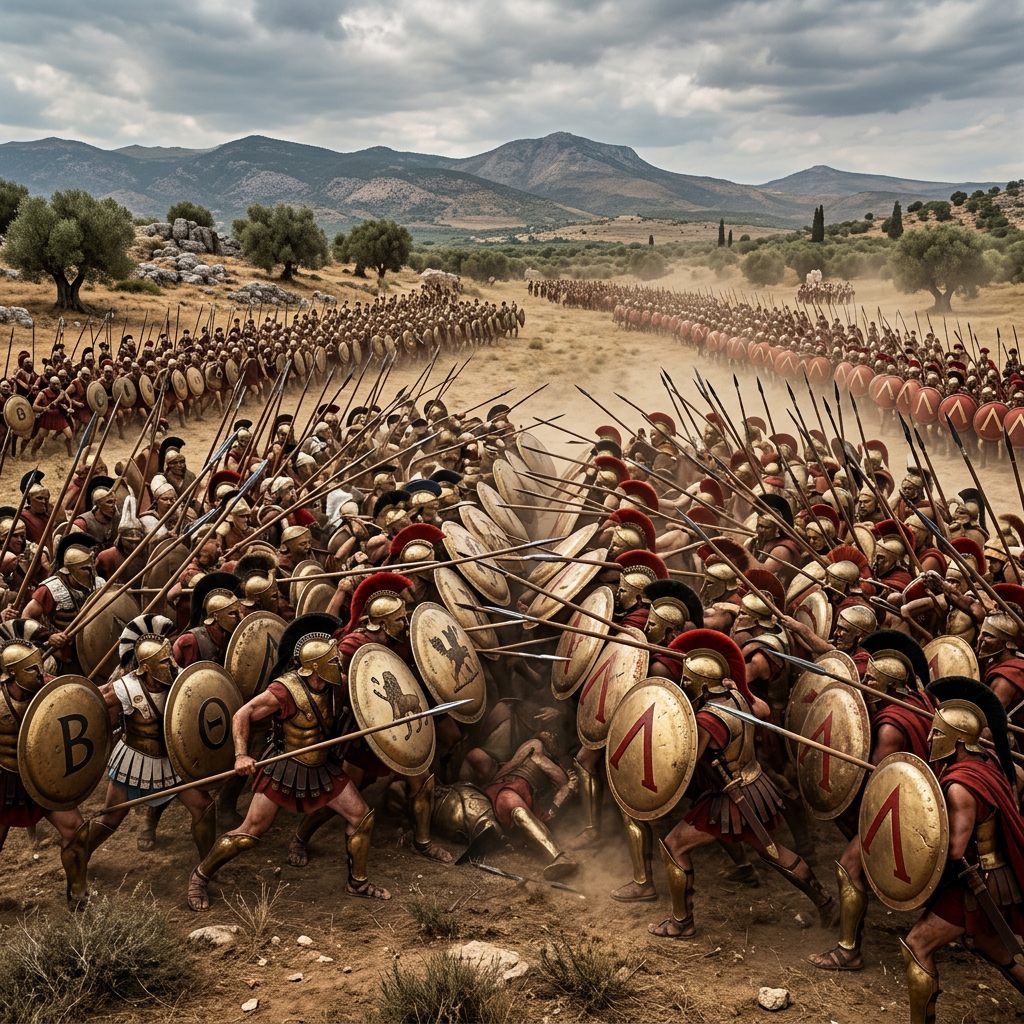
The traditional Greek method of warfare dominated the battlefield:
The hoplite phalanx.
Thousands of heavily armed infantrymen advanced in tightly organized formations, carrying:
- Large round shields (aspides)
- Spears (doru)
- Bronze helmets
- Body armor
- Greaves
Victory depended upon discipline, cohesion, and the ability of commanders to exploit weaknesses in the enemy formation.

The Battle Begins: Hoplite Armies Collide
As the armies approached each other near Coronea in Boeotia, the traditional methods of Greek hoplite warfare determined the shape of the battlefield.
The Greek phalanx was built around unity.
Each soldier depended on the shield of the man beside him.
A broken formation could lead to disaster, while a disciplined advance could crush an enemy line.
The Spartan army, famous throughout Greece for its training and organization, stood under the command of Agesilaus II.
The allied army was composed of several Greek contingents, including the powerful forces of Thebes and its Boeotian allies.
The opening movements followed the usual pattern of ancient Greek battles: both sides attempted to gain an advantage through positioning, morale, and the strength of their formations.
The outcome would depend not only on numbers but on experience and leadership.
The Spartan Right Wing and the First Victory
One of the defining characteristics of the Battle of Coronea 394 BC was the success of the Spartan forces on their right wing.
The Spartan and allied troops facing the opposing left wing achieved a significant breakthrough.
Their discipline and battlefield experience allowed them to push back their enemies, demonstrating once again why the Spartan army was feared throughout the Greek world.
The victory of this section of the battlefield created a dangerous situation for the allied forces.
However, ancient battles were rarely decided by a single clash.
While one side gained ground, another part of the battlefield continued to resist.
The Theban Resistance
The most determined resistance came from the Thebans.
Unlike some of their allies, the Theban troops refused to retreat after suffering losses.
They fought with exceptional courage, attempting to maintain their formation despite the collapse of other allied units.
The Thebans had already established a reputation as formidable warriors, and their stubborn resistance prevented a complete Spartan victory on the battlefield.
This moment revealed an important truth about Greek warfare:
A powerful army could win a battle, but defeating the spirit of a determined enemy was far more difficult.
The courage displayed by the Thebans at Coronea would later become significant in the rise of Thebes as a major Greek power.

Agesilaus II: Strategy and Leadership
The victory at Coronea strengthened the reputation of Agesilaus II as one of Sparta’s greatest commanders.
His greatest achievement was not simply winning the battle, but successfully bringing an experienced army from Asia Minor back into Greece and defeating a powerful coalition.
Several elements contributed to his success:
- Strong battlefield discipline.
- Experienced veteran troops.
- Effective coordination of allied forces.
- Understanding of traditional Spartan tactics.
- Ability to maintain morale under pressure.
However, Agesilaus was also realistic.
The victory did not destroy Sparta’s enemies.
The Corinthian War continued, and the political challenges facing Sparta remained unresolved.
The Aftermath of the Battle of Coronea
The Battle of Coronea 394 BC ended with a Spartan victory, but it was not a complete destruction of the opposing alliance.
The Thebans and their allies remained capable of resisting Spartan influence.
Agesilaus reportedly suffered wounds during the battle, demonstrating the intensity of the fighting.
After the victory, Spartan control in central Greece was temporarily strengthened.
The battle allowed Sparta to maintain its reputation as the dominant land power of Greece.
Yet beneath the surface, changes were already occurring.
The traditional Spartan system was beginning to face challenges from new military ideas and rising powers.
The Importance of Coronea in Ancient Greek History
The significance of the Battle of Coronea extends beyond the immediate military result.
It represented one of the final great victories of classical Sparta.
For generations, Sparta had been considered the greatest land military power in Greece. Its soldiers represented discipline, endurance, and professional excellence.
However, the world was changing.
The traditional Spartan model would soon be challenged by:
- The rise of Thebes.
- New battlefield tactics.
- Changing political alliances.
- Declining Spartan manpower.
Only a few decades later, in 371 BC, Sparta would suffer a devastating defeat at the Battle of Leuctra, where the Theban commander Epaminondas revolutionized Greek military tactics and ended Spartan dominance.
In this sense, Coronea was both a triumph and a warning.
It showed the strength of Sparta—but also revealed that its era of unquestioned supremacy was coming to an end.
Greek Hoplite Warfare and the Legacy of Coronea
The Battle of Coronea 394 BC remains an important example of classical Greek military traditions.
It demonstrates the strengths and weaknesses of the hoplite system:
Strengths
- Discipline and organization.
- Strong defensive formations.
- Importance of teamwork.
- Elite military training.
Weaknesses
- Limited flexibility.
- Dependence on formation stability.
- Difficulty adapting to new tactics.
Later Greek commanders would study these battles and develop new methods of warfare.
The lessons learned from conflicts like Coronea influenced the evolution of Greek military strategy before the rise of Macedon under Philip II and Alexander the Great.

The Legacy of the Battle of Coronea
Today, the Battle of Coronea 394 BC remains a fascinating chapter of ancient Greek history because it captures a moment of transition.
It was a time when old powers fought to preserve their influence while new forces prepared to emerge.
The Spartan army still possessed unmatched prestige.
The Greek city-states still fought for independence and dominance.
The battlefield of Coronea represented the final struggles of a world built on hoplite warfare and city-state rivalry.
Although Sparta won the battle, history would soon reveal that military victory alone could not stop political change.
Conclusion
The Battle of Coronea (394 BC) was one of the last great victories of ancient Sparta and a defining event of the Corinthian War.
Led by the experienced king Agesilaus II, the Spartan army defeated a powerful coalition of Greek rivals and temporarily preserved Spartan influence throughout Greece.
Yet the battle also marked the beginning of a transformation.
The dominance of Sparta was no longer guaranteed. New powers were rising, new strategies were developing, and the ancient Greek world was moving toward a new era.
Coronea reminds us that history is not shaped only by victories and defeats, but by the changes that follow them.
On the plains of Boeotia, Sparta won a battle—but the future of Greece was already beginning to change.
Fortisetliber’s View
The Battle of Coronea (394 BC) stands as one of the final great victories of ancient Sparta and a defining moment in the turbulent years following the Peloponnesian War. It was a battle fought not only with spears and shields, but with the ambitions, fears, and rivalries that shaped the Greek world of the 4th century BC.
Under the command of King Agesilaus II, the Spartan army faced a powerful coalition of Greek cities determined to challenge Spartan dominance. On the plains of Boeotia, the legendary discipline of the Spartan hoplite formation met the determination of Theban, Athenian, Corinthian, and Argive forces in a struggle that would influence the future balance of power in Greece.
Sparta’s victory at Coronea demonstrated the strength of its military tradition. The courage, organization, and experience of its soldiers remained unmatched, proving why Sparta had become the most feared land power of classical Greece.
Yet history often reveals a deeper truth: victory does not always mean lasting supremacy.
The Battle of Coronea represented both the height of Spartan military excellence and the beginning of a new era. Only a few decades later, the rise of Thebes and the revolutionary tactics of Epaminondas would challenge the Spartan system and end its dominance at the Battle of Leuctra in 371 BC.
From the perspective of FortisLiber, Coronea is not simply a story of one army defeating another. It is a reminder that civilizations are constantly changing, and even the greatest powers must eventually face transformation.
The battlefield of Coronea teaches us that history is not only written by those who win, but also by the changes that follow their victories.
Among the hills of Boeotia, Sparta achieved one of its final triumphs—but the winds of history were already carrying Greece toward a new age.
Leave a Reply