
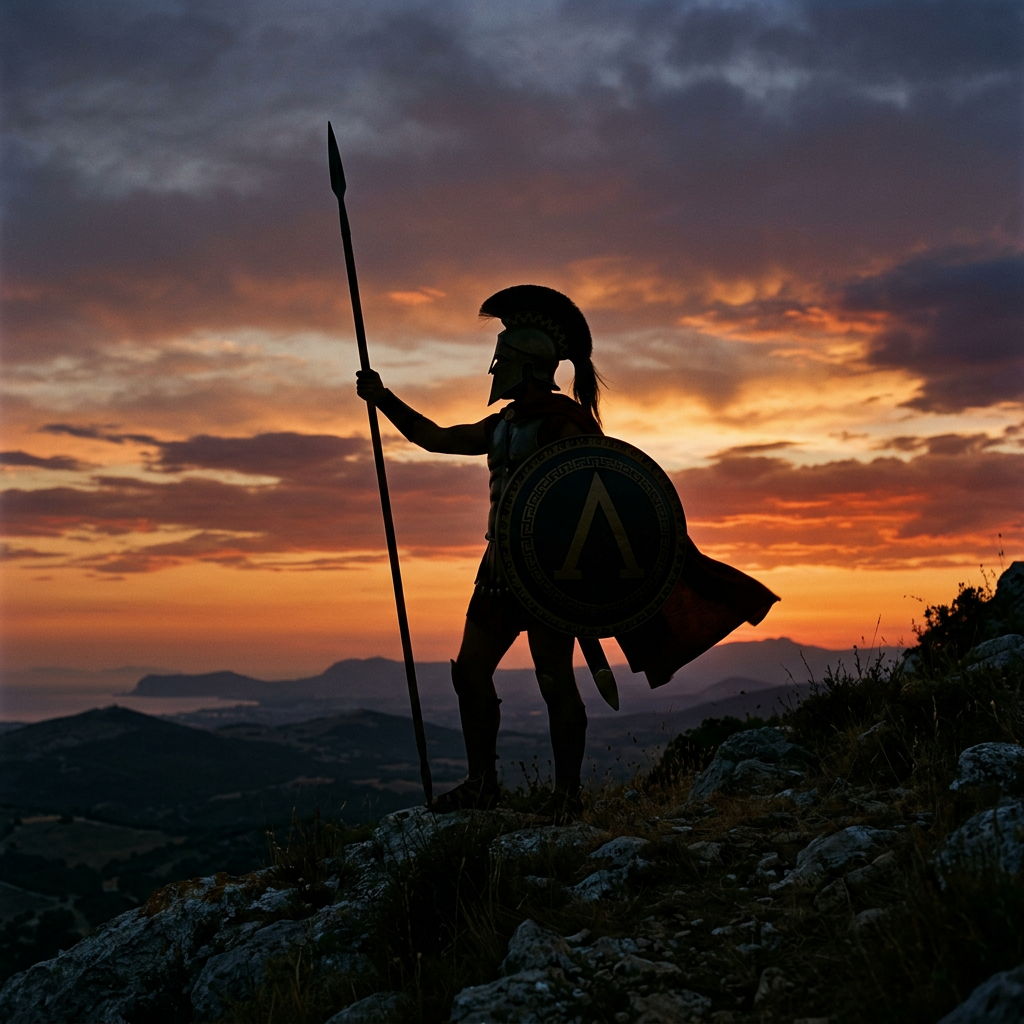
The Greek hoplite was the backbone of ancient Greek warfare for centuries.
Unlike professional standing armies, hoplites were citizen-soldiers—farmers, craftsmen, and landowners who equipped themselves for battle and fought to defend their city-state.
Their effectiveness came not from individual agility or long-range weaponry, but from disciplined formation fighting known as the phalanx. At the heart of this system was a carefully chosen set of weapons and armor designed for close, coordinated combat.
The Spear: The Primary Weapon
The most important weapon of a hoplite was the dory, a long thrusting spear.
Typically:
- Length: around 2 to 3 meters (6–9 feet), though later versions could be longer
- Material: a wooden shaft, usually ash
- Tip: an iron spearhead for thrusting
- Butt spike (sauroter): a secondary metal point at the rear
The spear was designed primarily for thrusting, not throwing. In battle, hoplites would extend their spears over or between shields in the phalanx, aiming at the enemy’s torso or legs.
The rear spike also had practical uses:
- Finishing wounded enemies
- Replacing a broken spearhead
- Anchoring the spear into the ground when needed
Because formations were tight, spear control and discipline mattered more than brute strength.
The Sword: The Backup Weapon
When the spear broke or battle collapsed into close quarters, hoplites relied on a secondary weapon: the xiphos.
The xiphos was:
- A short iron sword, typically 40–60 cm long
- Double-edged and leaf-shaped or straight-bladed
- Designed for stabbing and short slashing motions
Some hoplites also used the kopis, a curved sword better suited for cutting, though this was more common in later or specialized forces.
The sword was not the main weapon—it was a last resort, used when the phalanx formation disintegrated or fighting became chaotic.
The Shield: The Defining Tool of the Hoplite
Perhaps the most iconic piece of hoplite equipment was the aspis (also called the hoplon), the large round shield from which the term “hoplite” is derived.
Key features:
- Diameter: about 1 meter (3 feet)
- Material: wood core, bronze facing, and leather backing
- Weight: often 6–8 kilograms or more
- Held with a central arm band (porpax) and hand grip (antilabe)
The shield was designed for both defense and formation cohesion. Each hoplite’s shield protected:
- The soldier himself
- And the left side of the man beside him
This created a tightly linked defensive wall in the phalanx. Because of this system, maintaining position was more important than individual heroics.
The shield’s role was so central that losing it in battle was considered a major disgrace in many Greek city-states.

Armor: Protection in Close Combat
Hoplite armor varied depending on wealth and period, but typically included:
Bronze Breastplate (Thorax)
- Molded or composite bronze armor
- Protected the chest, back, and abdomen
- Expensive and often worn by wealthier soldiers
Linen Armor (Linothorax)
- Made of layered linen glued together
- Lighter and cheaper than bronze
- Became increasingly common over time
Helmet (Korythos)
Greek helmets evolved in several styles:
- Corinthian helmet: fully enclosed face with narrow eye and mouth slits
- Chalcidian helmet: improved vision and hearing
- Pilos helmet: simple, cap-like design used later
Helmets were often topped with horsehair crests for intimidation and identification.
Greaves
- Bronze shin guards
- Protected the lower legs
- Often the only armor worn below the waist
The Phalanx: Where Weapons Became One System
Hoplite weapons were not designed for individual duels. They were built for the phalanx formation, where soldiers stood shoulder-to-shoulder in tightly packed ranks.
In this formation:
- Shields formed a continuous wall
- Spears projected forward in overlapping layers
- Depth provided pushing power and stability
The effectiveness of the phalanx depended on:
- Unity
- Discipline
- Coordination
A well-formed phalanx could overwhelm more loosely organized forces, even if outnumbered.

Famous Use in Battle
Hoplite warfare defined many of the most important conflicts in ancient Greece, including battles such as:
- The Battle of Marathon (490 BCE)
- The Battle of Plataea (479 BCE)
- Numerous clashes during the Peloponnesian conflicts
In these battles, hoplite equipment and discipline proved decisive, especially when combined with terrain advantages and strong leadership.
Legacy of the Hoplite Arsenal
The weapons of the hoplite were simple compared to later military technology, but their effectiveness came from integration. The spear, shield, armor, and sword worked together within a disciplined system that prioritized collective strength over individual glory.
The hoplite remains one of history’s clearest examples of how equipment alone does not determine victory—how it is used, and how soldiers work together, matters far more.
Even today, the image of the hoplite—shield locked, spear forward—remains a powerful symbol of unity and resilience in warfare.
Fortisetliber’s View
At Fortis Liber, we see in the Greek hoplite a powerful lesson about the connection between responsibility, courage, and collective strength.
The hoplite was more than a soldier—he was a citizen, called upon to defend his city-state with both his body and his resources.
Equipped with the spear, shield, and armor, the hoplite’s effectiveness depended on discipline and cooperation.
The spear was his reach, the shield his protection, and together with his comrades, they formed the phalanx, a living wall of unity and determination. Individual skill mattered, but victory was won through shared effort and cohesion.
The hoplite reminds us that true strength does not lie in weapons alone, but in the willingness to act in concert with others, for a cause larger than oneself.
Even in the chaos of battle, the disciplined citizen-soldier exemplified resilience, commitment, and civic duty—qualities that remain timeless.
Leave a Reply