
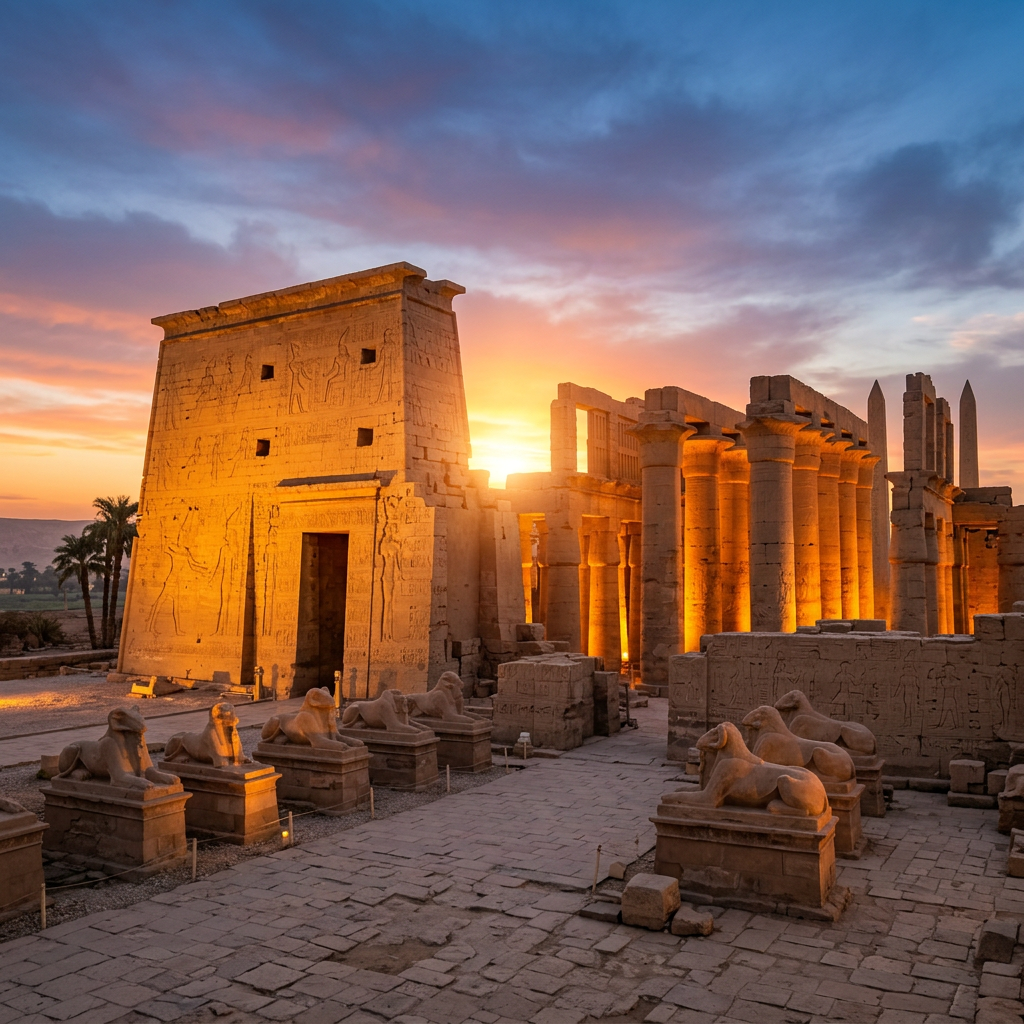
On the banks of the Nile in southern Egypt lies Luxor, a modern city built atop one of the greatest capitals of the ancient world: Thebes. For more than a thousand years, this city was the beating heart of pharaonic power, ritual, and art. Its temples, tombs, and statues still dominate the landscape, bearing witness to a civilization obsessed with eternity.
From Thebes to Luxor: A Sacred Landscape on the Nile
In antiquity, Luxor was known as Waset to the Egyptians and Thebes to the Greeks. Its location was strategic and symbolic:
- Strategic: Situated in Upper Egypt, Thebes controlled key routes along the Nile and into Nubia and the eastern deserts.
- Symbolic: The river divided the sacred landscape. The east bank, where the sun rises, was the realm of the living and the gods’ great temples. The west bank, where the sun sets, belonged to the dead and their tombs.
By the Middle and New Kingdoms (c. 2000–1000 BCE), Thebes had become Egypt’s political and religious capital, closely associated with the god Amun and the royal dynasties that transformed Egypt into an empire.
Karnak: The Temple of Amun and the Power of Empire
The most imposing monument in ancient Luxor is the Karnak Temple Complex, dedicated primarily to the Theban triad: Amun, Mut, and Khonsu. Rather than a single temple, Karnak is a vast, evolving complex built and rebuilt over nearly 2,000 years.
A City of Gods Within a City of Kings
Karnak showcases the ambitions of pharaohs across centuries:
- Massive pylons and gateways mark the entrances, each king seeking to outdo his predecessors.
- The Great Hypostyle Hall, with its forest of 134 giant columns, creates one of the most awe-inspiring interior spaces in the ancient world.
- Obelisks, such as those of Hatshepsut and Thutmose I, pierced the sky as stone symbols of the sun’s power.
Every king who reigned from Thebes left his mark here, carving his name into walls, adding chapels, or erecting statues. Karnak became not just a religious center but a visual record of royal power, victories, and piety.

Luxor Temple: The Sacred Heart of the City
Further south along the Nile stands Luxor Temple, dedicated to the rejuvenation of kingship itself. While Karnak was primarily a state cult center for Amun, Luxor Temple was closely linked with rituals of renewal.
The Opet Festival: Journey of the Gods
Each year, during the Opet Festival, statues of Amun, Mut, and Khonsu were carried in procession from Karnak to Luxor Temple:
- The divine statues traveled along an avenue lined with sphinxes (much of which still exists today).
- The festival symbolized the regeneration of the pharaoh’s power, linking the living king with the gods.
- It brought together priests, craftsmen, and ordinary people in a grand civic and religious celebration.
Luxor Temple’s architecture reflects this role. Its courtyards and halls formed a sacred stage where the drama of kingship and divine favor was enacted before the eyes of the city.
The West Bank: City of the Dead
Across the Nile from the temples of Karnak and Luxor lies a very different landscape: the necropolis of ancient Thebes. Here, cliffs and desert plateaus shelter some of the most famous tombs in the world.
Valley of the Kings
The Valley of the Kings became the royal burial ground during the New Kingdom. Instead of building visible pyramids, pharaohs carved their tombs deep into the rock to protect them from tomb robbers.
- Walls were covered with texts like the Book of the Dead, the Amduat, and other funerary compositions that guided the king through the underworld.
- Decorations are filled with solar imagery, gods, demons, and protective spells.
- The tomb of Tutankhamun, discovered almost intact in 1922, brought global attention to Luxor and revolutionized our understanding of ancient Egyptian burial practices.
Valley of the Queens and the Nobles
Nearby lie the Valley of the Queens and the tombs of high officials and nobles:
- The Valley of the Queens contains richly decorated tombs for royal women, most famously that of Nefertari, wife of Ramesses II, whose vibrant wall paintings are among the best preserved in Egypt.
- Tombs of nobles and officials, such as those at Sheikh Abd el-Qurna, preserve detailed scenes of daily life, agriculture, craft production, and religious rituals.
Together, these necropoleis show not just how Egyptians buried their dead, but how they understood life, work, and piety.

Deir el-Bahri and the Mortuary Temples
At the base of the cliffs on the west bank stands Deir el-Bahri, home to the mortuary temples of several pharaohs, most famously Hatshepsut.
Hatshepsut’s Terraced Temple
The mortuary temple of Hatshepsut, the female pharaoh of the 18th Dynasty, is one of Luxor’s architectural masterpieces:
- Three terraces rise dramatically from the desert, blending with the surrounding cliffs.
- Colonnades depict Hatshepsut’s divine birth and her expedition to the mysterious land of Punt, emphasizing her legitimacy and success as a ruler.
- The temple served as a place for the king’s cult in death, where rituals maintained the pharaoh’s ka (life force) for eternity.
Elsewhere along the west bank, ruined mortuary temples—like that of Amenhotep III, marked by the colossal seated statues known as the Colossi of Memnon—once lined the floodplain, forming a monumental avenue of temples facing the river.
Life in Ancient Thebes
While Luxor’s grand temples and tombs dominate the archaeological record, they were only part of a living city.
A City of Priests, Artisans, and Traders
Thebes supported a diverse population:
- Priests managed temple ritual and controlled significant economic resources through temple estates and workshops.
- Artisans and builders lived in communities like Deir el-Medina, a planned village of royal tomb workers whose houses, tools, and written records give us a rare glimpse into everyday life—wages, disputes, love letters, and even personal religious practices.
- Scribes and administrators kept the bureaucracy running, recording taxes, land ownership, and supplies for the temple and the state.
The Nile’s annual flood brought fertility to the fields, and the countryside around Thebes was filled with farms, vineyards, and small shrines.

Decline, Rediscovery, and Legacy
By the late New Kingdom and into the first millennium BCE, Thebes’ political importance declined as capitals shifted northward to cities like Pi-Ramesses and later Alexandria. The temples still functioned, but the city no longer stood at the center of imperial power.
Over centuries, sand and debris have buried many monuments. Local communities reused ancient stone for new buildings, and memories of the old city faded—until European travelers and scholars in the 18th and 19th centuries began to map, copy, and excavate its remains.
Luxor Today
Modern Luxor sits atop this ancient landscape:
- Archaeological work continues to reveal new tombs, temples, and settlements.
- Restoration projects at Karnak, Luxor Temple, and the west bank tombs help visitors experience something of their original splendor.
- For Egyptologists and tourists alike, Luxor is a living laboratory of pharaonic civilization.
Conclusion: Why Ancient Luxor Still Matters
Ancient Luxor, the Thebes of the pharaohs, was more than a city. It was a carefully orchestrated sacred landscape in which temples, tombs, and the Nile itself formed a grand stage for the drama of kingship, worship, and the afterlife.
From the towering columns of Karnak to the painted tombs in the Valley of the Kings, Luxor preserves a uniquely complete record of ancient Egyptian religion, politics, art, and daily life. To study Luxor is to trace the rise and fall of one of history’s most enduring civilizations—and to see how a society tried to build eternity in stone.
Fortisetliber’s View
Ancient Luxor is not only a museum of temples and tombs; it is a discipline in stone.
Thebes, as it was once called, organized an entire landscape around memory and meaning. The east bank faced the rising sun, the domain of temples and public ritual.
The west bank faced sunset, the domain of tombs and silence. Between them flowed the Nile: life, trade, and the ordinary tasks of each day. To move through Luxor was to move constantly between life and death, work and worship, the present and eternity.
In this, Luxor confronts us with an uncomfortable question: What do we consider worth building for the long term?
The Egyptians of Thebes invested unimaginable effort in carving prayers and narratives into rock, not to be seen by crowds, but to be read by the gods and by time itself. Their monuments are excessive by any practical standard—yet they have outlived empires, languages, and ideologies. We, by contrast, build quickly and forget quickly. Our “monuments” are often digital, weightless, and designed to be replaced.
Luxor reminds us that a free and strong life—fortis et liber—is not built on speed or novelty alone, but on chosen commitments. The Egyptians chose to remember their gods, their kings, and their vision of the afterlife.
Their choice was not ours, and we need not imitate their theology to learn from their seriousness. What deserves such deliberate remembrance in our own age? What truths, relationships, or promises should be treated as carefully as they treated their stone?
Walking through Luxor today, we see that even the most enduring works are partial and fragile: walls collapse, names are erased, colors fade. Yet the attempt to reach beyond one’s own lifetime remains deeply human. Luxor’s greatness is not that it solved the problem of mortality, but that it faced it without distraction.
To study Luxor, then, is to ask how we might order our own days between east and west bank—between action and contemplation, work and reflection—so that our lives, however brief, are aligned toward what is truly worth remembering.
Leave a Reply