
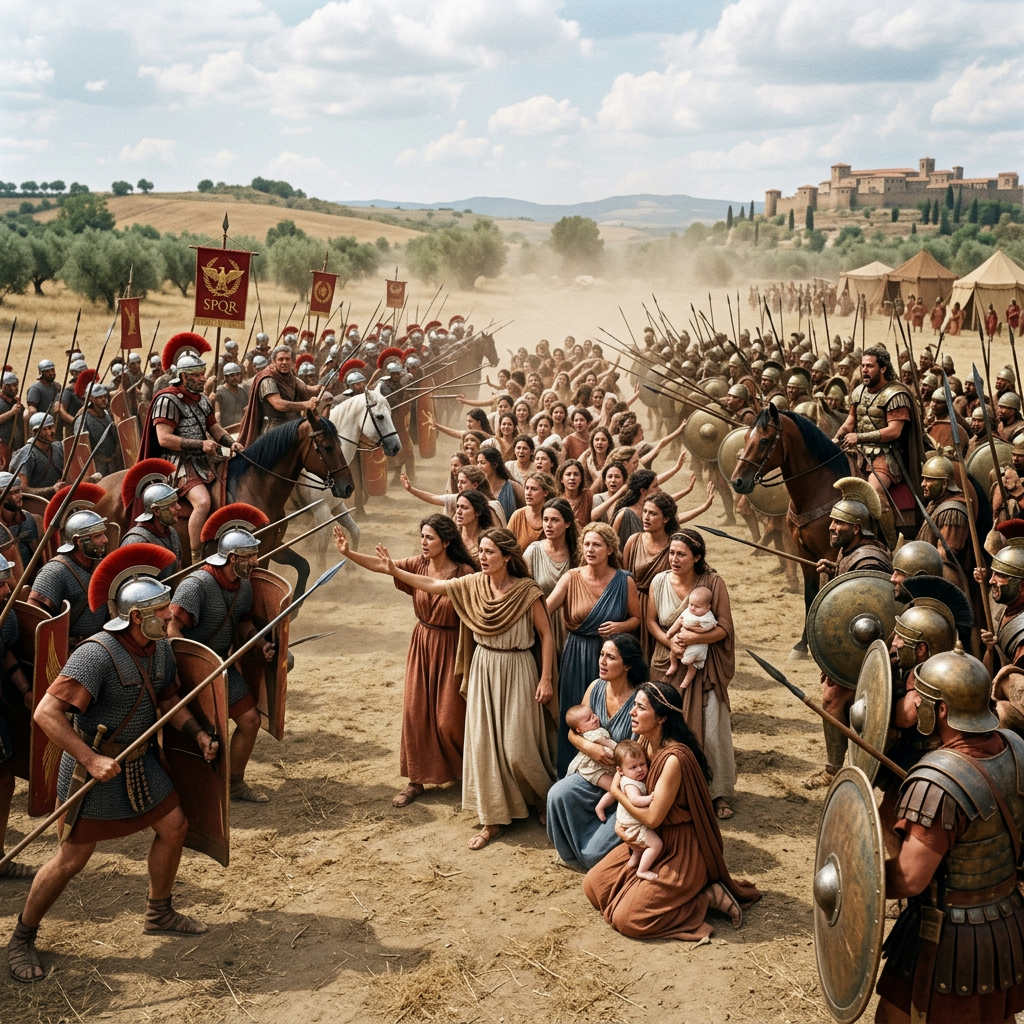
The Rape of the Sabine Women is one of the most famous and controversial stories in Roman mythology. For centuries, it has been interpreted as a tale of violence, state-building, and reconciliation.
Although traditionally presented as an event from the earliest days of Rome, modern historians generally regard it as a legend rather than a verifiable historical occurrence. Nevertheless, the story played an important role in how the Romans understood their origins and their identity as a people.
The term “rape” in the title often causes confusion among modern readers. The word comes from the Latin raptio, meaning “abduction,” “carrying off,” or “seizure.”
While the story involves the forced taking of women and therefore raises serious questions about consent and coercion, the ancient narrative focuses primarily on their abduction for marriage rather than describing a mass sexual assault.
Understanding this distinction is essential for interpreting the myth in its historical and cultural context.
The Early Rome of Romulus
According to Roman tradition, Rome was founded in 753 BCE by Romulus, one of the twin brothers Romulus and Remus. After a dispute between the brothers resulted in Remus’s death, Romulus became the sole ruler of the newly established city.
The early settlement attracted a diverse population. Roman writers describe it as a refuge for fugitives, exiles, escaped slaves, and adventurers from neighboring regions.
While this influx helped populate the city, it created a demographic problem. Most of the newcomers were men. Without women, the settlement could not grow naturally or establish stable family structures.
Romulus reportedly sought alliances with neighboring peoples and requested permission for intermarriage between Romans and local communities. These requests were rejected.
The surrounding tribes regarded Rome as a new and potentially threatening settlement populated by outsiders, and they were unwilling to allow their daughters to marry Roman men.
Faced with this challenge, Romulus devised a plan that would become one of the most famous episodes in Roman legend.
The Festival and the Abduction
According to accounts preserved by ancient authors such as Livy and Plutarch, Romulus announced a grand festival and invited neighboring communities to attend. Among those who came were the Sabines, a tribe living in the hills northeast of Rome.
The visitors arrived with their families, expecting a celebration of games and religious observances. During the festivities, Romulus gave a prearranged signal. At that moment, Roman men seized many of the unmarried women among the guests and carried them away.
Ancient writers emphasize that the Romans targeted young women suitable for marriage rather than indiscriminately attacking the visitors.
The men of the neighboring communities were outraged and returned home to prepare for war. The abducted women, meanwhile, found themselves in an unfamiliar city among people they had not chosen.
Roman sources portray Romulus as addressing the women afterward, explaining that they would become lawful wives and share in the prosperity and citizenship of Rome.
Whether this detail reflects an actual tradition or a later attempt to justify the episode is impossible to know. What is clear is that Roman authors sought to present the event not merely as an act of violence but as a step toward the creation of a new society.

The War with the Sabines
The abduction triggered conflict between Rome and several neighboring communities. According to the legend, some tribes attacked Rome independently and were defeated. The most serious challenge came from the Sabines.
The Sabine king, Titus Tatius, organized a campaign against Rome. In one famous episode, a Roman woman named Tarpeia betrayed the city by allowing Sabine soldiers access to a fortified position.
The story says that she expected a reward but was instead crushed beneath the shields of the warriors she had aided. This episode later became associated with the Tarpeian Rock, a place in Rome linked to the punishment of traitors.
The war culminated in a major battle between the Romans and the Sabines. Both sides fought fiercely, and neither gained a decisive advantage. At this critical moment, the abducted women intervened.
The Intervention of the Sabine Women
The most dramatic and memorable part of the story occurs when the women, now wives and in some cases mothers, entered the battlefield. They placed themselves between the opposing armies and begged their fathers, brothers, husbands, and relatives to stop fighting.
The women argued that continued warfare would destroy both sides. If the Sabines won, they would kill the husbands of the women; if the Romans won, they would kill the fathers and brothers of the women. Either outcome would bring tragedy to those caught between the two communities.
Moved by these appeals, the combatants agreed to end the conflict. The Romans and Sabines united into a single people, and Romulus and Titus Tatius ruled jointly for a time. The women thus became symbols of reconciliation and social harmony.
This conclusion was especially significant for Roman audiences. Rather than ending with conquest or revenge, the story culminates in integration. The women who had initially been taken by force become the bridge between two communities and the foundation of a larger political entity.
Historical Reality and Myth
Most modern scholars do not regard the Rape of the Sabine Women as a literal historical event. The earliest surviving accounts were written centuries after the supposed events they describe. By the time Livy and other Roman historians recorded the story, Rome had already become a major Mediterranean power.
Historians generally interpret the tale as a foundation myth—a narrative created or shaped to explain how Rome emerged and expanded. Foundation myths often combine historical memories with symbolic themes.
In this case, the story may reflect the gradual incorporation of neighboring peoples into an expanding Roman community.
Archaeological evidence suggests that early Rome developed through the merging of settlements and populations from different regions.
The legend of the Sabine women may therefore symbolize a real historical process of integration and alliance, expressed through a dramatic narrative.
Some scholars also view the story as an attempt to explain the close cultural connections between Romans and Sabines. The tale provides a memorable account of how two distinct groups supposedly became one people.

Women in the Story
Modern readers often focus on the experiences of the women themselves. The story raises difficult questions about agency, consent, and the role of women in ancient narratives.
Roman authors portrayed the women as victims of abduction but also as active participants in the eventual reconciliation. Their intervention transforms them from passive objects in a political struggle into key actors who determine the outcome of the conflict.
At the same time, the story reflects the patriarchal values of the ancient world. The women are largely defined by their relationships to men—as daughters, wives, and mothers.
Their importance in the narrative derives from their ability to connect male-dominated communities rather than from independent political power.
Because of these complexities, modern interpretations vary widely. Some scholars emphasize the violence and coercion at the center of the myth, while others focus on the symbolic role of women as creators of social unity.
The Story in Roman Culture
The legend occupied an important place in Roman cultural memory. It offered an explanation for Rome’s origins and highlighted qualities that Romans admired: courage, determination, and the ability to incorporate outsiders into the community.
Unlike many ancient societies that emphasized pure ancestry, Rome often celebrated its mixed origins. Roman writers took pride in the idea that their city had been built by people from diverse backgrounds.
The story of the Sabine women reinforced this theme by depicting Rome as a society formed through the union of different peoples.
The myth also conveyed political messages. Throughout Roman history, leaders sought to unite competing factions and integrate conquered populations. The reconciliation between Romans and Sabines provided a powerful example of such unity.
Artistic Legacy
Few ancient legends have inspired as much art as the Rape of the Sabine Women. During the Renaissance and Baroque periods, artists found the dramatic scene irresistible.
Perhaps the most famous representation is the marble sculpture Giambologna created in the late sixteenth century. Located in Loggia dei Lanzi, the sculpture depicts three intertwined figures in a dynamic upward spiral, capturing the intensity of the abduction.
Painters such as Nicolas Poussin, Pietro da Cortona, and Jacques-Louis David also depicted the story. Their works often focused either on the chaos of the abduction or the emotional power of the women’s intervention during the battle.
These artistic interpretations reflected the concerns of their own times as much as those of ancient Rome. Some emphasized heroism and state-building, while others highlighted suffering and human emotion.

Conclusion
The Rape of the Sabine Women remains one of the most influential myths of the ancient world. Although it is unlikely to describe a historical event exactly as it occurred, the story reveals much about Roman values and self-perception.
It addresses fundamental themes: the creation of a society, the integration of different peoples, the consequences of violence, and the possibility of reconciliation.
For the Romans, the legend explained how a small settlement became a thriving community. For later generations, it offered a rich subject for historical reflection, artistic expression, and ethical debate.
More than two thousand years after it was first recorded, the story continues to provoke discussion because it combines elements of conflict, power, family, and identity in a narrative that remains both compelling and controversial.
Fortisetliber’s View
Rome didn’t become great by waiting politely at the gate. According to legend, Romulus faced a problem any ambitious city would dread: too many men, not enough women.
His solution? A festival… and a bold, violent plan. He seized the unmarried women of the neighboring Sabine tribe, dragging them into the fledgling city. The word “rape” here is the old Latin raptio, meaning abduction—but don’t sugarcoat it: these women were taken against their will.
When the Sabine men came to fight back, the story takes a twist. The women stepped between their fathers and new husbands, forcing a peace by sheer courage. They became the bridge that merged two peoples and saved Rome from civil war.
Seen through modern eyes, the tale is horrifying—but the Romans celebrated it as a lesson: bold action and daring risk create empires; clever reconciliation keeps them standing. The story isn’t just myth—it’s Rome telling the world, “We take what we need, but we also make it last.”
Art, literature, and even modern debates still wrestle with this event. It’s a reminder that history—or myth—can be brutal, beautiful, and morally complicated all at once. The Sabine women weren’t just victims; they were the linchpins of Rome’s survival. And Rome? It never looked back.
Leave a Reply