
Introduction
The Temple of Poseidon stands proudly on the cliffs of Cape Sounion, overlooking the sparkling waters of the Aegean Sea. As one of the most remarkable monuments of Ancient Greece, this magnificent temple attracts thousands of visitors every year who come to admire its architectural beauty, historical significance, and breathtaking coastal views.
Located approximately 70 kilometers southeast of Athens, the Temple of Poseidon is not only an important archaeological site but also one of the most popular day-trip destinations in Greece. With its dramatic location, rich mythology, and enduring cultural legacy, the temple offers a fascinating glimpse into the world of ancient Greek civilization.
In this guide, we’ll explore the history, architecture, mythology, and visitor experience of the Temple of Poseidon, revealing why it remains one of Greece’s most treasured landmarks.
The History of the Temple of Poseidon
The Temple of Poseidon was built during the Golden Age of Athens around 444–440 BCE. It was constructed during the leadership of Pericles, the influential statesman responsible for many of Athens’ greatest architectural achievements, including the Parthenon on the Acropolis.
The temple was dedicated to Poseidon, the ancient Greek god of the sea, earthquakes, and horses. As a maritime nation heavily dependent on naval power and trade, the Athenians held Poseidon in high regard. Sailors would often stop at Cape Sounion to offer prayers and sacrifices before embarking on dangerous voyages across the Aegean Sea.
The current temple replaced an earlier sanctuary that was destroyed during the Persian invasion of Greece in 480 BCE. Following the Greek victories in the Persian Wars, Athens entered a period of prosperity and initiated ambitious building projects throughout the region. The Temple of Poseidon became one of the most important symbols of Athenian strength and devotion.
For centuries, the temple served as a religious center and strategic lookout point. Its elevated position allowed inhabitants to monitor ships approaching Athens and protect vital maritime routes.
Why Cape Sounion Was Chosen
The location of the Temple of Poseidon is as impressive as the structure itself. Cape Sounion forms the southernmost tip of the Attica Peninsula, where steep cliffs rise dramatically above the sea.
Ancient Greeks believed that places of natural beauty and power were ideal locations for sacred buildings. The cape’s commanding views of the Aegean made it the perfect site to honor the god of the sea.
The temple’s visibility was equally important. Sailors approaching Athens could spot the gleaming marble columns from miles away. The sight of the temple provided reassurance that they were nearing home and under the protection of Poseidon.
Today, visitors continue to be captivated by the spectacular scenery that surrounds the monument. The panoramic views of the coastline and nearby islands make Cape Sounion one of the most photographed locations in Greece.

Architectural Features of the Temple
The Temple of Poseidon is a classic example of Doric architecture, one of the three principal architectural styles of Ancient Greece.
Originally, the temple featured 34 elegant marble columns constructed from locally sourced white marble. Today, 15 columns remain standing, preserving much of the monument’s original grandeur.
The structure measured approximately 31 meters in length and 13.5 meters in width. Its clean lines, symmetrical proportions, and understated decorative elements reflect the sophistication of Greek architectural design.
Key architectural features include:
Doric Columns
The temple’s columns are characterized by their sturdy appearance and simple capitals. These columns exemplify the strength and balance associated with the Doric style.
Elevated Platform
The temple was built on a raised platform, enhancing its visibility from both land and sea while emphasizing its sacred status.
Strategic Orientation
The building was carefully positioned to maximize its visual impact against the backdrop of the sea and sky, creating a harmonious relationship between architecture and nature.
Marble Construction
The use of high-quality marble contributed to the temple’s durability and striking appearance. When illuminated by sunlight, the structure would have appeared especially magnificent to ancient travelers.
Despite centuries of exposure to wind, weather, and human activity, the Temple of Poseidon remains an extraordinary example of classical Greek engineering and craftsmanship.
The Mythology of Poseidon
To fully appreciate the significance of the temple, it is important to understand the role of Poseidon in Greek mythology.
Poseidon was one of the twelve Olympian gods and the brother of Zeus and Hades. Following the defeat of the Titans, the three brothers divided control of the universe. Zeus ruled the sky, Hades governed the underworld, and Poseidon became lord of the seas.
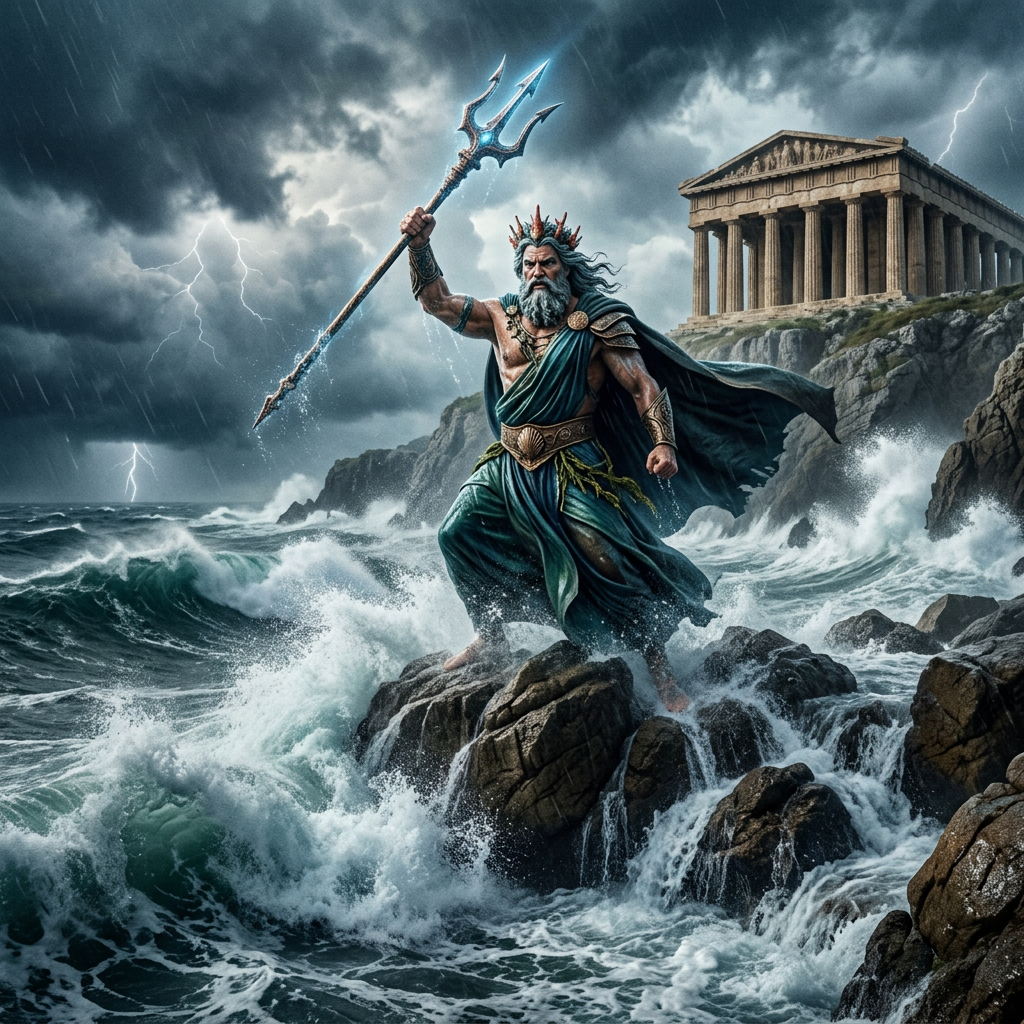
Poseidon was often depicted carrying a powerful trident, which he used to stir storms, create earthquakes, and command marine creatures. Sailors worshipped him for protection during their journeys, while coastal communities sought his favor to ensure prosperity and safety.
The connection between Poseidon and Cape Sounion was particularly strong because the site overlooked major maritime routes used by merchants, fishermen, and naval fleets.
The temple served as a place where people could offer sacrifices, seek divine assistance, and express gratitude for successful voyages.

The Legend of King Aegeus
One of the most famous myths associated with Cape Sounion involves King Aegeus and his son Theseus.
According to Greek mythology, Theseus sailed to Crete to defeat the fearsome Minotaur. Before departing, he promised his father that if he survived, he would return with white sails instead of black ones.
After successfully defeating the Minotaur, Theseus forgot to change the sails on his ship. When King Aegeus spotted the vessel approaching Cape Sounion with black sails still flying, he believed his son had perished.
Overcome with grief, Aegeus threw himself from the cliffs into the sea below. The body of water was later named the Aegean Sea in his honor.
This tragic story has become an enduring part of Greek mythology and adds another layer of cultural significance to the Temple of Poseidon and Cape Sounion.
Lord Byron and the Temple of Poseidon
The Temple of Poseidon gained renewed international attention during the 19th century thanks to the famous English poet Lord Byron.
During his travels through Greece, Byron visited Cape Sounion and was deeply inspired by its beauty. He famously carved his name into one of the temple’s columns, an inscription that can still be seen today.
Byron’s writings helped introduce European audiences to the wonders of ancient Greece and contributed to growing interest in Greek history, archaeology, and independence.
Although modern conservation standards would never permit such actions, Byron’s connection to the site remains an intriguing part of its history.
Visiting the Temple of Poseidon Today
Today, the Temple of Poseidon is one of the most visited archaeological attractions in Greece.
Travelers can easily reach Cape Sounion from Athens by car, bus, or organized tour. The journey along the Athens Riviera offers stunning coastal scenery and numerous opportunities to explore beaches, villages, and local restaurants.
Many visitors choose to arrive in the late afternoon to experience the site’s world-famous sunset. As the sun descends toward the horizon, the marble columns glow with golden hues, creating one of the most memorable views in Greece.
Visitors can enjoy:
- Exploring the ancient temple ruins
- Learning about Greek mythology and history
- Photographing spectacular coastal landscapes
- Watching the sunset over the Aegean Sea
- Visiting nearby beaches and seaside tavernas
The combination of historical significance and natural beauty makes the Temple of Poseidon a highlight of any Greek itinerary.
Conservation and Preservation
Preserving the Temple of Poseidon is an ongoing effort involving archaeologists, historians, and conservation specialists.
Over the centuries, the monument has faced numerous threats, including natural erosion, earthquakes, pollution, and human activity. Restoration projects have helped stabilize the remaining structure while ensuring that future generations can continue to appreciate this important cultural landmark.
Modern preservation techniques focus on maintaining the temple’s authenticity while protecting it from further deterioration. These efforts demonstrate Greece’s commitment to safeguarding its rich archaeological heritage.

Why the Temple of Poseidon Remains Important
The Temple of Poseidon is more than just an ancient ruin. It represents the achievements of one of history’s most influential civilizations and serves as a powerful reminder of humanity’s enduring connection to the sea.
Its architectural elegance, mythological associations, and extraordinary setting combine to create a destination unlike any other. Whether viewed as a historical monument, a work of art, or a symbol of Greek identity, the temple continues to inspire visitors from around the world.
For travelers seeking to understand Ancient Greece, few locations offer a more compelling experience than Cape Sounion.
Conclusion
The Temple of Poseidon stands as one of Greece’s most iconic and beloved landmarks. Perched high above the Aegean Sea, it embodies the architectural brilliance, religious traditions, and mythological imagination of Ancient Greece.
From its origins in the fifth century BCE to its status as a world-renowned tourist attraction, the temple has remained a symbol of strength, beauty, and cultural heritage. Whether you’re fascinated by history, mythology, architecture, or simply breathtaking scenery, a visit to the Temple of Poseidon offers an unforgettable journey into the heart of Greek civilization.
As the sun sets behind its marble columns and the waves crash against the cliffs below, it becomes easy to understand why this remarkable monument has captivated travelers for more than two thousand years.
Fortisetliber’s View
Seen through a Fortis et Liber lens, the Temple of Poseidon is more than an ancient ruin on the cliffs of Cape Sounion. It becomes a symbol of human strength shaped by nature, and of freedom anchored in perspective rather than possession.
Perched above the Aegean Sea, the temple stands where land ends and openness begins. The ancient Greeks did not place it in the center of power or wealth, but at the edge—where sailors faced uncertainty and distance. This location reflects a mindset that values courage over comfort. To stand there is to confront vast space, shifting winds, and the unpredictable sea, yet still choose to build something enduring.
The remaining Doric columns, weathered but upright, embody resilience. They do not dominate the landscape; they endure within it. In a Fortis et Liber interpretation, this is strength that does not resist change but survives it—strength that is quiet, not aggressive.
Freedom here is not political or abstract. It is the freedom of perspective. From Cape Sounion, the horizon is uninterrupted. The viewer is reminded that limits are often visual, not absolute. The sea stretches beyond certainty, suggesting that openness is part of understanding the world.
The Temple of Poseidon, then, is not only a dedication to a god of the sea. It is a reminder that strength and freedom often coexist in stillness—where endurance meets openness, and where ancient stone continues to speak without needing to move.
Leave a Reply