
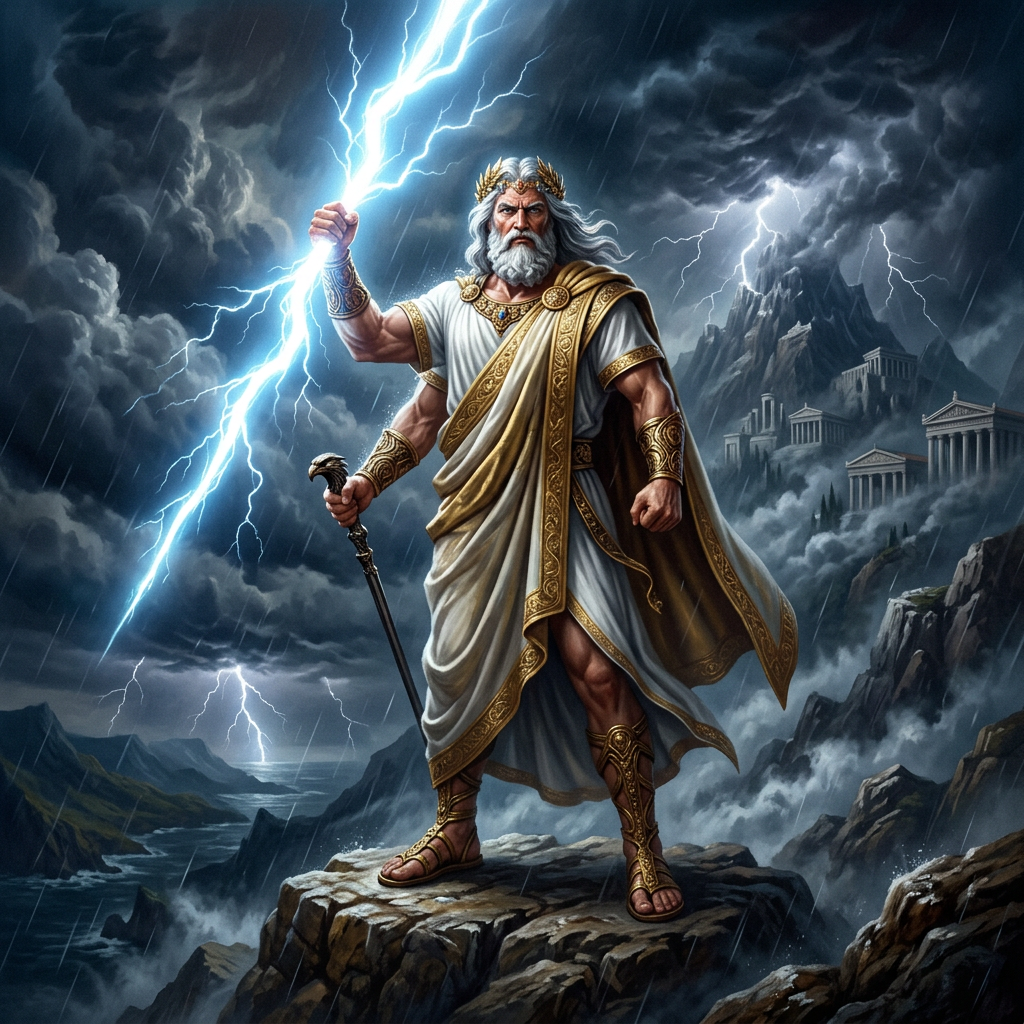
In the vast world of ancient storytelling, few figures are as powerful or enduring as Zeus. Known as the king of the gods in Greek mythology, Zeus ruled over the sky, thunder, lightning, law, and order.
His stories shaped ancient Greek religion and continue to influence modern literature, art, and popular culture.
This article explores Zeus in depth, including his origins, powers, symbols, myths, family, worship, and lasting cultural impact.
It is optimized for readers searching for topics like Zeus Greek god, Greek mythology Zeus stories, king of gods Olympus, and Zeus powers and symbols.
Who Is Zeus in Greek Mythology?
Zeus is the supreme deity in ancient Greek religion and the most powerful of the Olympian gods. He is often referred to as the “Father of Gods and men,” a title that reflects both his authority and his role as a protector of cosmic order.
According to myth, Zeus rules from Mount Olympus, the sacred mountain where the Olympian gods reside. From this divine throne, he governs the sky and enforces justice among gods and humans alike.
Zeus is commonly associated with leadership, authority, justice, hospitality (xenia), and divine law.
Origins and Family of Zeus
Zeus was born to the Titans Cronus and Rhea. His birth story is one of the most famous myths in Greek mythology.
Cronus, fearing that one of his children would overthrow him, swallowed each of them at birth. However, Rhea saved Zeus by hiding him in a cave on the island of Crete and giving Cronus a stone wrapped in cloth instead.
Raised in secrecy, Zeus eventually returned to challenge his father. With the help of his siblings—Poseidon, Hades, Hera, Demeter, and Hestia—he led a great rebellion known as the Titanomachy. After defeating Cronus and the Titans, Zeus and his brothers divided the cosmos:
- Zeus ruled the sky
- Poseidon ruled the sea
- Hades ruled the underworld
This marked the beginning of the Olympian age.

Zeus’ Powers and Abilities
Zeus is one of the most powerful deities in all mythology. His abilities reflect his role as ruler of the heavens and enforcer of divine justice.
1. Control Over the Sky and Weather
Zeus governs all atmospheric phenomena, including storms, rain, wind, and lightning. Thunderstorms were believed to be expressions of his anger or power.
2. The Thunderbolt Weapon
His most iconic weapon is the thunderbolt, forged by the Cyclopes during the Titanomachy. It symbolizes divine authority and unstoppable force.
3. Divine Authority
Zeus has the power to enforce laws among gods and humans. Even other Olympian gods fear his judgment.
4. Shape-Shifting and Disguise
Many myths describe Zeus transforming into animals or humans to interact with mortals, often for romantic pursuits or to test human virtue.
5. Omniscience (Limited)
Zeus is often portrayed as highly aware of events on Earth and Olympus, though not truly omniscient in all interpretations.
Symbols of Zeus
Zeus is represented by several powerful symbols that appear frequently in ancient art and literature:
- Thunderbolt – His primary weapon and symbol of authority
- Eagle – Represents strength, leadership, and vision
- Oak tree – Sacred tree associated with endurance and strength
- Scepter – Symbol of kingship and divine rule
- Aegis – A protective shield often associated with Zeus or Athena
These symbols reinforced his identity as the ruler of gods and men.
Zeus and His Relationships
Zeus is known for his complex family life, which plays a major role in Greek mythology.
Hera – Queen of the Gods
Zeus is married to Hera. Their relationship is often turbulent due to Zeus’ many affairs and Hera’s jealousy. Despite their conflicts, Hera remains the queen of Olympus.
Numerous Consorts and Children
Zeus fathered many children with various goddesses, nymphs, and mortal women. Some of his most famous offspring include:
- Athena (goddess of wisdom)
- Apollo (god of music and prophecy)
- Artemis (goddess of the hunt)
- Hermes (messenger of the gods)
- Perseus (hero who slayed Medusa)
- Heracles (legendary hero known for his strength)
These children played significant roles in Greek myths and heroic legends.

Famous Myths of Zeus
Zeus appears in many well-known Greek myths. Here are some of the most important ones:
The Titanomachy
Zeus led the Olympians in a ten-year war against the Titans. With the help of the Cyclopes and Hecatoncheires, he defeated Cronus and established his rule.
The Abduction of Europa
Zeus transformed into a white bull and abducted the Phoenician princess Europa, carrying her across the sea to Crete.
Prometheus and Fire
Zeus punished Prometheus for giving fire to humanity by chaining him to a rock where an eagle ate his liver daily.
Pandora’s Creation
Zeus ordered the creation of Pandora as punishment for humanity after Prometheus’ deception, leading to the release of suffering into the world.
Lycaon’s Punishment
Zeus turned King Lycaon into a wolf after he tried to trick the god by serving human flesh.
These myths highlight Zeus’ role as both protector and punisher.
Zeus in Ancient Greek Religion
Zeus was widely worshipped across ancient Greece. Temples dedicated to him were among the most important religious sites.
Major Worship Centers
- Olympia, home of the famous Temple of Zeus
- Dodona, where an ancient oracle of Zeus was located
The Olympic Games were originally held in his honor, emphasizing athletic excellence and unity among Greek city-states.
Zeus in Art and Literature
Zeus has been depicted extensively in ancient sculpture, pottery, and literature.
Ancient Art
He is often shown as a bearded, muscular man seated on a throne, holding a thunderbolt.
Classical Literature
Zeus appears in works such as:
- Homer’s Iliad
- Hesiod’s Theogony
These texts helped define his personality and role in the Greek pantheon.
Zeus in Modern Culture
Even today, Zeus remains a powerful cultural icon. He appears in:
- Movies and TV shows (often as a powerful sky god)
- Video games like God of War and Age of Mythology
- Books and fantasy literature
- Branding and sports team names
His image is often used to symbolize strength, leadership, and authority.

Symbolic Meaning of Zeus Today
In modern interpretation, Zeus represents more than mythology. He symbolizes:
- Leadership and authority
- Justice and moral order
- Natural power and chaos control
- Human ambition and divine struggle
Psychologically, Zeus can also represent the archetype of the “father figure” or authority complex in mythology studies.
Conclusion
Zeus remains one of the most influential figures in world mythology. As the ruler of the sky and king of the Olympian gods, he embodies power, justice, and divine authority. His myths continue to shape storytelling, symbolism, and cultural understanding thousands of years after they were first told.
From his rise against the Titans to his reign on Mount Olympus, Zeus stands as a timeless symbol of leadership and the human fascination with power and divinity.
Whether studied in ancient texts or modern media, Zeus continues to reign as one of the most iconic gods in human history.
Fortisetliber’s View
From a Fortis Liber view, mythology is not just ancient storytelling—it is a reflection of human psychology, power structures, and the eternal tension between freedom and control.
In this lens, Zeus is not merely the king of the gods, but an archetype of authority itself: the peak of dominance, order, and sovereign will.
Zeus represents the highest form of centralized power in the mythological imagination. He rules the heavens, commands the weather, and enforces divine law over both gods and mortals.
Yet, from a Fortis Liber perspective, this concentration of power also reveals a deeper philosophical question: what happens when order becomes absolute?
Mythological narratives show Zeus as both protector and disruptor. He maintains cosmic justice, yet frequently bends rules through disguise, intervention, and personal desire.
This duality reflects a core truth about authority—power often defines law while simultaneously existing above it.
In contrast to rigid interpretations of divine kingship, the Fortis Liber view emphasizes balance. Zeus is not only a symbol of control, but also a warning about unchecked dominance. His conflicts with other gods, Titans, and mortals illustrate the constant friction between hierarchy and resistance.
Even his rule from Mount Olympus can be interpreted symbolically: Olympus is the imagined center of ultimate authority, elevated above the world yet deeply entangled with it. It represents distance from humanity, but not detachment from human consequences.
Ultimately, the Fortis Liber interpretation reframes Zeus not as an unquestionable ruler, but as a narrative force exploring the limits of sovereignty. His myths ask a timeless question: can true justice exist when power is absolute?
Through this lens, Zeus becomes more than a god—he becomes a mirror reflecting humanity’s ongoing struggle between freedom and authority, chaos and order, liberation and control.
Leave a Reply