
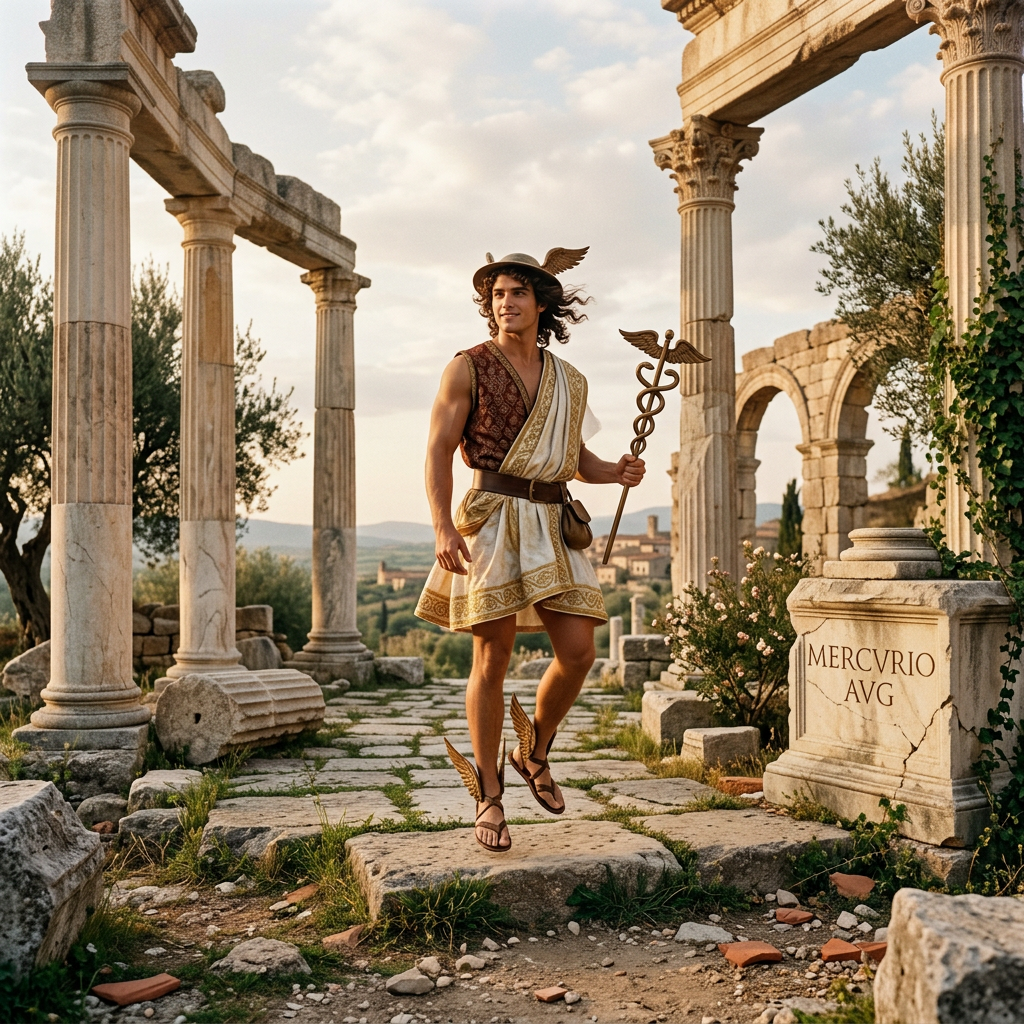
Among the gods of ancient Greek mythology, few are as versatile and fascinating as Hermes. Known primarily as the messenger of the gods, Hermes was far more than a divine messenger. He was the god of travel, trade, communication, merchants, roads, luck, boundaries, and cunning, and he was also closely associated with shepherds and herds.
Fast, intelligent, adaptable, and sometimes mischievous, Hermes occupied a unique position within the Greek pantheon. He could move freely between the worlds of gods, humans, and the dead, making him one of the most versatile figures in Greek mythology.
His distinctive symbols—the winged sandals, the kerykeion or caduceus, and the broad-brimmed traveler’s hat known as the petasos—have made Hermes one of the most recognizable gods of classical antiquity.
But behind the familiar image of the winged messenger lies a much older and more complex deity.
Hermes represents movement itself: the movement of people, information, goods, ideas, and even souls.
Who Was Hermes in Greek Mythology?
Hermes was one of the twelve Olympian gods and the son of Zeus, king of the gods, and Maia, one of the Pleiades.
Unlike many Olympian gods, Hermes had an unusual ability to move between different realms.
He could travel from Mount Olympus to the mortal world and even descend into the Underworld.
This made Hermes an ideal messenger.
But his responsibilities were much broader.
Hermes protected travelers, merchants, shepherds, athletes, and heralds. He was also associated with roads and crossroads, places where people made choices and where different paths came together.
His character was similarly complex.
Hermes could be helpful and generous, but he could also be deceptive and mischievous.
He was clever rather than powerful.
He succeeded through intelligence rather than brute strength.
This made him one of the most human-like gods in Greek mythology.

The Birth of Hermes
One of the most entertaining stories about Hermes appears in the Homeric Hymn to Hermes.
According to the myth, Hermes was born in a cave on Mount Cyllene in Arcadia.
His mother was Maia, who was the daughter of the Titan Atlas.
Even as an infant, Hermes demonstrated extraordinary intelligence.
On the very day of his birth, he escaped from his cradle and went looking for adventure.
He discovered a tortoise and transformed its shell into a musical instrument—the lyre.
But his adventures did not end there.
Hermes then stole cattle belonging to his half-brother Apollo.
He cleverly attempted to hide his tracks by making the cattle walk backward.
The story perfectly captures Hermes’ personality.
He was already a trickster, inventor, thief, and strategist.
When Apollo eventually discovered what had happened, Hermes managed to negotiate his way out of serious trouble.
The two gods eventually became friends, and Hermes gave Apollo the lyre.
In return, Apollo gave Hermes a magical staff and accepted him among the gods.
This story explains an important characteristic of Hermes:
He turns conflict into negotiation.
Hermes and Zeus
As the son of Zeus, Hermes occupied an important position among the Olympian gods.
Zeus frequently relied on Hermes to deliver messages, guide heroes, and carry out difficult assignments.
Hermes was particularly useful because of his speed and ability to move between worlds.
He was not simply a servant.
He was a trusted divine intermediary.
Hermes could communicate with gods and mortals, and he often acted as a negotiator between different parties.
This role made him essential to the functioning of the Olympian order.

Hermes, the Messenger of the Gods
The most famous role of Hermes is as messenger of the gods.
He carried divine messages from Mount Olympus to humans and other gods.
His speed made him uniquely suited to this responsibility.
The image of Hermes wearing winged sandals became one of the defining representations of the god.
In Greek art, however, Hermes was not always shown with literal wings on his feet. Artists often emphasized his role as a traveler through his hat, staff, and youthful appearance.
His messenger role also made Hermes the divine protector of communication.
Words had power in ancient Greek culture.
A message could prevent a war.
A treaty could end a conflict.
A merchant’s agreement could create wealth.
A herald could announce the beginning of a festival or athletic competition.
Hermes therefore represented the systems that allowed people and societies to communicate.
The Symbols of Hermes
Several symbols are strongly associated with Hermes.
The Winged Sandals
Known as the talaria, the winged sandals allowed Hermes to travel with extraordinary speed.
They became the most famous symbol of his mobility.
The Caduceus
Hermes carried a magical staff called the kerykeion.
It was traditionally associated with heralds and diplomacy.
Over time, the symbol became known as the caduceus.
It is important to distinguish the caduceus from the Rod of Asclepius, which is the traditional symbol associated with medicine.
The Petasos
Hermes was often depicted wearing the petasos, a broad-brimmed traveler’s hat.
It reinforced his identity as a traveler and messenger.
The Tortoise
The tortoise is associated with Hermes because of the myth explaining how he created the lyre from a tortoise shell.

Hermes: God of Travel
Travel in the ancient world was difficult and dangerous.
Roads could be rough.
Bandits could attack travelers.
Weather could change suddenly.
People crossing unfamiliar territory needed protection and good fortune.
Hermes became the divine protector of travelers.
Small stone monuments called hermai were placed along roads, boundaries, entrances, and other important locations.
These monuments typically consisted of a pillar topped with the head of Hermes.
They served both religious and practical purposes.
They marked boundaries and crossroads while invoking the protection of the god.
Hermes therefore became closely associated with movement through physical space.
Hermes and Trade
Hermes was also the god of merchants and trade.
This connection naturally developed from his role as a god of movement and communication.
Merchants traveled from city to city.
They negotiated prices.
They transported goods.
They relied on contracts and agreements.
And they needed luck.
Hermes represented all of these aspects of commercial life.
His association with commerce demonstrates how Greek religion connected divine power with everyday economic activity.
The gods were not distant figures who existed only in temples.
They were present in markets, roads, harbors, homes, farms, and workshops.
Hermes was especially suited to this practical world.

Hermes the Trickster
One of the most entertaining aspects of Hermes mythology is his role as a trickster.
Hermes was clever, unpredictable, and capable of deception.
But unlike a purely malicious character, Hermes’ tricks often involved intelligence and creativity.
His theft of Apollo’s cattle is the perfect example.
Hermes does not defeat Apollo through strength.
He outsmarts him.
This makes Hermes similar to other trickster figures found in mythologies around the world.
The trickster challenges established rules.
He finds loopholes.
He changes situations.
He uses intelligence to overcome stronger opponents.
Hermes therefore represents the power of adaptability.
Hermes and Apollo
The relationship between Hermes and Apollo is one of the most interesting stories in Greek mythology.
At first, Hermes steals Apollo’s cattle.
Apollo is furious.
Yet the conflict eventually becomes an exchange.
Hermes gives Apollo the lyre.
Apollo recognizes Hermes’ talent and accepts him.
This story symbolizes the relationship between two very different divine personalities.
Apollo represents order, music, prophecy, healing, and harmony.
Hermes represents movement, improvisation, trade, and cleverness.
Rather than remaining enemies, they become allies.
The myth suggests that intelligence and creativity can transform conflict into cooperation.

Hermes and the Underworld
Hermes had another important responsibility: guiding the souls of the dead.
In this role, he was known as Hermes Psychopompos, meaning Hermes the guide of souls.
He escorted souls toward the Underworld.
This role was particularly significant because Hermes could cross boundaries that other gods could not.
He moved between Olympus, Earth, and the realm of the dead.
This reinforces one of the central characteristics of Hermes:
He was the god of boundaries—and of crossing them.
Hermes in the Odyssey
Hermes appears several times in Homer’s Odyssey.
One important episode involves the enchantress Circe.
When Circe transforms Odysseus’ companions into animals, Hermes appears to help Odysseus.
He gives the hero a magical plant called moly, which protects him from Circe’s magic.
Hermes’ role here is consistent with his character.
He appears when a hero is facing danger and needs intelligence rather than physical strength.
He provides knowledge that allows Odysseus to survive.

Hermes and Perseus
Hermes also assists Perseus in his quest to kill Medusa.
In various traditions, Hermes provides Perseus with important equipment and guidance.
The myth highlights Hermes’ role as a divine helper of heroes.
He does not necessarily fight their battles for them.
Instead, he gives them the tools and information they need.
Again, intelligence becomes more important than brute force.
Hermes and the Trojan War
Hermes also appears in traditions surrounding the Trojan War.
In the Iliad, Hermes assists Priam, the elderly king of Troy, when Priam goes to the Greek camp to retrieve the body of his son Hector.
Hermes protects Priam during the dangerous journey.
This is a powerful example of Hermes as a guide.
The god does not choose sides simply because someone belongs to one faction.
Instead, he helps a vulnerable traveler cross dangerous territory.
His role as protector of travelers and guide between worlds is once again emphasized.

Hermes in Ancient Greek Art
Hermes was a popular subject in ancient Greek art.
He often appears as a youthful, athletic male figure.
Artists commonly depicted him wearing:
- the petasos;
- winged sandals;
- a traveler’s cloak;
- and the herald’s staff.
One of the most famous surviving sculptures associated with Hermes is the Hermes and the Infant Dionysus, traditionally attributed to Praxiteles.
The sculpture presents Hermes holding the infant Dionysus and demonstrates the elegance of Classical Greek sculpture.
Hermes also appears frequently on ancient pottery, reliefs, coins, and sculptures.
His distinctive attributes made him relatively easy for ancient viewers to recognize.
Hermes and the Ancient Greek Olympics
Hermes was also connected with athletics and physical movement.
The ancient Greeks associated athletic competition with strength, speed, and agility.
Hermes’ role as a swift and athletic god made him a natural divine figure for athletes.
His image could therefore appear in contexts associated with athletic competitions and physical excellence.
This reinforces the remarkable diversity of his responsibilities.
Hermes could simultaneously represent the merchant, traveler, athlete, messenger, shepherd, thief, and divine guide.
Hermes and Shepherds
Hermes’ oldest associations may have included shepherding and livestock.
His connection with herds appears strongly in the story of his theft of Apollo’s cattle.
In pastoral societies, protecting animals and guiding them safely was essential.
Hermes could therefore represent the movement and protection of livestock.
This pastoral dimension reminds us that Hermes was not originally simply the sophisticated messenger of Mount Olympus.
His mythology developed from older religious traditions connected to travel, animals, fertility, boundaries, and pastoral life.

Hermes in Roman Mythology
The Roman equivalent of Hermes was Mercury.
Mercury inherited many of Hermes’ characteristics.
He became the Roman god associated with commerce, communication, travelers, and financial success.
The Roman world adopted and transformed many Greek gods, and Hermes/Mercury became an important figure within Roman religion.
The name Mercury eventually became associated with speed, trade, and communication.
The planet Mercury was also named after the Roman god because of its rapid movement across the sky.
Hermes’ Importance in Greek Religion
What makes Hermes so fascinating is that he connected different parts of Greek life.
He connected:
Gods and humans.
Cities and roads.
Merchants and markets.
Travelers and destinations.
The living and the dead.
Conflict and negotiation.
This makes Hermes one of the most conceptually interesting gods in ancient mythology.
He represented transitions.
A boundary is only meaningful because someone can cross it.
A road only matters because someone travels along it.
A message only matters because someone receives it.
Hermes governed these moments of movement and connection.
Why Hermes Still Matters Today
The influence of Hermes continues far beyond ancient Greece.
His image appears in literature, art, philosophy, psychology, popular culture, and modern symbolism.
His name has inspired companies, institutions, scientific terminology, and artistic works.
The concept of the Hermetic tradition is also connected historically to Hermes Trismegistus, a later syncretic figure associated with Greek Hermes and the Egyptian god Thoth.
Although Hermes Trismegistus belongs to a much later religious and philosophical tradition, the connection demonstrates how powerful the image of Hermes became.
He evolved from an ancient Greek god into a symbol of knowledge, communication, mystery, and transformation.

Conclusion: Hermes, the God Who Crossed Every Boundary
Hermes was much more than the messenger of the Greek gods.
He was the god of travel, trade, communication, roads, boundaries, luck, shepherds, athletic movement, and the passage of souls into the Underworld.
His greatest weapon was not a sword.
It was intelligence.
He was fast when speed was necessary, clever when deception was useful, diplomatic when conflict threatened, and adaptable when circumstances changed.
That versatility explains why Hermes remained so important throughout Greek and Roman history.
He belonged everywhere and nowhere.
He stood at crossroads.
He walked between worlds.
He carried messages.
He guided travelers.
He protected merchants.
He helped heroes.
And sometimes, he simply caused trouble.
Perhaps that is the most enduring lesson of Hermes mythology.
The world does not belong only to the strongest.
It also belongs to those who can move, communicate, adapt, negotiate, and think faster than their opponents.
For the ancient Greeks, Hermes embodied all of these qualities.
And that is why, thousands of years later, the image of the young god with winged sandals still feels remarkably modern.
Hermes was the god of movement—and wherever humanity moves, trades, communicates, explores, or crosses a boundary, his ancient spirit remains close behind.
Fortisetliber’s View
Among the gods of ancient Greece, Hermes was different.
He was not simply a god who lived on Mount Olympus and watched over humanity. He was constantly moving—across roads, between cities, from Olympus to Earth, and even into the Underworld.
He carried messages for the gods, protected travelers and merchants, guided souls of the dead, and helped heroes when they needed intelligence rather than strength.
But Hermes was also a trickster.
According to myth, he stole Apollo’s cattle on the very day he was born. Instead of being destroyed by Apollo’s anger, however, Hermes turned the situation into a friendship—and gave Apollo the lyre he had invented.
That story tells us almost everything about Hermes.
He was clever.
He could turn a problem into an opportunity.
He could cross boundaries that others could not.
He could negotiate when others fought.
And he understood that knowledge and speed could sometimes be more powerful than physical strength.
For FortisLiber, Hermes represents the spirit of the traveler—the person who looks beyond the familiar road and asks what lies beyond the horizon.
His winged sandals symbolize speed, but perhaps they represent something deeper: the freedom to move.
Ancient Greeks understood that movement created connections.
Merchants carried goods.
Travelers carried stories.
Messengers carried information.
Explorers carried knowledge.
And Hermes watched over them all.
He was the god standing at the crossroads, where one road becomes two and every journey begins with a choice.
Perhaps that is why Hermes still feels relevant today.
The world may have changed, but people still travel, communicate, trade, negotiate, explore, and search for new paths.
Hermes never stood still—and perhaps his greatest lesson is that neither should we.
The road is always waiting.
Leave a Reply