
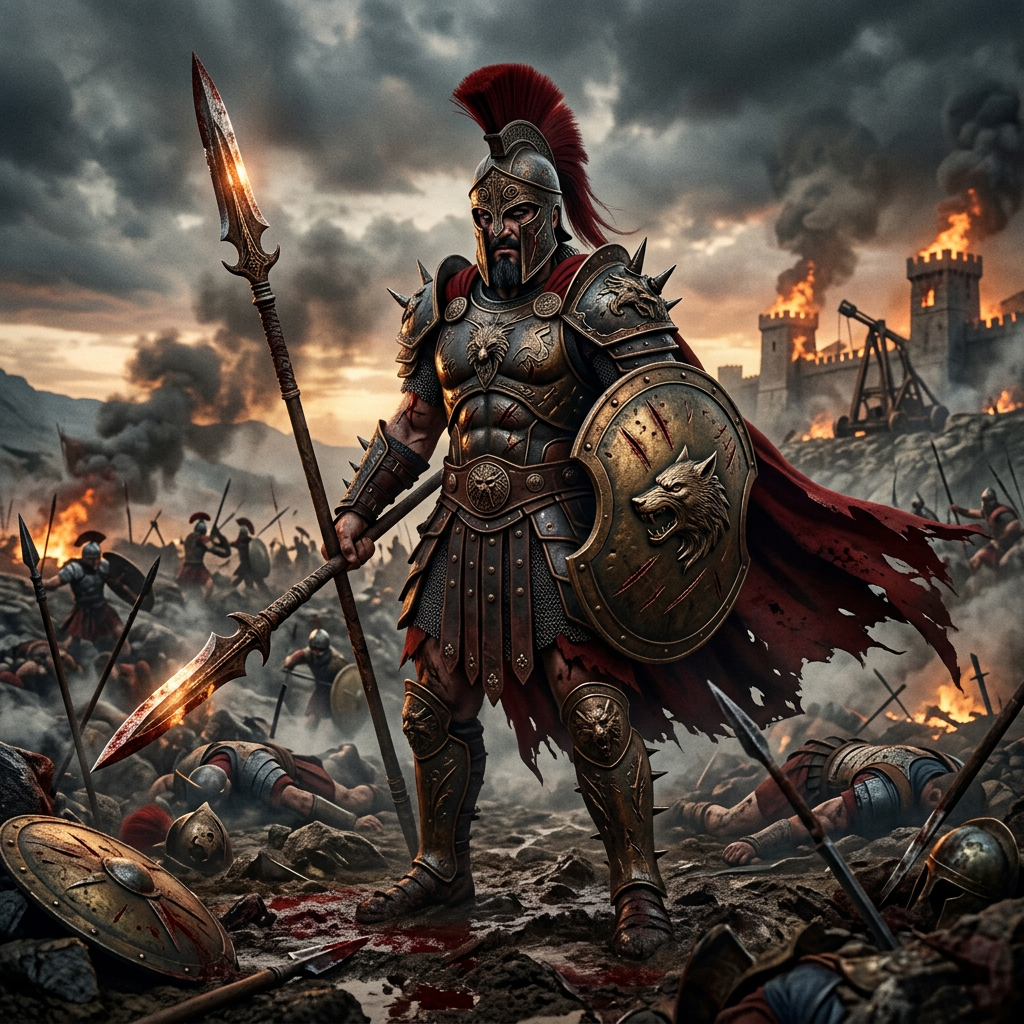
Introduction: The God Who Embodied the Fury of Battle
Among the twelve Olympian gods of ancient Greece, few figures inspired as much fear, fascination, and controversy as Ares, the god of war.
Unlike other deities who represented wisdom, justice, beauty, or civilization, Ares embodied the most violent and uncontrollable aspects of conflict: rage, destruction, bloodshed, and the brutal chaos of the battlefield.
To the ancient Greeks, war was not simply a matter of strategy and victory. It was a powerful force that could bring glory and honor but also suffering and devastation.
Ares represented the darker side of warfare—the uncontrollable passion that drives warriors into battle and the terrifying reality of violence.
Although often portrayed as aggressive and impulsive, Ares was a complex figure within Greek mythology. He was not merely a symbol of destruction but also a representation of courage, strength, and the warrior spirit.
His myths reveal the ancient Greek understanding that war contained both heroic and destructive elements.
Known by the Romans as Mars, Ares became one of the most recognizable gods of the ancient world, leaving a lasting influence on literature, art, warfare, and popular culture.
The Origins of Ares: Son of Zeus and Hera
According to Greek mythology, Ares was the son of Zeus, king of the gods, and Hera, queen of Olympus.
As a member of the Olympian family, Ares belonged to the highest level of divine beings. However, unlike many of his siblings, he was often viewed with suspicion and even dislike by the other gods.
His father Zeus himself expressed little affection for him.
In the Iliad of Homer, Zeus criticizes Ares for his violent nature, describing him as the most hateful of the gods because he represents conflict without restraint.
This relationship reflects an important idea in Greek thought:
War itself was not always condemned, but uncontrolled violence and destruction were viewed as dangerous forces.

The Personality of Ares
Ares was known for several characteristics:
- ⚔️ Courage and physical strength
- 🔥 Aggression and anger
- 🩸 Love of battle and conflict
- 🛡️ Fearlessness in combat
- 🌪️ Impulsiveness
Unlike gods associated with planning and intelligence, Ares was driven by emotion and instinct.
He did not fight because of strategy or political goals.
He fought because he loved the intensity of battle itself.
This made him both admired and feared.
Ancient Greeks understood that a warrior needed courage, but they also recognized that uncontrolled aggression could lead to disaster. Ares represented this dangerous balance.
Ares and the Nature of War
One of the most fascinating aspects of Ares is that he did not represent all forms of warfare.
The Greeks had another major war deity:
Athena, goddess of wisdom, strategy, and defensive warfare.
The contrast between Ares and Athena reveals two different views of battle.
Ares: The Violence of War
Ares represented:
- The battlefield frenzy
- Physical combat
- Bloodshed
- Anger
- The chaos of battle
Athena: The Strategy of War
Athena represented:
- Military intelligence
- Planning
- Discipline
- Tactical victory
- Strategic thinking
In many myths, Athena is respected because she uses wisdom to achieve victory, while Ares is often portrayed as powerful but reckless.
Together, they symbolized the two sides of warfare.

Ares in Greek Mythology
Although Ares was one of the twelve Olympians, he appears less frequently in myths than gods such as Zeus, Athena, Apollo, or Hermes.
This does not mean he was unimportant.
Instead, his presence often appears during moments of conflict, violence, and heroic struggle.
Some of the most famous myths involving Ares include his participation in the Trojan War, his relationship with Aphrodite, and his conflicts with Greek heroes.
Ares and the Trojan War
The Trojan War is one of the greatest stories of Greek mythology, preserved most famously in Homer’s Iliad.
During the conflict between the Greeks and Trojans, Ares supported the Trojans.
He fought alongside them because of his loyalty and his close relationship with Aphrodite, who favored the Trojan side.
Ares entered the battlefield as a terrifying warrior surrounded by destruction.
However, his power was challenged by the Greek hero Diomedes, who, with the assistance of Athena, managed to wound Ares.
This episode is extremely significant.
A mortal hero, guided by wisdom, was able to overcome the god who represented uncontrolled violence.
The story again emphasizes the Greek belief that intelligence and discipline could triumph over raw power.
Ares and Aphrodite: The God of War and the Goddess of Love
One of the most famous relationships in Greek mythology was the passionate romance between Ares and Aphrodite, goddess of love and beauty.
Their relationship represented a powerful symbolic contrast:
- ⚔️ War
- 🌹 Love
Although Aphrodite was married to Hephaestus, the god of craftsmanship and fire, she became Ares’ lover.
Their union produced several children, including:
- Phobos (Fear)
- Deimos (Terror)
- Harmonia (Harmony)
The children of Ares and Aphrodite themselves reflected the complexity of human experience.
From war came fear and terror, but also harmony—the idea that conflict and peace are connected parts of existence.

The Children and Companions of Ares
Ares was often accompanied on the battlefield by his sons Phobos and Deimos.
Their names became powerful symbols:
- Phobos represented fear and panic.
- Deimos represented terror and dread.
Ancient warriors believed that these forces followed armies into battle, affecting the minds and courage of soldiers.
Ares was also associated with:
- Enyo, goddess of war and destruction.
- The Keres, spirits of violent death.
- His warlike followers who represented the horrors of battle.
Ares and Ancient Greek Worship
Although Ares was one of the twelve Olympian gods, his worship was not as widespread as that of Zeus, Athena, Apollo, or Artemis. Many Greek cities respected him as a powerful divine force, but they often viewed him with caution because he represented the destructive nature of war.
The Greeks understood that war was sometimes necessary, especially for defending their homeland, but they also recognized its terrible consequences. Ares was therefore honored not only as a symbol of victory but also as a reminder of the dangers of violence.
Temples dedicated to Ares existed in various regions of Greece, although they were fewer compared with those of other major gods. One important center of his worship was Thrace, a region north of Greece that ancient writers considered closely connected with the warlike nature of Ares.
The Thracians especially respected Ares as a fierce warrior deity, and Greek mythology often described Thrace as his favorite homeland.
Ares and Sparta: The Warrior Ideal
Among the Greek city-states, Sparta was one of the places where the qualities associated with Ares were most admired.
Spartan society was built around military discipline, courage, and preparation for war. Although Sparta did not worship Ares in exactly the same way as other gods, the ideals connected with him reflected many aspects of Spartan culture.
The Spartan warrior valued:
- Courage in battle
- Strength and endurance
- Loyalty to the state
- Acceptance of sacrifice
However, Spartan warriors also understood something that Ares himself often lacked: discipline.
A successful army required more than anger and bravery. It required organization, strategy, and control.
This is why Athena, rather than Ares, often represented the highest form of military success in Greek thought.

The Areopagus: Ares and Ancient Athens
One of the most interesting connections between Ares and Athens is the legendary story of the Areopagus, the ancient hill where Athens’ highest court met.
According to mythology, Ares was accused of killing Halirrhothius, the son of Poseidon, who had attempted to violate Ares’ daughter Alcippe.
Ares was judged by the gods and was acquitted.
The hill where this trial supposedly took place became known as the Areopagus, meaning “Hill of Ares.”
Historically, the Areopagus became one of the most important judicial institutions of ancient Athens, showing how mythology and civic identity were deeply connected in the Greek world.
Ares in the Iliad: The Power and Weakness of War
Homer’s Iliad provides one of the most detailed portrayals of Ares.
In the epic, Ares is shown as a terrifying presence on the battlefield. His arrival brings chaos, fear, and destruction.
However, Homer does not portray him as invincible.
In fact, Ares is defeated and wounded during the Trojan War.
This portrayal reveals an important Greek idea:
Even the power of war itself can be overcome.
Ares may represent physical force, but strength without wisdom is incomplete.
The gods and heroes of Greek mythology often demonstrate that true victory requires more than power alone.
Ares and the Romans: The Transformation into Mars
When the Romans adopted many Greek myths and religious traditions, Ares was transformed into Mars, one of the most important gods of Roman religion.
However, there was a significant difference between the two figures.
Greek Ares was often associated with:
- Violence
- Rage
- Destruction
- The uncontrolled side of battle
Roman Mars became a much more respected figure:
- Protector of Rome
- Father of the Roman people
- Symbol of military honor
- Guardian of agriculture and prosperity
The Romans considered Mars one of their greatest gods.
According to Roman tradition, Mars was the father of Romulus and Remus, the legendary founders of Rome.
This gave Mars a central role in Roman identity.
While Ares represented the frightening nature of war, Mars represented disciplined military power serving the state.

The Symbolism of Ares
Ares remains fascinating because he represents a part of human nature that exists in every civilization.
He symbolizes:
The Warrior Spirit
Ares represents courage, strength, and the willingness to face danger.
The Destructive Side of Conflict
He also reminds humanity that war brings suffering and loss.
The Power of Emotion
Ares shows how anger and passion can create both greatness and destruction.
The Need for Balance
Through his contrast with Athena, Greek mythology teaches that strength must be guided by wisdom.
Ares in Art and Popular Culture
For thousands of years, artists have portrayed Ares as a powerful warrior wearing armor, carrying a spear, and surrounded by symbols of battle.
Ancient Greek sculptures often showed him as a strong and heroic figure, while later artists explored his darker and more violent characteristics.
In modern culture, Ares continues to appear in:
- Films
- Video games
- Novels
- Comic books
- Fantasy literature
His image as the ultimate warrior has made him one of the most recognizable mythological figures worldwide.
The Legacy of Ares
Although ancient Greeks often viewed Ares with mixed feelings, his importance in mythology cannot be denied.
He represents one of humanity’s oldest realities:
The existence of conflict.
Every civilization has experienced war, and every generation has struggled to understand why humans fight.
Ares personifies this eternal question.
Is war only destruction?
Or does it also reveal courage, sacrifice, and the desire to protect what people value?
Greek mythology does not give a simple answer.
Instead, through Ares, it shows both sides of war—the glory and the tragedy.

Conclusion: The Eternal Warrior of Olympus
Ares, the Greek god of war, remains one of the most powerful symbols of ancient mythology.
He was feared by many gods and respected by warriors. He represented the violence of battle, but also the courage required to face danger. Unlike Athena, who embodied strategy and wisdom, Ares represented the raw and emotional force of conflict.
His myths remind us that power without control can become destructive, and courage without wisdom can lead to disaster.
Thousands of years later, Ares continues to stand as a symbol of humanity’s relationship with war—a force capable of creating heroes, but also leaving behind tragedy.
The god of war still speaks to the modern world:
Victory is not only won by strength, but by understanding the true cost of conflict.
Fortisetliber’s View
Among the mighty gods of ancient Greece, few carried a presence as powerful and feared as Ares, the god of war. He was not the god of strategy or diplomacy, but the embodiment of the battlefield itself—the roar of armies, the clash of weapons, and the unstoppable force of human conflict.
Born as the son of Zeus and Hera, Ares stood among the Olympian gods, yet he was often viewed with caution even by his own divine family. He represented the violent side of war: anger, destruction, and the uncontrollable passion that drives warriors into battle.
Unlike Athena, who represented wisdom and military strategy, Ares symbolized the raw power of combat. His strength was unmatched, but Greek mythology often showed that power without discipline could lead to defeat.
In the legendary Trojan War, Ares fought alongside the Trojans, bringing fear and destruction to the battlefield. Yet even the god of war could be wounded, reminding mortals and gods alike that strength alone does not guarantee victory.
His famous relationship with Aphrodite, the goddess of love, revealed another side of his character—the connection between destruction and creation, violence and passion, conflict and harmony.
To the Romans, Ares became Mars, a far more honored figure who represented military strength, protection, and the foundation of Rome itself.
From the battlefields of ancient Greece to modern stories, Ares remains a timeless symbol of war and the warrior spirit. His legend reminds humanity that conflict has two faces: the glory of courage and the tragedy of destruction.
For FortisLiber, Ares is not simply the god of war. He is a reflection of one of the oldest forces in human history—the struggle between power, ambition, and the price of victory.
The battlefield changes. The weapons change. But the questions raised by war remain eternal.
Leave a Reply