
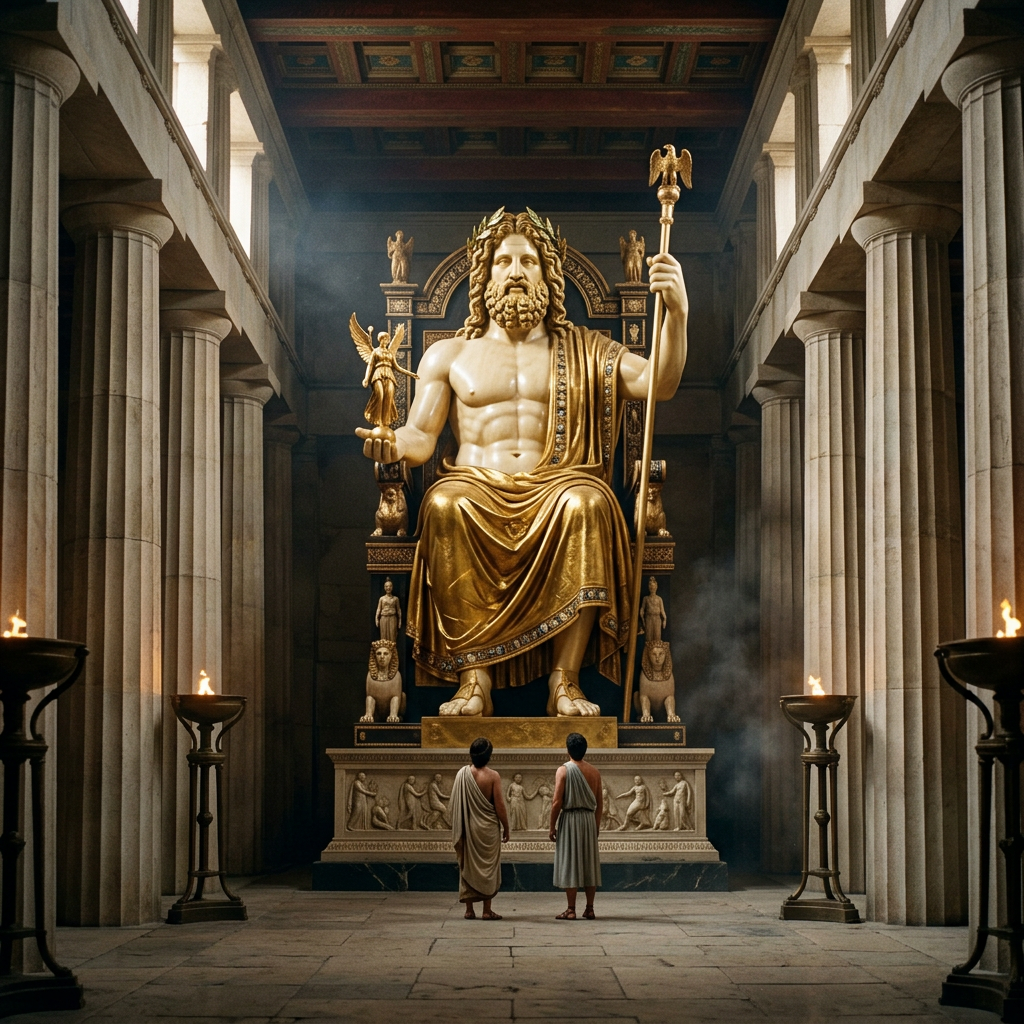
The Statue of Zeus at Olympia was one of the most magnificent creations of the ancient Greek world. Standing inside the Temple of Zeus at Olympia, the enormous seated figure of the king of the gods became one of the Seven Wonders of the Ancient World and represented the extraordinary artistic achievements of Classical Greece.
Created by the famous Greek sculptor Phidias during the 5th century BC, the Statue of Zeus in Olympia was not simply a religious image. It was a masterpiece of sculpture, craftsmanship, architecture, and religious symbolism. Ancient visitors who entered the Temple of Zeus would have encountered a colossal figure of Zeus seated upon an elaborate throne, surrounded by precious materials and intricate decorations.
Although the statue has disappeared, descriptions by ancient writers allow historians and archaeologists to reconstruct something of its appearance and importance. The story of the Statue of Zeus at Olympia is therefore also a story about Greek religion, Classical art, the Olympic Games, and the extraordinary cultural influence of ancient Olympia.
Olympia: The Sacred Home of Zeus
To understand the importance of the Statue of Zeus at Olympia, we first need to understand Olympia itself.
Ancient Olympia was one of the most important religious sanctuaries in Greece. Located in the western Peloponnese, the sanctuary was dedicated primarily to Zeus, the supreme god of the ancient Greek pantheon.
Olympia was also the home of the ancient Olympic Games.
The games were traditionally associated with the 8th century BC, although their origins are surrounded by mythology and ancient traditions. Athletes from different Greek communities gathered at Olympia to compete in events including running, wrestling, boxing, chariot racing, and the pentathlon.
The sanctuary consequently became much more than a religious center.
It was a place where religion, athletic competition, politics, art, and Greek identity came together.
At the heart of the sanctuary stood the Temple of Zeus, one of the greatest temples of Classical Greece.
And inside it stood the statue that would become one of the world’s most famous ancient monuments.
The Temple of Zeus at Olympia
Construction of the great Temple of Zeus at Olympia began in the early 5th century BC, probably around 470 BC, and was completed around 457 BC.
The temple was built in the Doric architectural order, the simplest and most massive of the major Greek architectural styles.
Its monumental proportions reflected the importance of Zeus and the prestige of Olympia.
The temple was decorated with elaborate sculptures, including famous pediments depicting mythological scenes. Its sculptural decoration is considered among the greatest achievements of early Classical Greek art.
But the temple needed something extraordinary at its center.
That extraordinary creation would be the work of Phidias.

Who Created the Statue of Zeus?
The Statue of Zeus at Olympia was created by Phidias, one of the most celebrated sculptors of ancient Greece.
Phidias was active during the 5th century BC and is traditionally associated with some of the most important artistic projects of Classical Athens.
He is also famous for his role in the sculptural decoration of the Parthenon and for creating the monumental Athena Parthenos statue in Athens.
His reputation was extraordinary.
The commission at Olympia therefore went to an artist whose name was already associated with monumental representations of the gods.
According to ancient sources, Phidias created the Zeus statue at Olympia sometime around 430 BC.
The result was radically different from a conventional stone sculpture.
It was enormous.
It was richly decorated.
And it was designed to create an overwhelming religious experience for anyone who entered the temple.
What Did the Statue of Zeus Look Like?
The exact appearance of the Statue of Zeus is uncertain because the original has been lost.
Fortunately, ancient writers provide descriptions.
The statue depicted Zeus seated on an elaborate throne.
The god held a figure of Nike, the goddess of victory, in his right hand. In his left hand, he held a scepter, traditionally described as supporting an eagle.
Zeus wore a decorated robe, while his head was crowned with an olive wreath.
The throne itself was extraordinarily elaborate.
Ancient descriptions mention gold, precious materials, ivory, ebony, and decorative stones.
The statue was created using the chryselephantine technique, in which gold and ivory were applied to a wooden structural framework.
This technique allowed ancient artists to create sculptures with extraordinary visual richness.
The flesh of Zeus was represented using ivory, while gold was used for his clothing and other elements.
The effect must have been spectacular.
Imagine entering a relatively dark ancient temple and suddenly encountering a gigantic golden and ivory representation of the supreme Greek god.
It was not designed merely to be admired.
It was designed to inspire awe.

How Big Was the Statue of Zeus?
One of the most frequently asked questions about the Statue of Zeus at Olympia concerns its height.
Ancient sources give measurements that are difficult to reconcile with modern archaeological evidence.
The statue was approximately 12–13 meters high, although exact figures vary depending on the ancient source and interpretation.
Its enormous size meant that the seated Zeus nearly filled the interior of the temple.
Ancient historian Strabo famously remarked that if Zeus stood up, he would appear to break through the roof of the temple.
Whether this was intended literally or as a dramatic description, the statement conveys the enormous scale of the sculpture.
The proportions were deliberately impressive.
Zeus was not represented as an ordinary human being.
He was the ruler of the gods.
The size of the statue reinforced that divine status.
Gold, Ivory, and Precious Materials
The Statue of Zeus at Olympia was remarkable not only because of its size but because of the materials used in its construction.
Gold and ivory were among the most prestigious materials available to ancient craftsmen.
The visible skin of Zeus was represented with ivory, while his clothing and other elements incorporated gold.
The throne was decorated with additional precious materials and imagery.
This was a form of ancient luxury art.
The sculpture communicated wealth through material as well as artistic skill.
But there was also a religious meaning.
Gold was associated with divine magnificence, while ivory provided a luminous representation of the human body.
Together, these materials transformed Zeus into a supernatural presence.

The Throne of Zeus
The throne was almost a separate masterpiece.
Ancient descriptions attribute elaborate decorations to the throne, including mythological figures and scenes.
Sphinxes, winged figures, gods, heroes, and mythical creatures were reportedly incorporated into the composition.
The throne therefore became a visual representation of the Greek mythological universe.
Zeus sat at its center.
Everything surrounding him reinforced his position as ruler of the gods.
This was one of the key characteristics of Classical Greek religious art.
Artists did not simply represent gods as portraits.
They created entire visual systems through which divine power, mythology, morality, and cosmic order could be communicated.
The Statue and Ancient Greek Religion
The Statue of Zeus at Olympia had a fundamentally religious purpose.
Ancient Greeks did not think about statues of gods in exactly the same way modern museum visitors think about sculptures.
A cult statue could be an important focus of religious activity.
The image provided a physical representation of the deity within the sacred space.
At Olympia, Zeus was not merely a mythological character.
He was the central divine figure of the sanctuary.
The statue therefore became the focal point of religious experience.
Visitors came to Olympia for the games, religious festivals, political meetings, and personal reasons.
For many of them, seeing the monumental Zeus must have been one of the defining experiences of their journey.
Why Was the Statue One of the Seven Wonders?
The Seven Wonders of the Ancient World were a collection of monuments celebrated by ancient Greek and later writers.
The list included the Great Pyramid of Giza, the Hanging Gardens of Babylon, the Temple of Artemis at Ephesus, the Mausoleum at Halicarnassus, the Colossus of Rhodes, the Lighthouse of Alexandria, and the Statue of Zeus at Olympia.
The Zeus statue earned its place because it represented the highest achievements of Classical Greek sculpture.
It combined enormous scale, precious materials, sophisticated craftsmanship, religious symbolism, and artistic realism.
But there was another reason.
Phidias was considered a master.
The statue represented the ability of Greek artists to transform religious ideas into monumental physical forms.
The Statue of Zeus was therefore both a religious object and an artistic statement.

The Statue of Zeus and the Olympic Games
The connection between the statue and the ancient Olympic Games is particularly important.
Olympia was internationally significant because athletes and representatives from different Greek communities gathered there.
The sanctuary became a meeting point for the Greek world.
The statue of Zeus stood above this entire cultural environment.
The Olympic Games were conducted in honor of Zeus, meaning that the athletic competitions, religious rituals, and monumental temple were closely connected.
Victory at Olympia brought enormous prestige.
Athletes competed for honor rather than modern concepts of professional sports.
The presence of the great Zeus statue reinforced the sacred character of the festival.
What Happened to the Statue?
One of the great mysteries of ancient history is the final fate of the Statue of Zeus at Olympia.
The statue survived for many centuries.
After Greece became part of the Roman world, Olympia continued to exist as an important religious site for a considerable period.
Roman emperors and wealthy individuals visited or supported Greek sanctuaries.
However, the religious landscape of the Mediterranean eventually changed.
Christianity became dominant within the Roman Empire, and traditional pagan sanctuaries gradually lost their importance.
The Olympic Games were eventually discontinued in late antiquity.
The Temple of Zeus fell into decline.
The statue itself was reportedly moved to Constantinople, although the precise historical details remain debated.
Some ancient and later sources state that it was transferred to the palace of a wealthy aristocrat in Constantinople.
A devastating fire in the 5th century AD is often associated with the statue’s final destruction.
Other theories have suggested that the statue may have remained at Olympia until earthquakes and the abandonment of the sanctuary destroyed it.
The exact sequence remains uncertain.
This uncertainty is one reason why the lost Statue of Zeus at Olympia continues to fascinate historians.
The Archaeological Search for Zeus
Archaeologists have excavated Olympia extensively.
The remains of the Temple of Zeus are among the most impressive ruins of the sanctuary.
Fragments of the temple’s architectural decoration have survived, allowing researchers to understand the scale and artistic quality of the building.
Perhaps the most intriguing discovery connected with Phidias is the Workshop of Phidias.
Archaeologists discovered a large structure at Olympia that was traditionally identified as the workshop where Phidias created the famous Zeus statue.
Artifacts found at the site include tools, fragments, molds, and materials associated with the production of monumental sculpture.
The workshop provides extraordinary insight into the technology behind ancient Greek art.
It demonstrates that enormous sculptures were not magically created inside temples.
They were carefully designed, constructed, assembled, decorated, and transported using sophisticated techniques.

The Legacy of Phidias
Even though the original Zeus statue disappeared, Phidias’ influence survived.
His approach to representing divine figures became one of the defining achievements of Classical Greek sculpture.
The surviving archaeological evidence from Olympia and Athens allows historians to understand something of the artistic environment in which he worked.
Roman copies and later representations of Zeus also preserve aspects of the ancient visual tradition.
But none can completely replace the original.
The Statue of Zeus at Olympia was an experience created for a particular place.
Its scale depended on the Temple of Zeus.
Its meaning depended on Olympia.
Its materials depended on the resources of the ancient Mediterranean.
And its religious power depended on the beliefs of the people who came to see it.
Why the Statue of Zeus Still Matters
More than two thousand years later, the Statue of Zeus at Olympia remains one of the most famous sculptures in history.
Its importance goes beyond Greek mythology.
It tells us about ancient engineering, artistic technology, religion, politics, craftsmanship, and cultural identity.
It also demonstrates how ancient civilizations used monumental art to communicate ideas about power.
The Greeks did not possess modern technology, yet they created works on a scale that continues to astonish modern observers.
The Zeus statue was constructed from materials that were difficult to work with and expensive to acquire.
Its enormous size required careful engineering.
Its decorations required highly skilled craftsmen.
And its final appearance had to communicate the majesty of the most powerful god in the Greek pantheon.
Conclusion: The God Who Disappeared
The Statue of Zeus at Olympia has been gone for more than a millennium.
No complete fragment survives.
No photograph exists.
No modern visitor can stand inside the Temple of Zeus and look up at the golden and ivory figure of the god.
Yet the monument remains alive through history.
Ancient writers described its magnificence.
Archaeologists uncovered the sanctuary where it once stood.
The workshop associated with Phidias reveals the extraordinary technical skill behind its creation.
And the surviving ruins of Olympia allow us to imagine the setting in which one of antiquity’s greatest artistic masterpieces once dominated the sacred landscape.
Perhaps the greatest mystery is not how such a statue disappeared.
It is how strongly its memory survived.
The Statue of Zeus at Olympia was created to represent an immortal god.
The statue itself was mortal.
It burned, collapsed, or disappeared into the turbulent history of late antiquity.
But the image of Zeus created by Phidias became immortal in another way.
It survived in the imagination of generations.
The statue is gone. The temple is in ruins. But the wonder of Zeus at Olympia still stands in the pages of history.
Fortisetliber’s View
There are monuments that survive through stone.
And there are monuments that survive through memory.
The Statue of Zeus at Olympia belongs to the second kind.
More than two thousand years ago, inside the magnificent Temple of Zeus at Olympia, stood one of the greatest artistic achievements of the ancient Greek world. Created by Phidias, the celebrated sculptor of Classical Greece, the enormous figure represented Zeus seated upon an elaborate throne, surrounded by gold, ivory, and scenes from Greek mythology.
For the people who entered the temple, this was not simply a sculpture.
It was an encounter with a god.
The Statue of Zeus at Olympia was created around the 5th century BC, at a time when Greek art was reaching extraordinary levels of sophistication. The statue was enormous—roughly 12 meters high—and depicted the ruler of the gods seated in divine majesty.
Gold represented his magnificent clothing and ornaments.
Ivory represented his flesh.
The throne itself was covered with elaborate mythological imagery.
Everything about the statue was designed to communicate one message:
Zeus was the ruler of the divine world.
Yet the setting was equally important.
Olympia was not an ordinary city. It was one of the most sacred places in ancient Greece and the home of the ancient Olympic Games, where athletes from across the Greek world gathered in honor of Zeus.
Imagine arriving at Olympia after traveling for days or weeks.
You enter the sanctuary.
You see the temples.
You hear the crowds.
You see athletes preparing for competition.
And then you enter the Temple of Zeus.
Before you stands a gigantic golden and ivory god.
For an ancient Greek visitor, the experience must have been overwhelming.
That is perhaps why the statue became one of the Seven Wonders of the Ancient World.
But the greatest irony of the story is that the statue itself did not survive.
The religious world that created it eventually disappeared. The Olympic Games were abandoned, the sanctuary declined, and the magnificent statue was ultimately lost.
Today, almost nothing remains of the actual sculpture.
Yet the place where it once stood can still be visited.
The ruins of Olympia remain beneath the Greek sky, surrounded by the landscape that once witnessed religious festivals, athletic contests, political gatherings, and countless personal journeys.
Nearby, the archaeological evidence associated with the Workshop of Phidias gives us a glimpse into the extraordinary craftsmanship behind the masterpiece.
The god is gone.
The gold is gone.
The ivory is gone.
But the idea remains.
For FortisLiber, that is what makes the story of Zeus at Olympia so powerful.
Civilizations often believe that their greatest monuments will last forever.
They rarely do.
Buildings collapse.
Statues burn.
Empires disappear.
Even the greatest works of human hands eventually become archaeological fragments.
But sometimes something more important survives.
The memory of what humanity was capable of creating.
Phidias’ Zeus has been gone for centuries, yet historians still search for clues about his appearance. Artists continue to reconstruct him. Archaeologists continue to study the sanctuary. And travelers still walk through Olympia wondering what it must have been like to stand before the greatest statue of the ancient Greek world.
Perhaps that is the true immortality of the Statue of Zeus at Olympia.
The statue disappeared.
The wonder did not.
Leave a Reply