
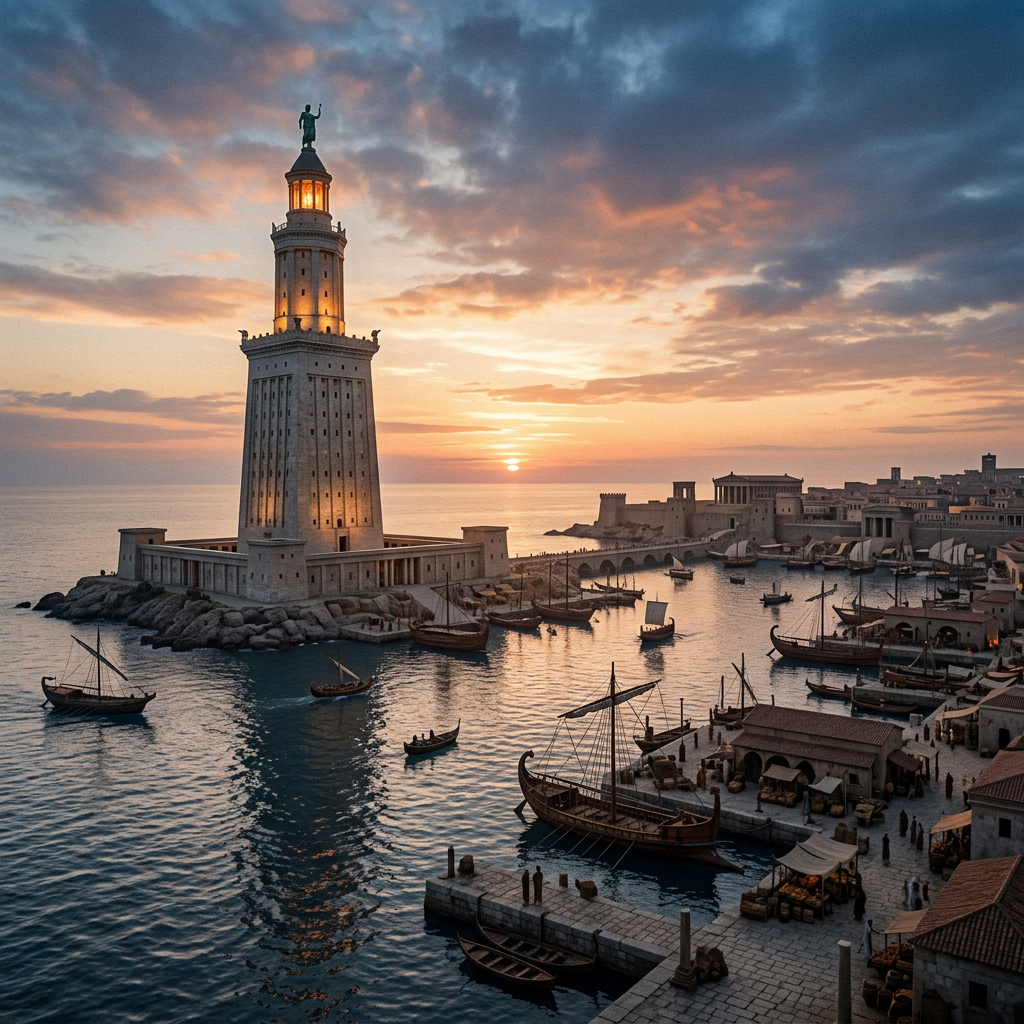
Few monuments in ancient history have captured the imagination quite like the Lighthouse of Alexandria in Egypt. Known in antiquity as the Pharos of Alexandria, this extraordinary structure stood on the island of Pharos beside one of the most important harbors of the Hellenistic Mediterranean. For centuries, it guided sailors toward Alexandria while simultaneously proclaiming the wealth, technological ambition, and political power of the Ptolemaic Kingdom.
The Lighthouse of Alexandria was also one of the Seven Wonders of the Ancient World. Although the monument has disappeared, its influence has survived for more than two millennia. The Greek word pharos, associated with the famous Alexandria lighthouse, eventually became a term used for lighthouses in several languages.
Today, archaeologists are combining ancient texts, underwater discoveries, architectural fragments, coins, and digital technology to reconstruct this lost masterpiece. The result is giving us an increasingly detailed picture of one of antiquity’s greatest engineering achievements.
SEO Keywords: Lighthouse of Alexandria, Pharos of Alexandria, Lighthouse of Alexandria Egypt, ancient lighthouse, Seven Wonders of the Ancient World, Alexandria Egypt history, Ptolemy II, Pharos lighthouse, ancient Greek architecture, Hellenistic architecture, Sostratus of Cnidus, ancient Alexandria, lost wonders of the ancient world.
The Origins of the Lighthouse of Alexandria
The story of the Lighthouse of Alexandria Egypt begins in the early Hellenistic period.
Alexandria itself was founded by Alexander the Great in 331 BC and rapidly became one of the most important cities in the Mediterranean. After Alexander’s death, Egypt came under the control of his general Ptolemy, who established the Ptolemaic dynasty.
The new rulers understood the strategic importance of Alexandria.
The city possessed an enormous natural and artificial harbor system, but navigation into the harbor was not always easy. Low-lying coastal areas, reefs, shoals, and changing maritime conditions created dangers for approaching ships.
The solution was an enormous tower on the island of Pharos.
According to the Centre d’Études Alexandrines, construction of the lighthouse began around 297 BC, probably under Ptolemy I Soter, although he died before the project was completed. The monument was finished under his son, Ptolemy II Philadelphus, probably between 283 and 281 BC according to the chronology of Eusebius.
The building therefore belonged to the early generations of Ptolemaic Alexandria.
It was both a practical maritime structure and a monumental statement of royal power.

Where Was the Pharos of Alexandria Located?
The lighthouse stood on the eastern extremity of the island of Pharos, immediately offshore from Alexandria.
The island was connected to the mainland by the Heptastadion, a long causeway that helped create the city’s two principal harbor areas. The position of the lighthouse was therefore exceptionally advantageous.
From its elevated position, the tower could serve as a prominent landmark for ships approaching Alexandria.
Ancient sources indicate that the Pharos helped sailors identify the coastline and navigate around dangerous waters. Strabo, who visited Egypt in the first century BC, described the tower as dominating Alexandria’s great harbor and emphasized its impressive construction in white stone.
The location was not chosen simply because the tower needed to be tall.
It was part of a larger maritime system.
Alexandria was one of the major ports of the ancient Mediterranean, connecting Egypt with Greece, the Aegean, the Levant, North Africa, and the wider Mediterranean world. A highly visible landmark at the entrance to this commercial center had enormous practical value.
Who Built the Lighthouse of Alexandria?
The architect traditionally associated with the Pharos Lighthouse was Sostratus of Cnidus, although the precise details of his role remain debated.
Ancient tradition associates Sostratus with the monument, and an inscription connected with him famously described the project as being dedicated for the safety of sailors.
The Centre d’Études Alexandrines notes the famous dedication associated with Sostratus: essentially, the monument was erected for the salvation of those who sailed.
This is significant because it captures the dual character of the lighthouse.
It was not simply a royal monument.
It had a practical purpose: protecting sailors and directing maritime traffic toward Alexandria.
The combination of monumental architecture and practical engineering was one of the defining characteristics of Hellenistic civilization.
How Tall Was the Lighthouse of Alexandria?
One of the most fascinating questions surrounding the Lighthouse of Alexandria height is its exact size.
Ancient and later sources provide varying figures, while archaeological evidence is incomplete.
Modern estimates generally place the structure at more than 100 meters tall, with some reconstructions suggesting approximately 100–130 meters.
Whatever its exact height, the lighthouse was enormous by ancient standards.
For centuries, it was among the tallest human-made structures in the world.
Its height served an obvious purpose.
The higher the light and observation point, the farther it could potentially be seen from ships at sea.
The monument was therefore an early example of architecture designed around visibility.
Its enormous scale also transformed it into a symbol.
A sailor approaching Alexandria would not simply encounter a city.
He would encounter the towering monument announcing that he had reached one of the world’s great urban centers.

The Architecture of the Pharos Lighthouse
The traditional reconstruction of the Pharos of Alexandria architecture divides the monument into three principal sections.
The lower portion was approximately square.
Above it stood an octagonal section.
The uppermost part was cylindrical or circular.
This three-part design created a structure that became narrower as it rose.
The Centre d’Études Alexandrines emphasizes that ancient evidence describes the lighthouse as a multi-storied tower constructed from white stone.
The design was not only aesthetically impressive.
It also had structural advantages.
A massive lower section provided stability, while the narrower upper levels reduced the weight and wind forces acting on the highest parts of the building.
The result was a monumental tower that combined geometric simplicity with sophisticated engineering.
Inside, ramps and passages allowed people and materials to move through the building.
The exact internal arrangement remains uncertain because no complete ancient architectural plan has survived.
This is one of the reasons modern reconstruction remains such a fascinating archaeological challenge.
How Did the Lighthouse Work?
The most famous feature of the ancient Lighthouse of Alexandria was its beacon.
At night, a fire was maintained at the top of the structure to provide a visible signal to ships.
During daylight hours, the elevated structure itself served as a landmark.
Ancient descriptions and later traditions have also associated the Pharos with a reflective device or mirror capable of amplifying the visibility of the fire or reflecting sunlight.
The precise technology of this system remains uncertain.
It is important not to automatically accept every later story about the lighthouse. Medieval writers sometimes attributed extraordinary optical powers to the Pharos, but the Centre d’Études Alexandrines stresses the importance of distinguishing reliable ancient evidence from later legendary material.
Nevertheless, the basic concept was revolutionary.
The lighthouse combined:
- height
- fire
- visibility
- maritime navigation
- architectural engineering
into one enormous structure.

The Lighthouse and the Port of Alexandria
The importance of the Lighthouse of Alexandria cannot be separated from the importance of Alexandria’s harbor.
The city became one of the greatest commercial centers of the ancient Mediterranean.
Ships transported grain, wine, olive oil, papyrus, luxury goods, metals, textiles, and countless other products through the port.
Egyptian grain was particularly important to the ancient Mediterranean economy.
The lighthouse therefore protected access to a harbor that was central to the wealth and political power of the Ptolemaic kingdom.
Its significance increased further under Roman rule after Egypt became a Roman province in 30 BC.
The Pharos continued to serve as a maritime landmark for centuries.
The Lighthouse Becomes One of the Seven Wonders
The Seven Wonders of the Ancient World were not simply a modern tourist list.
They represented monuments that ancient travelers and writers considered exceptionally impressive.
The Lighthouse of Alexandria earned its place because it combined extraordinary height, engineering sophistication, beauty, and practical usefulness.
Unlike many monumental structures, the Pharos was not primarily a tomb or temple.
It was infrastructure transformed into monumental architecture.
That distinction makes it particularly remarkable.
The lighthouse showed that engineering itself could become a wonder.
Its reputation spread throughout the ancient Mediterranean, and other lighthouse builders used it as an architectural model.
The Centre d’Études Alexandrines notes that the Pharos influenced later ancient lighthouses, including monumental towers at Ostia and Ravenna, while ancient writers also compared other maritime towers with the Alexandrian monument.

The Roman and Byzantine Lighthouse
The Pharos survived the transition from the Ptolemaic Kingdom to Roman Egypt.
When Augustus incorporated Egypt into the Roman Empire, Alexandria remained a major Mediterranean city.
The lighthouse continued to serve its maritime purpose.
Its reputation also continued to grow.
Roman writers admired the monument, and its design became a reference point for other maritime towers.
For many centuries, the Pharos remained one of the defining landmarks of Alexandria.
Its longevity is remarkable.
The monument survived not only political transformations but also centuries of changing religious, cultural, and economic conditions.
Eventually, however, nature proved more powerful than human engineering.

The Earthquakes That Destroyed the Lighthouse
The destruction of the Lighthouse of Alexandria was not caused by a single event.
A series of powerful earthquakes damaged Alexandria over several centuries.
The monument was progressively weakened, and by the medieval period it had become a ruin.
Earthquakes in 956, 1303, and 1323 AD are commonly associated with the major stages of the lighthouse’s destruction, although the chronology and exact effects of individual seismic events remain subjects of scholarly investigation.
By the fourteenth century, the Pharos had largely collapsed.
The great tower that had dominated Alexandria’s harbor for more than a millennium was disappearing.
But its story was not over.
The Citadel of Qaitbay and the Remains of the Pharos
One of the most fascinating connections between ancient and medieval Alexandria can be seen at the site of the lighthouse today.
The Citadel of Qaitbay, constructed in the fifteenth century, occupies the general area of the ancient Pharos.
Traditionally, stones from the ruined lighthouse were reused in the construction of the fortress.
This means that the physical remains of the ancient wonder did not simply vanish.
They became part of another monumental structure.
In a sense, the history of the site continued through the stones themselves.
The medieval fortress replaced the ancient lighthouse as the guardian of Alexandria’s harbor.
Underwater Archaeology and the Lost Lighthouse
For centuries, scholars had to reconstruct the Pharos primarily from ancient texts, medieval descriptions, coins, and artistic representations.
Then underwater archaeology transformed the investigation.
Large architectural fragments were discovered beneath the waters around Alexandria.
Massive blocks, columns, architectural elements, and other remains have been documented in the submerged harbor.
Recent archaeological work has recovered and studied enormous stone blocks believed to belong to the lighthouse complex. A major research initiative is using 3D scanning and digital reconstruction to investigate the monument’s architecture.
The ongoing PHAROS project is particularly significant because it aims to combine archaeological evidence with historical sources and digital modeling.
The Centre d’Études Alexandrines describes the project as an effort to reconstruct the lighthouse based on archaeological data, ancient sources, iconography, and later evidence.
Modern technology is therefore allowing researchers to approach an ancient monument that disappeared centuries ago.

What Did the Lighthouse Really Look Like?
Despite the wealth of evidence, we should be cautious about claiming that we know exactly what the Pharos looked like.
Ancient descriptions are limited.
Later artistic representations sometimes contain imaginative details.
Archaeological remains are incomplete.
And the monument changed over its long history.
The Centre d’Études Alexandrines emphasizes that no precise complete description from antiquity has survived. Strabo provides one of the most important early accounts, describing the Pharos as a remarkable multi-storied tower of white stone.
Consequently, modern reconstructions should be viewed as informed hypotheses rather than perfect photographs of the past.
This uncertainty actually makes the monument more fascinating.
Every archaeological discovery has the potential to change our understanding of the ancient lighthouse.
Why the Lighthouse of Alexandria Still Matters
The significance of the Lighthouse of Alexandria extends far beyond its physical remains.
It represents the meeting of science, architecture, commerce, politics, and maritime technology.
The Ptolemaic rulers understood that Alexandria’s power depended partly on its connection to the sea.
The lighthouse made that connection visible.
It guided ships.
It protected sailors.
It advertised the wealth of the city.
And it demonstrated the technological capabilities of the Hellenistic world.
Few monuments combined these functions so successfully.
The Pharos also left a linguistic legacy. The word pharos became associated with the concept of a lighthouse, demonstrating how the monument influenced not only architecture but also the vocabulary of maritime civilization.
The Legacy of the Pharos of Alexandria
The Pharos of Alexandria disappeared physically, but its influence survived.
Ancient architects copied its concept.
Roman authors celebrated it.
Medieval travelers continued to describe it.
Modern archaeologists search for its remains.
And digital technology is now attempting to reconstruct it.
The monument’s story is therefore not simply about a building that was destroyed.
It is about an idea that survived.
The idea was simple but powerful: a city could place a light above the sea and turn architecture into a guide for travelers.
For ancient Alexandria, that light symbolized safety.
For the Ptolemies, it symbolized power.
For later civilizations, it became a model.
And for modern historians, it remains one of the most extraordinary archaeological mysteries of the ancient Mediterranean.

Conclusion: The Light That Outlived the Lighthouse
The Lighthouse of Alexandria once stood above the harbor of one of antiquity’s greatest cities.
Built during the early Ptolemaic period, it became one of the Seven Wonders of the Ancient World, guided sailors toward Alexandria, inspired later lighthouse architecture, and survived for centuries before earthquakes reduced it to ruins.
Today, the tower itself is gone.
But the story remains.
Fragments of its architecture rest beneath the Mediterranean.
Ancient writers preserve memories of its extraordinary appearance.
The medieval Citadel of Qaitbay occupies its historic location.
And archaeologists continue to reconstruct its lost form through underwater discoveries and digital technology.
Perhaps this is the greatest achievement of the Pharos.
The lighthouse was built to remain visible across the sea.
More than two thousand years later, although the tower has disappeared, its memory is still visible across the landscape of history.
The Lighthouse of Alexandria is no longer standing—but its light has never truly gone out.
Fortisetliber’s View
There are monuments that dominate history because of their size. Others become immortal because of the stories surrounding them.
The Lighthouse of Alexandria, the legendary Pharos of Alexandria, was both.
Rising above the harbor of ancient Alexandria in Ptolemaic Egypt, the lighthouse was more than an extraordinary tower. It was a statement of ambition. Built during the early Hellenistic period, probably under Ptolemy I Soter and completed during the reign of Ptolemy II Philadelphus, the monument stood at the entrance to one of the Mediterranean’s greatest ports.
Its purpose was practical: to help guide sailors safely toward Alexandria.
But the Ptolemies understood something that great civilizations have always understood.
Useful things can also become symbols of power.
The Pharos transformed a navigational aid into one of the Seven Wonders of the Ancient World. Its enormous height made it visible from far across the sea, while its beacon represented safety for merchants and sailors approaching Egypt.
For FortisLiber, this is what makes the Lighthouse of Alexandria so fascinating.
It stood at the meeting point between land and sea, between engineering and imagination, between commerce and civilization.
Alexandria itself was a city built around connections. Ships arrived from Greece, Asia Minor, the Levant, North Africa, and beyond. Goods, languages, religions, scientific ideas, and people moved through its harbor.
And above all of this stood the Pharos.
A tower of stone.
A fire in the darkness.
A message to every sailor approaching the Egyptian coast:
Alexandria is here.
The lighthouse survived for centuries, witnessing the transformation of Egypt from a Ptolemaic kingdom into a Roman province and later into a Byzantine world. Yet eventually earthquakes weakened and destroyed the great monument.
The tower disappeared.
Its stones became scattered among the ruins of Alexandria, while the sea swallowed enormous architectural fragments. Centuries later, the Citadel of Qaitbay was built near the traditional site of the ancient lighthouse, creating a remarkable connection between medieval and ancient Alexandria.
Today, underwater archaeologists continue to discover massive blocks and architectural remains associated with the ancient harbor. Modern technology is even allowing researchers to create digital reconstructions of what the lost Pharos may have looked like.
And perhaps that is the greatest irony.
The lighthouse was built to guide people through darkness.
Although the tower itself vanished centuries ago, its memory continues to guide us toward the world of ancient Alexandria.
The Pharos no longer shines over the Mediterranean.
But its story still does.
The lighthouse is gone. The light remains.
Leave a Reply