
Introduction
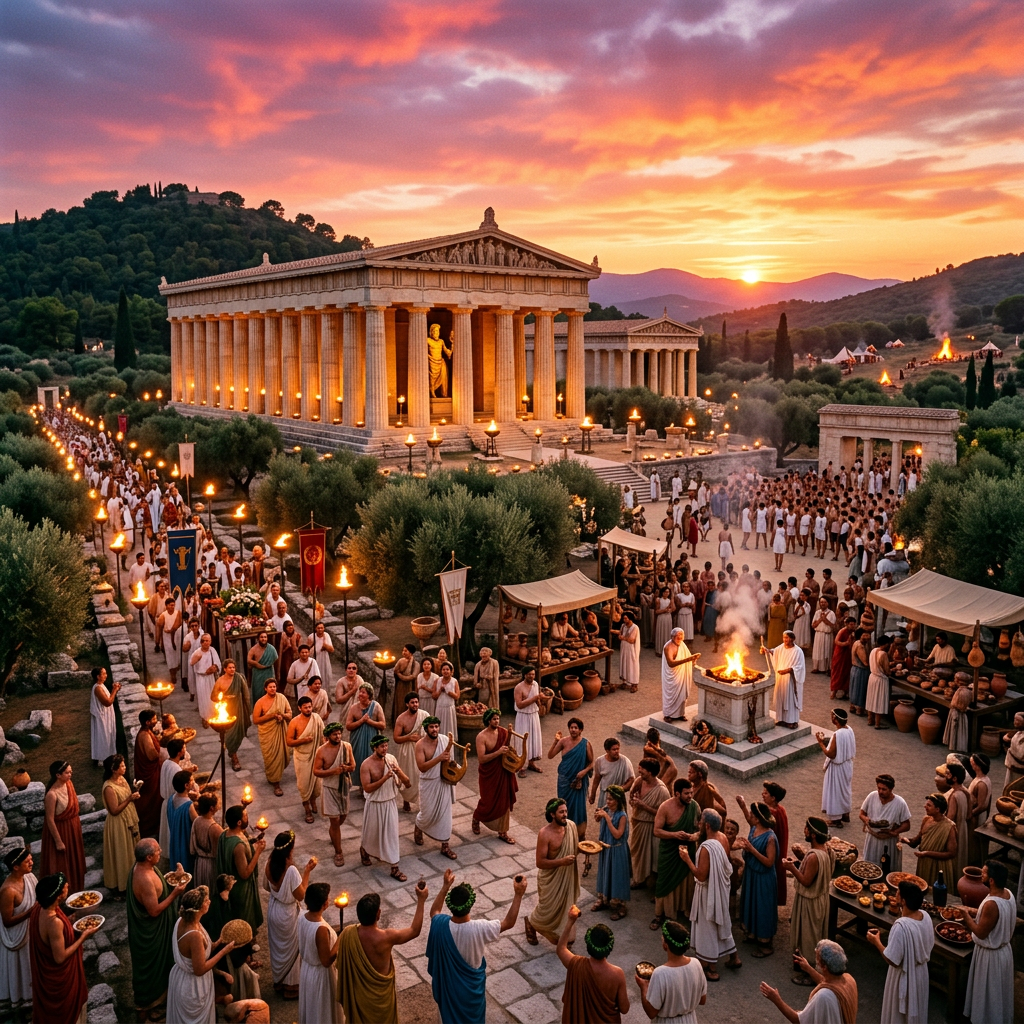
The ceremonies of ancient Greece were far more than religious observances—they were the foundation of civic life, political identity, and cultural expression. Every stage of life, from birth to death, and every season of the year was marked by rituals that honored the gods, celebrated communal values, and reinforced social order.
Religion in ancient Greece was deeply integrated into everyday existence. Unlike modern distinctions between sacred and secular life, the Greeks viewed divine worship as an essential component of governance, warfare, athletics, agriculture, and family traditions. Public ceremonies brought entire city-states together, while private rituals connected households with ancestral customs and protective deities.
From the magnificent Olympic festivals dedicated to Zeus to the secretive Eleusinian Mysteries honoring Demeter and Persephone, ancient Greek ceremonies reflected a civilization that sought harmony between humanity, nature, and the divine. These rituals influenced philosophy, art, literature, and politics, leaving a legacy that continues to shape Western culture today.
This guide explores the most important ceremonies of ancient Greece, their religious significance, and the lasting impact they have had on world civilization.
Religion and Ceremony in Ancient Greece
Ancient Greek religion was polytheistic, meaning the Greeks worshipped numerous gods and goddesses, each responsible for different aspects of life and nature.
The principal Olympian gods included:
Every city had its own patron deity, and ceremonies were designed to gain divine favor, express gratitude, or seek protection during times of crisis.
Public Religious Festivals
Large public festivals formed the heart of Greek religious life. These celebrations combined worship, athletic competitions, music, drama, sacrifices, and communal feasting.
The Olympic Games
Perhaps the most famous religious ceremony in ancient Greece was the Olympic Games, held every four years at Olympia in honor of Zeus.
Although remembered today as a sporting event, the Olympics began as a sacred festival.
The ceremonies included:
- Animal sacrifices to Zeus
- Processions through the sanctuary
- Religious oaths by athletes
- Victory crowns made from olive branches
- Public feasts and celebrations
During the festival, a sacred truce known as the Ekecheiria suspended warfare, allowing athletes and pilgrims to travel safely across Greece.

The Panathenaea
The Panathenaic Festival honored Athena, the patron goddess of Athens.
Held annually, with a grand celebration every four years, it featured:
- Magnificent processions
- Musical contests
- Poetry competitions
- Athletic games
- Horse races
- Sacrificial offerings
One of the festival’s most symbolic acts was presenting Athena with a newly woven sacred robe (peplos), carried in procession to the Parthenon.
The Dionysia
Dedicated to Dionysus, the Dionysia became one of Greece’s greatest cultural celebrations.
Its ceremonies included:
- Dramatic performances
- Choral singing
- Religious processions
- Wine offerings
- Public sacrifices
Many masterpieces by Sophocles, Euripides, and Aeschylus premiered during these festivals.
The Eleusinian Mysteries
Among the most sacred ceremonies of ancient Greece were the Eleusinian Mysteries, held at Eleusis.
These secret religious rites honored Demeter and Persephone and focused on themes of:
- Death
- Rebirth
- Agricultural fertility
- Hope for life after death
Unlike public festivals, participants swore never to reveal the ceremonies’ inner rituals.
Initiates believed participation offered spiritual purification and blessings in the afterlife.
Sacrificial Rituals
Animal sacrifice formed one of the central elements of Greek religious practice.
Common sacrificial animals included:
- Bulls
- Sheep
- Goats
- Pigs
The ritual generally followed a specific sequence:
- Purification with water
- Prayer to the deity
- Decoration of the animal
- Sacrifice
- Burning portions for the gods
- Communal feast
Rather than being viewed as cruel, sacrifices symbolized reciprocal relationships between humans and the gods.

Household Ceremonies
Not every ceremony occurred in temples.
Greek families maintained domestic shrines dedicated to:
- Hestia (hearth)
- Zeus Ktesios (household prosperity)
- Ancestors
Daily rituals often included:
- Lighting sacred fires
- Pouring libations
- Offering bread or wine
- Family prayers
These simple ceremonies strengthened family identity and reinforced religious devotion.
Marriage Ceremonies
Marriage was both a social and religious institution.
The ceremony typically lasted several days.
Before the Wedding
- Sacred bathing
- Offerings to Artemis
- Preparation of gifts
Wedding Day
- Religious sacrifices
- Formal procession
- Torch-lit journey to the groom’s house
- Hymns celebrating the union
Marriage represented not only a partnership but also the continuation of the family line under divine protection.
Funeral Ceremonies
Proper burial held enormous importance in Greek belief.
The dead were honored through three principal stages:
Prothesis
The deceased was washed, dressed, and displayed for mourning.
Ekphora
Family members carried the body in procession to the burial site.
Burial or Cremation
Offerings included:
- Coins for the ferryman
- Food
- Oil
- Personal belongings
The Greeks believed proper funeral rites helped ensure peaceful passage into the afterlife.
Military and Civic Ceremonies
Before battles, Greek armies sought divine favor through:
- Animal sacrifices
- Oracles
- Sacred omens
- Public prayers
Victorious armies dedicated captured weapons and armor to the gods, particularly at sanctuaries such as Delphi.
Political ceremonies also accompanied:
- Election of magistrates
- Foundation of colonies
- Peace treaties
- Public assemblies
Religion and government remained closely intertwined.

Oracles and Divine Consultation
Greeks frequently consulted oracles before making important decisions.
The most famous sanctuary was Delphi.
Here, the priestess known as the Pythia interpreted the will of Apollo.
People sought guidance on:
- Warfare
- Colonization
- Marriage
- Politics
- Disease
Oracle consultations were ceremonial events involving purification, offerings, and formal questions.
Music, Dance, and Processions
Ceremonies rarely occurred in silence.
Music included:
- Lyres
- Flutes
- Drums
- Choral singing
Sacred dances often accompanied religious festivals.
Large processions united citizens in displays of civic pride and devotion.
These spectacles reinforced social unity while honoring the gods.
Seasonal Agricultural Ceremonies
Agriculture depended heavily upon divine favor.
Important agricultural ceremonies honored:
- Demeter
- Persephone
- Dionysus
Farmers prayed for:
- Rain
- Fertile fields
- Healthy livestock
- Successful harvests
Many festivals coincided with sowing and harvesting seasons.
Women and Religious Ceremonies
Women played central roles in many Greek ceremonies.
Certain festivals, such as the Thesmophoria, were celebrated exclusively by women.
These ceremonies honored Demeter and emphasized:
- Fertility
- Marriage
- Family prosperity
Priestesses also served in many important temples, demonstrating women’s religious influence despite political limitations.
The Legacy of Ancient Greek Ceremonies
The ceremonies of ancient Greece profoundly influenced later civilizations.
Their legacy survives in:
- The modern Olympic Games
- Democratic civic celebrations
- Western theater
- Religious architecture
- Public festivals
- Ritual symbolism
Many customs surrounding weddings, funerals, athletic competitions, and public commemorations trace elements of their traditions back to ancient Greece.
Visiting Ancient Greek Ceremonial Sites Today
Travelers can still explore many locations where these ceremonies once took place:
- Acropolis of Athens
- Olympia
- Delphi
- Eleusis
- Temple of Apollo at Delphi
These remarkable archaeological sites continue to reveal the ceremonial heart of one of history’s greatest civilizations.

Frequently Asked Questions (FAQ)
What were the main ceremonies of ancient Greece?
The most important ceremonies included the Olympic Games, Panathenaea, Dionysia, Eleusinian Mysteries, religious sacrifices, weddings, funerals, and seasonal agricultural festivals.
Why were ceremonies important in ancient Greece?
They honored the gods, strengthened civic identity, reinforced social cohesion, and marked major life events while connecting communities through shared traditions.
What were the Eleusinian Mysteries?
They were secret initiation rites dedicated to Demeter and Persephone that promised spiritual renewal and hope for a blessed afterlife.
Did ancient Greek ceremonies include sacrifices?
Yes. Animal sacrifices, libations, prayers, and communal feasts were central elements of many public and private religious ceremonies.
Can these ceremonial sites still be visited?
Yes. Many of the principal sanctuaries—including Olympia, Delphi, Eleusis, and the Acropolis of Athens—are open to visitors and remain among Greece’s most significant archaeological destinations.
Conclusion
The ceremonies of ancient Greece formed the spiritual and cultural framework of one of history’s most influential civilizations. They united city-states, celebrated the changing seasons, honored the gods, and marked life’s most significant moments with rituals that blended faith, community, and tradition.
From the grandeur of the Olympic Games and the Panathenaic procession to the profound symbolism of the Eleusinian Mysteries, these ceremonies reflected a worldview in which the divine and the human were inseparable. Their influence continues to resonate through modern sports, theater, civic celebrations, and cultural traditions, reminding us that ritual has long been a powerful force in shaping societies.
For historians, travelers, and lovers of classical culture, the ceremonies of ancient Greece offer more than a glimpse into the past—they provide enduring insight into the beliefs, values, and aspirations of a civilization whose legacy still shapes the modern world.
Fortisetliber’s View
From a FortisLiber perspective, the ceremonies of ancient Greece were not merely acts of worship—they were the mechanisms through which society remembered who it was. Every procession, sacrifice, festival, and rite served as a bridge between the individual, the community, and the divine, reinforcing a shared identity that endured across generations.
Unlike many modern societies, where religion and civic life are often viewed as separate spheres, the ancient Greeks saw no such division. Public festivals honored the gods while strengthening political unity, athletic competitions celebrated both physical excellence and religious devotion, and theatrical performances explored moral questions under the patronage of the divine. Ceremony was the thread that wove together every aspect of public life.
The great festivals at Olympia, Delphi, and Eleusis reveal a civilization that understood ritual as more than tradition—it was a language of continuity. Each generation repeated the ceremonies not simply to preserve the past but to reaffirm the values that defined the polis: respect for the gods, civic responsibility, excellence, and collective memory.
From this viewpoint, ancient Greek ceremonies also demonstrate the remarkable power of symbolic action. A procession through the streets, a libation poured upon an altar, or an athlete crowned with an olive wreath carried meanings far beyond the moment itself. They transformed ordinary acts into expressions of cultural identity and connected citizens with myths that explained their place in the world.
In the FortisLiber view, the enduring legacy of these ceremonies lies not only in their religious significance but in their ability to unite communities around shared ideals. They remind us that civilizations are sustained not only by monuments and laws, but also by the rituals that give meaning to collective life.
Leave a Reply