
Introduction
History often celebrates kings who expanded their kingdoms through conquest or secured their legacy through wise leadership. Greek mythology, however, remembers Pentheus, the legendary King of Thebes, for a very different reason.
His reign became synonymous with one of the most profound tragedies of the ancient world—a fatal confrontation with Dionysus, the Olympian god of wine, ecstasy, theatre, and divine liberation.
Immortalized in Euripides’ The Bacchae, Pentheus embodies the dangers of pride, rigid authority, and the refusal to recognize forces beyond human control. His story is not merely the tale of a king who opposed a new religious cult; it is a timeless exploration of the conflict between reason and instinct, order and chaos, mortal power and divine will.
For more than two thousand years, philosophers, historians, playwrights, and psychologists have revisited the myth of Pentheus as one of the greatest cautionary tales ever created.
Today, the legend of Pentheus continues to fascinate readers because it speaks to universal themes that remain relevant in every age: leadership, belief, identity, fear of change, and the consequences of arrogance. Understanding his story also provides valuable insight into the religious traditions, political structure, and cultural values of ancient Greece.
The Royal House of Cadmus
Before Pentheus became King of Thebes, the city itself had already become one of the most celebrated places in Greek mythology.
According to tradition, Thebes was founded by Cadmus, the legendary Phoenician prince who journeyed across the Mediterranean in search of his sister Europa. Following the guidance of the Oracle of Delphi, Cadmus established the city that would become one of ancient Greece’s greatest political and cultural centers.
The House of Cadmus was marked by extraordinary achievements but also by repeated misfortune. Generation after generation experienced tragedy, betrayal, divine punishment, and internal conflict, creating what later writers described as the curse of the Cadmean dynasty.
Pentheus inherited not only a powerful kingdom but also a family legacy shaped by destiny and divine intervention.
Pentheus’ Family and Lineage
Pentheus was the son of Echion, one of the legendary Spartoi—the warriors who sprang from the dragon’s teeth sown by Cadmus—and Agave, one of Cadmus’ daughters.
This lineage made Pentheus the grandson of Cadmus and a direct descendant of Thebes’ royal founders.
Ironically, Agave was also the aunt of Dionysus through her sister Semele, establishing a close family connection between the king and the god he refused to acknowledge.
This blood relationship transforms the myth into something even more tragic. The conflict was not simply between a ruler and a deity, but between members of the same divine family line.

The Birth of Dionysus
To understand Pentheus, one must first understand Dionysus.
According to Greek mythology, Zeus fell in love with the mortal princess Semele. Jealous of the relationship, Hera deceived Semele into asking Zeus to reveal himself in his true divine form. Bound by an oath, Zeus complied, and the overwhelming power of his lightning destroyed Semele.
Before she perished, Zeus rescued the unborn child and sewed him into his own thigh until the time of his birth.
Thus, Dionysus became known as the twice-born god, a unique status among the Olympians that emphasized his connection to death, rebirth, transformation, and renewal.
After traveling through distant lands and spreading his worship, Dionysus eventually returned to Thebes—the city of his mother—to claim recognition as a god.
It was there that Pentheus stood in his way.
The Arrival of Dionysus in Thebes
After years of traveling through Asia and the Greek world, Dionysus finally returned to Thebes, the birthplace of his mortal mother Semele.
His purpose was not only to introduce his worship but also to prove that he truly belonged among the gods.
However, the women of Thebes, including Pentheus’ own mother Agave and his aunts Ino and Autonoe, refused to accept the divine nature of Dionysus.
They questioned the story of Semele and believed that she had falsely claimed to have been loved by Zeus.
Dionysus responded by causing the women of Thebes to enter a state of divine madness and join his followers, the Maenads.
Leaving the city, they abandoned their homes and went to the mountains to celebrate the ecstatic rituals of the god.
This was the beginning of the conflict between Dionysus and Pentheus.

Pentheus Rejects the God
As king of Thebes, Pentheus viewed the new religious movement as a threat to social order.
To him, the followers of Dionysus were not worshippers participating in a sacred tradition—they were people abandoning their responsibilities, breaking laws, and causing disorder.
Pentheus represented a world based on:
- Political authority
- Discipline
- Military strength
- Rational control
Dionysus represented:
- Emotion
- Nature
- Spiritual transformation
- The mysterious forces beyond human understanding
The conflict between them was therefore much deeper than a simple disagreement over religion.
It was a clash between two different visions of human existence.
The First Encounter Between Pentheus and Dionysus
One of the most fascinating aspects of the myth is that Dionysus appears before Pentheus not as a powerful god surrounded by divine glory, but as a calm and mysterious stranger.
Pentheus orders his guards to capture him, unaware that he is imprisoning a deity.
According to Euripides’ The Bacchae, Dionysus remains peaceful and confident.
He does not fight back because he knows that Pentheus’ own arrogance will lead to his destruction.
The king questions the stranger, demanding to know who he is and why he spreads this strange worship.
Dionysus answers with wisdom and patience, but Pentheus refuses to listen.
His greatest mistake is not simply denying a god—it is believing that his own understanding is greater than divine truth.

The Destruction of Pentheus’ Palace
After Pentheus imprisons Dionysus, the god reveals his power.
The palace of Thebes is shaken.
The walls tremble.
The earth moves.
The prison doors open.
Yet Pentheus still refuses to recognize what is happening.
Instead of accepting that he faces a supernatural force, he becomes even more determined to destroy Dionysus’ followers.
This moment reveals the central tragedy of Pentheus:
The evidence is before him, but his pride prevents him from seeing the truth.
The Temptation of Pentheus
Perhaps the most psychologically fascinating part of the story occurs when Dionysus changes his strategy.
Instead of openly defeating Pentheus, the god decides to manipulate him.
Dionysus knows that the king secretly desires to see the mysterious rituals of the Maenads. Although Pentheus condemns their behavior publicly, his curiosity grows stronger.
The god encourages this hidden desire.
Slowly, Pentheus moves from being the hunter to becoming the one who is controlled.
Dionysus convinces him to disguise himself as a woman so he can secretly observe the Bacchic ceremonies.
This is one of the greatest ironies of the myth.
The man who wanted to suppress the worship of Dionysus becomes part of the very world he rejected.
Pentheus Goes to Mount Cithaeron
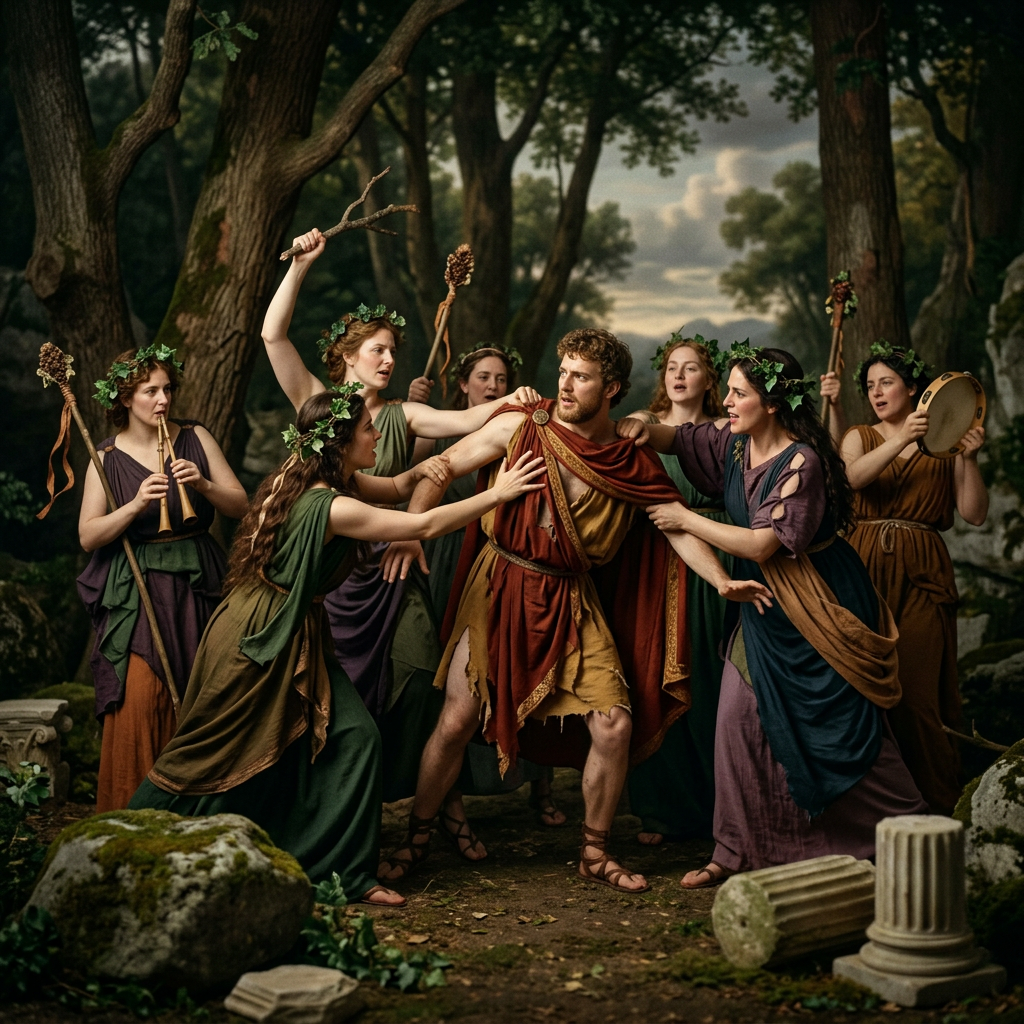
Disguised in women’s clothing, Pentheus follows Dionysus toward Mount Cithaeron, where the Maenads are celebrating their rituals.
However, his plan fails.
The followers of Dionysus discover him.
In their state of divine madness, they mistake him for a wild animal.
Leading the group is his own mother, Agave.
The tragedy reaches its horrifying conclusion.
The Death of Pentheus
Driven by Dionysian madness, Agave and the Maenads attack Pentheus.
His own mother becomes the instrument of his destruction.
According to the myth, Agave tears Pentheus apart with her bare hands, believing that she has killed a mountain lion.
Only after returning to Thebes does she slowly realize the terrible truth.
The object she carries is not the head of a beast.
It is the head of her own son.
The recognition of her deed brings overwhelming grief and horror.
The punishment is complete—not only has Pentheus died, but his family has been destroyed by the very forces he attempted to deny.

The Meaning of the Myth of Pentheus
The story of Pentheus is one of the richest myths in Greek tradition because it allows many interpretations.
The Danger of Hubris
Like many tragic heroes of Greek mythology, Pentheus suffers from hubris, excessive pride and confidence.
He believes human authority can overcome divine power.
His downfall demonstrates the Greek belief that mortals must understand their limits.
Order Versus Chaos
Pentheus represents civilization and order.
Dionysus represents the wild and uncontrollable aspects of existence.
The myth suggests that neither side can simply eliminate the other.
Human beings require both reason and emotion, structure and freedom.
The Fear of the Unknown
Pentheus is also a symbol of resistance to change.
He fears a new religious movement because he does not understand it.
Instead of seeking knowledge, he chooses destruction.
His inability to accept what he cannot control becomes the cause of his downfall.
Pentheus in Euripides’ The Bacchae
The tragedy The Bacchae, written by Euripides in the 5th century BC, remains one of the greatest works of ancient Greek drama.
Unlike many tragedies where humans suffer because of unavoidable fate, Pentheus’ downfall is connected to his own choices.
Euripides presents a complex character:
- Pentheus is arrogant, but also understandable.
- Dionysus is divine, but also frightening.
- The conflict has no simple heroes or villains.
This complexity is one reason why The Bacchae continues to be performed around the world today.
The Legacy of Pentheus
More than two thousand years after his mythical death, Pentheus remains an important figure in literature, theatre, psychology, and cultural studies.
His story continues to inspire discussions about:
- Leadership and authority
- Religious tolerance
- Human psychology
- The balance between civilization and instinct
- The consequences of refusing change
Pentheus is not remembered because he was a great king.
He is remembered because his tragedy reveals something universal about humanity.

Conclusion
The legend of Pentheus, King of Thebes, is one of the most powerful stories preserved from ancient Greek mythology. His confrontation with Dionysus represents the eternal struggle between human certainty and forces beyond human control.
A king with authority, intelligence, and power was ultimately defeated not by an army, but by his own inability to recognize what stood before him.
Through the pages of Euripides’ The Bacchae, Pentheus continues to remind every generation of a timeless lesson:
Power without wisdom can become destruction, and those who refuse to understand the world around them may eventually become victims of their own pride.
Fortisetliber’s View
In the legendary city of Thebes, one of the most tragic stories of Greek mythology unfolded. It was the story of Pentheus, the young king who dared to challenge one of the most powerful gods of ancient Greece: Dionysus, the god of wine, ecstasy, and transformation.
Pentheus was a descendant of the great House of Cadmus, a royal family surrounded by glory, but also by tragedy. When Dionysus returned to Thebes to claim his place among the gods, Pentheus refused to accept him. Seeing the new religion as a threat to order and authority, the king attempted to suppress the worship of Dionysus and his followers, the Maenads.
But Pentheus made a fatal mistake.
He believed that human power could defeat divine will.
Instead of understanding the mysterious force represented by Dionysus, he chose resistance and arrogance. The god, rather than destroying him immediately, led Pentheus into a trap by awakening his hidden curiosity. Disguised as a woman, the king entered the mountains to spy on the sacred rituals of Dionysus’ followers.
There, his destiny was sealed.
In a tragic moment of madness, Pentheus was discovered by the Maenads, led by his own mother Agave, who unknowingly became the instrument of his destruction.
The story of Pentheus, immortalized in Euripides’ masterpiece The Bacchae, is more than an ancient myth. It is a timeless lesson about pride, power, and the dangers of refusing to accept forces greater than ourselves.
From the perspective of FortisLiber, Pentheus represents one of the most fascinating figures of Greek mythology—not because he conquered kingdoms, but because his tragedy reveals the eternal struggle between human ambition and the mysteries of the divine world.
Thousands of years later, the fall of the King of Thebes continues to remind us of one powerful truth:
Those who believe they cannot be defeated often discover that their greatest enemy is their own pride.
Leave a Reply