
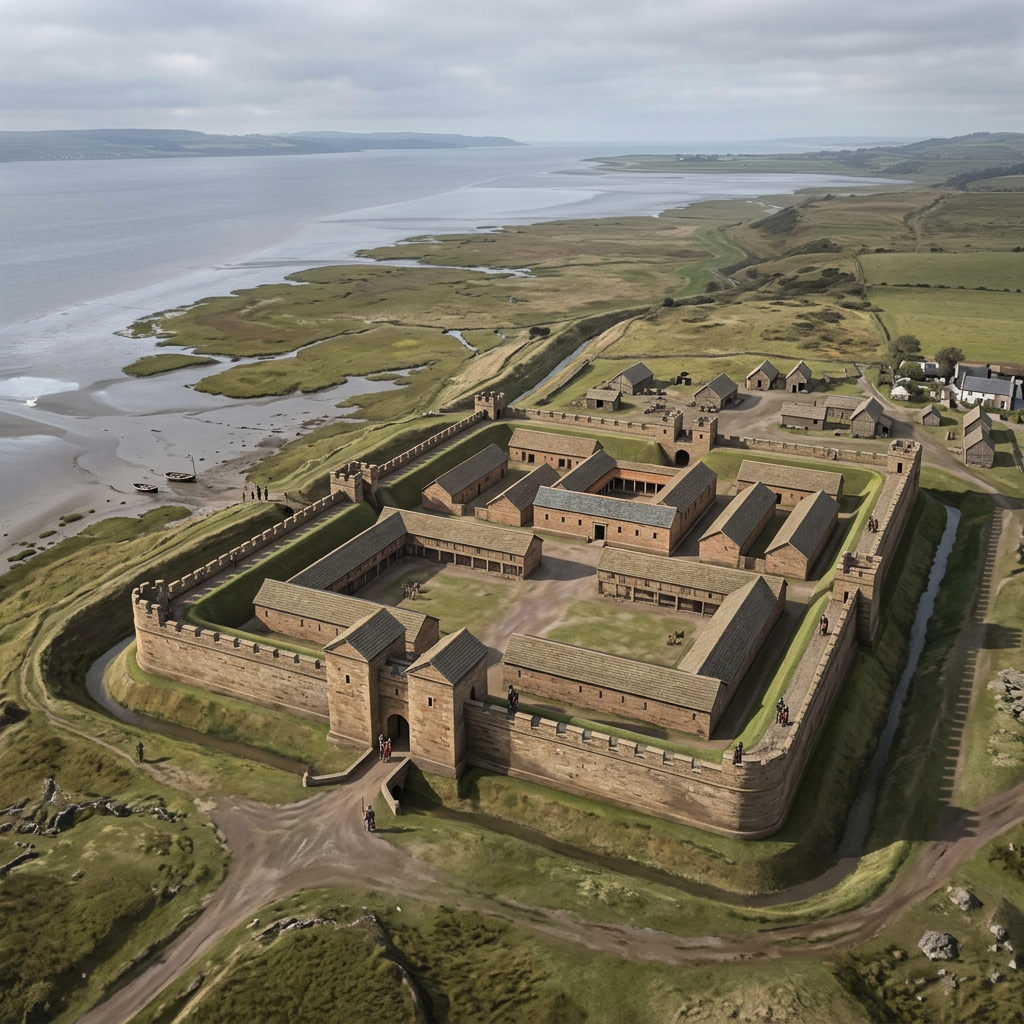
The ancient Roman fort of Aballava was one of the many military installations that formed the defensive network of Hadrian’s Wall, Britain’s most famous Roman frontier. Located on the windswept Solway Plain in present-day Cumbria, England, Aballava played a vital role in protecting the western end of the Wall from incursions by northern tribes while safeguarding the coastal route that connected frontier garrisons.
Although overshadowed by larger forts such as Vindolanda and Housesteads, Aballava offers valuable insights into Rome’s frontier strategy, military organization, and daily life on the empire’s northernmost border. Archaeological discoveries reveal a fort that remained occupied for centuries, adapting to changing military and political circumstances until the end of Roman rule in Britain.
What Was Aballava?
Aballava was a Roman auxiliary fort situated near the western terminus of Hadrian’s Wall. It was strategically positioned to oversee the low-lying coastal approaches between the Irish Sea and the Wall itself, preventing hostile groups from bypassing the frontier.
The fort was part of the Cumbrian Coastal Defences, a chain of milefortlets and watchtowers extending south from Hadrian’s Wall along the Solway coast. Together, these fortifications created a continuous defensive system that protected one of the most vulnerable sectors of Roman Britain.
The name Aballava appears in the Notitia Dignitatum, a late Roman administrative document listing military units across the Empire. While the exact meaning of the name remains uncertain, many scholars believe it derives from a Brittonic word possibly referring to “apple trees” or an orchard, though this interpretation remains debated.
Where Was Aballava Located?
Aballava stood near the modern village of Burgh by Sands in Cumbria, approximately 11 kilometers (7 miles) west of Carlisle.
Its location was carefully chosen. Unlike the dramatic cliffs found farther east along Hadrian’s Wall, the western frontier consisted of open marshland and flat coastal terrain. These landscapes made movement easier for potential raiders, requiring additional military protection.
From Aballava, Roman soldiers could monitor coastal traffic, patrol nearby roads, and communicate with neighboring forts through an established network of signal stations.
The Construction of Aballava
The fort was probably constructed around AD 122–125, shortly after Emperor Hadrian ordered the construction of Hadrian’s Wall during his visit to Britain.
Like many frontier forts, Aballava was initially built using timber and earth before later being rebuilt in stone as Rome strengthened its northern defenses.
The fort covered approximately three acres (1.2 hectares), a typical size for an auxiliary fort designed to house a cohort of several hundred soldiers.
Its layout reflected standard Roman military planning, including:
- Defensive walls
- Surrounding ditches
- Four main gates
- Headquarters building (principia)
- Commander’s residence (praetorium)
- Barracks
- Granaries
- Workshops
Outside the walls grew a civilian settlement, or vicus, where traders, craftsmen, soldiers’ families, and local Britons lived and worked.

The Soldiers of Aballava
Unlike the famous Roman legions, Aballava was garrisoned primarily by auxiliary troops recruited from across the Empire.
Epigraphic evidence indicates that one of the principal units stationed there was the Second Cohort of Nervians, an auxiliary infantry regiment originally recruited from the Nervii, a Belgic people from present-day Belgium.
Later inscriptions suggest that other auxiliary units also occupied the fort during different periods, reflecting Rome’s practice of rotating troops along the frontier.
These soldiers came from diverse cultural backgrounds but shared Roman military discipline, training, and equipment.
Daily Life at Aballava
Life on Rome’s northern frontier was demanding but highly organized.
Soldiers stationed at Aballava balanced military duties with numerous practical responsibilities, including:
- Guarding the frontier
- Patrolling nearby roads
- Maintaining Hadrian’s Wall
- Repairing buildings
- Training
- Escorting officials
- Supervising trade
When not on duty, soldiers socialized in bathhouses, visited local taverns, participated in religious ceremonies, and traded with civilians living in the surrounding settlement.
Excavations have uncovered pottery, coins, tools, jewelry, and everyday household objects that provide a glimpse into frontier life nearly two thousand years ago.
Aballava and Hadrian’s Wall
Aballava formed an integral part of the wider defensive system created by Hadrian.
Rather than serving as an impenetrable barrier, Hadrian’s Wall functioned as a sophisticated border-control network.
Its purposes included:
- Monitoring movement
- Collecting customs duties
- Controlling trade
- Deterring raids
- Demonstrating Roman authority
The western sector required additional attention because tidal flats and coastal routes offered opportunities to bypass the Wall itself.
Aballava helped close this potential gap.
Archaeological Discoveries
Although much of the original fort lies beneath later development, archaeological investigations have revealed important features.
Among the discoveries are:
- Stone foundations
- Defensive ditches
- Roman roads
- Inscriptions
- Altars dedicated to Roman gods
- Military equipment
- Pottery
- Coins spanning several centuries
These finds indicate continuous occupation throughout much of the Roman period.
The discovery of inscribed stones has also helped historians identify the military units stationed there.

Religion on the Frontier
Religion played a central role in military life.
Soldiers stationed at Aballava worshipped the traditional Roman gods, including Jupiter, Mars, and Minerva, while also honoring local Celtic deities.
Altars dedicated by officers and ordinary soldiers demonstrate the remarkable religious diversity that characterized the Roman army.
Many auxiliary troops continued to venerate the gods of their homelands alongside Roman state religion, creating a unique blend of cultural traditions.
Aballava During the Late Roman Empire
As the Roman Empire entered the fourth century AD, Britain’s frontier defenses evolved.
The Notitia Dignitatum, compiled around AD 400, still lists Aballava as an active military post under the command of the Duke of the Britains (Dux Britanniarum).
This suggests that the fort remained operational until the final decades of Roman administration.
Following the withdrawal of Roman authority in the early fifth century, military occupation gradually ended, and the fort slowly fell into ruin.
Its stones were later reused in local buildings, a common fate for abandoned Roman sites.
Why Aballava Matters
Although smaller than some frontier forts, Aballava illustrates several important aspects of Roman frontier policy.
It demonstrates:
- The strategic sophistication of Hadrian’s Wall
- Rome’s ability to integrate soldiers from across Europe
- The importance of logistics and communication
- The interaction between military communities and local populations
- The long-term adaptability of Roman frontier defenses
Its continued occupation into the late Roman period also highlights the enduring importance of Britain’s northern frontier.
Visiting Aballava Today
Today, little of the original fort remains visible above ground, as much of the site lies beneath the village of Burgh by Sands.
Nevertheless, the surrounding landscape still conveys the strategic importance of its location.
Visitors exploring Hadrian’s Wall can appreciate how Aballava formed part of a much larger defensive network stretching nearly 117 kilometers (73 miles) across northern England.
Nearby museums, including Tullie House Museum in Carlisle, preserve artifacts recovered from the western frontier and provide valuable context for understanding the site’s history.

Frequently Asked Questions
Where was Aballava located?
Aballava was located at modern Burgh by Sands in Cumbria, England, near the western end of Hadrian’s Wall.
What was Aballava?
It was a Roman auxiliary fort built during the reign of Emperor Hadrian to defend Britain’s northern frontier.
Which soldiers were stationed at Aballava?
The fort was primarily occupied by auxiliary units, including the Second Cohort of Nervians.
Was Aballava part of Hadrian’s Wall?
Yes. It was one of the forts supporting Hadrian’s Wall and the associated coastal defense system.
Can Aballava still be visited?
Although little survives above ground, the site can be visited as part of the wider Hadrian’s Wall landscape, with nearby museums displaying artifacts from the fort.
Conclusion
Aballava may not possess the fame of Vindolanda or Housesteads, but its historical significance is undeniable.
Positioned at one of the most strategically important sectors of Hadrian’s Wall, it helped secure Rome’s northern frontier for nearly three centuries.
Its garrison, drawn from distant provinces, its bustling civilian settlement, and its enduring role in Britain’s defense illustrate the complexity and resilience of Roman frontier life.
Today, Aballava stands as a reminder that the Roman Empire was sustained not only by great cities and famous battles but also by smaller forts whose soldiers quietly guarded the edges of an empire that stretched across three continents.

Fortisetliber’s View
History often remembers Rome’s greatest generals and decisive battles, but places like Aballava remind us that empires are sustained as much by vigilance as by victory.
Far from the grandeur of Rome, ordinary auxiliary soldiers stood watch on the windswept frontier of Hadrian’s Wall, ensuring the security of an empire that stretched across three continents.
Aballava was more than a military outpost. It was a community where soldiers, traders, and local Britons lived side by side, illustrating how Rome’s frontiers were not simply barriers but places of cultural exchange and cooperation.
Its legacy is a timeless one. Great achievements are rarely maintained by dramatic moments alone; they depend on countless individuals who perform their duties with discipline and perseverance, often far from the spotlight.
In that sense, Aballava reminds us that history is built not only by famous victories, but also by the quiet dedication of those who guard what others have created.
Leave a Reply