
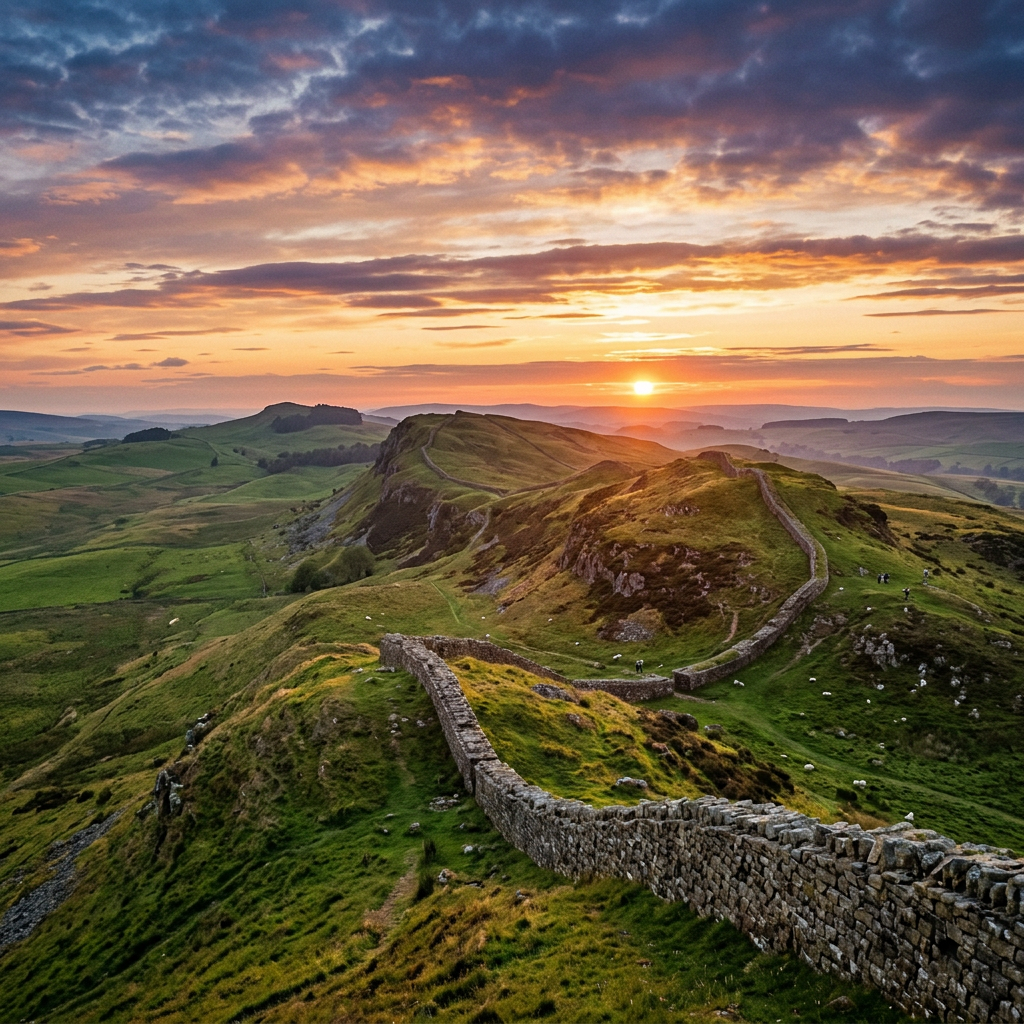
Hadrian’s Wall is one of the most iconic monuments of Roman Britain. Stretching across the narrowest part of northern England, it marked the edge of the Roman Empire and symbolized the power, organization, and ambition of Rome at its height.
Where Is Hadrian’s Wall?
Hadrian’s Wall runs roughly 73 miles (117 km) from the banks of the River Tyne near modern‑day Newcastle in the east to Bowness‑on‑Solway on the Cumbrian coast in the west. It cuts across rolling hills, river valleys, and exposed moorland, following the contours of the landscape to create a formidable barrier.
Why Was Hadrian’s Wall Built?
The wall takes its name from the Roman emperor Hadrian, who visited Britain around AD 122. Unlike some of his predecessors, Hadrian was less interested in conquering new territories and more focused on stabilizing and securing the empire’s existing borders.
The wall served several purposes:
- Military defense: It was a line of forts, towers, and soldiers designed to monitor movement and deter large‑scale incursions from tribes to the north.
- Border control: Gates along the wall functioned like customs posts, regulating trade and taxation between Roman Britain and neighboring peoples.
- Symbolic power: The wall sent a clear message about Rome’s presence and authority at the very edge of its world.
How Was the Wall Built?
Construction began soon after Hadrian’s visit and involved thousands of Roman legionaries stationed in Britain. They were not only soldiers but also highly trained engineers and builders.
Key features included:
- The stone wall: In its eastern sections, the wall was built of stone, originally up to around 4–5 meters high. In the west, parts were initially built in turf and later rebuilt in stone.
- The ditch and vallum: On the northern side, a deep ditch added another line of defense. To the south, an earthwork called the vallum—a large ditch with mounds—helped control access from Roman Britain itself.
- Forts and milecastles: Large forts such as Housesteads, Birdoswald, and Chesters housed garrisons of auxiliary troops. Between them, smaller fortlets known as milecastles were placed at intervals of roughly one Roman mile, with two even smaller turrets between each pair of milecastles.

Who Lived and Worked on the Wall?
The wall was manned not by Roman citizens from Italy, but by auxiliary units recruited from across the empire. Soldiers along the wall came from places such as:
- Gaul (modern France and Belgium)
- Germany
- Spain
- North Africa
- The Balkans and the Near East
These men served for many years in a land far from home. Around the forts, civilian settlements grew up, including families of soldiers, traders, craftsmen, and local Britons. Daily life involved:
- Guard duty on ramparts and at gates
- Patrols north and south of the wall
- Training, maintenance, and construction work
- Trade and interaction with local communities
In this sense, Hadrian’s Wall was not just a military frontier but a lively cultural crossroads.
Conflict and Cooperation on the Frontier
Although the wall was a defensive structure, it did not completely cut off contact with the peoples to the north. Instead, it regulated it. Trade, negotiation, and periodic conflict all took place along this border.
Roman sources mention raids and uprisings, and there is archaeological evidence of damaged and rebuilt sections of the wall. Yet there are also signs of long‑term interaction—goods, ideas, and even religious practices flowed across the frontier.
After Hadrian: Change and Continuity
Later emperors modified the northern frontier. Under Emperor Antoninus Pius, the Romans pushed further north and built the Antonine Wall in Scotland, but this advance proved temporary. Within a few decades, Hadrian’s Wall was reoccupied and continued to be used and maintained.
By the late 4th and early 5th centuries, as Roman power in Britain weakened, the wall gradually lost its imperial garrison. Stones were taken for other building projects, and parts of the structure collapsed or were buried over time. Yet its line remained imprinted on the landscape.

Hadrian’s Wall Today
Today, Hadrian’s Wall is a UNESCO World Heritage Site and one of Britain’s most popular archaeological attractions. Visitors can:
- Walk the Hadrian’s Wall Path, a long‑distance trail that follows much of the original route
- Explore well‑preserved forts such as Housesteads, Vindolanda, and Birdoswald
- See museums displaying artifacts like armor, tools, altars, and the famous wooden writing tablets from Vindolanda
The wall has also become a powerful symbol in modern culture: a reminder of borders, identity, and the meeting of different peoples and traditions.
Legacy of the Wall
Hadrian’s Wall stands as a testament to:
- Roman engineering skill
- The complexity of empire and frontier life
- The enduring impact of ancient decisions on modern landscapes
More than a simple barrier, it was a living frontier—shaped by soldiers, civilians, and local communities on both sides. Its stones still trace a line across northern England, inviting us to imagine what life was like at the edge of Rome’s world.
Fortisetliber’s View
Hadrian’s Wall is often described as a line of stone across northern England, but it is more truthfully a line in the Roman mind. Built around AD 122, it marks the point where empire chose to stop—where Rome decided that holding the frontier was a greater strength than endless advance.
For nearly 73 miles, the wall stitched together forts, milecastles, ditches, and roads. Along it stood soldiers from across the empire, enforcing Roman order at the edge of the known world. Around them, small communities formed: traders, families, and local Britons living with the wall as their constant horizon.
Yet this frontier was never only a barrier. Goods, stories, and beliefs crossed it in both directions. The line meant to divide also connected empire and outsiders, authority and resistance. At Fortis et Liber, we look at Hadrian’s Wall as a reminder that every border is a choice about fear, control, and trust. To be fortis et liber—strong and free—is to ask what our walls protect, what they exclude, and whether they make us safer, or simply smaller.
Leave a Reply