
Introduction: Where the Story of Chania Began
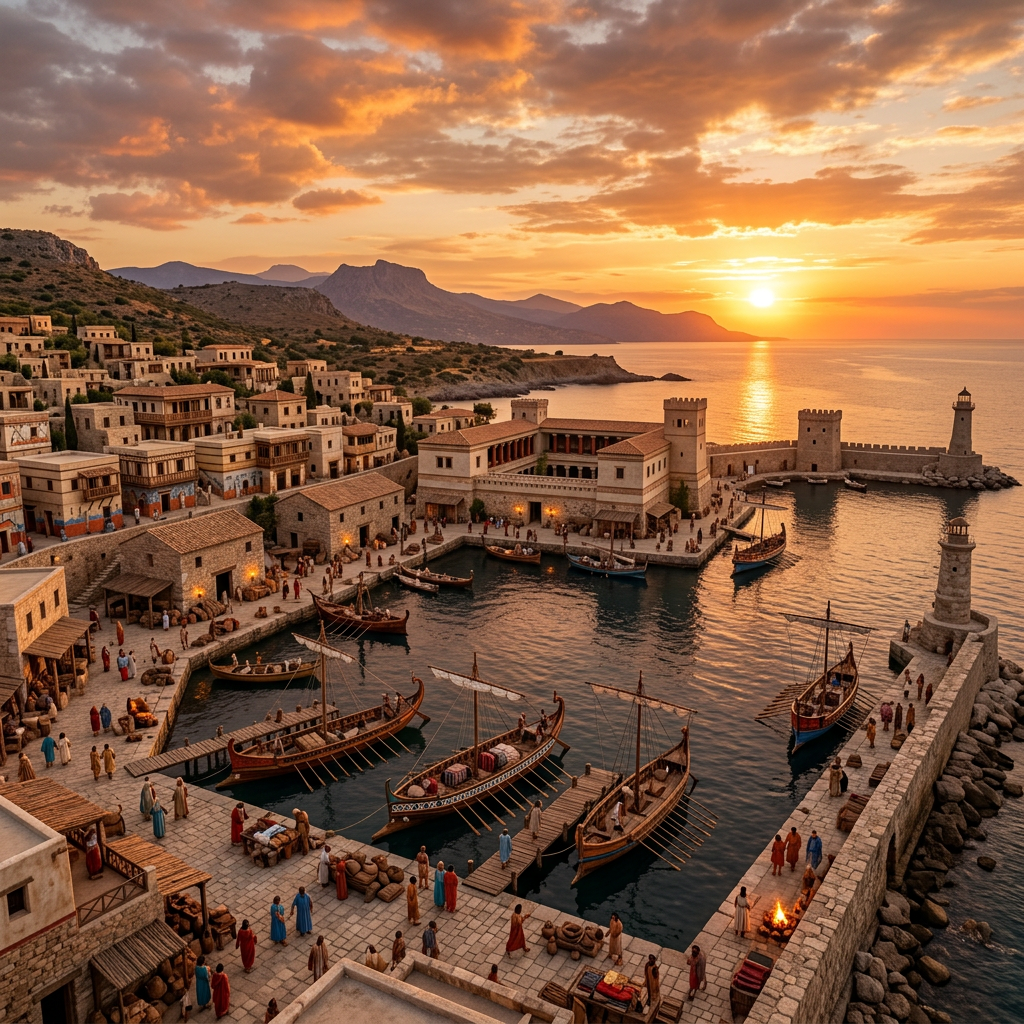
Long before the Venetian Harbor became the symbol of modern Chania, another city stood proudly upon the same fertile hill overlooking the Cretan Sea. Merchants arrived with ships filled with copper from Cyprus, ivory from Egypt, pottery from mainland Greece, and precious goods from across the eastern Mediterranean. The bustling harbor echoed with the voices of sailors, craftsmen, and traders who transformed this settlement into one of the most important centers of western Crete.
This was Ancient Kydonia, the predecessor of modern Chania and one of the oldest continuously inhabited urban centers in Europe.
Situated along the northwestern coast of Crete, Ancient Chania occupied a strategic position that connected the Minoan world with mainland Greece, Egypt, the Levant, and the wider Mediterranean. Over thousands of years, the city witnessed the rise of the Minoan Civilization, the arrival of the Mycenaeans, the flourishing of the Greek polis, and later the expansion of the Roman Empire.
Although much of Ancient Kydonia now lies beneath the streets of modern Chania, archaeological discoveries continue to reveal a remarkable civilization whose influence stretched far beyond the shores of Crete.
Today, the story of Ancient Chania reminds us that beneath every stone of the modern city lies a history that spans more than three millennia.
The Origins of Ancient Kydonia
The earliest evidence of human settlement in the area dates back to the Neolithic period, making Kydonia one of the oldest inhabited locations on the island.
Its fertile plains, abundant freshwater sources, and naturally protected coastline encouraged communities to settle here thousands of years before written history.
According to Greek mythology, the city was named after Kydon, traditionally described as the son of Hermes or, in other traditions, the son of Apollo and the nymph Akakallis, daughter of King Minos. Like many Cretan cities, Kydonia blended myth and history, giving its inhabitants a legendary ancestry that reflected the island’s rich cultural identity.
By the early Bronze Age, the settlement had developed into a thriving community that participated in the growing maritime networks of the eastern Mediterranean.
Kydonia During the Minoan Civilization
The rise of the Minoan Civilization transformed Ancient Kydonia into one of western Crete’s most important urban centers.
From approximately 2000 BCE, the city flourished as a center of commerce, craftsmanship, and administration.
Archaeological excavations have revealed:
- Large residential buildings.
- Storage complexes.
- Workshops.
- Fine pottery.
- Clay tablets.
- Religious sanctuaries.
- Advanced drainage systems.
These discoveries demonstrate that Kydonia shared many characteristics with the great Minoan palaces of Knossos, Phaistos, and Malia, although it likely served as the principal administrative center for western Crete.
The city’s economy relied heavily on agriculture, olive oil production, wine, and maritime trade.
Its harbor connected Crete with Egypt, Cyprus, the Cyclades, and the Near East, allowing ideas, technologies, and artistic styles to circulate freely.

The Mycenaean Influence
Following the decline of the Minoan palatial system around 1450 BCE, Mycenaean Greeks established their influence across much of Crete.
Ancient Kydonia adapted rather than disappeared.
Evidence discovered by archaeologists—including Linear B tablets—indicates that Mycenaean administrators governed the city while preserving many aspects of its earlier Minoan traditions.
Trade continued to flourish, and Kydonia remained one of the island’s major political and economic centers.
The blending of Minoan and Mycenaean cultures produced a unique society whose influence can still be traced through pottery, architecture, burial customs, and administrative practices.
The Rise of the Greek City-State
During the Archaic and Classical periods, Ancient Kydonia emerged as an independent Greek polis.
Like other city-states across Greece, it developed its own political institutions, minted its own coinage, and maintained diplomatic relations with neighboring Cretan cities.
Ancient writers frequently described Kydonia as one of the most prosperous and powerful cities of western Crete.
Its fertile countryside supplied grain, olives, wine, and timber, while its strategic location made it an important commercial port connecting the Aegean with the central Mediterranean.
The city’s prosperity allowed it to construct temples, defensive walls, public buildings, and marketplaces that reflected the confidence of a flourishing Greek community.
Trade and Maritime Prosperity
The sea shaped every aspect of life in Ancient Chania.
Merchant vessels sailed regularly between Kydonia and:
- Mainland Greece.
- Egypt.
- Cyprus.
- Asia Minor.
- The Cyclades.
- Southern Italy.
Exports included:
- Olive oil.
- Wine.
- Timber.
- Pottery.
- Agricultural products.
- Textiles.
Imports brought luxury goods, metals, artistic influences, and new technologies that enriched local society.
Its harbor became one of the busiest commercial centers in western Crete, strengthening both its economy and political influence.

Daily Life in Ancient Kydonia
Life in Ancient Kydonia reflected the prosperity of a thriving Mediterranean city.
Citizens gathered in public squares where trade, politics, and religion shaped daily life.
Artisans produced fine ceramics, bronze tools, jewelry, and textiles, while farmers cultivated the fertile lands surrounding the city.
Religious ceremonies honored both Minoan and later Greek deities, illustrating the cultural continuity that characterized Cretan society.
Public festivals, athletic competitions, and communal celebrations reinforced civic identity and strengthened social bonds.
The city’s wealth supported skilled craftsmen, merchants, priests, and administrators, creating a vibrant urban community that endured through centuries of political change.
A Strategic City at the Crossroads of Civilizations
Perhaps the greatest strength of Ancient Chania was its location.
Positioned between Europe, Asia, and Africa, Kydonia became a meeting point for civilizations.
Ideas, religions, artistic styles, technologies, and commercial innovations all passed through its harbor.
This openness to the wider Mediterranean helped the city prosper through successive historical periods while preserving its distinctive Cretan identity.
Its story reflects not only the history of Crete but also the history of the ancient Mediterranean itself.
Ancient Kydonia Under Roman Rule
The fortunes of Ancient Kydonia entered a new chapter following the Roman conquest of Crete in 67 BCE. After the Roman general Quintus Caecilius Metellus subdued the island, Crete was incorporated into the Roman world, eventually becoming part of the province of Crete and Cyrenaica.
Unlike many cities that declined after conquest, Ancient Chania continued to prosper. The Romans recognized Kydonia’s strategic location on the northwestern coast of Crete and invested in its infrastructure, ensuring that it remained an important commercial harbor and administrative center.
Trade flourished under the stability of Roman rule, while the city’s Greek traditions continued to shape its cultural identity. Roman officials, merchants, and travelers moved through Kydonia’s busy port, linking Crete with Italy, North Africa, mainland Greece, and Asia Minor.
Public Buildings and Sacred Sanctuaries
As prosperity continued, Ancient Kydonia developed an impressive urban landscape that reflected both its Greek heritage and Roman influence.
The city featured:
- Temples dedicated to the Olympian gods.
- Public squares (agoras).
- Administrative buildings.
- Stoas lined with merchants’ shops.
- Residential districts.
- Fortified walls.
- Water supply and drainage systems.
Religious life remained central to the community. Sanctuaries dedicated to Athena, Apollo, and other Greek deities served as places of worship, while local cults preserved traditions dating back to the Minoan period.
Roman engineering introduced improvements in roads, water management, and public facilities, allowing Kydonia to maintain its status as one of western Crete’s leading cities.

Commerce and the Mediterranean Economy
The prosperity of Ancient Chania depended on its position within the vast commercial network of the Mediterranean.
Its harbor connected Crete with major ports across three continents.
Merchants traded:
- Olive oil
- Wine
- Honey
- Timber
- Pottery
- Bronze goods
- Marble
- Fine textiles
- Imported luxury products
The fertile plains surrounding Kydonia supplied agricultural products that were exported throughout the Roman Empire.
The city’s economy benefited not only from trade but also from shipbuilding, fishing, and skilled craftsmanship, creating a prosperous urban society that endured for centuries.
Archaeological Discoveries
Although modern Chania has been continuously inhabited for thousands of years, archaeologists have uncovered remarkable evidence of the city’s ancient past beneath its streets.
Excavations have revealed:
- Minoan houses.
- Mycenaean tombs.
- Hellenistic fortifications.
- Roman buildings.
- Pottery workshops.
- Storage facilities.
- Coins.
- Clay tablets.
- Religious artifacts.
- Burial sites.
Among the most important discoveries are inscriptions and Linear B tablets, which provide valuable evidence for the Mycenaean administration of Kydonia and demonstrate the city’s significance during the Late Bronze Age.
Each archaeological season continues to deepen our understanding of one of Crete’s oldest urban centers.
The Legacy of Ancient Chania
The influence of Ancient Kydonia extends far beyond antiquity.
Its Minoan origins illustrate the remarkable achievements of Europe’s earliest advanced civilization, while its later Greek and Roman history reflects the island’s continuing importance within the Mediterranean world.
Unlike many ancient cities that disappeared completely, Kydonia evolved continuously through the Byzantine, Venetian, and Ottoman periods into the modern city of Chania.
This uninterrupted history makes Chania one of the rare places where more than three thousand years of urban life can still be experienced within a single landscape.
Walking through today’s historic center often means walking directly above streets once used by Minoan merchants, Greek citizens, and Roman officials.
Ancient Chania Today
Modern Chania preserves traces of every civilization that shaped its remarkable past.
Visitors can explore the collections of the Archaeological Museum of Chania, where artifacts from prehistoric, Minoan, Greek, and Roman periods illustrate the city’s continuous development.
Excavation sites scattered throughout the city continue to reveal houses, workshops, sanctuaries, and public buildings hidden beneath modern neighborhoods.
These discoveries confirm that Ancient Kydonia was not simply another Cretan settlement but one of the island’s principal political, economic, and cultural centers.
Today, Chania stands as a living testament to the enduring legacy of Crete’s ancient civilizations.

The Enduring Importance of Kydonia
Among the many great cities of ancient Crete, Kydonia occupies a unique position.
It served as:
- A major Minoan administrative center.
- An important Mycenaean settlement.
- A prosperous Greek city-state.
- A thriving Roman harbor.
- A bridge between Europe, Asia, and Africa.
Its strategic location allowed civilizations to exchange goods, technologies, artistic traditions, and ideas for more than three millennia.
Few Mediterranean cities can claim such extraordinary historical continuity.
Conclusion
The story of Ancient Chania (Kydonia) is the story of Crete itself—a civilization shaped by the sea, strengthened through trade, and enriched by centuries of cultural exchange.
From its beginnings as a flourishing Minoan settlement to its rise as a powerful Greek city-state and later an important Roman center, Kydonia played a vital role in the history of the eastern Mediterranean.
Its merchants connected distant civilizations, its artisans produced remarkable works of craftsmanship, and its strategic harbor ensured prosperity across successive empires.
Although the ancient city now lies beneath modern Chania, its legacy continues to emerge through archaeology, reminding us that every layer of the city tells another chapter in one of Europe’s oldest continuous urban stories.
To explore Ancient Chania is to discover far more than the origins of a beautiful Cretan city—it is to uncover a civilization whose influence helped shape the history of the Mediterranean for over three thousand years.
Frequently Asked Questions (FAQ)
Where was Ancient Kydonia located?
Ancient Kydonia was located on the site of modern Chania, on the northwestern coast of Crete, Greece.
Why was Ancient Chania important?
Kydonia was one of the principal cities of ancient Crete, serving as a major Minoan, Greek, and Roman center of trade, administration, and maritime commerce.
Was Kydonia part of the Minoan Civilization?
Yes. Archaeological evidence confirms that Kydonia was an important urban center during the Minoan period and maintained strong commercial links throughout the eastern Mediterranean.
What archaeological discoveries have been made in Ancient Chania?
Excavations have uncovered Minoan buildings, Mycenaean tombs, Linear B tablets, Hellenistic fortifications, Roman structures, pottery, coins, and religious artifacts.
Can visitors explore Ancient Kydonia today?
Yes. Although much of the ancient city lies beneath modern Chania, visitors can explore important finds in the Archaeological Museum of Chania and view archaeological sites throughout the city.

Fortisetliber’s View
Hidden beneath the vibrant streets of modern Chania lies Ancient Kydonia, one of the oldest continuously inhabited cities in Europe and a cornerstone of Crete’s remarkable history. Long before Venetian fortresses, Byzantine churches, or Ottoman landmarks defined the city’s skyline, Kydonia had already emerged as a flourishing center of the Minoan Civilization, connecting Crete with the great cultures of the eastern Mediterranean.
Its strategic position along the island’s northwestern coast transformed Ancient Chania into a thriving maritime hub where merchants, sailors, and craftsmen exchanged goods, ideas, and innovations. Olive oil, wine, timber, and fine pottery departed from its harbor, while luxury products, metals, and artistic influences arrived from Egypt, Cyprus, mainland Greece, and the Near East. The sea was not merely a route of commerce—it was the foundation upon which Kydonia built its prosperity.
As centuries passed, the city successfully adapted to changing civilizations. It flourished under the Mycenaeans, evolved into an influential Greek polis, and later became an important urban center of Roman Crete. Unlike many ancient cities that faded into history, Kydonia never truly disappeared. Each era added another chapter to its story, creating an extraordinary continuity that still defines Chania today.
Archaeological excavations continue to reveal Minoan houses, Linear B tablets, Hellenistic fortifications, Roman structures, and countless artifacts that testify to the city’s enduring importance. Every discovery reinforces the idea that beneath the modern city lies one of the Mediterranean’s oldest and most resilient urban landscapes.
From the perspective of FortisLiber, Ancient Chania is far more than the birthplace of a modern Cretan city. It is a symbol of endurance, adaptation, and cultural continuity—a place where civilizations rose, transformed, and left their mark without ever breaking the thread of history.
To walk through Chania is to walk across more than three thousand years of civilization, where every stone whispers the story of Ancient Kydonia and the timeless spirit of Crete.
Leave a Reply