
Introduction: Before the Age of Sparta and Athens
Long before the legendary battles of Marathon, Thermopylae, and Salamis, the Greek world was already experiencing conflicts that would shape the future of European military history.
The year 684 BC belongs to a very different Greece.
The great city-states of the Classical period had not yet reached their peak. Athens was still developing its political identity. Sparta was only beginning to establish the military traditions that would later make it famous. Across the Aegean world, Greek communities were transforming from small settlements into organized city-states known as poleis.
During this early period, warfare was becoming an essential part of political life.
One of the earliest recorded conflicts from this era was the Battle of Deres (684 BC), a battle remembered as one of the first known examples of organized warfare between Greek communities.
Although information about the battle is limited, its historical importance is enormous. It provides a rare glimpse into the military culture of Archaic Greece and the gradual development of the Greek warrior tradition that would later dominate the ancient Mediterranean.
Greece in the Archaic Period
To understand the significance of the Battle of Deres, it is necessary to understand the world in which it occurred.
The 7th century BC was a period of transformation.
After the collapse of the Mycenaean civilization centuries earlier, Greek communities slowly rebuilt themselves. By the Archaic period, independent city-states were emerging throughout mainland Greece, the Aegean islands, and the western coast of Asia Minor.
These communities competed for:
- Fertile land
- Trade routes
- Political influence
- Resources
- Strategic territory
Conflict became increasingly common.
Unlike the professional armies of later centuries, early Greek forces were composed mainly of citizens who fought when their city required military service.
The warrior was not separate from society.
He was a farmer, merchant, craftsman, and citizen who carried weapons to defend his community.
The Origins of the Battle of Deres
The exact details surrounding the Battle of Deres 684 BC remain uncertain because very few ancient sources survive from this period.
The battle is associated with early Greek conflicts in the region of Messenia, an area of great importance during the formation of Spartan power.
Ancient traditions connect Deres with struggles between Greek communities during a period when control over land and resources was a constant source of tension.
The conflict belongs to the broader era of rivalry that eventually produced major wars such as the First Messenian War and later shaped the military identity of Sparta.
Although historians continue to debate the precise location and participants of the battle, Deres remains significant because it represents one of the earliest recorded examples of Greek interstate warfare.

The Importance of Early Greek Warfare
The Battle of Deres occurred during a crucial stage in the evolution of Greek military organization.
At this time, warfare was moving away from small-scale raids conducted by aristocratic warriors and toward larger formations of citizen soldiers.
This transformation would eventually create the famous hoplite system.
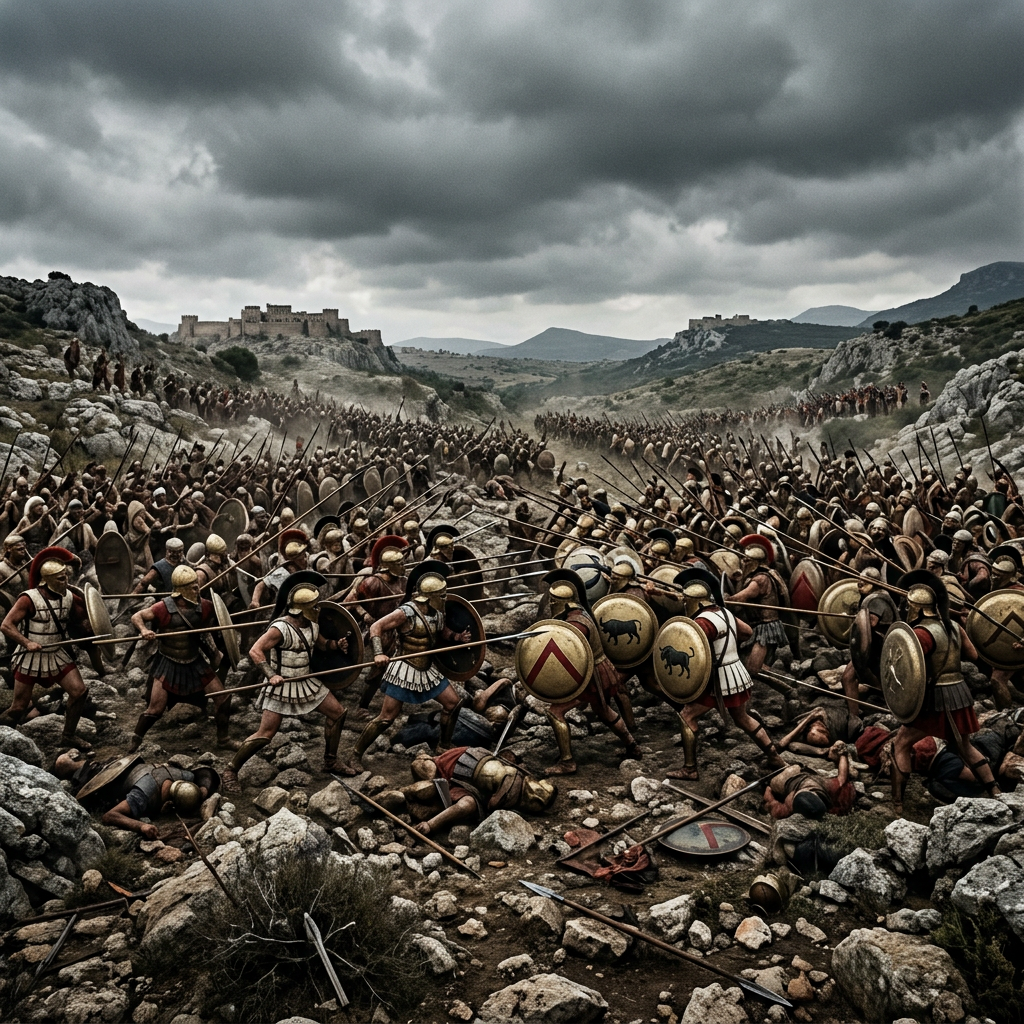
The hoplite warrior carried:
- A large round shield (aspis)
- A long spear (doru)
- A bronze helmet
- Body armor
- Greaves protecting the legs
The strength of the hoplite was not individual skill alone.
It was unity.
A successful formation depended on every soldier protecting the man beside him.
This concept of collective military discipline became one of the defining characteristics of Greek warfare.
The Role of Callinus of Ephesus
One of the reasons the Battle of Deres 684 BC remains known today is its connection with Callinus of Ephesus, one of the earliest Greek elegiac poets.
Callinus lived during the 7th century BC and is considered one of the first Greek poets to write about war and patriotism.
His works encouraged warriors to defend their homeland and demonstrated how military events were already becoming part of Greek cultural identity.
Through poetry, battles were transformed from simple conflicts into stories of courage, honor, and duty.
For ancient Greeks, memory was preserved not only through monuments and inscriptions, but also through the words of poets.
Weapons and Tactics of Early Greek Soldiers
The warriors who fought in the era of the Battle of Deres represented the beginning of a military tradition that would dominate Greece for centuries.
Early Greek soldiers relied on:
Spears
The primary offensive weapon, used for thrusting attacks in close combat.
Shields
The shield was not only protection but a symbol of belonging and responsibility.
Bronze Armor
Wealthier warriors possessed helmets, breastplates, and greaves.
Formation Fighting
Although the fully developed hoplite phalanx came later, the foundations of organized infantry tactics were already emerging.
The battlefield was becoming a place where discipline mattered as much as individual bravery.

The Historical Significance of Deres
The Battle of Deres (684 BC) may not have the dramatic details of later Greek battles, but its importance lies elsewhere.
It represents a turning point in the history of Greek warfare.
It shows:
- The rise of organized city-state conflicts.
- The growing importance of citizen soldiers.
- The development of military identity in Archaic Greece.
- The connection between warfare and political power.
Without understanding early battles like Deres, it is impossible to fully understand the military traditions that later produced Spartan warriors, Athenian naval forces, and the armies that confronted Persia.
From Deres to the Great Battles of Greece
The battlefield of Deres stands at the beginning of a long military tradition.
Over the following centuries, Greek warfare would evolve dramatically.
The small citizen armies of the Archaic period would eventually become the powerful hoplite forces of Classical Greece.
The lessons learned through early conflicts influenced:
- Spartan military discipline.
- Athenian defense strategies.
- Greek alliances.
- The development of battlefield tactics.
The path from Deres to Marathon was not sudden.
It was the result of centuries of experimentation, conflict, and adaptation.
Conclusion
The Battle of Deres (684 BC) remains one of the earliest windows into the military world of ancient Greece.
Although historical details are limited, its importance is undeniable. It represents a moment when Greek communities were beginning to organize themselves into powerful city-states and when warfare became a central element of political and cultural identity.
Long before the famous battles that defined Greek history, conflicts like Deres created the foundations upon which later generations built their military traditions.
The warriors of Deres may not have been remembered like Leonidas, Themistocles, or Alexander the Great, but they belonged to the same historical journey.
On the fields of early Greece, before the glory of the Classical age, the foundations of a legendary warrior culture were already being formed.

Fortisetliber’s View
Before the legendary battles of Marathon, Thermopylae, and Salamis, before the rise of Sparta and Athens, there were smaller conflicts that quietly shaped the foundations of Greek civilization.
The Battle of Deres (684 BC) belongs to this forgotten age. It was a time when Greek communities were transforming into organized city-states, where loyalty to the homeland was becoming stronger, and where the warrior was beginning to represent not only personal honor but the survival of an entire community.
Little is known about the exact events of the battle, yet its importance lies precisely in its place at the beginning of history. Deres represents the early steps of Greek military organization, when citizens began standing together in defense of their lands and when the ideas of discipline, courage, and collective responsibility started to define Greek warfare.
From these early struggles would eventually emerge the famous hoplite tradition, the disciplined formations that would make Greek armies legendary throughout the ancient world.
From the perspective of FortisLiber, the Battle of Deres is not remembered because of a famous king or a dramatic victory, but because it represents a beginning. Every great civilization has a first chapter, and Deres belongs to the opening pages of the Greek military story.
The warriors who fought at Deres did not know that centuries later their descendants would face Persian invasions, build powerful city-states, and create some of the most influential military traditions in history.
They fought for their homes, their communities, and their future.
On the fields of Archaic Greece, before legends were born, the first foundations of Greek courage were already being written.
Leave a Reply