
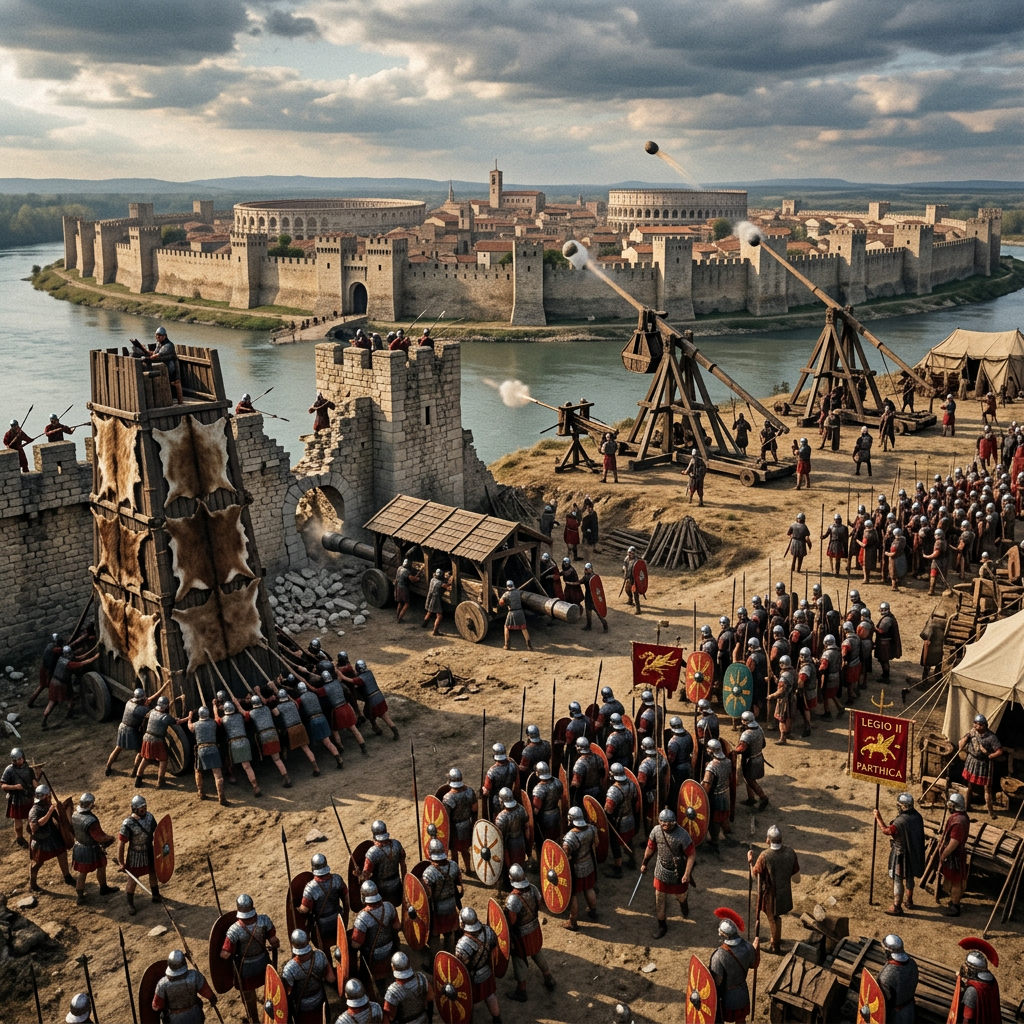
Introduction: A Battle at the End of an Empire
The Battle of Arles in 411 CE was one of the decisive episodes of the turbulent fifth century, a period when the Western Roman Empire faced internal rebellions, barbarian invasions, political fragmentation, and an increasingly fragile imperial government.
Fought at Arles in southern Gaul, the conflict formed part of a larger Roman civil war involving several competing claimants to imperial power. On one side stood Constantine III, a usurper who had established his authority across much of Gaul and Britain. Opposing him was the imperial general Constantius, who acted on behalf of the legitimate emperor Honorius.
Although the Battle of Arles is less famous than battles such as Adrianople or the later sack of Rome, its importance should not be underestimated. The defeat of Constantine III marked a major step toward restoring Honorius’ authority in Gaul and demonstrated the growing importance of military commanders in the politics of the late Roman Empire.
The battle also illustrates a central reality of the fifth century: Rome was increasingly threatened not simply by enemies outside its borders, but by conflicts within its own political and military system.
The Western Roman Empire in Crisis
By the beginning of the fifth century, the Roman Empire was under extraordinary pressure.
The empire was still vast, wealthy, and militarily powerful, but its political structure had become increasingly unstable.
The Western Roman Empire was particularly vulnerable.
Roman armies had to defend enormous frontiers while emperors struggled with internal rivalries and competing military commanders.
The early fifth century saw repeated invasions and migrations by groups such as the Visigoths, Vandals, Alans, and Suebi.
At the same time, Roman generals increasingly possessed enough military power to challenge imperial authority.
This combination created a dangerous cycle.
An emperor needed powerful generals to defend the empire, but those same generals could become political threats.
The story of Constantine III and the Battle of Arles emerged directly from this environment.
Who Was Constantine III?
Constantine III was one of several military figures who claimed imperial authority in the western provinces during the early fifth century.
In 407 CE, Roman troops in Britain proclaimed Constantine emperor.
The reasons for his elevation remain debated, but the political situation in Britain and Gaul was extremely unstable.
Constantine crossed into Gaul with his forces and established himself as a rival emperor.
His power expanded rapidly.
He gained control over much of Gaul and eventually extended his authority into Hispania.
For a time, Constantine III appeared to have created a serious alternative Roman government in the West.
His headquarters and political influence were centered in Gaul, where the cities and military networks of the region were essential to maintaining power.

Why Arles Was So Important
The location of Arles was one of the major reasons the city became a strategic objective.
Situated in southern Gaul near the Rhône River and connected to important routes throughout the region, Arles was a major Roman administrative and commercial center.
Control of Arles meant access to communications between southern Gaul, the Mediterranean, and the interior provinces.
For Roman commanders, controlling such cities was essential.
The battle was therefore not simply a confrontation between two armies.
It was a struggle for control of the political and logistical infrastructure of Roman Gaul.
Whoever controlled Arles could strengthen his ability to move troops, communicate with provincial authorities, and maintain access to important economic resources.
Constantius and the Return of Imperial Authority
The man sent to challenge Constantine III was Constantius, one of the most important Roman generals of the period.
Constantius was a highly capable military commander and would eventually become one of the dominant political figures in the Western Roman Empire.
He served Emperor Honorius, whose government was determined to restore imperial authority in Gaul.
Constantius therefore represented more than another Roman general.
He represented the attempt of the legitimate imperial government to reassert control over territories that had fallen under the authority of rival emperors.
His campaign against Constantine III became one of the most important military operations of Honorius’ reign.
The Siege and Battle of Arles
In 411 CE, Constantius advanced against Constantine III at Arles.
Ancient sources provide relatively limited details about the fighting itself, and modern historians must reconstruct the campaign from fragmentary evidence.
Constantine had established himself in Arles, hoping to maintain his position in southern Gaul.
Constantius, however, brought a powerful force against him.
The conflict appears to have involved both military pressure and political maneuvering.
The imperial government did not simply need to defeat Constantine’s soldiers. It needed to break the political network supporting his regime.
This distinction is important.
Late Roman civil wars were rarely determined solely by battlefield victories.
Generals needed to secure the loyalty of cities, provincial elites, military officers, and other commanders.
A defeated army could sometimes be rebuilt.
A collapsing political coalition was much harder to recover.

The Role of Gerontius
The situation surrounding Constantine III became even more complicated because another Roman military leader, Gerontius, had rebelled against him.
Gerontius had originally been associated with Constantine’s regime but eventually turned against him.
His rebellion severely weakened Constantine’s position.
Constantine was therefore facing pressure from multiple directions.
The empire’s political fragmentation had become a weapon against him.
Constantius could exploit these divisions to isolate Constantine and reduce the possibility that his forces would receive meaningful support.
This was a classic feature of late Roman politics: military campaigns were often inseparable from negotiations, defections, and political alliances.
The Defeat of Constantine III
The forces of Constantius ultimately defeated Constantine’s position at Arles.
Constantine’s cause collapsed rapidly.
He had once controlled large parts of Gaul and Britain and had presented himself as a legitimate Roman emperor.
Now his political base was disappearing.
Constantine eventually surrendered to Constantius.
He was promised protection under conditions of surrender, but those promises did not save him.
He was later executed.
The defeat at Arles therefore represented the effective end of Constantine III’s imperial challenge.
Why the Battle of Arles Matters
The significance of the Battle of Arles (411) goes far beyond the fate of one usurper.
The victory strengthened the authority of Emperor Honorius and his government.
It also demonstrated that the imperial court could still project military power into Gaul.
Yet the victory came at a considerable cost.
The Western Roman Empire remained deeply unstable.
The empire had not solved the problems that produced Constantine’s rebellion in the first place.
Roman Britain was increasingly isolated.
Gaul remained vulnerable to invasions and internal political instability.
Germanic groups were establishing themselves inside imperial territory.
The Roman state was becoming increasingly dependent on powerful military commanders.

The Battle of Arles and the Decline of Rome
It would be misleading to describe the Battle of Arles as a direct cause of the fall of the Western Roman Empire.
The collapse of the Western Empire was a long and complicated process.
Nevertheless, the battle illustrates several of the forces that contributed to that decline.
First was political fragmentation.
Roman generals increasingly challenged emperors and created alternative power bases.
Second was the growing importance of regional armies.
A commander who controlled troops could become a political kingmaker.
Third was the weakening of centralized authority.
Although Honorius remained emperor, his government relied heavily on generals such as Constantius.
Finally, the empire faced increasing pressure from outside groups that were becoming permanent political actors within Roman territory.
The Battle of Arles therefore provides a snapshot of an empire struggling to maintain unity.
Arles and the Transformation of Roman Gaul
The long-term history of Arles demonstrates that the Roman world did not simply disappear after battles such as this one.
Instead, it transformed.
Arles remained an important center for centuries.
The city continued to serve as a political, religious, and economic hub in southern Gaul.
Roman institutions gradually evolved into the structures of the early medieval world.
This makes the history of Arles particularly valuable.
Rather than presenting the fifth century as a sudden collapse, the city reveals a gradual transformation from the Roman imperial system into the political landscape of medieval Europe.
Constantine III: Usurper or Failed Emperor?
The historical reputation of Constantine III is complicated.
From the perspective of Honorius’ government, he was unquestionably a usurper.
Yet his rise also reflected genuine problems within the empire.
His soldiers proclaimed him emperor because they believed their interests were not adequately represented by the imperial government.
Britain and Gaul were increasingly exposed to military threats, while central authorities struggled to respond effectively.
Constantine’s rebellion can therefore be understood as both a political challenge and a symptom of imperial weakness.
He did not create the crisis.
He emerged from it.
The Legacy of Constantius
Constantius’ victory at Arles helped establish his reputation as one of the Western Empire’s most important military leaders.
His influence increased dramatically after the defeat of Constantine III.
He would eventually become emperor himself as Constantius III in 421 CE.
His career illustrates how military commanders had become central to the survival of the Western Roman Empire.
The empire increasingly depended upon men who could restore order through military force.
Ironically, this dependence also strengthened the political power of generals.

Conclusion: A Victory in a Failing Empire
The Battle of Arles in 411 CE was a victory for Emperor Honorius and his general Constantius, but it was not a victory that solved the deeper problems facing the Western Roman Empire.
Constantine III was defeated.
His imperial ambitions ended.
Arles returned to imperial control.
Yet the forces that had produced his rebellion remained.
Political instability, military fragmentation, barbarian settlement, economic pressures, and weak imperial authority continued to shape the history of the fifth century.
The Battle of Arles therefore occupies an important place in the story of the decline and transformation of the Roman Empire.
It reminds us that empires rarely collapse in a single moment.
They weaken through a series of crises, recoveries, compromises, and temporary victories.
In 411, Rome won at Arles.
But the empire was already changing.
And within a few decades, the political world that Constantine III and Constantius fought to control would look dramatically different.
Fortisetliber’s View
The Battle of Arles in 411 CE was not simply another Roman battle. It was a confrontation that reveals one of the deepest problems of the late Western Roman Empire: Rome was increasingly fighting itself.
For centuries, the Roman Empire had built its strength through unity—one imperial authority, one political system, and armies capable of defending an enormous territory. But by the fifth century, that unity was becoming fragile.
At Arles, Roman soldiers fought Roman soldiers. Constantius fought on behalf of Emperor Honorius against Constantine III, another Roman who had claimed imperial authority. Both sides believed they were defending Rome.
And that is what makes the story so powerful.
The danger facing Rome was no longer simply beyond the frontier. It was inside the empire itself.
Constantine III had emerged from a world of political instability, military insecurity, and weakened central authority. His rebellion was a symptom of a larger problem: provinces and armies were beginning to depend increasingly on their own commanders for protection.
When the center becomes weak, the edges begin to make their own decisions.
The victory of Constantius at Arles therefore appears, at first, to be a triumph for Rome. A rival emperor was defeated, imperial authority was restored, and another challenge to Honorius disappeared.
But victories can sometimes hide deeper weaknesses.
Rome had won the battle, yet the conditions that had produced Constantine’s rebellion remained. The empire still faced invasions, political rivalries, military fragmentation, and enormous pressure on its western provinces.
This is perhaps the greatest lesson of Arles 411.
An empire does not become strong simply because it wins battles. It becomes strong when its institutions are strong enough to prevent the same crisis from returning.
The Roman state could defeat Constantine, but it could not easily eliminate the political environment that had created him.
There is also a lesson here about leadership.
Constantius demonstrated that military strength could restore order. But the increasing dependence of the empire upon powerful generals carried its own danger. The more Rome depended on individual commanders, the more important those commanders became within the political system.
The army was supposed to serve the empire.
Increasingly, the empire needed the army to determine who could control the empire.
That was a dangerous transformation.
The Battle of Arles therefore should not be remembered simply as a victory over a usurper. It should be remembered as a warning about internal division.
History repeatedly demonstrates that civilizations rarely collapse because of one enemy or one battle. They weaken through accumulated pressures: political mistrust, institutional instability, economic difficulties, military fragmentation, and the inability to adapt.
Rome would survive Arles.
It would survive many more crises.
But the western empire was entering a very different age.
Within decades, the political structure that had dominated the western Mediterranean for centuries would disappear.
From the perspective of FortisLiber, perhaps the most important message of Arles is this:
The greatest threat to a civilization is not always the enemy standing outside its walls. Sometimes it is the division growing within them.
Rome’s soldiers at Arles spoke the same language, served the same imperial tradition, and claimed the same civilization.
Yet they fought one another.
And when a civilization begins using its strength against itself, even victory can become another step toward decline.
Arles was a Roman victory—but it was also a glimpse of a Rome that was becoming increasingly difficult to unite.
Leave a Reply