
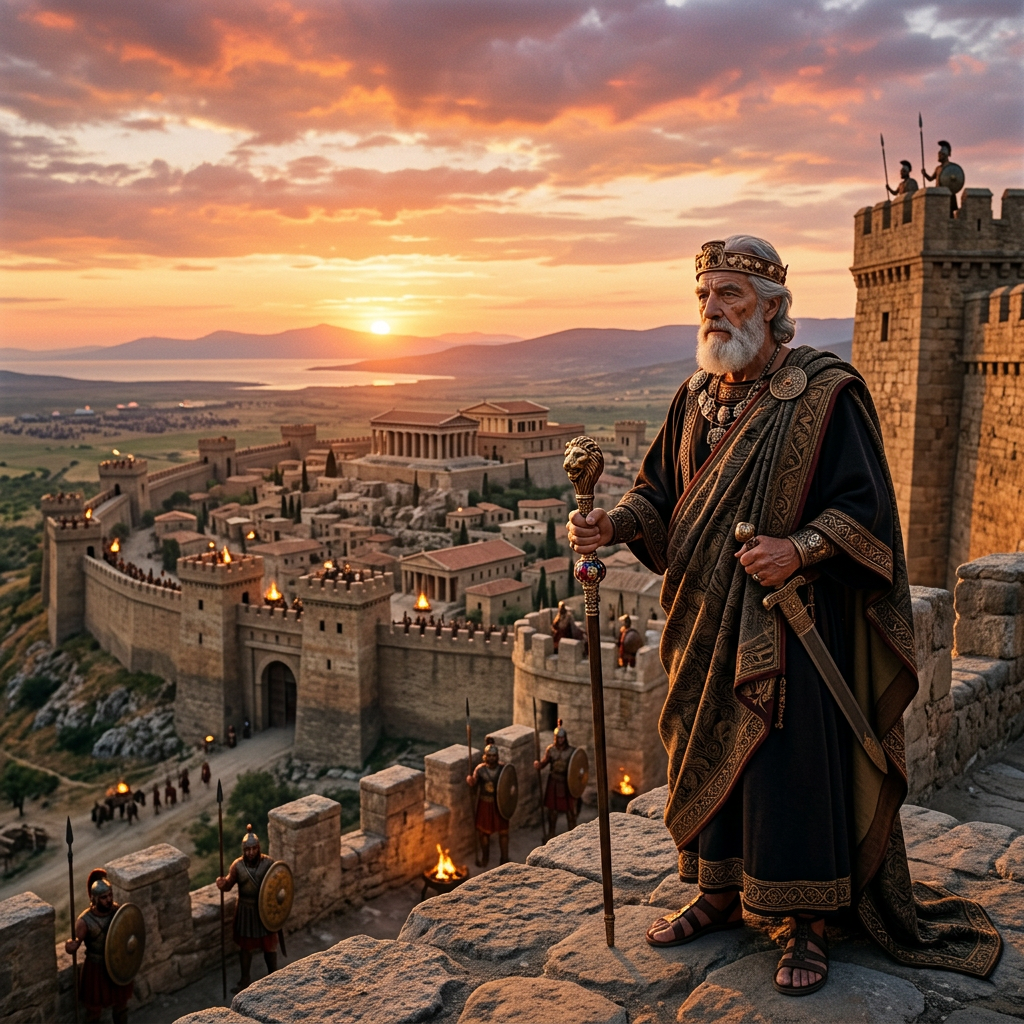
King Priam of Troy is one of the most memorable figures in Greek mythology and one of the central characters associated with the legendary Trojan War. As the elderly ruler of the ancient city of Troy, Priam is portrayed as a powerful king, a devoted father, and a tragic figure caught between the glory of his kingdom and its devastating destruction.
Although much of what we know about Priam of Troy comes from ancient Greek literature rather than independently verified historical records, his story has survived for thousands of years. His name is closely connected with Troy, Helen of Troy, Hector, Paris, Achilles, and the Trojan War, making him an important figure for anyone interested in Greek mythology and ancient history.
Who Was King Priam?
King Priam was the legendary king of Troy during the Trojan War. In Homer’s Iliad, he appears as the aging ruler of a wealthy and powerful city threatened by the Greek army.
Priam was married to Queen Hecuba, and together they had many children. Among them were some of the most famous characters in Greek mythology, including Hector, the greatest warrior of Troy, and Paris, whose actions helped trigger the Trojan War. Priam’s children also included Cassandra, famous for her prophetic abilities, and several other sons and daughters associated with the royal family of Troy.
Priam’s position was particularly difficult because the Trojan War was not simply a conflict between armies. It became a disaster that directly affected his family. His sons fought and died defending Troy, while his city was eventually destroyed.
King Priam and the Trojan War
The Trojan War is traditionally said to have begun after Paris, son of Priam, took Helen, the wife of the Spartan king Menelaus, to Troy. According to the mythological tradition, Helen’s departure led the Greeks to launch an enormous expedition against Troy.
The Greek forces included legendary warriors such as Achilles, Odysseus, Ajax, and Agamemnon. For many years, the Greeks attempted to capture the heavily defended city.
King Priam himself was already an elderly man during the war and was not presented as the principal warrior of Troy. Instead, leadership on the battlefield largely fell to his sons, especially Hector.
This distinction is important when understanding Priam’s character. He represents the king, father, and guardian of Troy rather than the heroic warrior archetype represented by Achilles or Hector.

Priam and Hector: A Father and Son
One of the most emotional relationships in the story of King Priam of Troy is his relationship with his son Hector.
Hector was Troy’s greatest defender and one of the most respected warriors in the Iliad. Unlike Paris, Hector is portrayed as courageous, responsible, and deeply committed to his family and city.
Priam’s love for Hector makes the prince’s death particularly tragic. When Hector is killed by Achilles, Priam loses not only his greatest warrior but also his beloved son.
The grief of King Priam is one of the defining elements of his story. His tragedy is not simply the destruction of a kingdom; it is the destruction of a family.
King Priam and Achilles
One of the most famous scenes in the Iliad involves Priam and Achilles.
After Achilles kills Hector in single combat, he refuses to return Hector’s body to the Trojans. Priam eventually takes an extraordinary risk. He secretly enters the Greek camp and approaches Achilles himself.
Priam asks Achilles to return Hector’s body so that Troy can give the fallen prince a proper funeral.
This encounter is one of the most powerful moments in ancient literature. Priam, an old king who has lost his son, stands before the man responsible for Hector’s death. Achilles, meanwhile, is reminded of his own father, Peleus.
The confrontation changes from one between enemies into a moment of shared human grief. Achilles agrees to return Hector’s body.
This scene is significant because it shows another side of King Priam. He is not portrayed merely as a political ruler. He is a father willing to humble himself and risk his life to honor his dead son.

The Family of King Priam
The family of King Priam plays a major role in the mythology of Troy.
His wife was Hecuba, queen of Troy, who appears in numerous ancient stories concerning the Trojan royal family. Priam and Hecuba had numerous children, although ancient sources differ regarding the exact number.
Some of the best-known children of Priam include:
- Hector – Troy’s greatest warrior and defender.
- Paris – the Trojan prince whose relationship with Helen helped lead to the Trojan War.
- Cassandra – a princess gifted with prophecy but cursed so that nobody would believe her predictions.
- Helenus – a Trojan prince associated with prophecy and later traditions about the fall of Troy.
- Polyxena – a Trojan princess who appears in later traditions surrounding the war and its aftermath.
Through his children, Priam is connected to many of the most important stories in Greek mythology.
The Death of King Priam
The death of King Priam occurs during the final destruction of Troy.
According to later traditions surrounding the fall of Troy, the Greeks eventually enter the city using the famous Trojan Horse. Once the Greek warriors are inside, Troy is attacked and overwhelmed.
Priam’s final moments are particularly tragic. In Virgil’s Aeneid, the Greek warrior Neoptolemus, also known as Pyrrhus and the son of Achilles, kills the elderly king at an altar.
The death of Priam symbolizes the complete collapse of the Trojan royal house. The king who once ruled one of the ancient world’s most famous cities dies as Troy falls around him.

Was King Priam a Real Historical King?
One of the most interesting questions surrounding King Priam is whether he was a real historical ruler.
There is no definitive historical evidence proving that Priam existed exactly as he is described in Greek mythology. The stories about him are primarily literary and mythological.
However, the city of Troy itself is associated with a real archaeological site at Hisarlik in modern-day Turkey. Archaeological excavations have revealed multiple layers of settlement, showing that the site was occupied and destroyed repeatedly over many centuries.
Some scholars have suggested that the Trojan War traditions may preserve memories of real conflicts involving Bronze Age Troy. Nevertheless, connecting a specific historical king to the legendary Priam remains uncertain.
Therefore, it is best to describe Priam as the legendary king of Troy, while recognizing that the mythology may contain echoes of real Bronze Age events.
King Priam in Homer’s Iliad
Homer’s Iliad is the most important ancient literary source for understanding Priam during the Trojan War.
The epic does not tell the entire story of the Trojan War. Instead, it focuses on a relatively short period during the final phase of the conflict, particularly the anger of Achilles and its consequences.
Within this story, Priam is portrayed as an aging but respected king. His interactions with Hector, his family, the Trojan elders, and Achilles reveal the human cost of war.
The famous meeting between Priam and Achilles is especially important because it moves beyond traditional ideas of heroism. The Iliad presents enemies who are capable of recognizing each other’s suffering.
Priam, Troy, and the Fall of a Civilization
The story of King Priam and Troy has endured because it represents more than an ancient war.
Troy is often portrayed as a magnificent city with strong walls, a royal family, and a proud cultural identity. Yet even a powerful kingdom can collapse.
Priam’s story therefore becomes a symbol of the fragility of power. He begins as the ruler of Troy and ends as a grieving father during the destruction of his city.
His tragedy is made even more powerful by the fact that he cannot prevent the catastrophe. His sons fight, his family suffers, and his kingdom eventually disappears.

The Legacy of King Priam
The legacy of King Priam extends far beyond the Iliad. His story has inspired poets, playwrights, artists, filmmakers, and historians for centuries.
Priam has appeared in adaptations of the Trojan War in literature, theater, television, and film. His relationship with Hector and his encounter with Achilles continue to attract attention because they explore universal themes: family, grief, courage, leadership, and the consequences of war.
Unlike many mythological kings who are remembered primarily for military victories, Priam is remembered for his humanity. His most important moment is not a battlefield triumph but his desperate journey to Achilles to recover his son’s body.
Conclusion: Why Is King Priam Important?
King Priam of Troy remains one of the most compelling figures in Greek mythology. As the legendary last king of Troy, he stands at the center of one of antiquity’s greatest stories.
His life connects the major figures of the Trojan War, including Hector, Paris, Helen of Troy, Achilles, and Hecuba. More importantly, his story demonstrates the devastating personal cost of war.
Priam is remembered as a king, but his most enduring identity is that of a father. His meeting with Achilles after Hector’s death transforms an epic story about war into a deeply human story about grief and compassion.
Whether viewed through the lens of Greek mythology, Homer’s Iliad, ancient Troy, or the history of the Trojan War, King Priam continues to fascinate modern audiences. His tragic story has survived because the emotions at its heart—love for family, fear of loss, grief, dignity, and the desire to protect one’s home—remain universal.
Fortisetliber’s View
King Priam of Troy is one of the most tragic figures in ancient Greek mythology. As the legendary king of Troy during the Trojan War, Priam witnessed the destruction of his city, the deaths of his sons, and the collapse of his royal family.
Priam was the husband of Queen Hecuba and the father of many famous Trojan figures, including Hector, Troy’s greatest warrior, and Paris, whose relationship with Helen of Troy helped spark the war between the Greeks and Trojans.
Unlike Achilles or Hector, Priam was not remembered primarily as a warrior. His importance lies in his role as a king and father. His greatest moment comes in Homer’s Iliad, after Achilles kills Hector.
Driven by grief, the elderly Priam secretly enters the Greek camp and approaches Achilles. He begs the Greek hero to return his son’s body so that Hector can receive a proper funeral. The encounter becomes one of the most moving scenes in ancient literature. Achilles recognizes Priam’s suffering and agrees to return Hector’s body.
The story of King Priam and Achilles demonstrates that even in the middle of war, compassion can exist between enemies.
Priam’s tragedy reaches its final stage when Troy falls. According to later traditions, the Greeks enter the city through the famous Trojan Horse, and Priam is killed during the destruction of Troy.
The historical existence of Priam remains uncertain. Troy itself is associated with the archaeological site at Hisarlik in modern Turkey, but there is no conclusive evidence that the legendary king existed exactly as described in Greek mythology.
Nevertheless, King Priam of Troy has remained an enduring symbol of a ruler who loses everything. His story is not simply about the fall of an ancient city. It is about the human cost of war, the love between a father and son, and the grief of watching one’s world disappear.
For thousands of years, the legend of Priam has survived because his greatest strength was not his power as a king, but his humanity as a father.
Leave a Reply